5 mohru 1961
Market Prices
18 salesAbout This Note
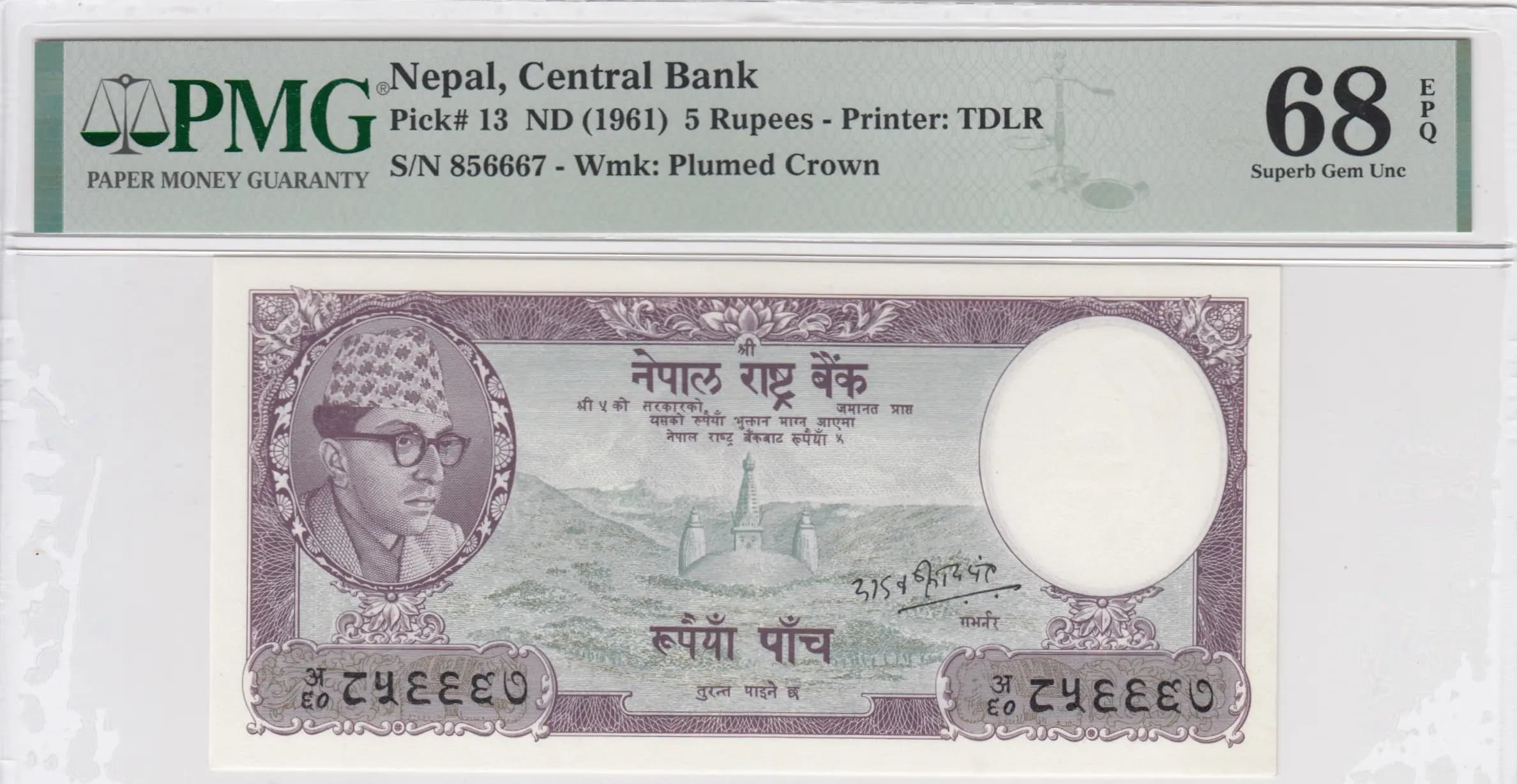
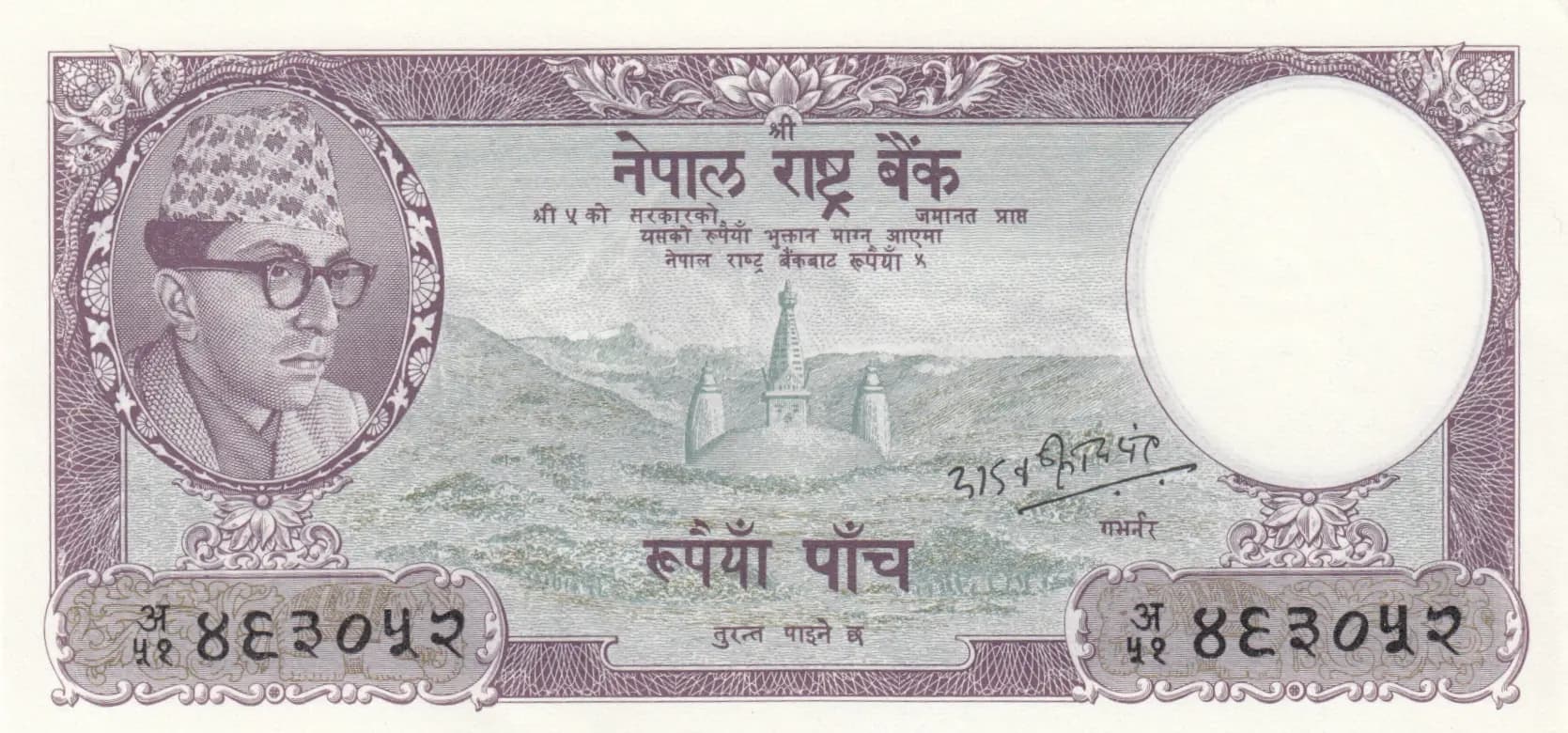
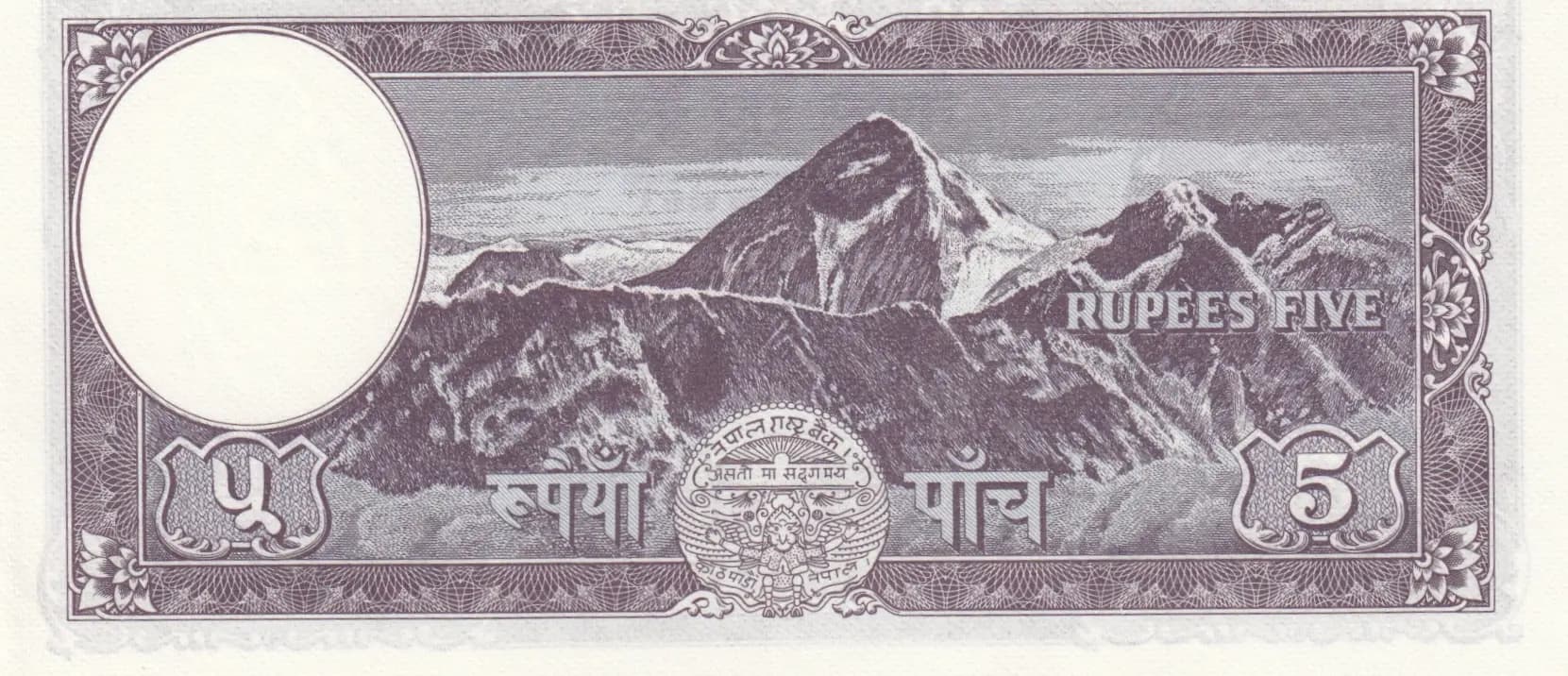
This 5 Rupees note from Nepal Rastra Bank (1961, Pick P-13) presents an attractive example of early Nepalese currency featuring King Mahendra Bir Bikram in traditional dress on the obverse and a prominent Himalayan peak on the reverse. The note exhibits purple and mauve coloration with fine engraving detail throughout, and while the presence of handwritten notation suggests handling, the overall preservation appears consistent with circulated examples of this era.
Common. Secondary market data from eBay auctions (2013-2021) shows this note consistently trading between $3-$41 USD depending on grade, with UNC examples averaging $8-12 USD. The catalog value for UNC condition is listed at $12 (2019), and the frequency of auction sales indicates adequate supply in the market. The note was issued over an extended period (1961-1972), suggesting a substantial print run. There is no evidence of scarcity, recall, or limited distribution for Pick P-13.
Issued during the reign of King Mahendra Bir Bikram (1955-1972), this note reflects Nepal's modernization period following the establishment of Nepal Rastra Bank in 1956. The iconography—featuring the reigning monarch and Mount Everest—symbolized Nepal's national identity and sovereignty during a transformative era, while the inclusion of Swayambhunath Stupa on the obverse connected the modern nation-state to its Buddhist religious heritage.
The obverse features a left-facing portrait of King Mahendra Bir Bikram wearing glasses and a traditional Nepali topi (hat), rendered in profile—a formal presentation befitting a reigning monarch. The center-right depicts Swayambhunath Stupa, one of Nepal's most sacred Buddhist monuments, situated on a hillside with mountains in the background, establishing the religious and cultural foundation of the nation. The reverse showcases a detailed engraved landscape of the Himalayan mountain range with a prominent snow-capped peak (representing Mount Everest or a major Himalayan summit), demonstrating Nepal's geographical significance and natural identity. Both sides employ ornate floral borders and decorative motifs, with watermark circles positioned on the right (obverse) and upper left (reverse), indicating the planned security feature locations.
FRONT SIDE: 'नेपाल राष्ट्र बैंक' (Nepal Rastra Bank) / Legal tender declaration in Nepali relating to the official status of the note / 'हप्पो पञ्च' (Five rupees in colloquial Nepali) / Serial numbers: 'अ ४८३०५२' (appearing on left and right) / Authority/signature marks present. BACK SIDE: 'RUPEES FIVE' (English denomination) / 'नेपाल पञ्च' (Nepal Five in Nepali) / Denomination numeral '5' in corner positions / Additional Nepali inscriptions relating to prosperity or national sentiment.
Intaglio engraving (line engraving), evidenced by the fine detailed line work visible throughout the ornamental borders, the mountain landscape, and facial features of the portrait. According to the PMG Population Report, this note was produced by TDLR (Thomas De La Rue), a prominent British security printer known for producing high-quality banknotes with classical engraved designs. The precision of the floral patterns and the sharpness of the mountain scenery confirm professional intaglio production methods typical of mid-20th century currency manufacture.
The PMG Population Report identifies two catalogued variants: P-13 (regular issue, printer TDLR) and P-13s (specimen note variant). The observed example exhibits serial number 'अ ४८३०५२' with standard printing characteristics consistent with the regular P-13 issue. The presence of handwritten notation on the note suggests this may be a post-issue bank marking rather than a printing variety. No printing errors, overprints, or significant signatures variations are evident that would distinguish this as a notable sub-variety within the P-13 designation.