50 escudos 1958
Market Prices
18 salesAbout This Note
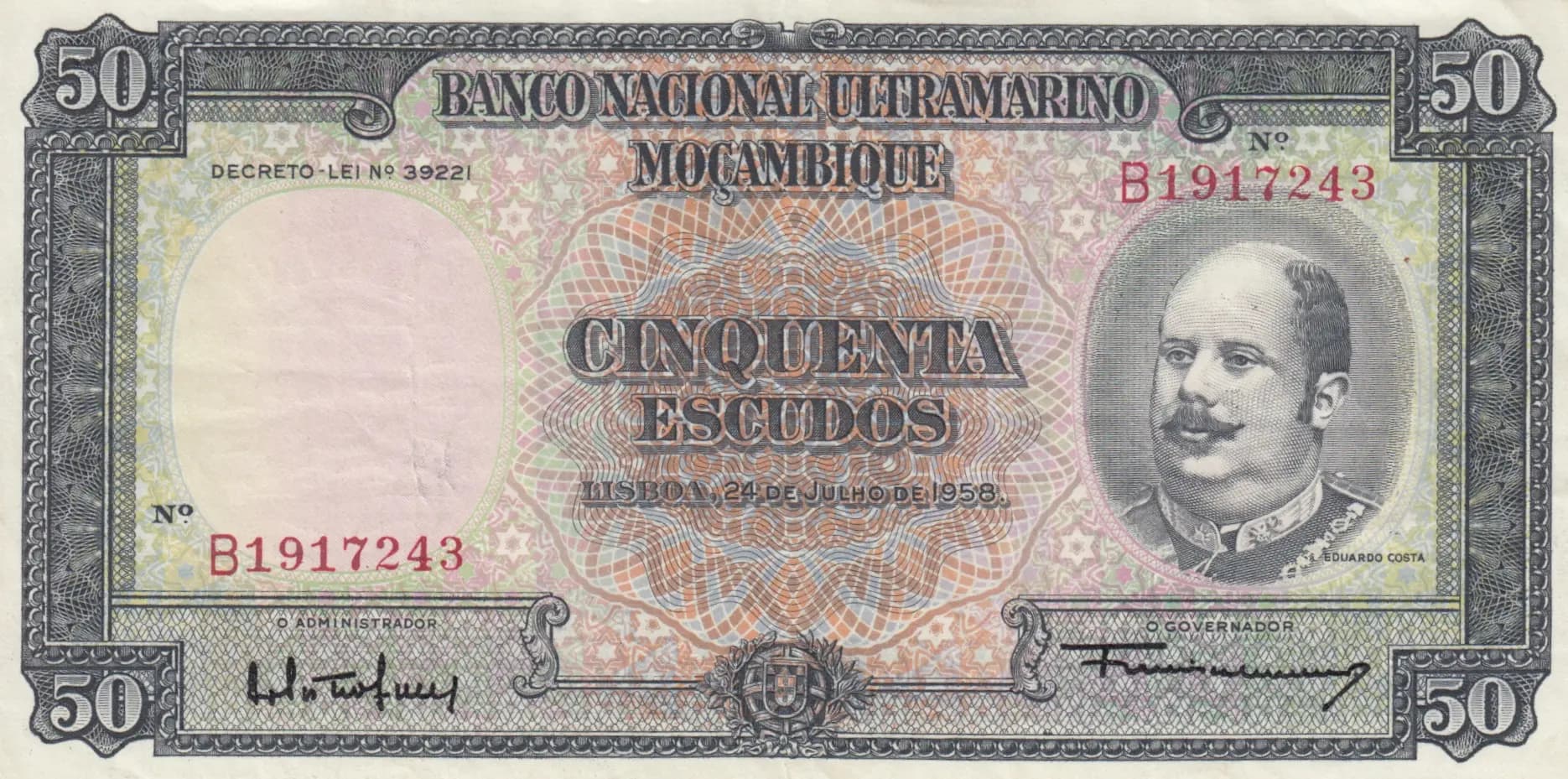
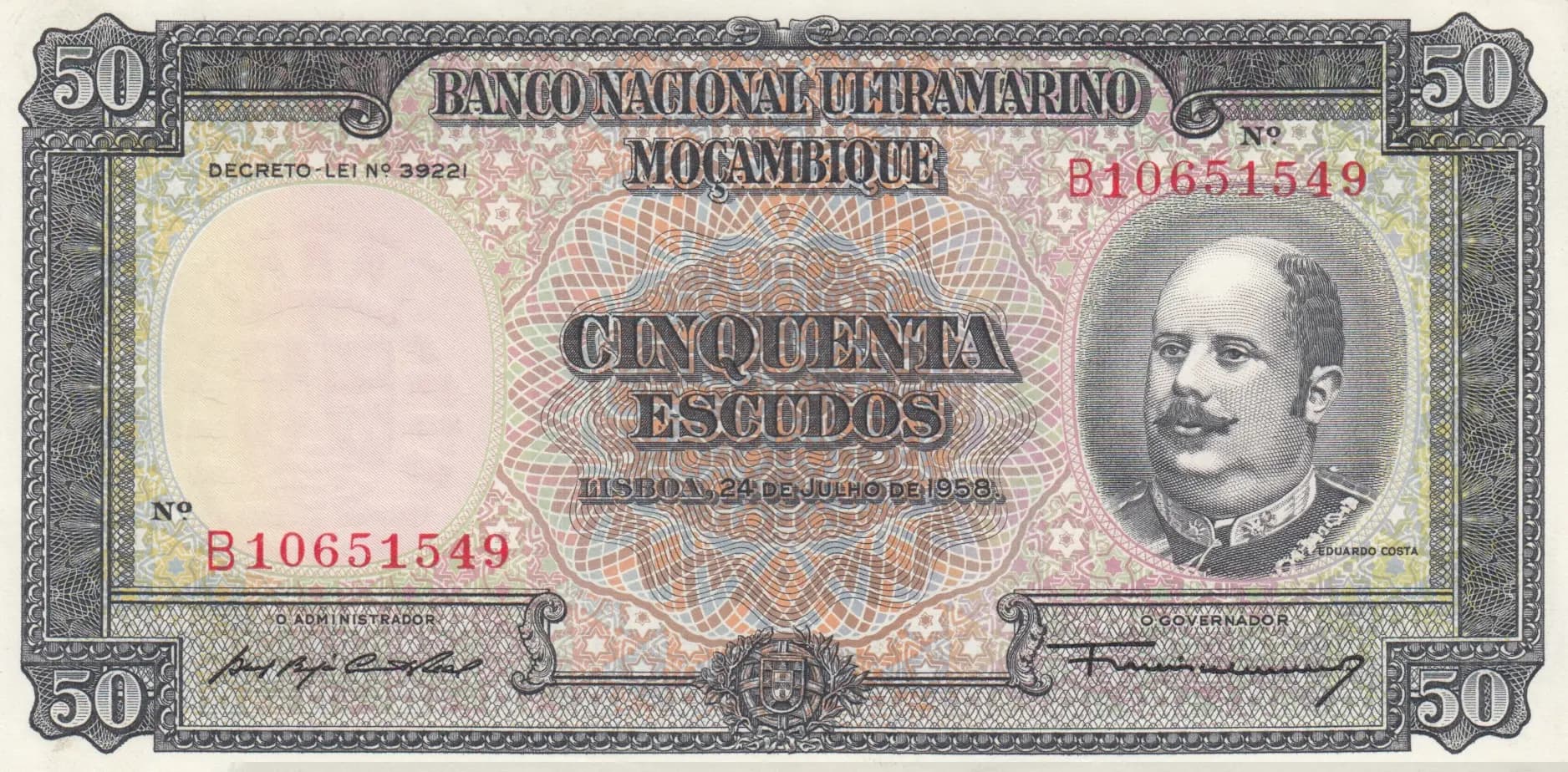
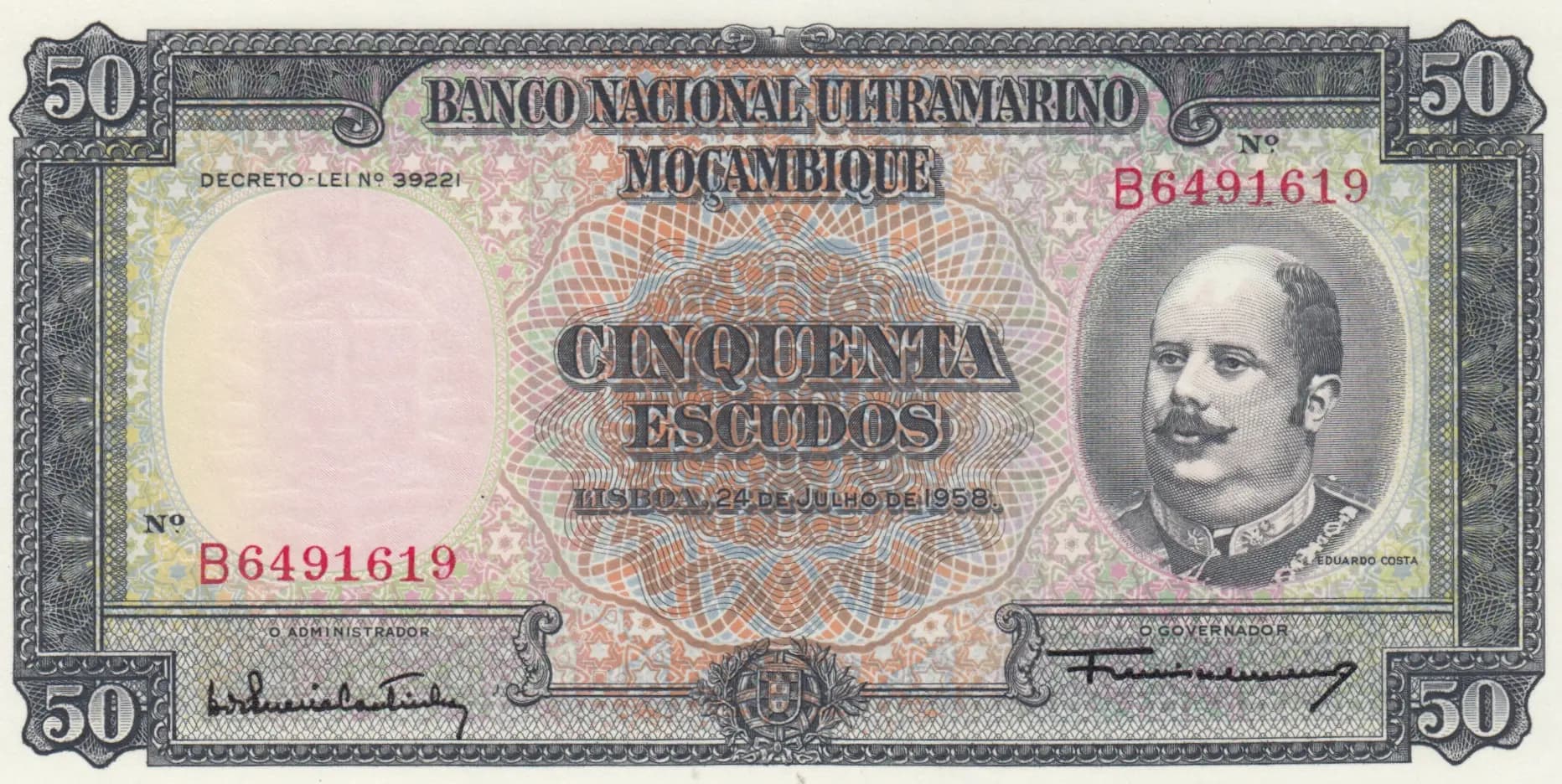
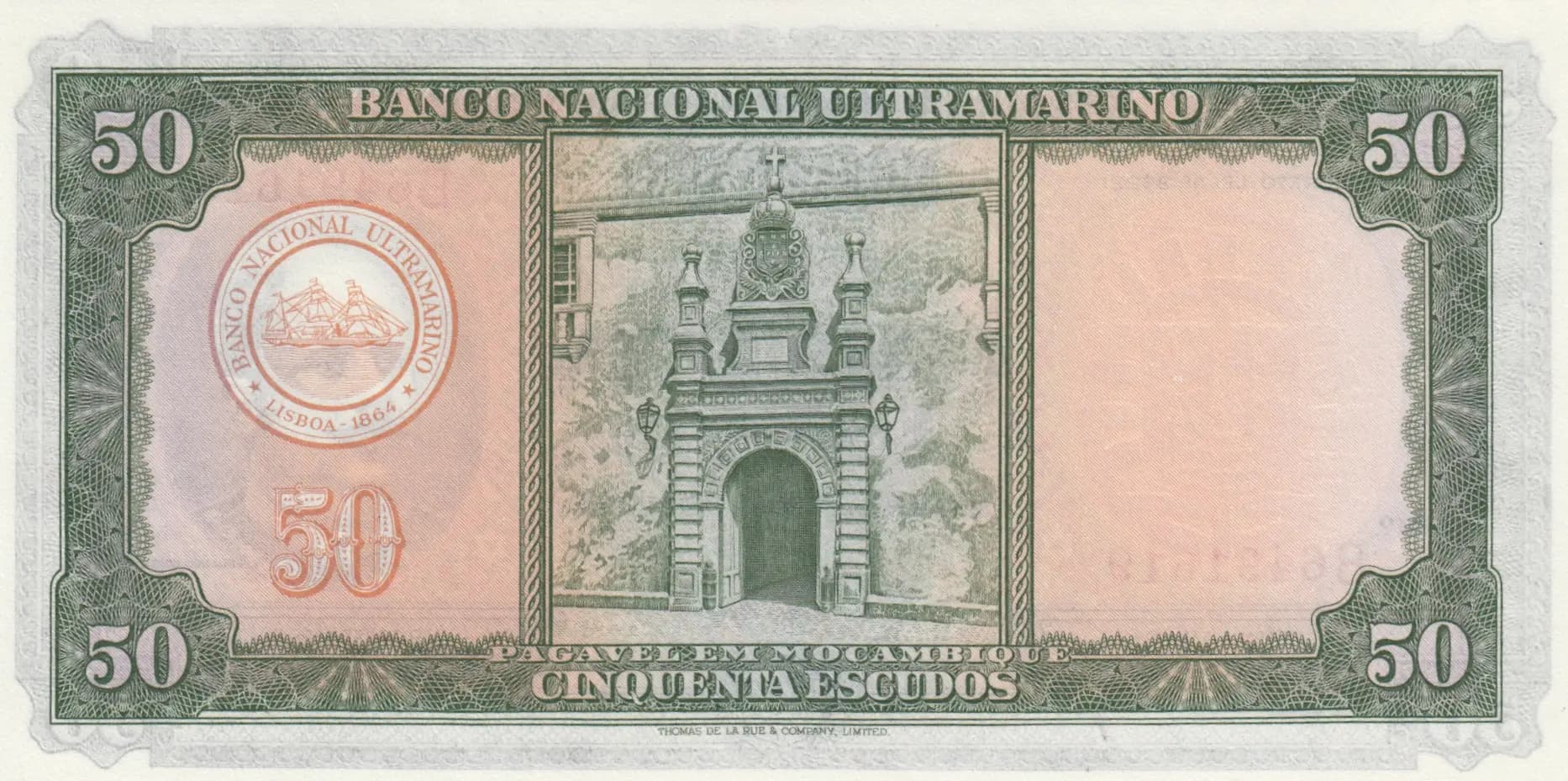
This is an uncirculated 1958 Mozambique 50 Escudos note (Pick P-106) issued by Banco Nacional Ultramarino, featuring a striking portrait of Eduardo Costa and an ornate architectural landmark on the reverse. The note displays exceptional clarity with crisp black printing on multicolor stock, complex guilloche work, and fine engraving typical of Thomas de la Rue's premium security printing. In UNC condition, this note represents a well-preserved example of Portuguese colonial monetary design from the waning years of the Estado Novo regime.
Common. While this is a vintage colonial-era note from 1958, eBay market data shows UNC examples selling in the $23-$50 range with multiple sales recorded, and catalog values list UNC at only $15 (2016). The note was issued in substantial quantities by the Banco Nacional Ultramarino and is readily available in the collector market. The Print run was not restricted, and the note remained in circulation until 1975 without being recalled or superseded prematurely. No scarcity premium applies.
Issued on 24 July 1958, this note was produced during Portugal's Estado Novo dictatorship under António de Oliveira Salazar, a period that would see increasing colonial tensions leading to Mozambique's independence in 1975. The back features the entrance to Fort São Sebastião on Ilha de Moçambique, a historic Portuguese colonial fortress symbolizing the centuries of Portuguese presence in Mozambique. The Banco Nacional Ultramarino's seal dated 1864 on the reverse references the bank's founding, underscoring the deep institutional continuity of Portuguese financial control in its African colonies.
The obverse features a formal portrait of Eduardo Costa, identified as 'Administrador' and 'Governador' (Administrator/Governor), shown in right-facing profile with distinctive facial hair. His portrait is positioned on the right side of an ornately bordered design with complex guilloche patterns in black and multicolor inks (pink, rust, cream tones). The denomination 'CINQUENTA ESCUDOS' is prominently displayed in the center with the issuer information and decree-law reference at top, and the issue date below. The reverse depicts the entrance gateway to Fort São Sebastião (Fortaleza de São Sebastião) on Ilha de Moçambique—a historically significant Portuguese military fortress with crenellated walls and a central arched entrance rendered in green tones. The Banco Nacional Ultramarino's circular seal (featuring a sailing ship and 'LISBOA - 1864' inscription) anchors the left side of the reverse, with denomination numerals in corners. The design reflects institutional Portuguese colonial aesthetics with symmetrical, formal composition and extensive security-grade engraving.
FRONT: 'BANCO NACIONAL ULTRAMARINO' (National Overseas Bank) / 'MOÇAMBIQUE' (Mozambique) / 'CINQUENTA ESCUDOS' (Fifty Escudos) / 'DECRETO-LEI Nº 39221' (Decree-Law No. 39221) / '24 DE JULHO DE 1958' (24 July 1958) / 'EDUARDO COSTA' (Eduardo Costa - portrayed figure) / 'ADMINISTRADOR' (Administrator) / 'GOVERNADOR' (Governor) / Serial number 'B6491619'. BACK: 'BANCO NACIONAL ULTRAMARINO' (National Overseas Bank) / 'BANCO DE MOÇAMBIQUE' (Bank of Mozambique) / 'CINQUENTA ESCUDOS' (Fifty Escudos) / 'LISBOA - 1864' (Lisbon - 1864, bank founding year) / '50' (denomination) / 'THOMAS DE LA RUE & COMPANY, LIMITED' (printer attribution).
Intaglio (engraved) printing by Thomas de la Rue, London, identifiable from the fine line work, detailed guilloche patterns, gradation shading, and complex geometric security features throughout. The multiple color plates (black, green, pink/rose, and cream) indicate separate color passes in the printing process, characteristic of high-security banknote production. The crisp definition of portraits, architectural details, and ornamental flourishes confirms the premium engraving and printing standards employed by this security printer.
This note is catalogued as Pick P-106a in the PMG population report, representing the standard variety with 'CINQUANTA ESCUDOS' spelling (as confirmed by the visual analysis showing 'CINQUENTA'). The catalog reference notes a related variant P-102 with 'CINCOENTA' spelling and without bank seal on reverse. The observed note includes the distinctive Banco Nacional Ultramarino seal on the back and lacks the 'COLONIA PORTUGUESA' text that appears on some earlier variants. Serial number 'B6491619' is typical for this issue series. No exceptional serial number characteristics noted.