50 escudos 1958
Market Prices
18 salesAbout This Note
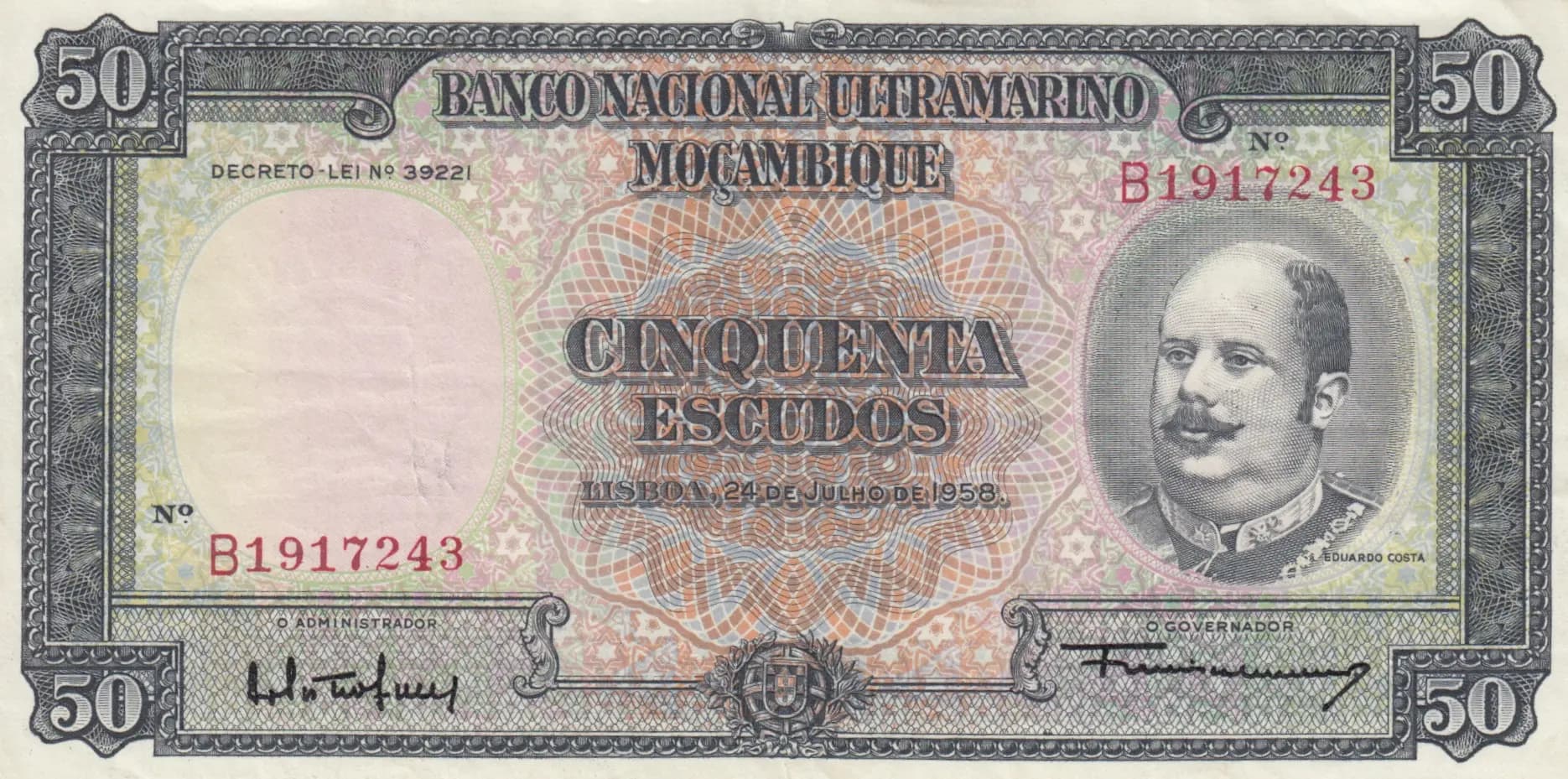
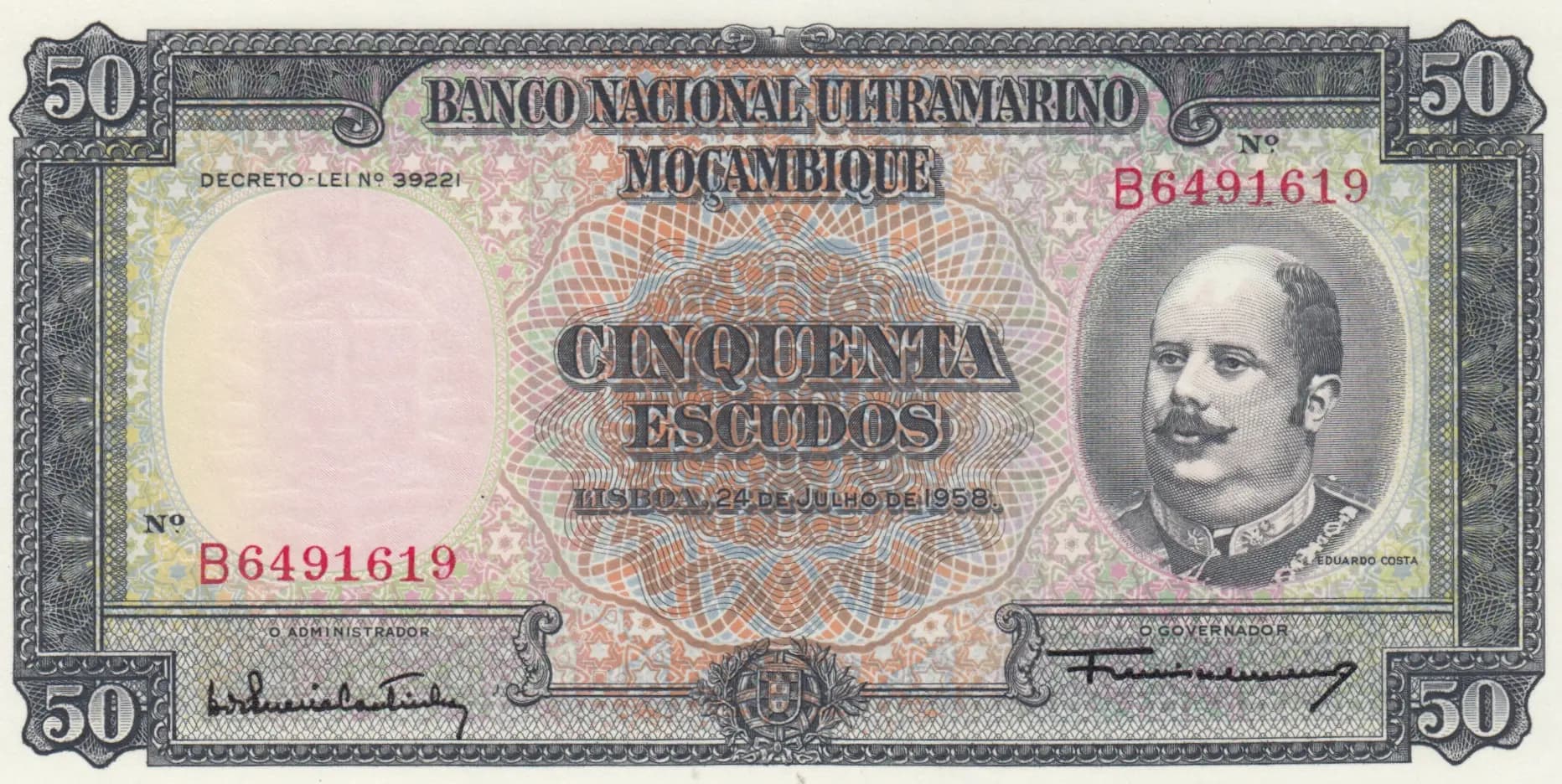
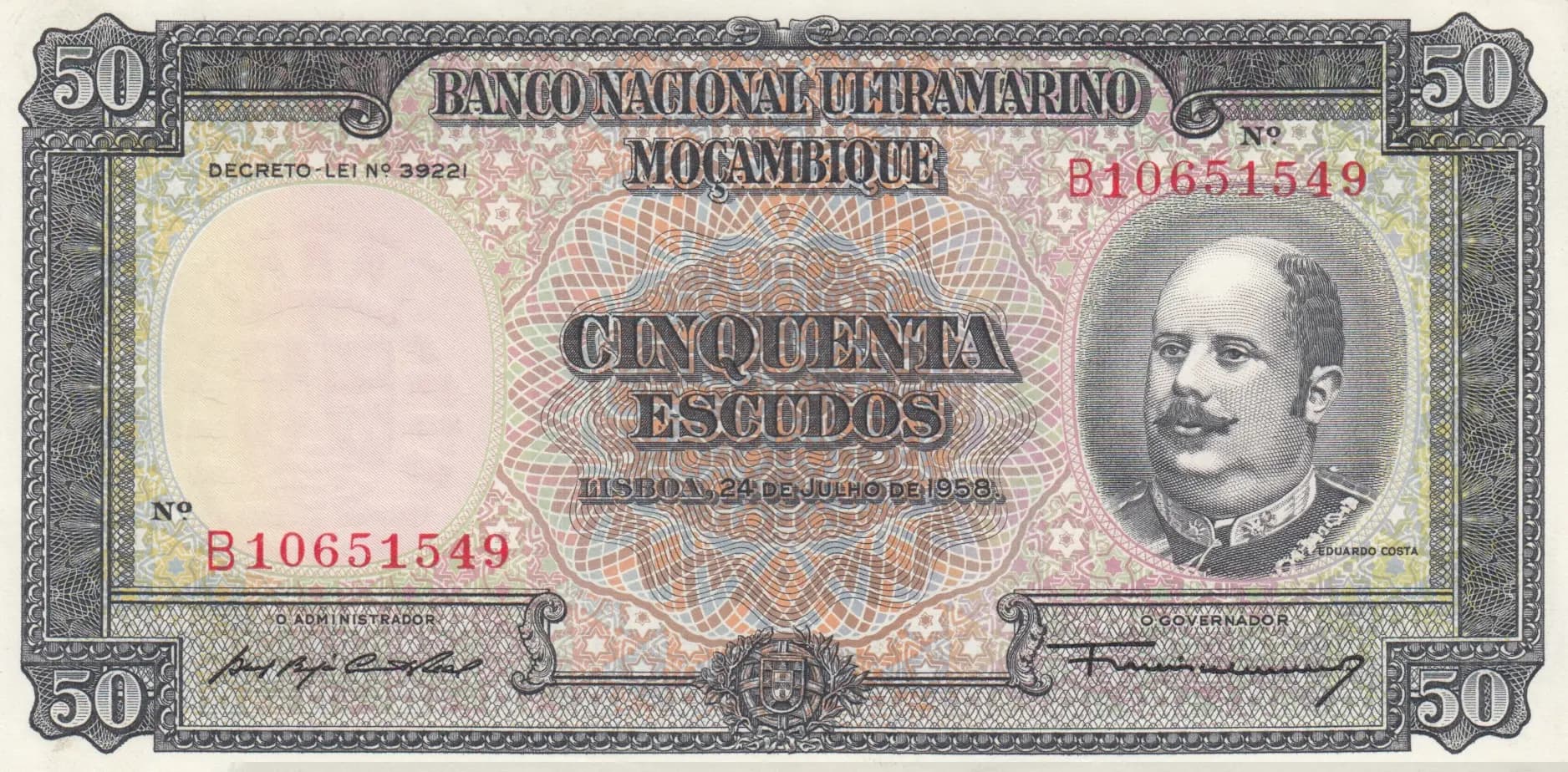
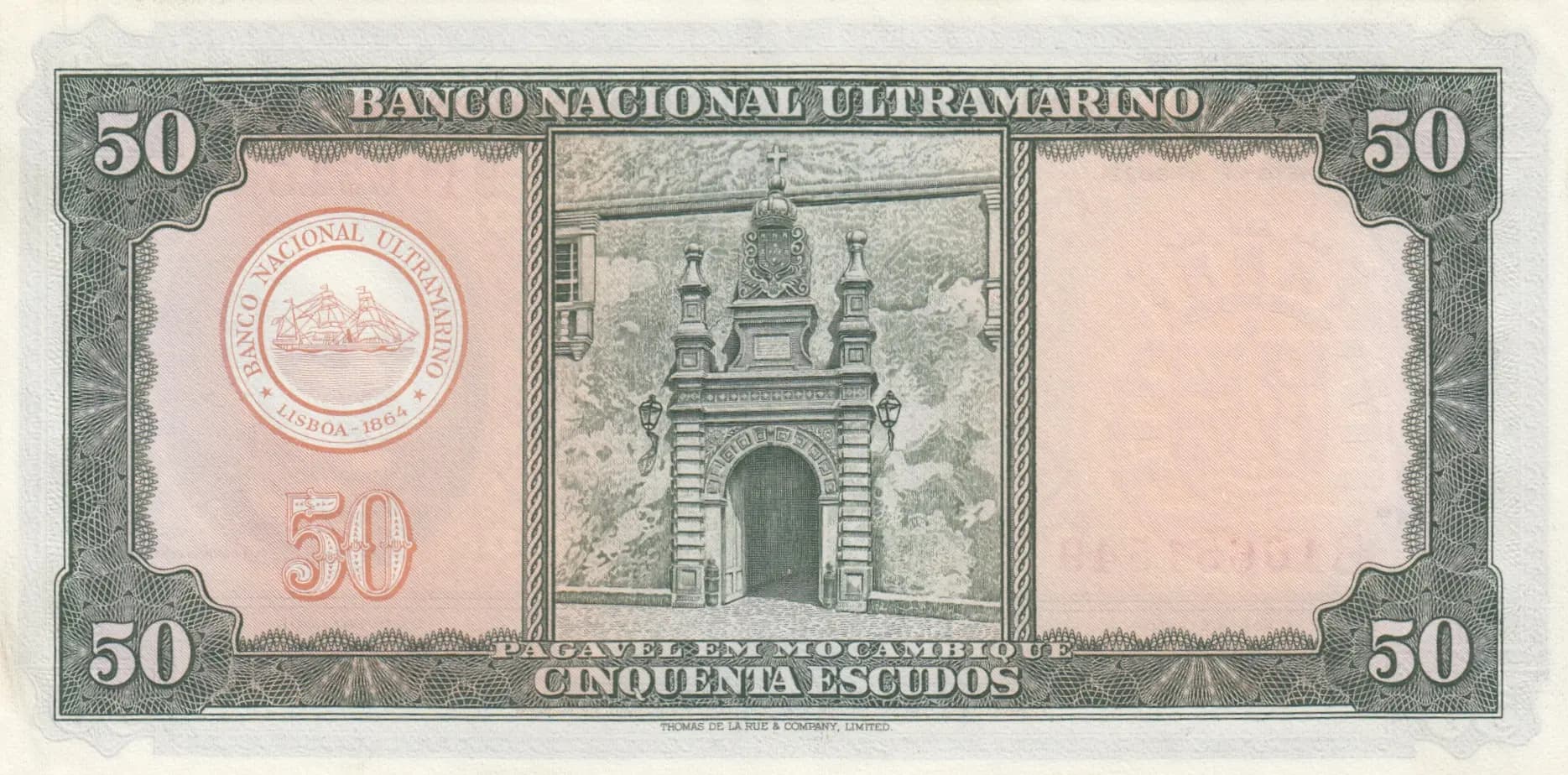
This is a stunning example of the 1958 Mozambique 50 Escudos (P-106) issued by the Banco Nacional Ultramarino, graded AU based on its pristine condition with no visible wear, creases, or stains. The note features exceptional engraving quality with a distinctive pink/mauve color scheme and showcases a military portrait of Eduardo Costa on the obverse alongside an ornate central rosette pattern, while the reverse displays the fortified entrance to Fort São Sebastião with its characteristic crenellated gateway. This is a notable banknote from the late Portuguese colonial period, representing a transitional issue that omits the "COLONIA PORTUGUESA" text found on earlier variants.
Common. This is a standard regular issue of the 1958 Mozambique 50 Escudos with no indication of restricted print runs or short-lived circulation. The eBay market data shows consistent availability across grades, with AU/UNC specimens selling in the $35-$50 range in recent years, and numerous lower-grade examples available at under $25. Catalog values from 2016 list UNC at $15, consistent with common-grade pricing. The note appears with regularity in dealer inventory and private collections, indicating substantial original circulation figures. The primary varietal distinction (P-106 vs. P-102) relates to spelling and design elements rather than scarcity factors.
This 50 Escudos note was issued on July 24, 1958, during the twilight of the Portuguese Estado Novo colonial administration in Mozambique, just four years before the beginning of the armed struggle for independence (1964). The reverse depicts Fort São Sebastião on Ilha de Moçambique, a fortress that had served Portuguese colonial interests since the 16th century and symbolized Portugal's historical dominion over the territory. The portrait of Eduardo Costa, a Portuguese colonial administrator, and the bank seal dated 1864 (when the Banco Nacional Ultramarino was founded) underscore the institutional continuity of Portuguese financial control in the overseas territories during this period.
The obverse displays a formal three-quarter portrait of Eduardo Costa in military dress uniform with decorative insignia, positioned on the right side of the note. The central design element is an elaborate rosette or medallion pattern executed in pink and multicolors with interlocking geometric elements, framed by ornate scrollwork and floral motifs forming the decorative border. The reverse features the fortified gateway entrance to Fort São Sebastião (Ilha de Moçambique), rendered as a rectangular architectural vignette showing the defensive structure with its distinctive arched doorway, crenellations, flanking lanterns, and heraldic shield. On the left side of the reverse is a circular seal bearing the Banco Nacional Ultramarino's ship emblem and foundation date of 1864 in Lisbon. The entire design employs fine-line engraving with a consistent pink/mauve background against which black and green elements create strong visual contrast.
FRONT: 'BANCO NACIONAL ULTRAMARINO' (Overseas National Bank), 'MOCAMBIQUE' (Mozambique), 'CINQUENTA ESCUDOS' (Fifty Escudos), 'DECRETO-LEI Nº 39221' (Decree-Law No. 39221), 'LISBOA 24 DE JULHO DE 1958' (Lisbon, July 24, 1958), 'EDUARDO COSTA' (portrait identification), serial number 'B10651549'. BACK: 'BANCO NACIONAL ULTRAMARINO' (Overseas National Bank), '50' and 'CINQUENTA ESCUDOS' (Fifty Escudos), 'PAGA VEL EM MOCAMBIQUE' (Payable in Mozambique), 'BANCO NACIONAL ULTRAMARINO LISBOA 1864' (bank founding year on circular seal).
This note was printed by Thomas de la Rue & Company, London (TDLR), one of the world's premier security printers of the era. The production method was intaglio/engraving, evidenced by the fine detail work visible in the ornate border patterns, the complex rosette central medallion, the portrait rendering, and the architectural details of Fort São Sebastião. The multi-color printing (pink/mauve, black, green, gray, and cream accents) was accomplished through successive engraved plate impressions, a standard technique for security banknotes of this period. The watermark features the Portuguese arms, providing additional security against counterfeiting.
This note is identified as Pick P-106, which is distinguished from the earlier P-102 variant by the spelling 'CINQUENTA' (rather than 'CINCOENTA') and the absence of the text 'COLONIA PORTUGUESA' below the bank name, and lack of printing over the watermark at left. The visual analysis confirms the correct 'CINQUENTA' spelling on this example. The PMG population report indicates P-106a as a catalogued variant, though specific distinguishing characteristics of this variant are not detailed in the provided data. The serial number format 'B10651549' follows the standard prefix system used for this issue series.