50 centavos 1919
Market Prices
1 saleAbout This Note
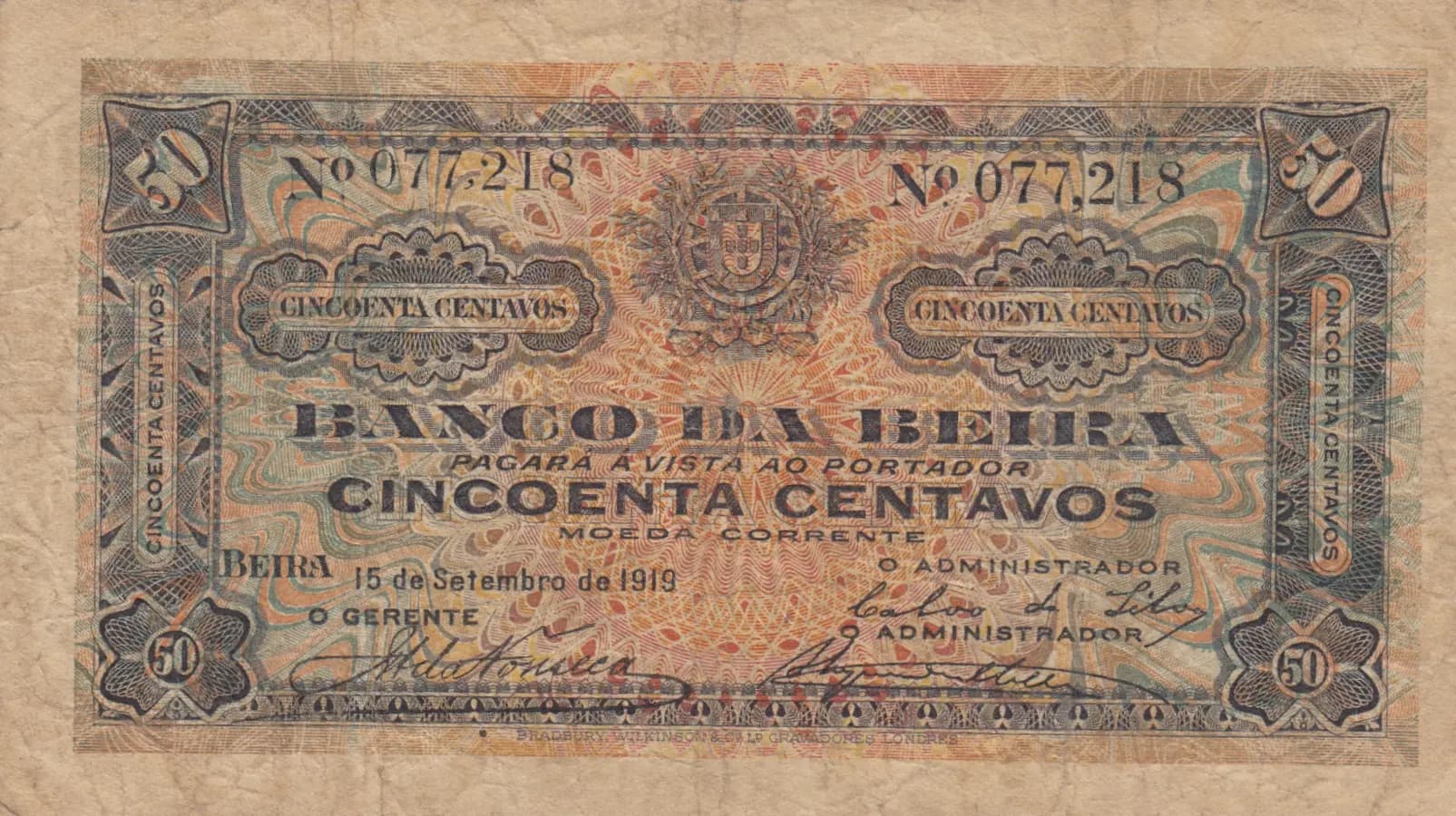
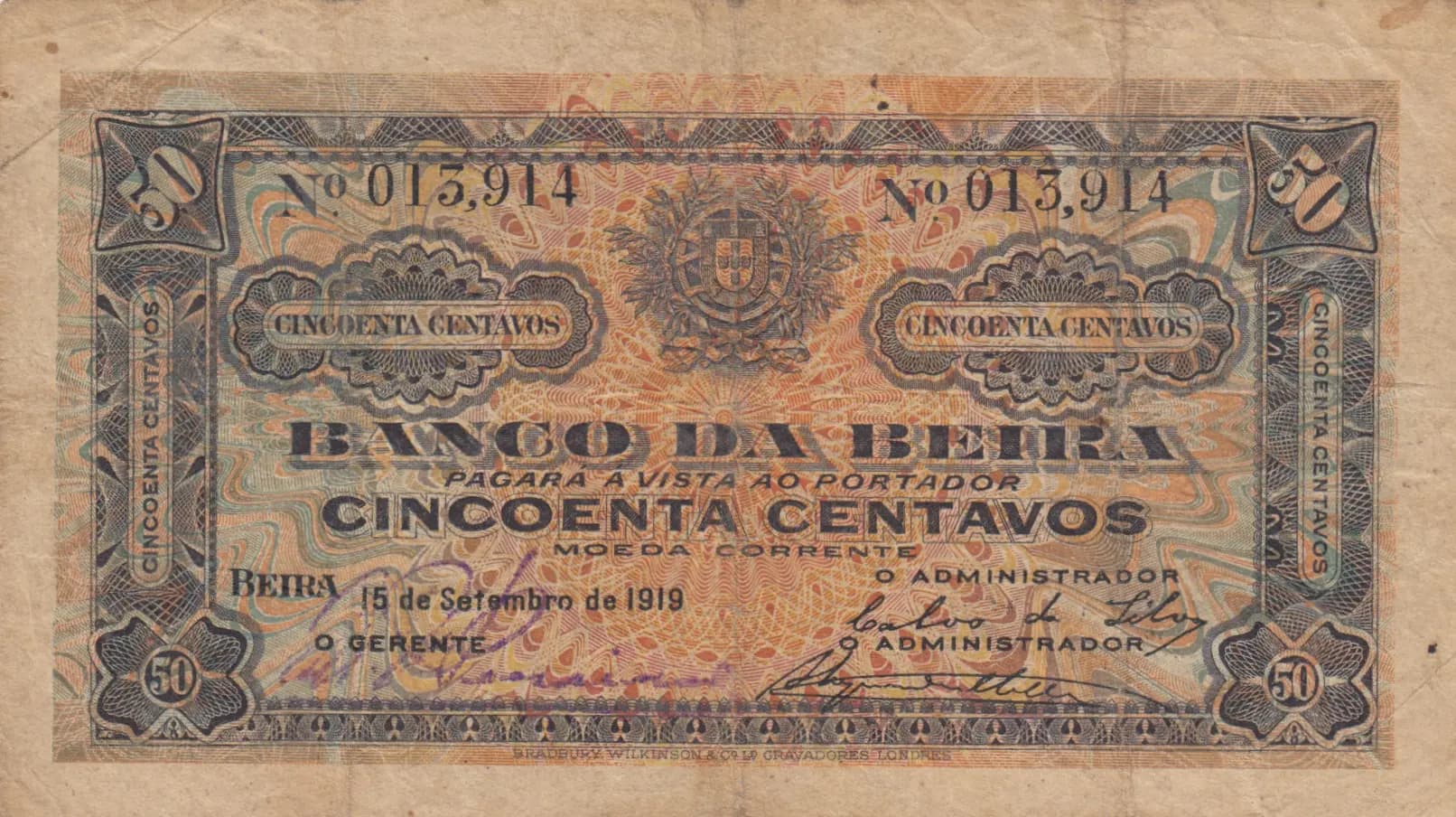
This 50 centavos note from the Banco da Beira (1919) presents a beautifully engraved regional banknote from Portuguese Mozambique with characteristic baroque ornamental design featuring intricate geometric borders, floral motifs, and a Portuguese coat of arms. The note exhibits Fair condition with visible creasing, foxing, and age-related wear consistent with over a century of circulation, yet the fine line engraving remains legible throughout. As a regional issue from this early period, it represents an interesting piece of Portuguese colonial currency with strong collector appeal for specialists in African or Portuguese colonial numismatics.
Common. While this is a regional banknote from Portuguese colonial Mozambique, the 50 centavos Banco da Beira note appears in the market with reasonable frequency for this category. The catalog valuation of $8 in Fine condition and the recorded eBay sale of a VF example for $15.95 in 2021 indicate modest collector pricing consistent with common regional banknotes. The note was likely produced in substantial quantities for circulation in Beira, and the relatively low price points in both catalog values and secondary market sales suggest good availability for serious collectors of Portuguese colonial currency or African banknotes.
This banknote was issued by the Banco da Beira on September 15, 1919, during the early Portuguese colonial period in Mozambique, specifically for the important port city of Beira. The Portuguese coat of arms prominently displayed at the center reflects Portugal's sovereignty and control over the territory, while the inscription 'PAGARÁ À VISTA AO PORTADOR' (payable to bearer on demand) indicates this was a demand note backed by the bank's reserves. The baroque-style ornamental security design typical of Bradbury, Wilkinson & Co's production reflects the security printing standards of the post-WWI era.
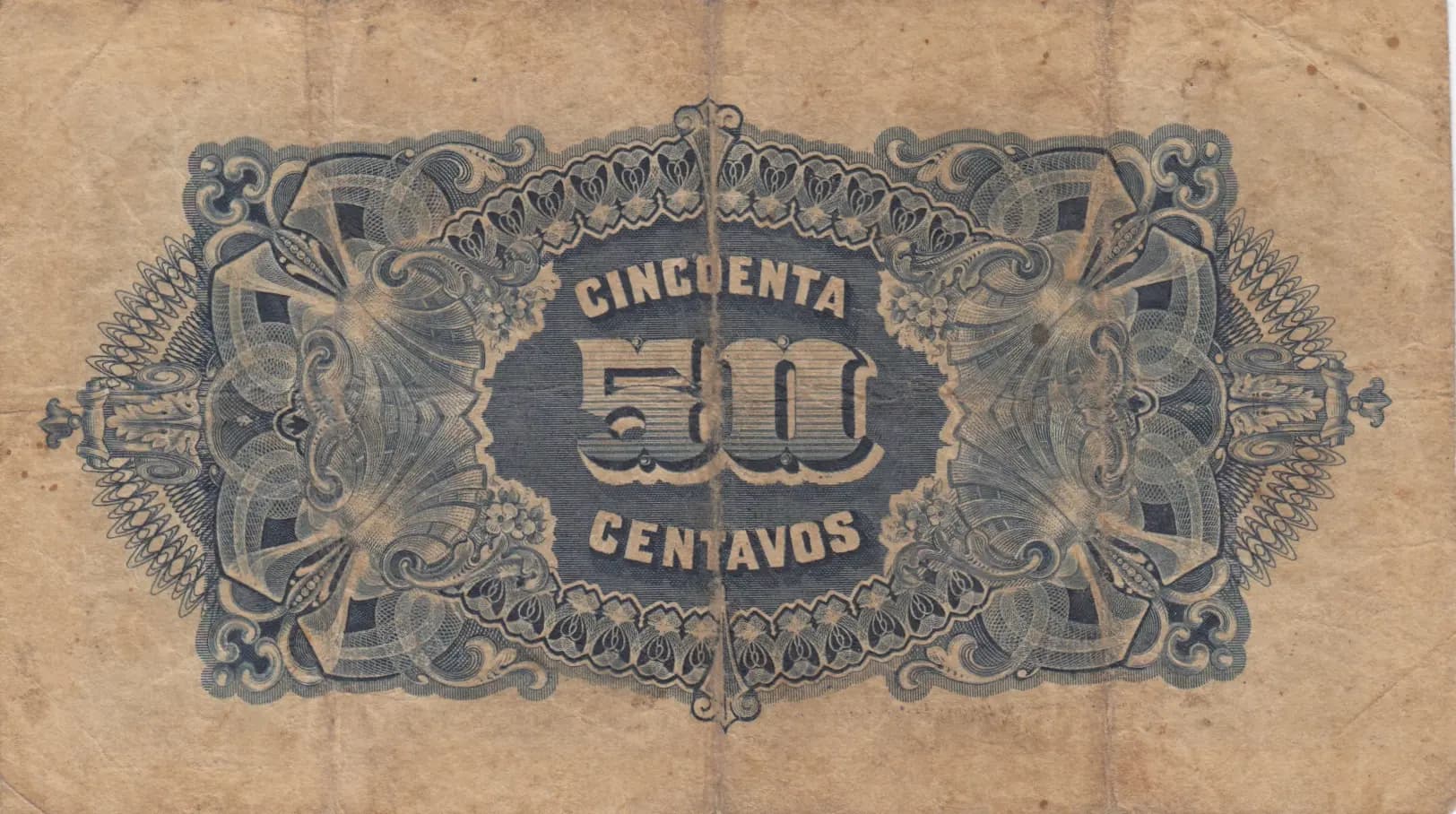
The obverse features an elaborate symmetrical design centered on the Portuguese royal coat of arms at the top, rendered in the style typical of Portuguese official heraldry. The denomination 'CINCOENTA CENTAVOS' is prominently positioned with the issuer name 'BANCO DA BEIRA' in gothic-style lettering. The entire design is framed by intricate baroque-style ornamental borders composed of scrollwork, floral engravings, and geometric patterns extending into all four corners with decorative medallion-style corner flourishes. The reverse presents a large central ornamental rectangular frame containing the denomination text, surrounded by elaborate curved scrollwork and botanical engraved motifs. The color scheme combines tan/beige base paper with black and dark blue-gray printing, creating the multicolor effect noted in catalog descriptions. Serial number placement and signature lines for 'O Gerente' (Manager) and 'O Administrador' (Administrator) are typical of bank-issued notes from this era.
FRONT SIDE: 'CINCOENTA CENTAVOS' (Fifty centavos); 'BANCO DA BEIRA' (Bank of Beira); 'PAGARÁ À VISTA AO PORTADOR' (Will pay to bearer on demand); 'MOEDA CORRENTE' (Current currency); 'BEIRA' (Beira); '15 de Setembro de 1919' (15th of September 1919); 'O GERENTE' (The Manager); 'O ADMINISTRADOR' (The Administrator); 'N°0013,914' (Serial number); 'BRADBURY, WILKINSON & CO LTD GRAVADORES LONDRES' (Bradbury, Wilkinson & Co Ltd Engravers London). BACK SIDE: 'CINCOENTA CENTAVOS' (Fifty centavos); '500' (denomination indicator).
Intaglio engraving (fine line engraving), characteristic of security printing by Bradbury, Wilkinson & Co Ltd, the renowned London-based security printer credited on the note. The intricate geometric borders, floral motifs, and fine line work throughout serve dual purposes as both aesthetic design and anti-counterfeiting security measures. The multicolor effect combining orange-brown, blue, and black elements was achieved through multiple pass printing on a single sheet, a standard technique for high-security banknotes of this period.
This specimen represents the P-R3a variety (Pick catalog designation), with Bradbury, Wilkinson & Co (BWC) as the printer. The PMG population report indicates a known P-R3b variant also exists for the 50 centavos denomination. The observed serial number '0013,914' and the presence of hand signatures for both the Manager and Administrator are consistent with standard production characteristics. The specific issue date of 15 de Setembro de 1919 and the particular signature styles may further distinguish varieties, though only two variants are catalogued for this base Pick number.