5 libras 1934
Market Prices
31 salesAbout This Note
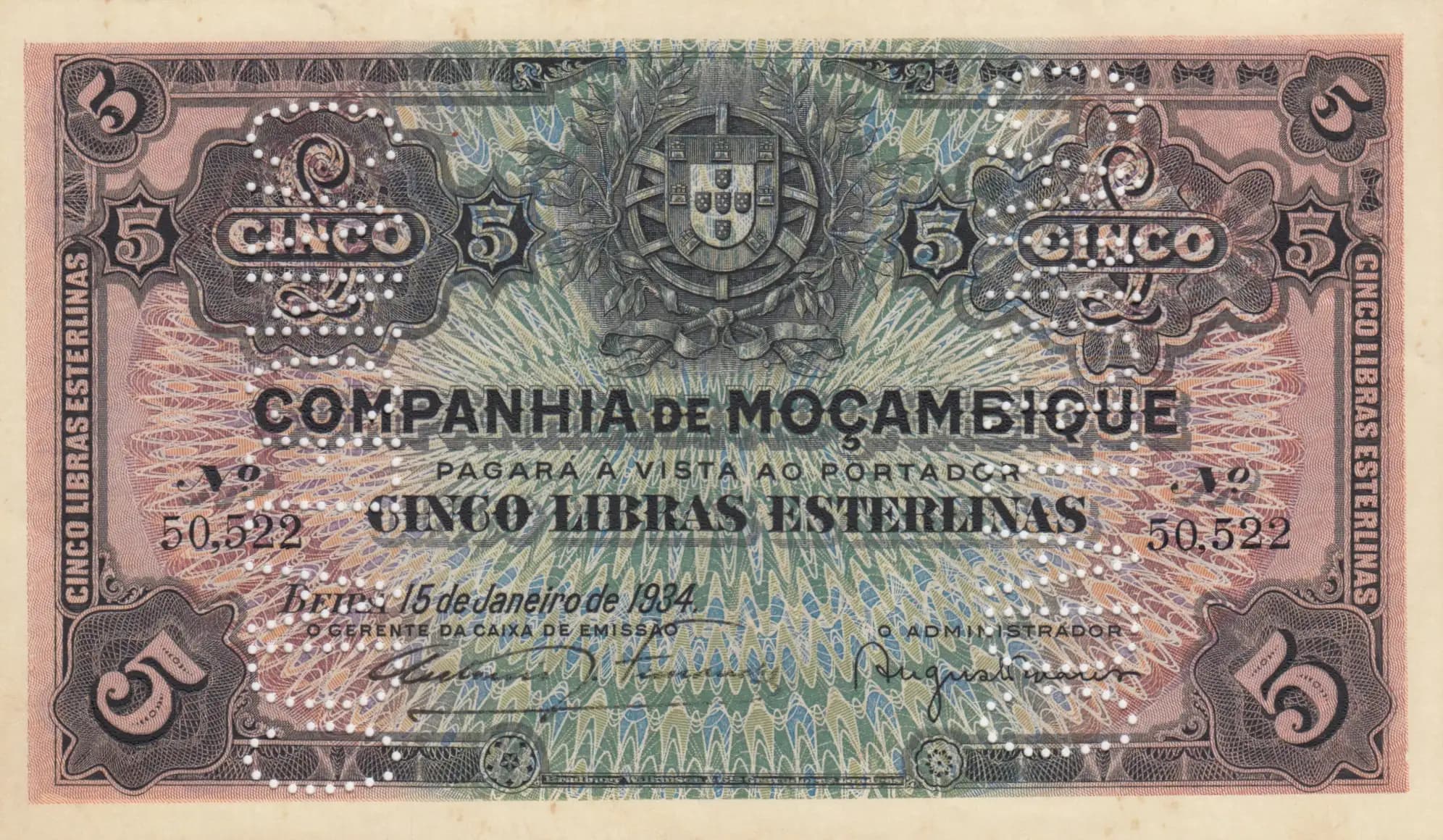
This is a handsome example of the 1934 Companhia de Moçambique 5 Libras Esterlinas note graded AU, featuring beautifully executed baroque-style engraving with ornate pink/mauve borders and a central Portuguese coat of arms. The note displays the characteristic crisp detail of period intaglio printing, though age-related foxing and discoloration on the cream background are consistent with the note's nearly century-old provenance. As a regional colonial issue from Portuguese Mozambique's chartered company, this scarce denomination represents an important piece of Portuguese colonial numismatic history.
Common. eBay market data shows steady, modest pricing with most examples in VF–AU condition selling in the $7–$35 range from 2010–2025, including recent sales (January 2025 PMG 30 at $20.50; 2023 EF at $10.79). The consistent availability across multiple condition grades and the relatively low realized prices indicate this is a regularly traded item without scarcity premium. The 1934 issue appears to have had a substantial print run sufficient to allow regular circulation among collectors and dealers. While historically interesting as a colonial piece, it is not rare in absolute terms.
The Companhia de Moçambique (Mozambique Company) was a Portuguese chartered company granted monopoly rights to develop and administer the Mozambique territory during the colonial period. This 1934 issue, denominated in British pounds sterling, reflects the complex trade relationships and currency arrangements of Portuguese colonial Africa, where the company maintained significant economic autonomy. The prominent Portuguese coat of arms on the obverse symbolizes the Crown's authority over this private commercial venture, while the formal 'pagará a vista ao portador' (payable to bearer on demand) language underscores the note's function as a bearer instrument in colonial commerce.
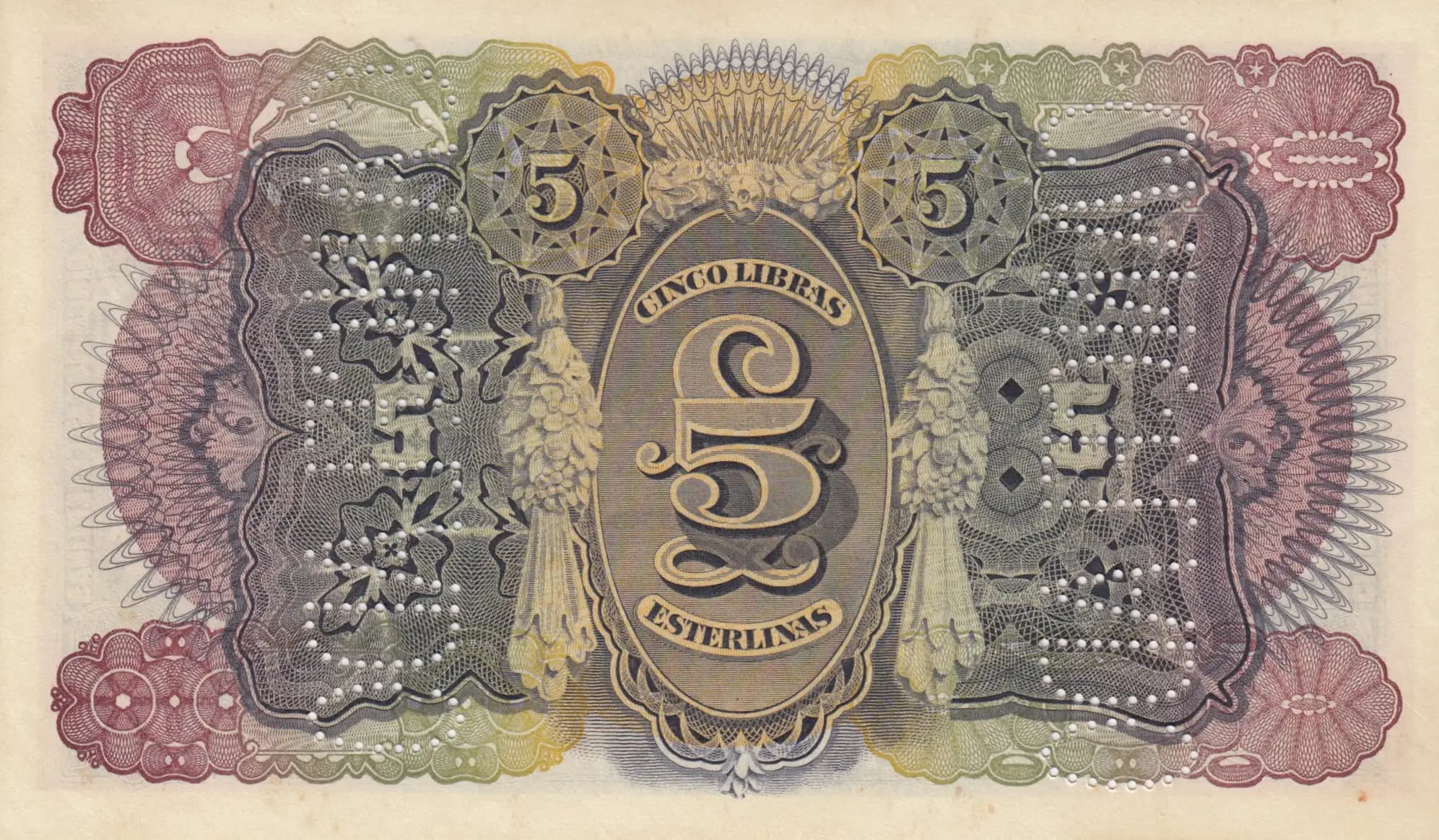
This note exemplifies fine late colonial Portuguese banknote design with meticulous attention to baroque ornamentation. The obverse features a centrally positioned Portuguese royal coat of arms (shield with heraldic elements) at the top center, flanked by ornate corner medallions containing the numeral 5. The design incorporates elaborate engraved scrollwork and radiating line patterns in the background, with decorative floral and botanical elements surrounding the central shield. The reverse presents a large central oval medallion containing the denomination 5, surrounded by flanking laurel wreaths (classical symbols of achievement and authority) and comprehensive ornamental floral designs. The scalloped borders and marginal flourishes on both sides create a frame befitting a high-value bearer instrument. The color palette—pink/mauve, olive green, and gold/yellow tones—was typical of high-security Portuguese colonial currency of the era.
FRONT: '5' and 'CINCO' (Five); 'COMPANHIA DE MOÇAMBIQUE' (Mozambique Company); 'PAGARÁ A VISTA AO PORTADOR' (Will pay on demand to bearer); 'CINCO LIBRAS ESTERLINAS' (Five Pounds Sterling); 'Emitido 15 de janeiro de 1934' (Issued January 15, 1934); 'GERENTE DA CAIXA DE EMISSÃO' (Manager of the Issuing Office); 'O ADMINISTRADOR' (The Administrator); '50,522' (serial/reference number). BACK: '5' (Five); 'CINCO LIBRAS ESTERLINAS' (Five Pounds Sterling).
Intaglio engraving (taille-douce) on multiple color plates, executed with exceptional detail characteristic of early 20th-century European security printing. The note exhibits the hallmark features of period intaglio production: intricate line work patterns, complex multi-layer engraving creating depth perception, detailed botanical and floral designs, and precise color registration across multiple printing passes. The crisp definition of fine decorative lines and the consistent ink application throughout both sides indicate professional security printing executed by a leading European banknote printer, likely Thomas De La Rue or a comparable specialist firm contracted by the Portuguese Crown.
Pick catalog P-R32, variant Beira (P-R32s per PMG Population Report). This note is dated 15 January 1934, the official issue date for this series. The serial number '50,522' suggests this is from the early portion of the print run. PMG has recorded one variant for this base Pick number (P-R32s designation for Beira issues). No overprints or date varieties are evident on this specimen. The signatures appear to be standard for the Manager of the Issuing Office and Administrator positions, consistent with the formal administrative presentation typical of Companhia de Moçambique notes.