50 centavos 1919
Market Prices
6 salesAbout This Note
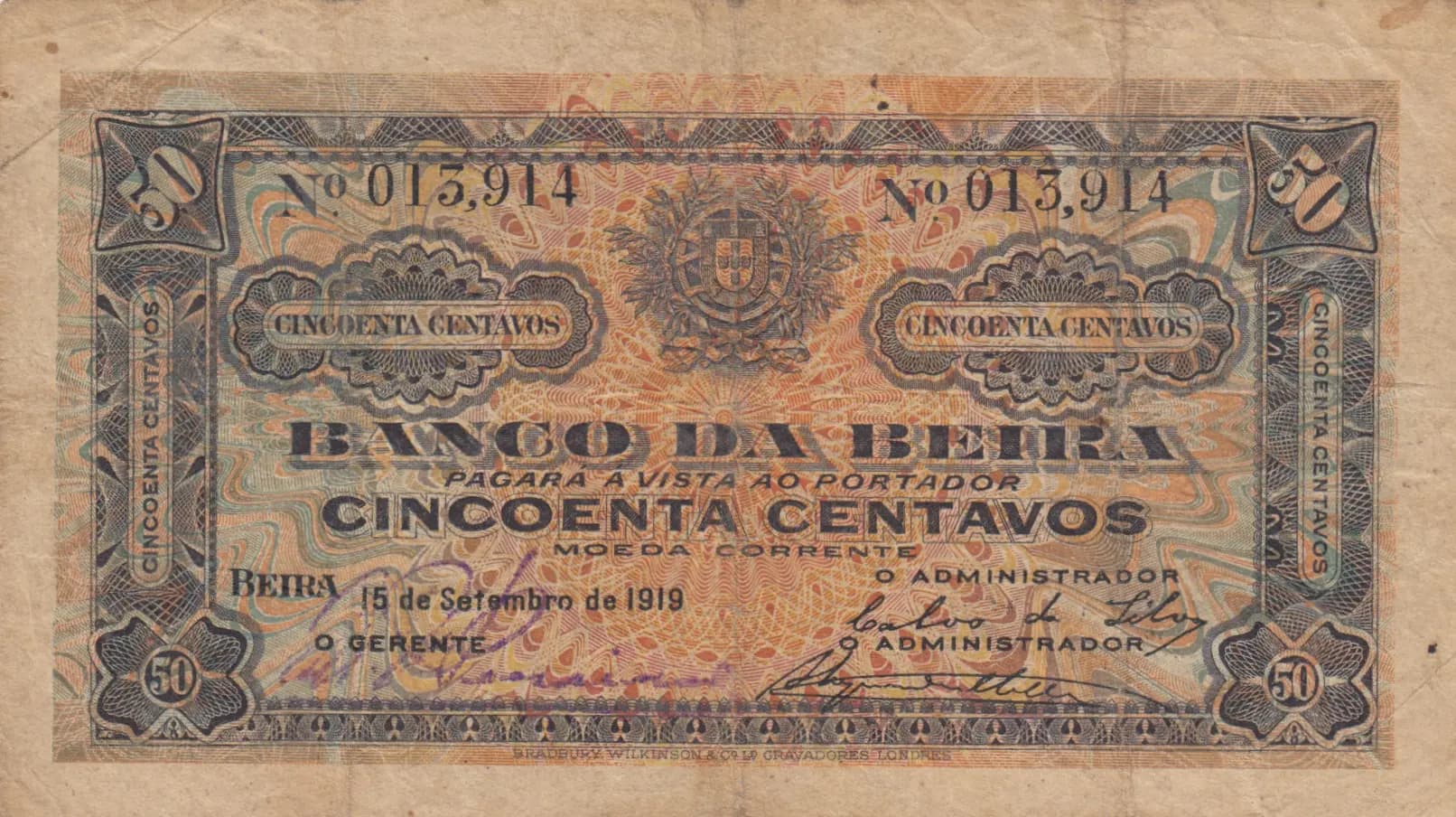
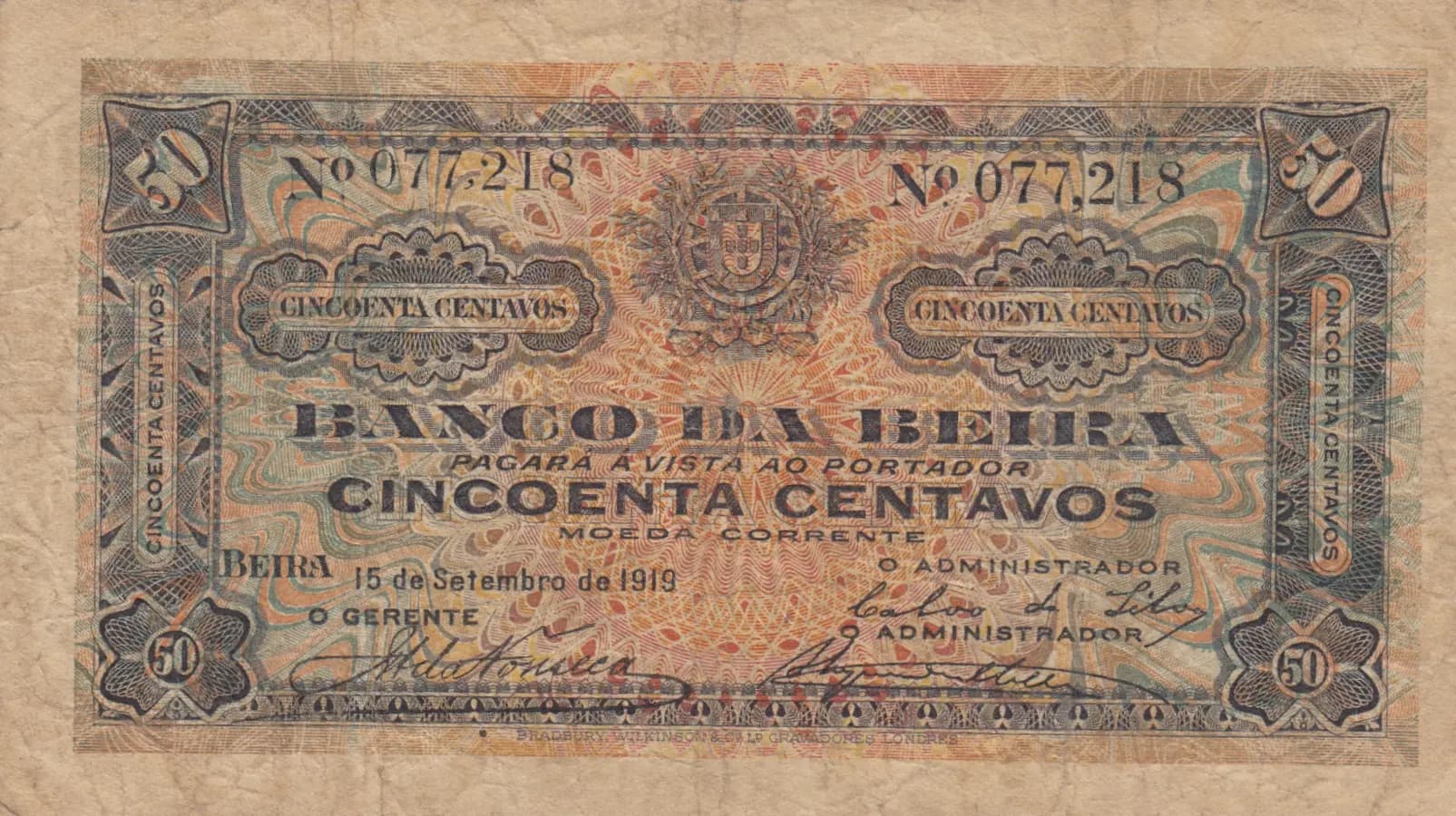
This is a 50 centavos banknote issued by Banco da Beira on 15 September 1919, representing a regional currency from Portuguese Mozambique during the early 20th century. The note displays the characteristic ornate Art Nouveau-influenced design typical of this era, with elaborate decorative borders, a central coat of arms, and carefully engraved security patterns rendered in black, orange-brown, and blue tones. In Fine condition as catalogued, the note shows appropriate age-related wear including creases, foxing, and patina consistent with circulation or decades of storage, making it a solid historical example of Mozambique's regional banking system.
Common. This note trades actively on the secondary market with consistent sales history documented from 2010-2017, with Fine condition examples selling in the $6-9.50 range according to both catalog valuations (2008: $6 for F grade) and eBay realized prices. The presence of PMG cataloguing and multiple documented sales indicates adequate surviving population. Regional Portuguese colonial banknotes from this period, while historically interesting, were produced in sufficient quantities that examples remain accessible to collectors. No evidence of scarcity, short print runs, or recall status that would elevate rarity.
The Banco da Beira operated as a regional bank in the port city of Beira during Portuguese Mozambique's colonial period, issuing its own currency under Portuguese imperial authority. This 1919 issue date places the note during the post-World War I period when many regional Portuguese banks maintained independent note-issuing privileges before centralization. The Portuguese coat of arms or shield emblem depicted on the obverse reinforces the colonial administrative structure under which this regional bank operated, while the bearer-payable format ('PAGARÁ À VISTA AO PORTADOR') and denomination in centavos reflect the Portuguese monetary system's extension into colonial territories.
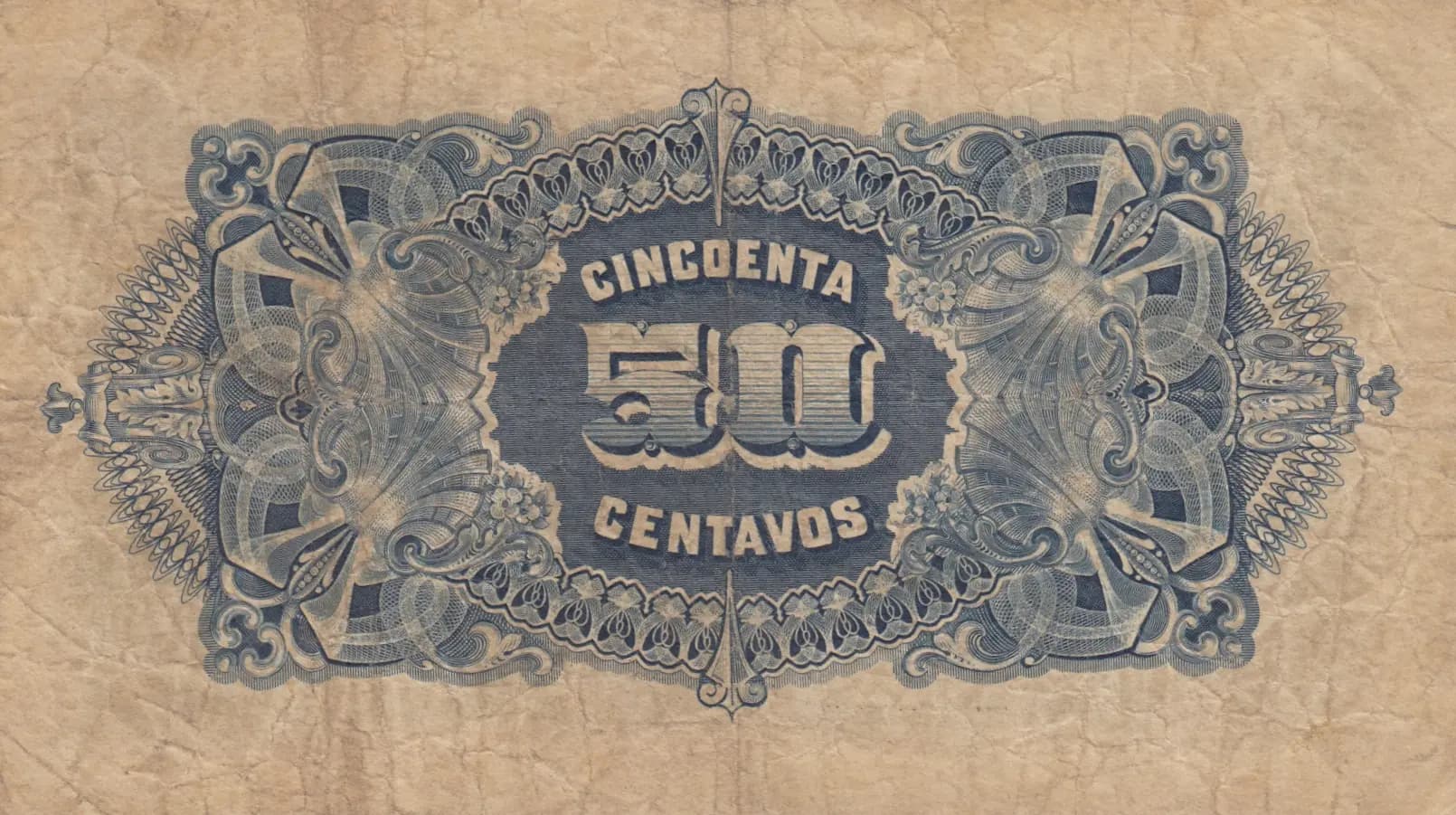
The obverse features a classical rectangular design with multiple concentric ornamental borders composed of geometric and floral motifs rendered in blue-grey and orange-tan. The central focal point is a coat of arms or heraldic shield emblem positioned in the upper center, flanked by decorative corner cartouches in all four corners. The design employs baroque and Art Nouveau stylistic elements with elaborate quatrefoil patterns and scrollwork distributed throughout the field. Text is arranged both horizontally and vertically, creating a balanced, symmetrical composition. The reverse displays a simplified but equally ornate design centered on a large decorative cartouche with elaborate scrollwork and floral flourishes rendered primarily in blue-grey and cream, featuring the denomination prominently within an ornamental frame. The overall aesthetic reflects the security and prestige conventions of early 20th-century European bank note design adapted for colonial currency.
FRONT SIDE: 'CINCOENTA CENTAVOS' (Fifty centavos) — appears twice as denomination markers; 'BANCO DA BEIRA' (Bank of Beira) — issuing institution; 'PAGARÁ À VISTA AO PORTADOR' (Payable on sight to bearer) — negotiability clause; 'MOEDA CORRENTE' (Current currency) — legal tender designation; '15 de Setembro de 1919' (15 September 1919) — issue date; 'O GERENTE' (The manager) and 'O ADMINISTRADOR' (The administrator) — signature authority lines; 'BEIRA' (Beira) — location; Serial number 'No0077218' (repeated for security). BACK SIDE: 'CINCOENTA CENTAVOS' (Fifty centavos) — primary denomination; '500' (Five hundred, presumably reis equivalent) — secondary denomination notation.
Intaglio engraving, executed by Bradbury, Wilkinson & Company (BWC) as indicated in the catalog data. The visual analysis confirms characteristic features of fine line engraving: intricate, varying line densities in background patterns, fine detail work in decorative elements particularly evident in the scrollwork and cartouches, and complex engraved security patterns throughout that would have been difficult to counterfeit with contemporary reproductive technologies. The multi-color printing (black on orange-brown underprint for obverse; blue for reverse) was accomplished through sequential intaglio passes, a standard security printing technique for this era.
This note is catalogued as Pick P-R3b, representing the 50 Centavos denomination issued by Banco da Beira. The 'b' suffix indicates this is a known variant within the base Pick number series; PMG records note two catalogued variants for this base Pick number (P-R32s for 5 Libras and P-R3b for 50 Centavos). The serial number observed (No0077218) is a standard circulation serial. No overprints, date variations, or signature varieties are evident from the visual analysis that would constitute separate catalog entries; the note represents the standard issue type for this Pick number.