100 meticais 1980 specimen
Market Prices
6 salesAbout This Note
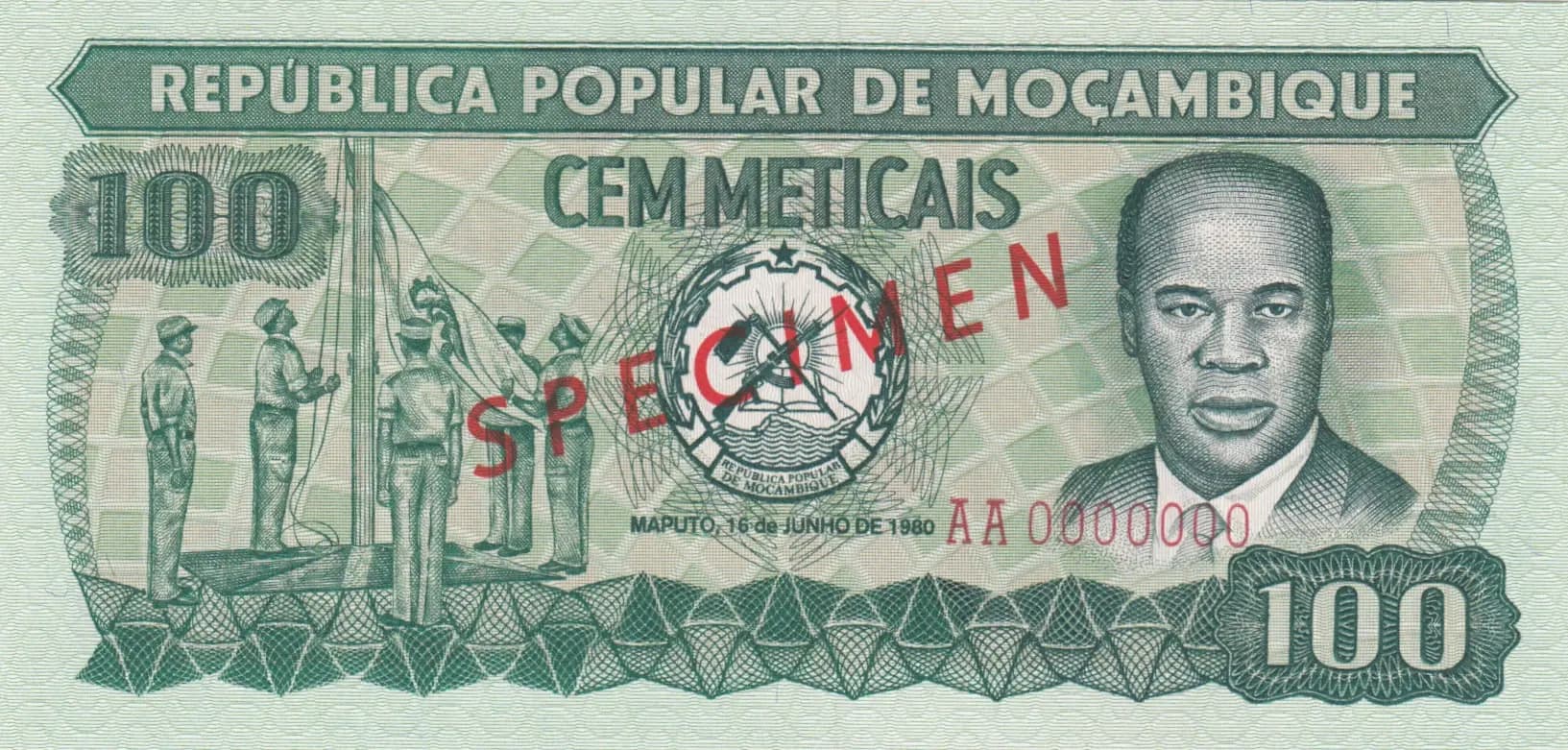
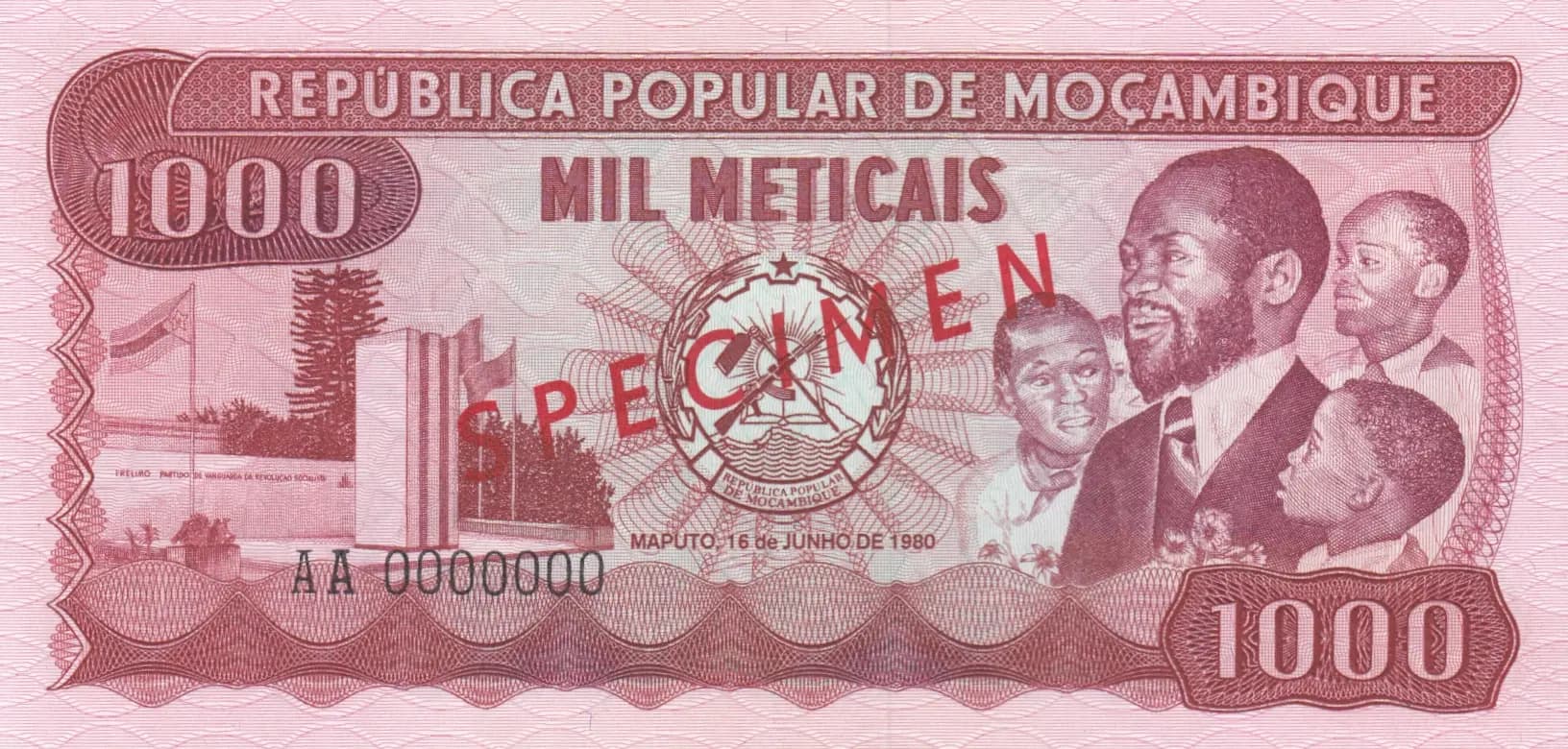
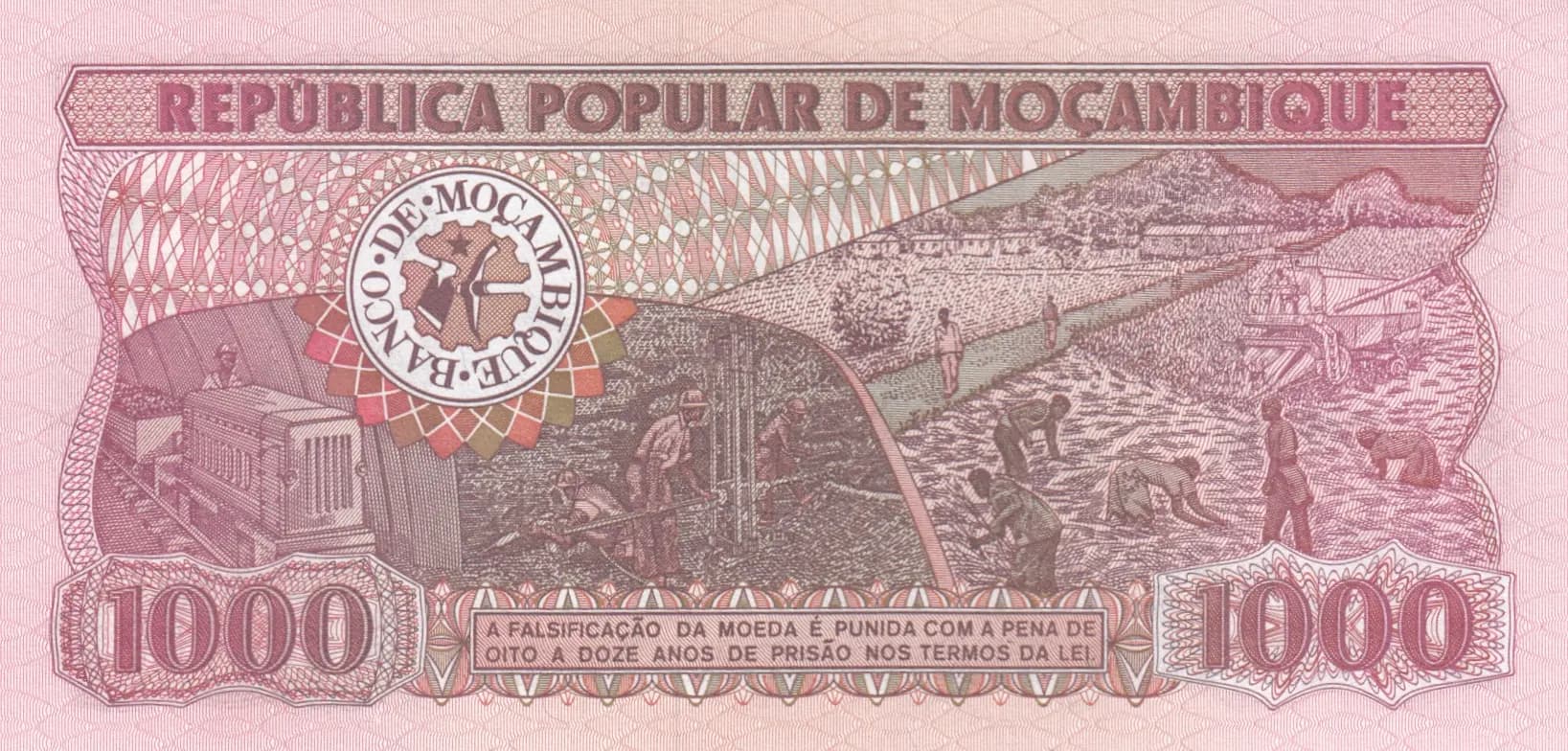
This is a pristine UNC specimen of Mozambique's 1980 1000 meticais banknote (Pick P-128s), featuring a striking pink/mauve color scheme with a portrait group of political figures and children on the obverse, alongside the Monument to the Socialist Vanguard. The reverse depicts workers engaged in agricultural labor—mining and harvesting scenes reflecting the nation's economic priorities during the early independence period. As a specimen note with serial number AA 0000000 and printed 'SPECIMEN' overprint, this is a non-circulating display piece that represents the Bank of Mozambique's official release design.
Common. This denomination and issue from the 1980 Mozambique series appears regularly in the collector market with consistent pricing. eBay historical sales data shows regular circulation of UNC examples at $8.50-$17.50, with typical UNC catalog value around $8.50 (2019). The note was produced in substantial quantities during normal currency circulation and has survived in relatively good quantities. Specimen versions like this example are slightly less common than circulation strikes but do not command significant premiums in the collector market. The consistent sub-$20 pricing across multiple sales over a decade confirms common status.
This banknote was issued on June 16, 1980, just nine years after Mozambique's independence from Portugal and during the presidency of Samora Moisés Machel, whose portrait dominates the obverse. The revolutionary imagery—including the Socialist Vanguard monument and the depiction of workers in agricultural and mining scenes—reflects the nation's commitment to socialist ideology and nation-building in the immediate post-colonial period. The prominent display of the red star in the national coat of arms and the emphasis on collective labor underscore the political messaging characteristic of People's Republic governance in 1980s Africa.
The obverse features a composed group portrait on the right side centered on Samora Moisés Machel, Mozambique's first president, accompanied by young male figures and a child, symbolizing revolutionary leadership and the youth of the nation. On the left stands an architectural monument with vertical design elements and pine trees—representing the Monument to the Socialist Vanguard, a key symbol of revolutionary achievement. The national coat of arms occupies the center, displaying the characteristic red star at its apex and circular heraldic design. Denomination numerals '1000' appear in ornamental oval frames in the upper left and lower right corners, surrounded by decorative guilloche patterns and wave-like border designs. The reverse presents an expansive landscape scene of terraced agricultural fields with multiple workers depicted in various harvesting and farming poses, emphasizing rural labor and national economic activity. The 'BANCO DE MOCAMBIQUE' circular emblem is positioned in the upper center, with denomination numerals again appearing in decorative frames at lower corners. The entire design employs fine-line engraving with complex security patterns throughout.
FRONT SIDE: 'REPUBLICA POPULAR DE MOCAMBIQUE' (People's Republic of Mozambique) — governmental authority designation; 'MIL METICAIS' (One Thousand Meticais) — denomination in words; 'SPECIMEN' — indicating this is an official specimen not for circulation; 'MAPUTO 16 de JUNHO DE 1980' (Maputo, 16 June 1980) — place and date of issue; '1000' — denomination in numerals; 'AA 0000000' — specimen serial number. BACK SIDE: 'REPUBLICA POPULAR DE MOCAMBIQUE' (People's Republic of Mozambique); 'BANCO DE MOCAMBIQUE' (Bank of Mozambique) — issuing authority; 'A FALSIFICAÇÃO DA MOEDA É PUNIDA COM A PENA DE OITO A DOZE ANOS DE PRISÃO NOS TERMOS DA LEI' (The counterfeiting of currency is punished with a sentence of eight to twelve years imprisonment under the terms of the law) — statutory warning; '1000' — denomination in numerals.
Intaglio (engraved) banknote printing, utilizing fine-line engraving and complex guilloche patterns for security purposes. The detailed portraiture, landscape scenes, and geometric lattice patterns characteristic of high-security currency production are evident throughout. The specific printer for this issue is not definitively documented in standard catalog references, though Mozambique's notes from this era were typically produced by established international security printers such as Waterlow & Sons or Thomas De La Rue. The fine line work density and security feature complexity suggest professional state-level currency production standards of the early 1980s.
This is specifically a SPECIMEN variety (Pick P-128s) as distinguished from the regular circulation issue (Pick P-128). Specimen notes are identified by the printed 'SPECIMEN' overprint and the serial number consisting entirely of zeros (AA 0000000). PMG records indicate at least one additional variant exists (P-128*), likely representing a starred note variant or printer's variant, though visual distinction between main P-128 and P-128* varieties is not detailed in standard catalogs. The June 16, 1980 date is consistent with the first printing of this denomination. Serial number prefixes may vary on circulation examples, but this specimen note carries the standardized AA 0000000 designation.