5 perpera 1916
Market Prices
About This Note
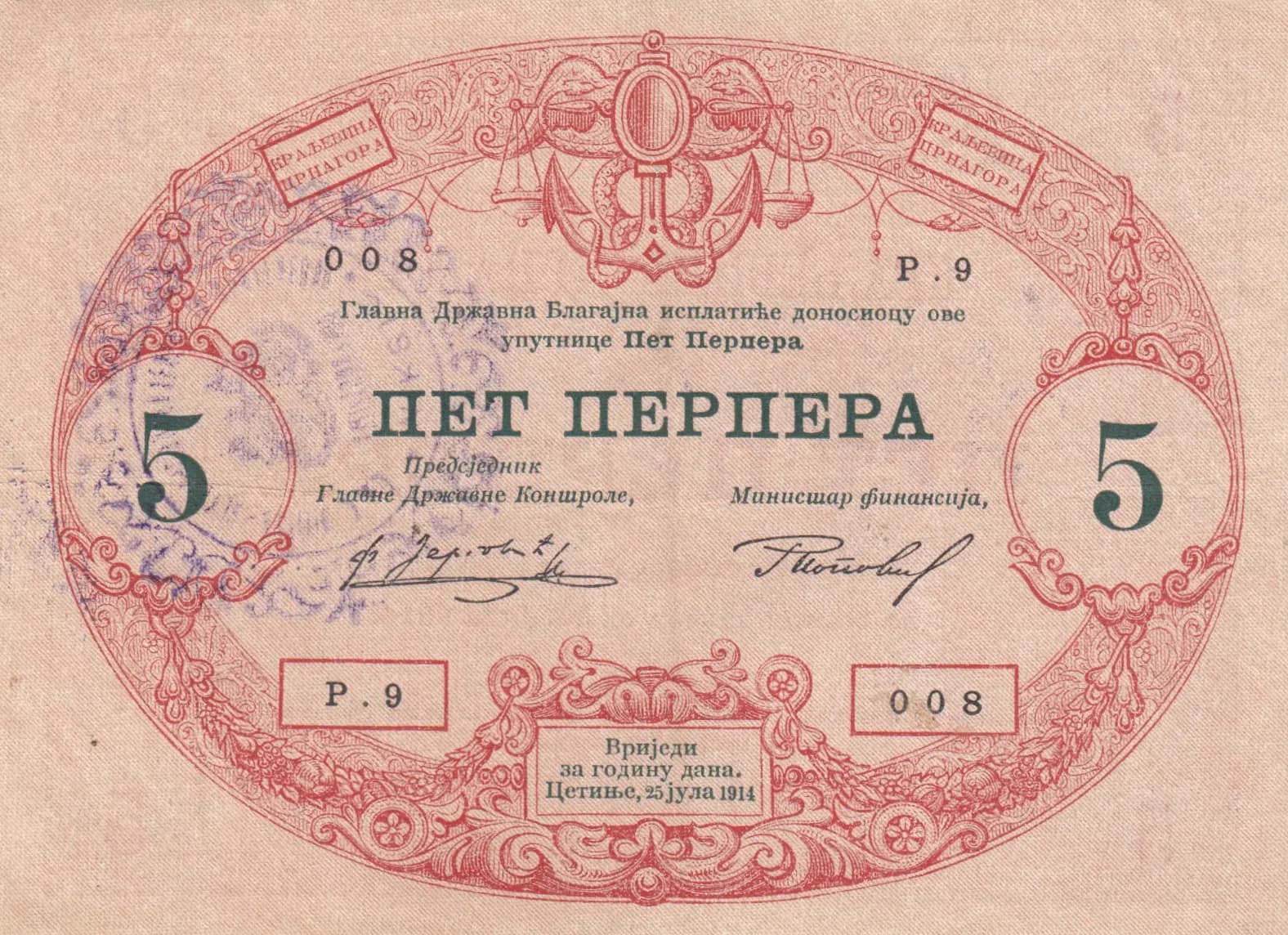
This Kingdom of Montenegro 5 Perpera military payment note from 1916 presents an impressive example of early 20th-century Balkan currency with ornate classical design elements characteristic of Austro-Hungarian influence. The note displays significant circulation wear with visible stamps and foxing consistent with its VF condition grade, featuring elaborate red borders, ornamental scrollwork, and dual denomination markers. As a relatively short-lived military issue from a kingdom that ceased independent existence within a decade, this note represents an important transitional piece of Serbian/Montenegrin monetary history.
Common. The eBay market data provided shows VF examples trading in the $26.00-$225.00 range with multiple listings at the lower end ($26-$39), indicating adequate collector availability. The 2008 catalog value of $18 EF confirms this is a standard issue without significant scarcity premium. While the note represents a historically important transitional piece from a short-lived polity, the Kingdom of Montenegro's brief independent existence (1878-1918) and the 1916 date place this within a recognized collecting category with consistent market presence. No evidence of limited print runs, recalls, or extraordinary rarity factors specific to this Pick number exists in the data.
This note was issued under the July 25, 1914 law during Montenegro's tumultuous period following the Balkan Wars and leading into World War I, when the kingdom faced severe financial pressures. The elaborate heraldic symbols, including what appears to be a double-headed imperial emblem at the top center of the front, reflect Montenegro's complex geopolitical position between the Ottoman and Austro-Hungarian spheres of influence. The 'Upputnica' (promissory note) designation and one-year validity clause indicate this was an emergency government financial instrument issued during a period of national crisis, ultimately made obsolete when Montenegro was incorporated into the Kingdom of Serbs, Croats and Slovenes in 1918.
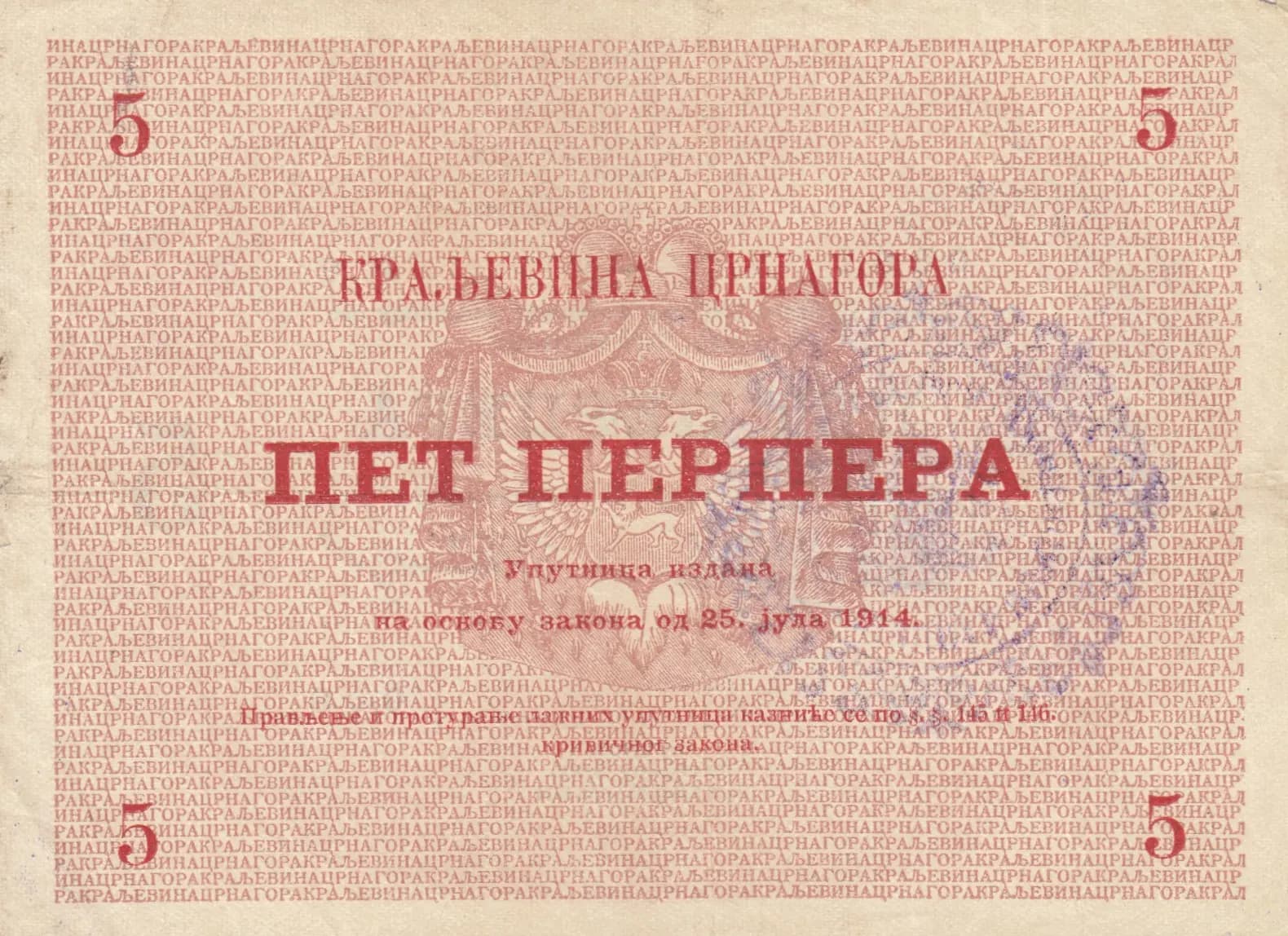
The 5 Perpera note features a symmetrical classical design typical of Central European currency of the period. The front is dominated by an ornate oval cartouche with elaborate red borders and dense scrollwork in the neoclassical tradition, with the denomination '5' positioned in circles at both left and right margins. At the top center sits a heraldic double-headed eagle or imperial state emblem, flanked by ornamental crown motifs—symbolizing Montenegro's royal authority and its position within European monarchical traditions. The color scheme employs deep red/crimson for borders and text against a cream/beige background, with dark green or teal used for the Cyrillic inscriptions. The reverse side maintains the red and cream palette with a repetitive background text pattern serving as a security measure, large denomination numerals at top-left and bottom-right corners, and two small red flag or pennant symbols typical of nationalist insignia of the period. The fine line engraving throughout indicates high-quality security printing standards for the era.
FRONT SIDE: The note declares 'ПЕТ ПЕРПЕРА' (Five Perpera) in multiple locations. The primary authority statement reads: 'Главна Државна Благајна исплаћивање доносиону ове упутнице Пет Перпера' (Main State Treasury payment to the bearer of this note Five Perpera). The issuing authority is identified as: 'Предсједник Главне Државне Контроле, Министар финансија' (President of Main State Control, Minister of Finance). The validity clause states: 'Вриједи за годину дана. Цетиње, 25 јула 1914' (Valid for one year. Cetinje, July 25, 1914). Serial designation: R.9, Serial number: 008. BACK SIDE: The header reads 'КРАЛ̀ЕВИНА ЦРНА̀ГОРА' (Kingdom of Montenegro) with 'ПЕТ ПЕРПЕРА' (Five Perpera) displayed prominently. The legal basis is stated: 'УПУТНИЦА ИЗДАНА НА ОСНОВУ ЗАКОНА ОД 25. ЈУЛА 1914' (Note issued on the basis of the law of July 25, 1914). A protective notice states: 'Препоручује се врачање употребљених упутница по добијању новца по чл. 11 и 116 кривичног закона' (It is recommended to return used notes upon receipt of money according to articles 11 and 116 of the criminal law). The background contains a repetitive security pattern with variations of: 'НАЦИОНАЛНА КРАЉЕВИНА НАРОДНА ГОРА' (National Kingdom, People's Mountain/Montenegro).
This note was produced using traditional intaglio engraving (steel plate engraving), evident from the fine line work, detailed scrollwork, and sharp denomination characters visible in the visual analysis. The repetitive background text pattern on the reverse demonstrates advanced multi-pass printing or specialized security printing techniques. The precision of the border design and the consistent density of the ornamental elements indicate professional security printer standards. While the specific printer is not definitively identified in available catalog data, the quality and style suggest production by one of the Austro-Hungarian security printers that handled Balkan monetary issues during this period, potentially the Oesterreichisch-Ungarische Bank or similar imperial printing facilities.
The noted variety is identifiable by the serial designation 'R.9' with serial number '008' visible on the front. The date of issue is consistently July 25, 1914 (Cetinje) per the law cited. Collectors should note that signature varieties likely exist on this issue, as multiple officials (President of Main State Control and Minister of Finance) signed these notes; variations in specific signatory names would constitute different varieties. The notation 'R.9' may indicate a specific printing run or series designation. No overprints are visible on this example, though overprinted or re-stamped varieties from subsequent government reorganizations may exist. The presence of administrative stamps in purple/blue ink suggests post-issue handling by treasury or banking authorities, but these are not printing varieties inherent to the note itself.