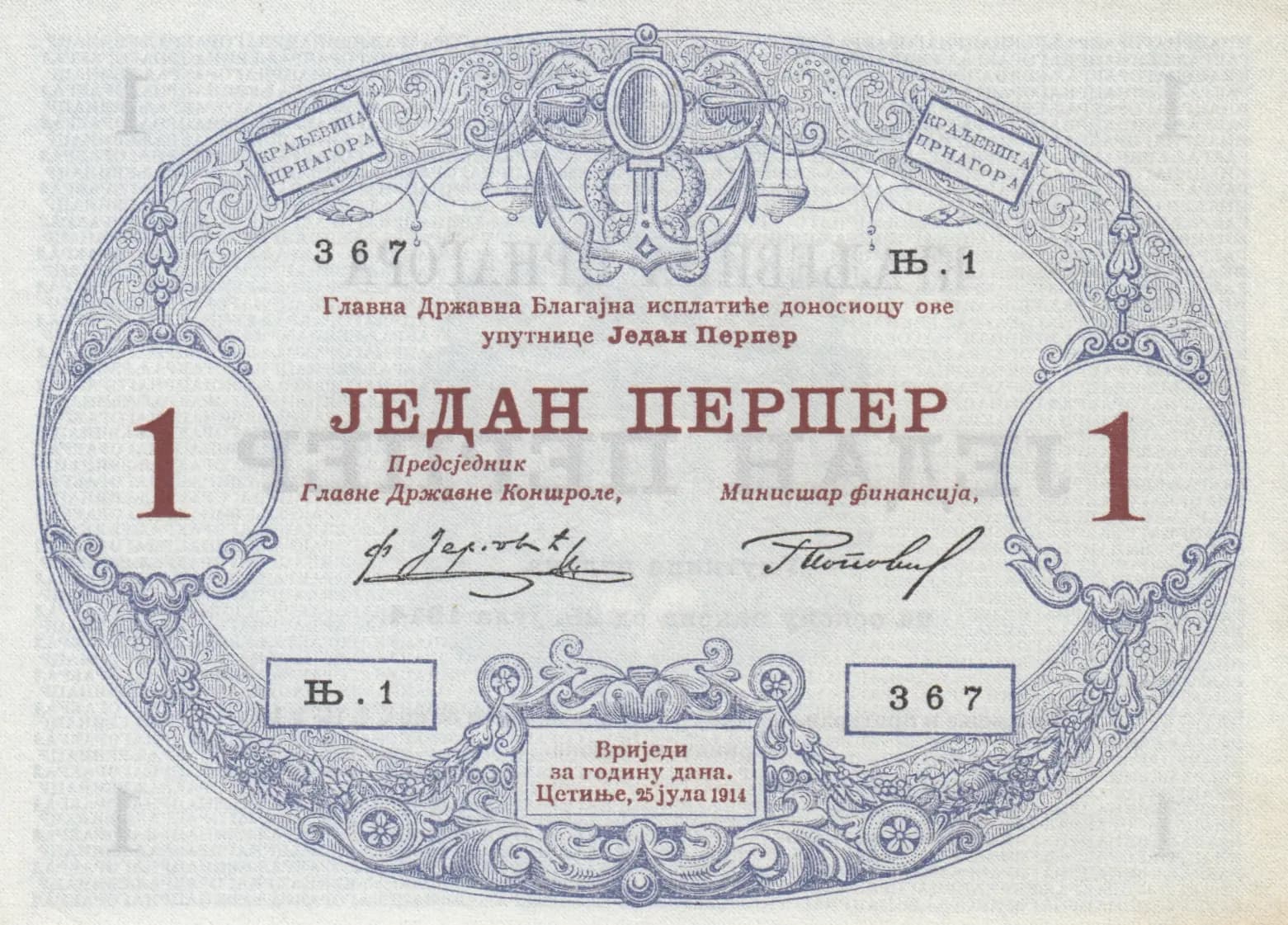
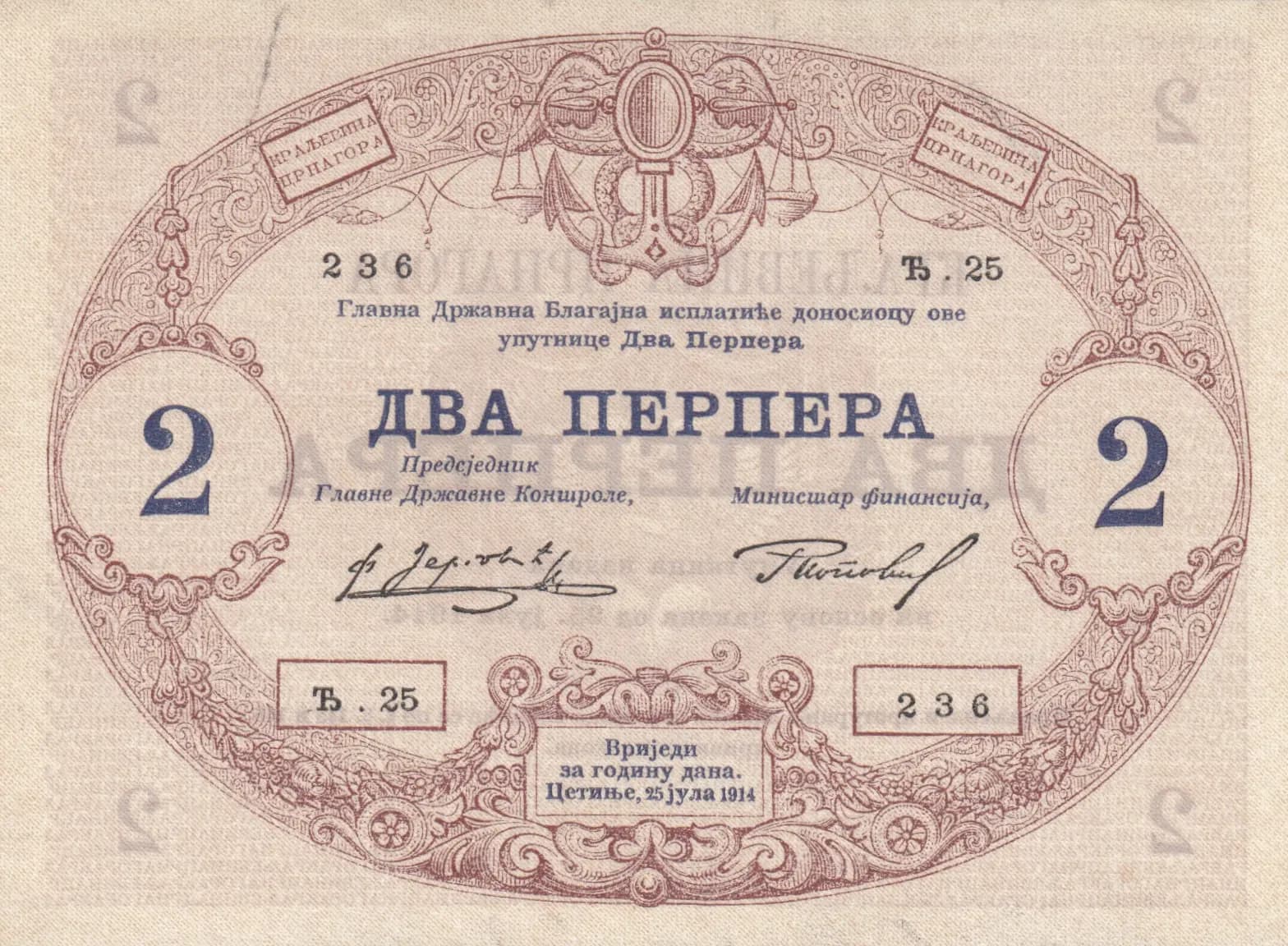
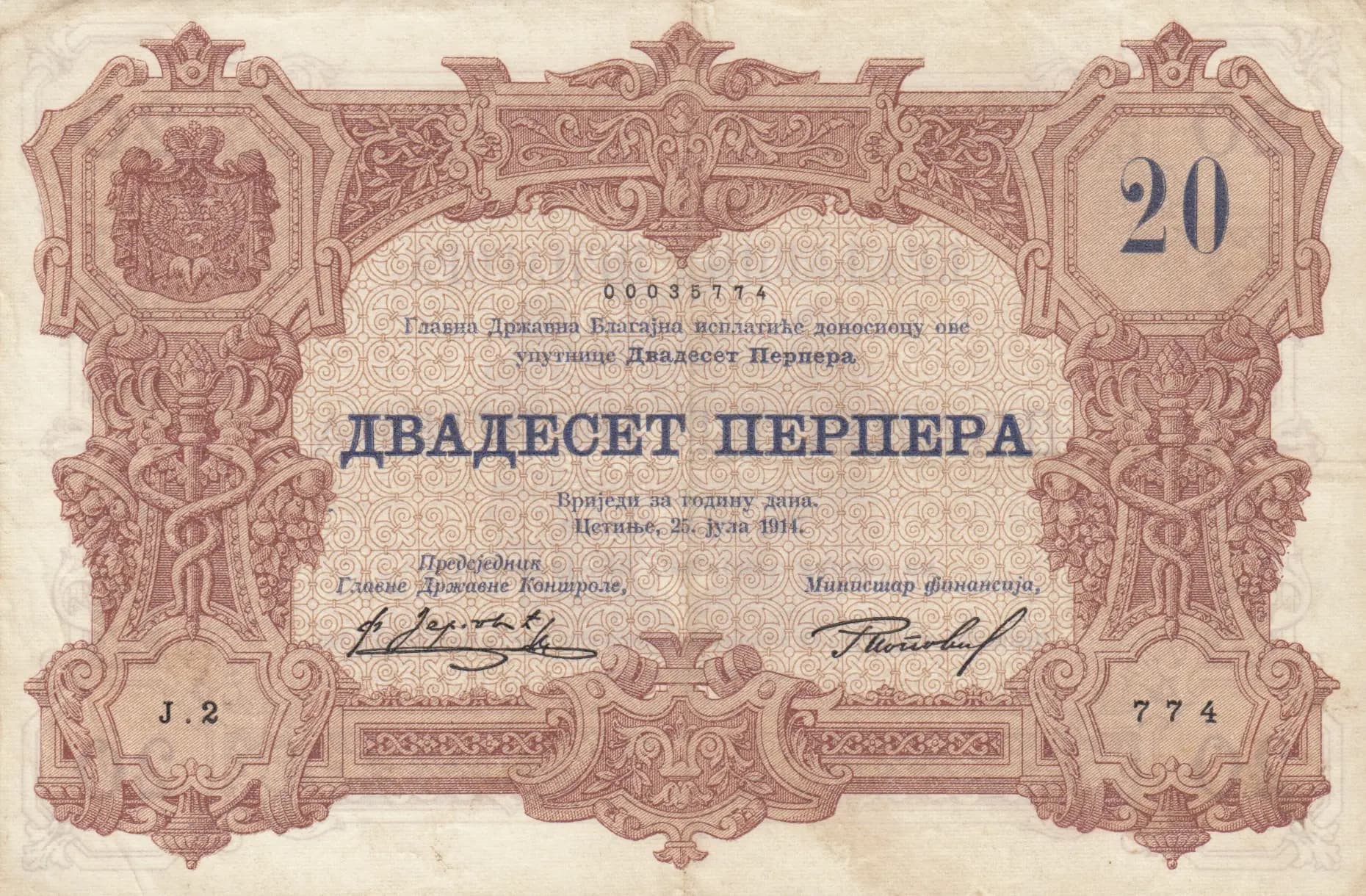
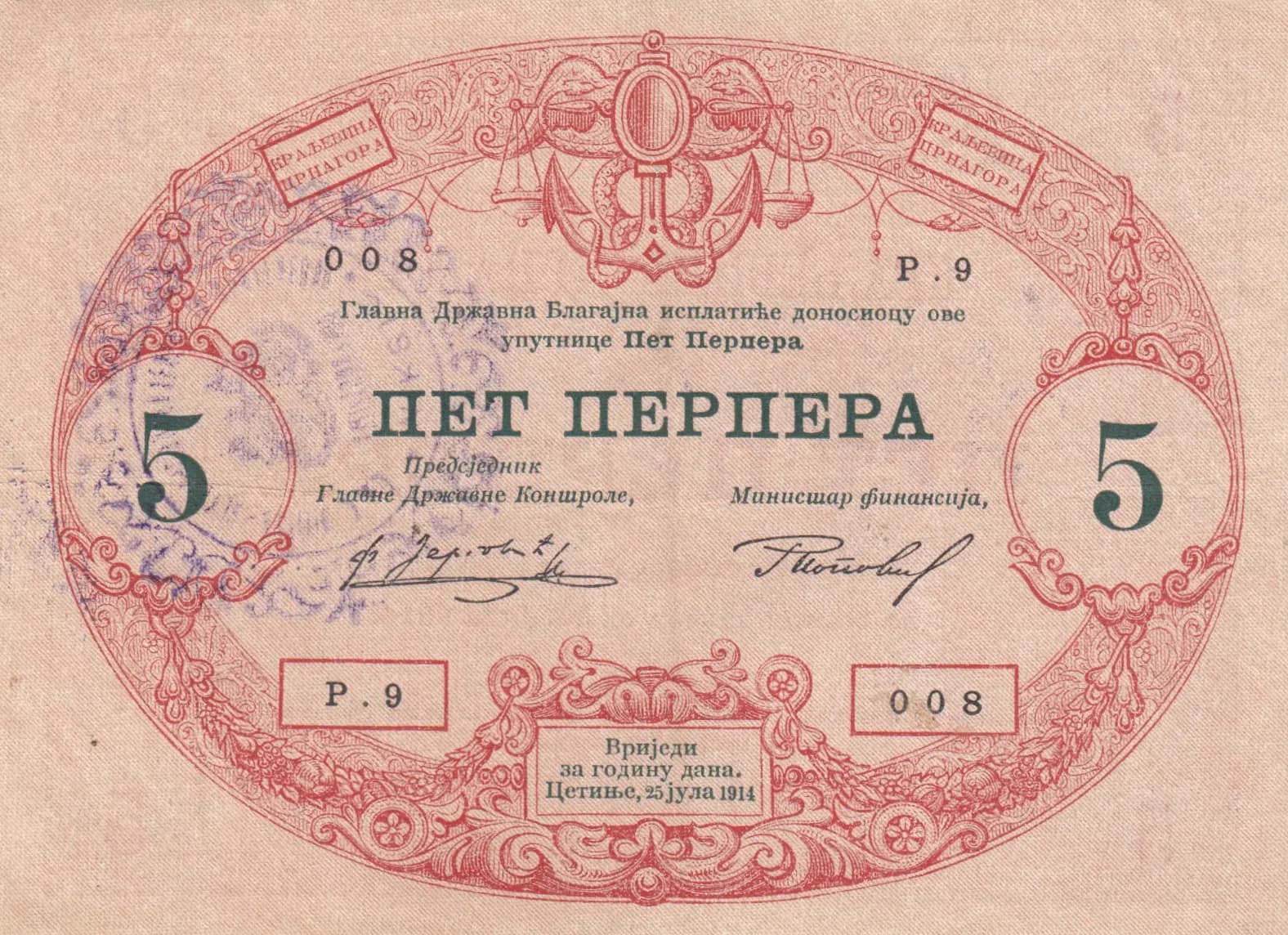
10 perpera 1914
Market Prices
17 salesAbout This Note
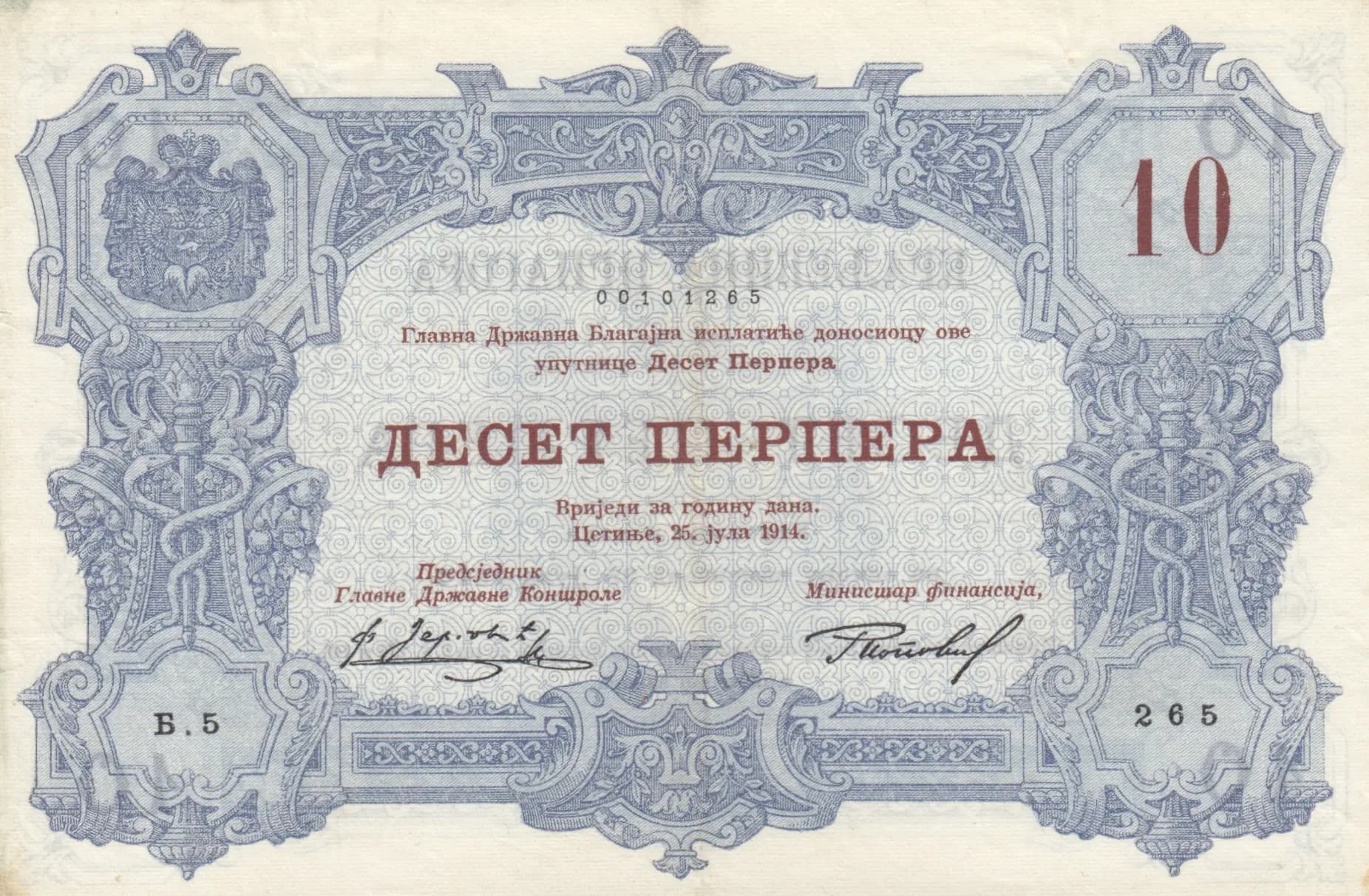
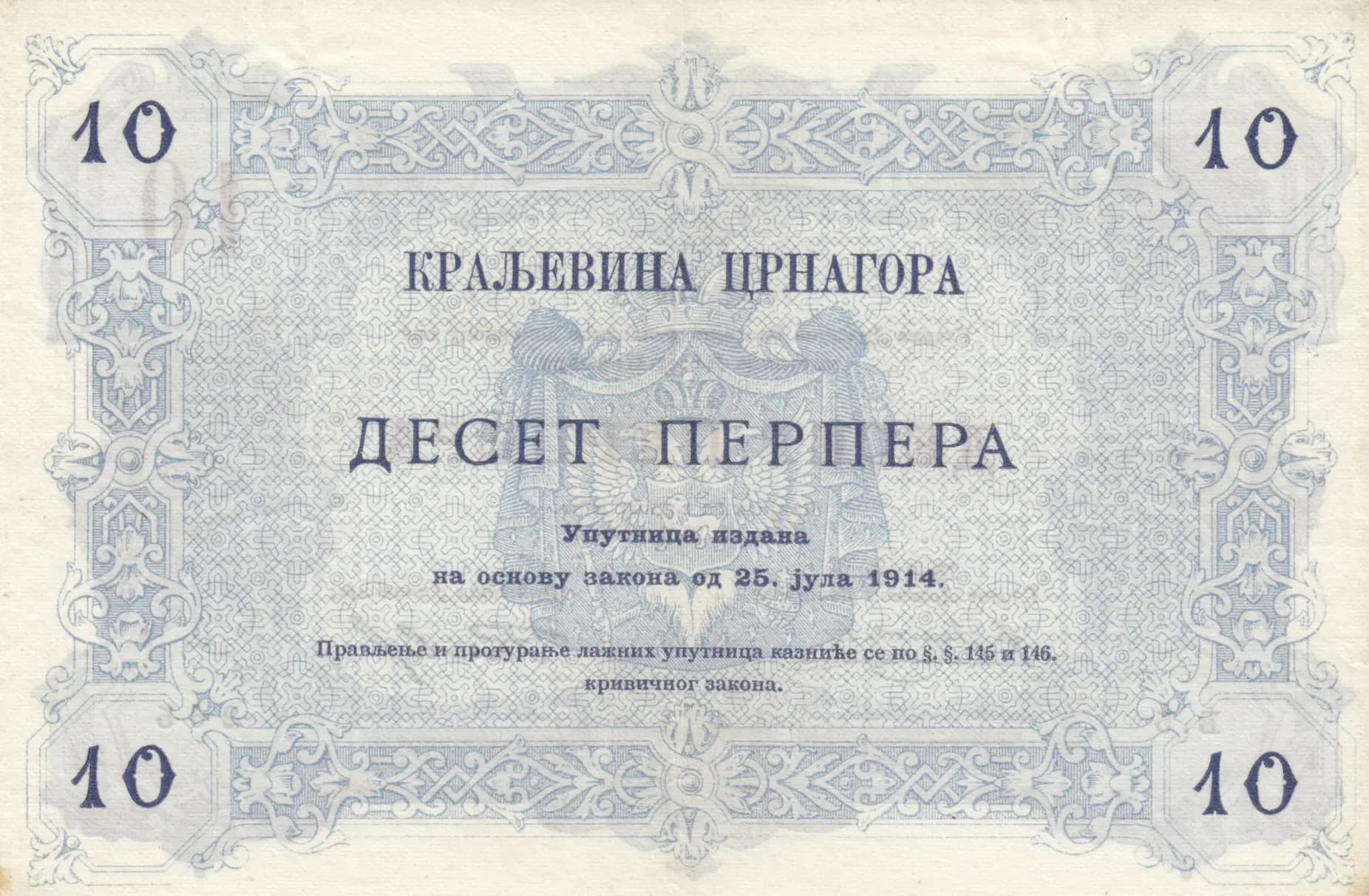
This is a 10 perpera banknote from the Kingdom of Montenegro, issued July 25, 1914, just days before the outbreak of World War I. The note displays exceptional baroque ornamental design with blue decorative borders, dual double-headed eagle emblems on both sides, and Serbian Cyrillic inscriptions. In EF condition, the note shows expected age-related foxing and discoloration consistent with a 110-year-old banknote, but retains clear ink impressions and structural integrity without tears.
Common. eBay historical pricing data shows consistent sales in the $10-$41 range across all grades from 2012-2024, with EF examples averaging $20-32. The note appears regularly on the secondary market with multiple sales per year. No indication of restricted print runs or recalls. P-18 represents a standard emergency treasury issue from Montenegro's final year of independence, with sufficient surviving circulation quantities to make it readily available to collectors.
Issued during the final months of the Kingdom of Montenegro's independence before its absorption into the South Slavic state following WWI, this 1914 emergency treasury note represents a critical moment in Balkan history. The double-headed eagle emblem reflects Montenegro's historical ties to the broader South Slavic and Austro-Hungarian spheres of influence. The note's one-year validity period and explicit July 25, 1914 date place it precisely at the onset of the Great War, making it a tangible artifact of Montenegro's last independent financial actions.
This treasury note features a highly ornamental baroque design typical of early 20th-century Balkan currency. The front displays a double-headed imperial eagle coat of arms within an octagonal frame on the left side, symbolizing Montenegro's historical sovereignty and regional allegiances. The reverse centers a more elaborate double-headed eagle emblem with ornamental crown and detailed heraldic styling, rendered as the primary security device. The entire design is framed by elaborate blue scrollwork and flourishes in all corners, with fine-line engraving patterns creating a dense background texture. The cream/beige paper stock contrasts with blue borders and red/burgundy administrative text. All inscriptions are rendered in Serbian Cyrillic, reflecting the Slavic character of the Kingdom of Montenegro.
FRONT: 'ДЕСЕТ ПЕРПЕРА' (Ten Perpera) — the denomination in Serbian Cyrillic. 'Главна Државна Благајна испплатиће доносиону ове упутнице Десет Перпера' (The Main State Treasury will pay the bearer of this note Ten Perpera) — the standard promise to pay. 'Вриједи за годину дана. Цетиње, 25. јула 1914.' (Valid for one year. Cetinje, 25th July 1914.) — validity period and issue location/date. 'Предсједник Главне Држане Контролe' (President of the Main State Control) and 'Министар финансиа' (Minister of Finance) — authorized signatories. Serial number 00101265, Series B.5, Sequential number 265. BACK: 'КРАЊЕВИНА ЦРНАГОРА' (Kingdom of Montenegro) — the issuing authority. 'ДЕСЕТ ПЕРПЕРА' (Ten Perpera) — denomination repeated. 'Уиутница издава на основу закона од 25. јула 1914' (Note issued on the basis of the law of 25th July 1914) — legal authorization. 'Прављене и протураже лажних упутница казике се по §. 145 и 146. кривичног закона.' (Manufacturing and circulation of false notes is punishable under § 145 and 146 of the criminal law.) — counterfeiting penalty notice.
This note was produced using intaglio (steel engraving) printing, evidenced by the fine-line engraving patterns visible throughout the background, the crisp detail in the imperial eagle emblems, and the precise rendering of ornamental borders and scrollwork. The multiple colors (blue, red, black inks on cream paper) suggest simultaneous or sequential multi-color intaglio printing typical of high-security banknote production of this era. The specific printer for this Pick-18 issue is not identified in available catalog data, but Serbian/Austro-Hungarian or Swiss security printers were typical contractors for Montenegrin currency of this period.
Observed variety: Series B.5, Sequential number 265, Serial number 00101265. The series designation 'B.5' may indicate different printing batches or series within the 1914 issue. No overprints or signatures visible on this specific specimen. PMG cataloging indicates one primary variant for P-18. Regional or printer-specific varieties may exist but are not documented in standard catalogs. Date of issue is uniform across the type (25 July 1914).