20 perpera 1914
Market Prices
12 salesAbout This Note
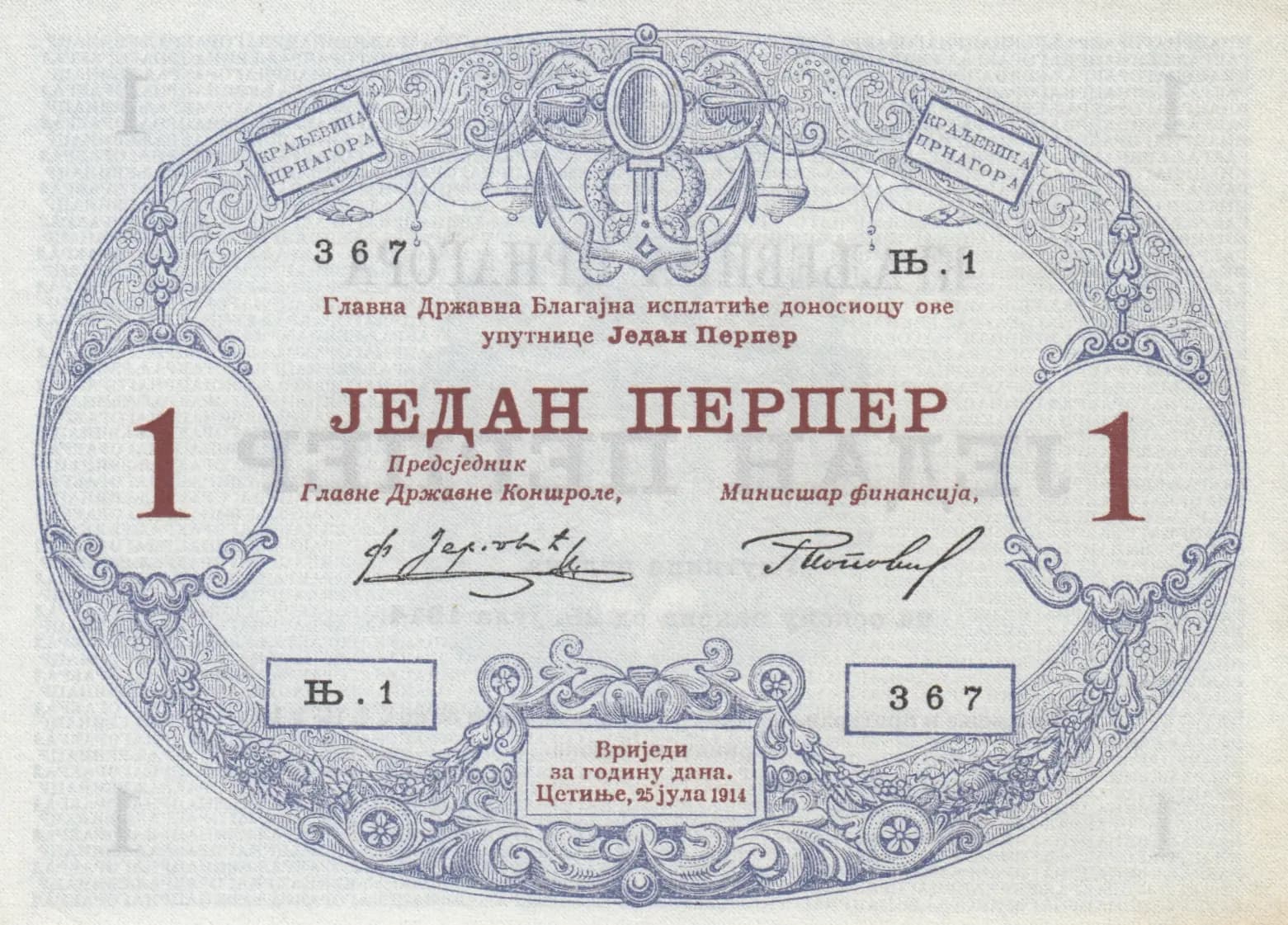
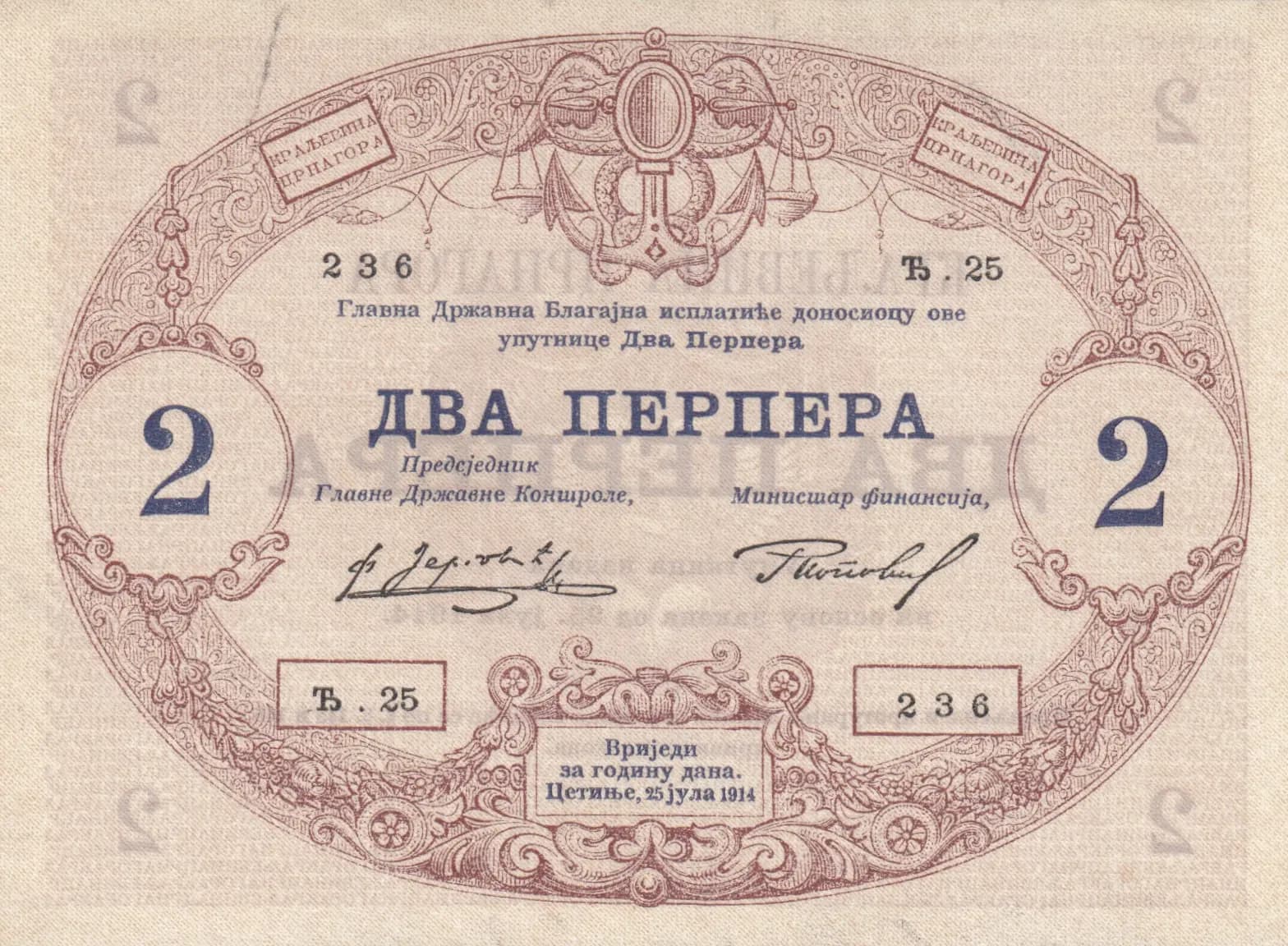
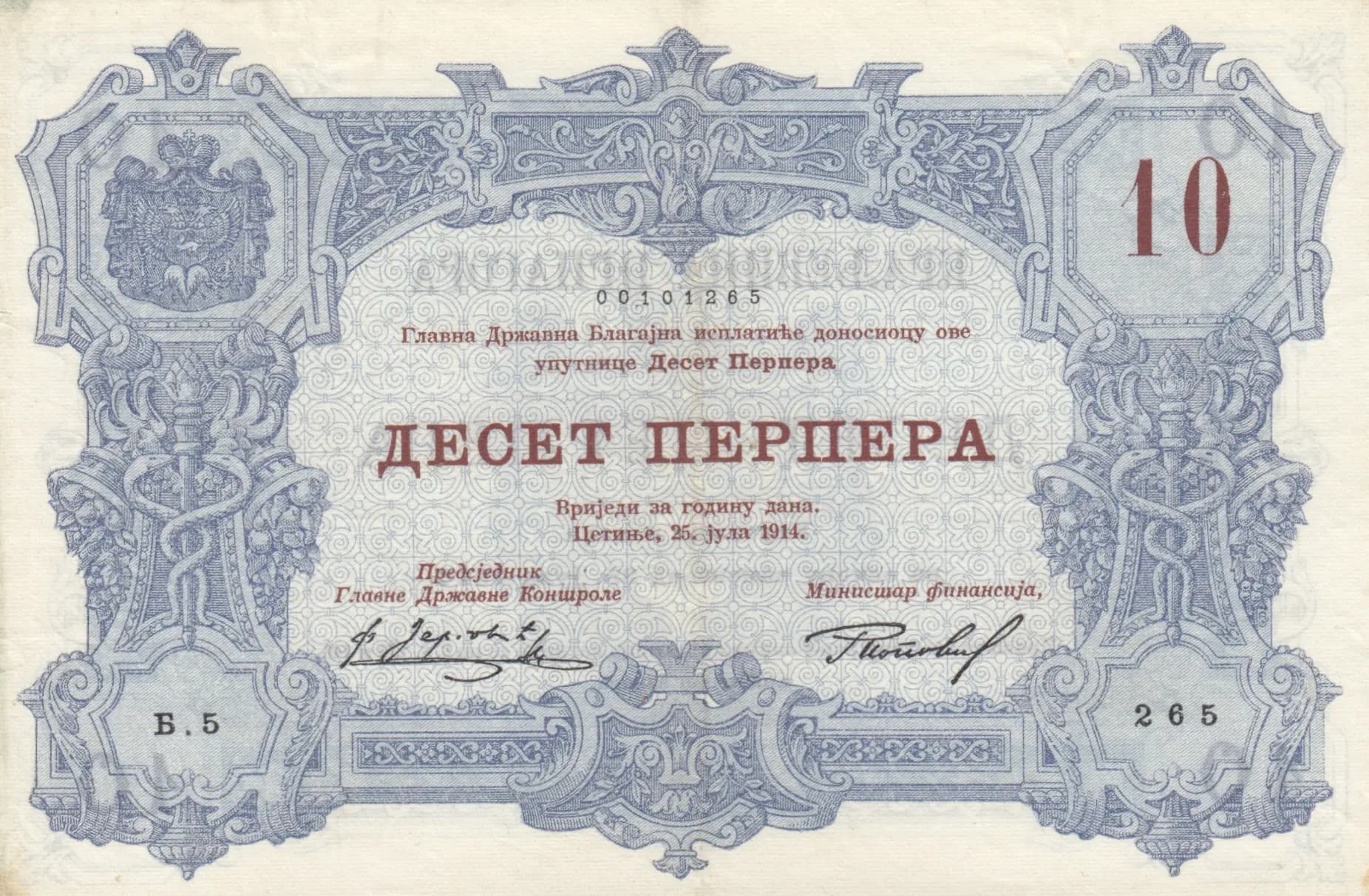
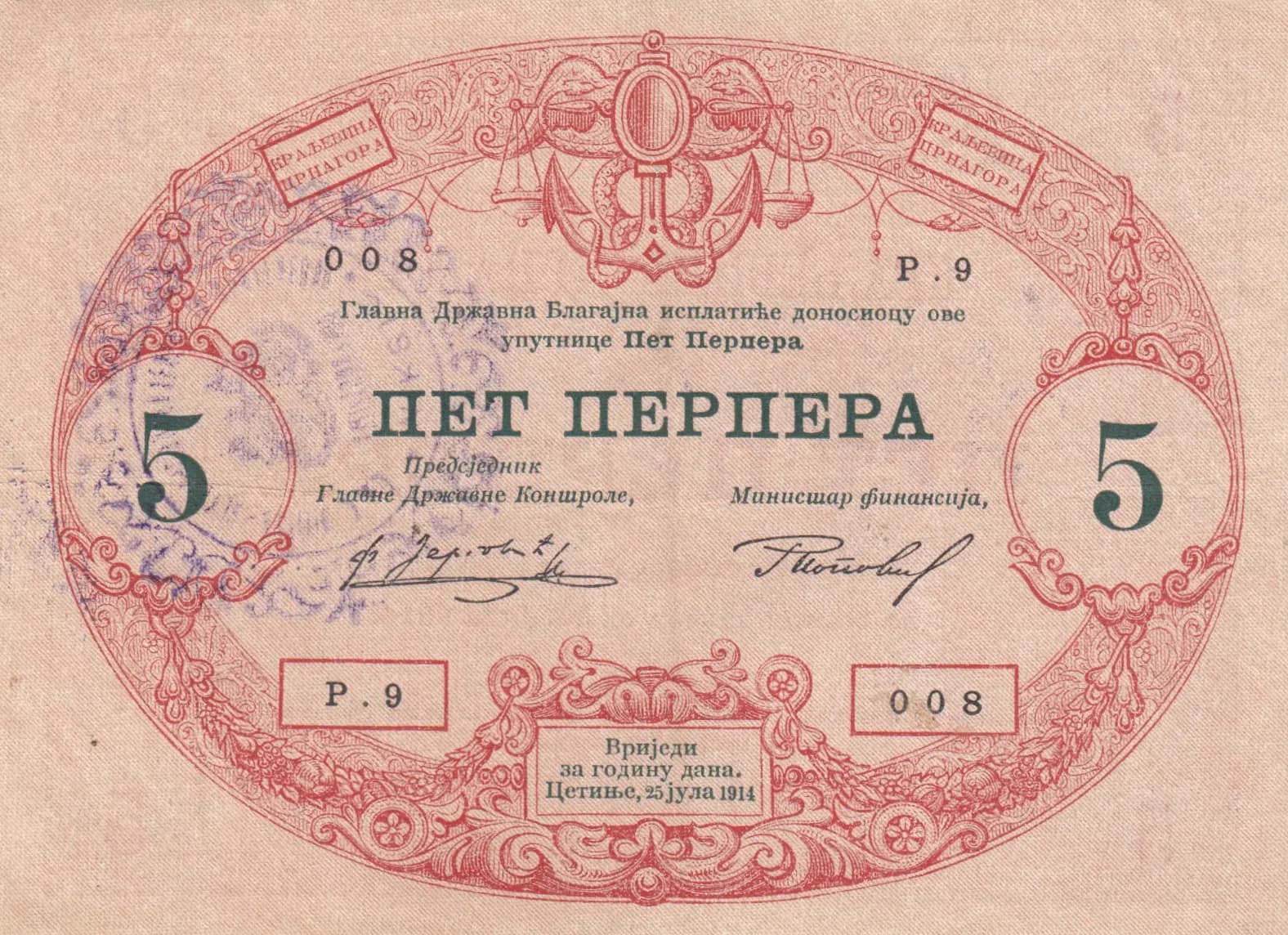
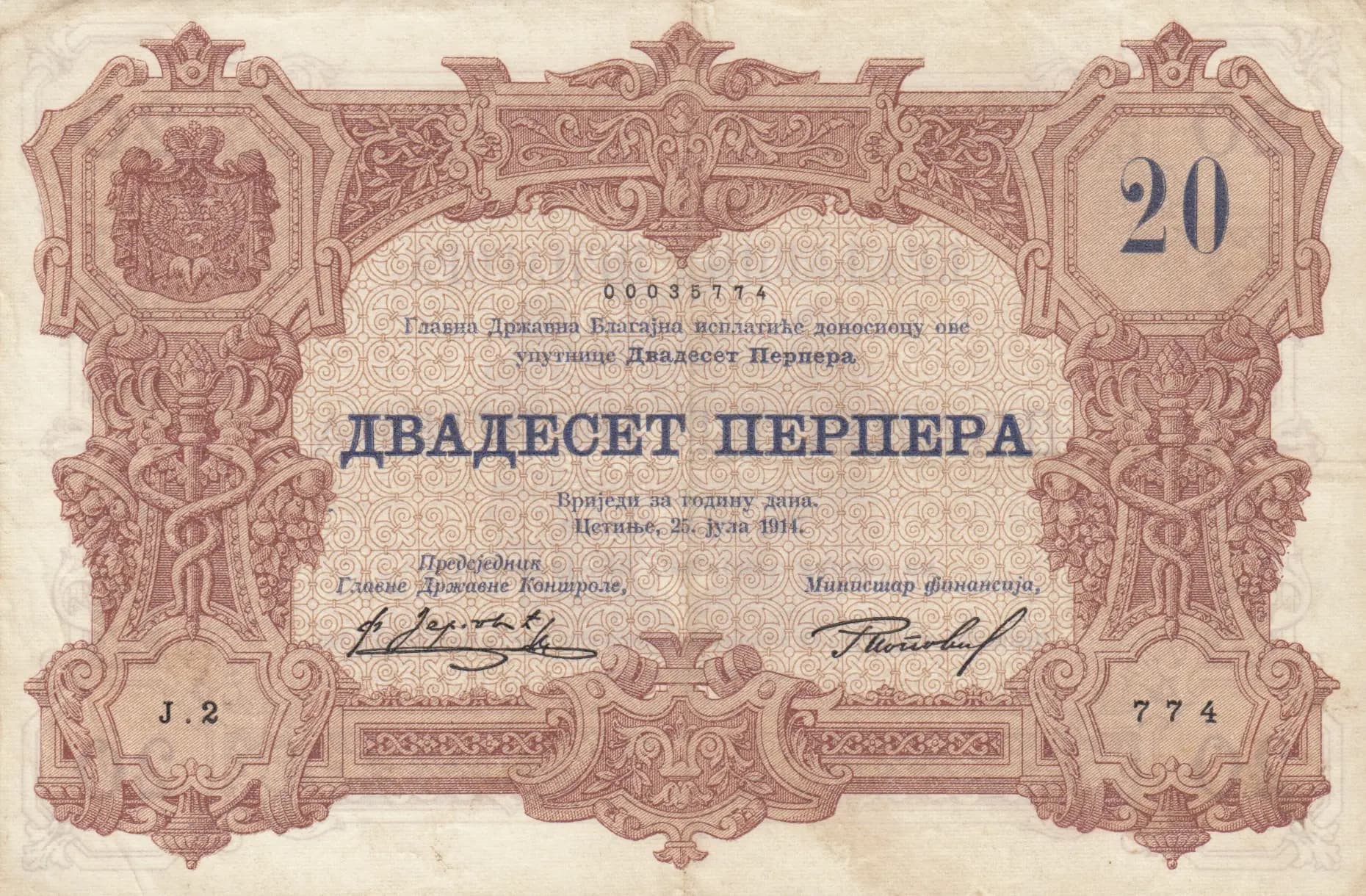
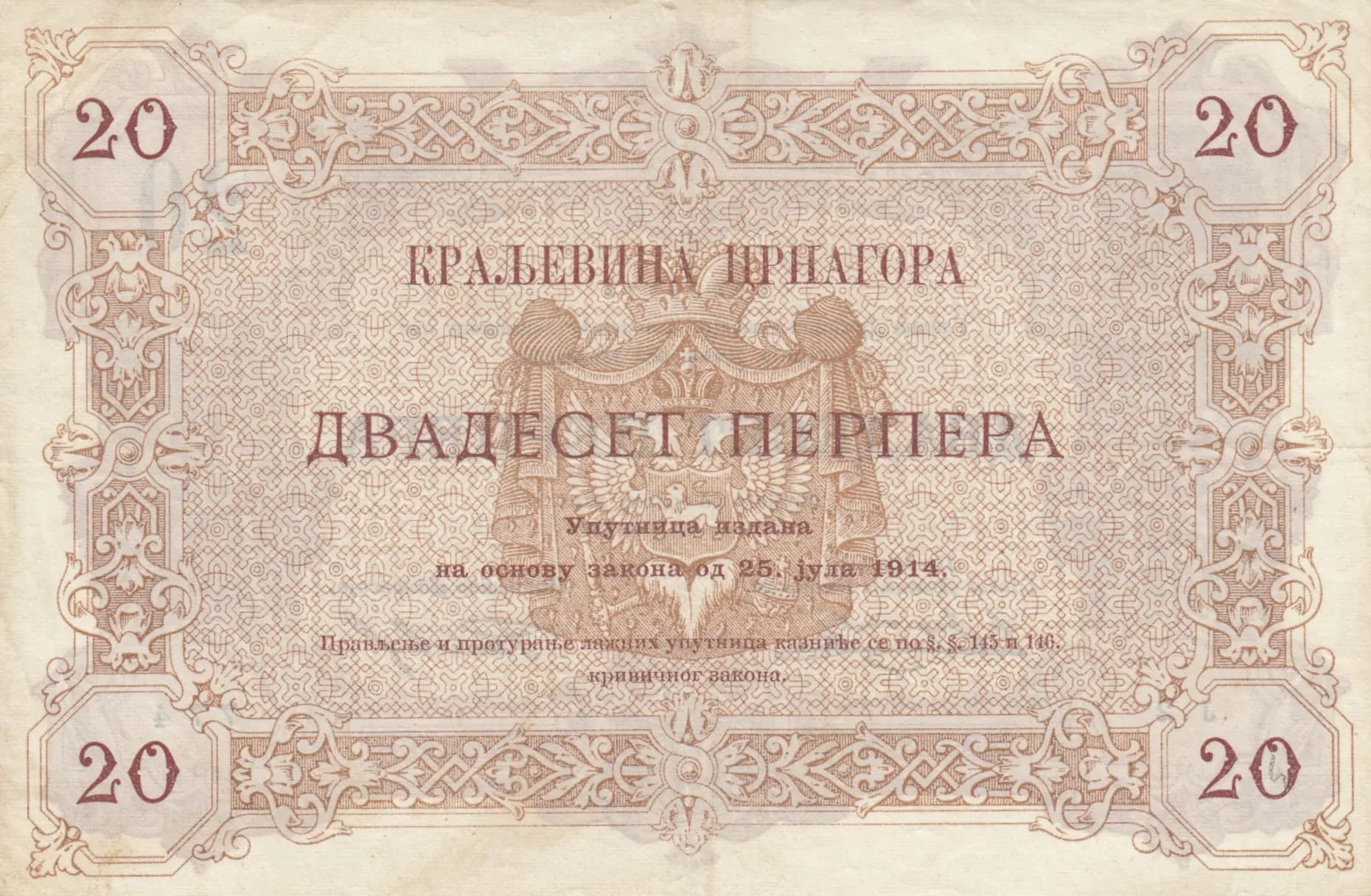
This is a VF-grade 20 Perpera note from the Kingdom of Montenegro issued on 25 July 1914, displaying classic rococo-style ornamentation with burgundy and tan decorative elements. The note features dual coats of arms in octagonal frames, a central double-headed eagle motif, and handwritten official signatures, all rendered in fine line work. The paper exhibits moderate age-related foxing and creasing consistent with genuine circulation from the early 20th century, with all text and imagery remaining legible despite visible patina.
Common. This note exhibits typical market pricing for the VF grade—eBay sold comparables for $17.11 to $52.00 in VF condition between 2013 and 2023, with a 2016 catalog value of $35 for EF condition. The moderate bid counts (8-23 bids) and regular appearance in online auctions indicate steady, non-scarce supply. The Kingdom of Montenegro issued this Treasury note in 1914 under wartime emergency conditions, but surviving specimens remain accessible to collectors. No evidence of limited mintage or recall rarity appears in the historical record or market behavior.
This 1914 issue represents the Kingdom of Montenegro's monetary authority during a critical historical moment—just weeks before the outbreak of World War I and Montenegro's entry into the conflict. The prominent double-headed eagle and coat of arms imagery reflects Montenegro's national sovereignty and Eastern Orthodox heritage during the final years of the Austro-Hungarian regional sphere of influence. The note's explicit validity statement ('Вриједи за годину дана'—valid for one year) and bearer-format design indicate the provisional, emergency-response nature of this Treasury issue during wartime mobilization.
This note features a symmetrical rococo design typical of Balkan Treasury issues from the early 20th century. The coat of arms depicted in the upper octagonal frames represents the Kingdom of Montenegro—likely showing the royal arms with heraldic eagles and crowns. The dominant central motif on the reverse is a heraldic double-headed eagle with an ornamental crown above, symbolizing Montenegro's sovereignty and Eastern Orthodox cultural identity. Elaborate scrollwork, geometric patterns, and floral designs form an interlocking border frame in burgundy and tan ink. The front bears two signature lines for official authorization (President, State Control Chief, and Finance Minister). The design employs fine-line engraving throughout, with the denomination '20' appearing in large numerals in the upper corners (front) and all four corners (back). The serial number (0003577774) and printer's mark (J.2 / 774) are positioned strategically. The paper is cream to off-white colored with visible aging patina.
FRONT SIDE: The main text translates to 'The Main State Treasury will pay the bearer of this note Twenty Perpera' (Главна Аржаја Благајна испплатиће доносиоцу ове уџтине Двадесет Перпера). The denomination appears as 'TWENTY PERPERA' (ДВАДЕСЕТ ПЕРПЕРА). Authority and date: 'President / Chief State Control / Minister of Finance' with location and date 'Cetinje, 25 July 1914' (Цетиње, 25 Јули 1914). The note includes the validity clause 'Valid for one year' (Вриједи за годину дана). BACK SIDE: The header reads 'KINGDOM OF MONTENEGRO' (КРАЊЕВИНА ОРНАТОРА) with denomination 'TWENTY PERPERA' (ДВАДЕСЕТ ПЕРПЕРА). Legal text states 'on the basis of the law of 25 July 1914' and includes counterfeiting penalties: 'Counterfeiting and circulation of fake notes is punishable under law 8, sections 115 and 116 of criminal law' (Прављење и протурање занаких уџтина казvannе се по 8. с. 115 в 116 кринчног закона).
This note was produced using intaglio (engraved) printing, the standard security printing method for the era. Evidence includes the fine line work, precise geometric patterns, and sharp inscription edges visible throughout the design. The multi-color printing (burgundy, blue, brown, and black inks) suggests separate plate impressions, typical of early 20th-century Treasury currency production. The printer/security printer for Montenegrin Treasury notes of this period is not definitively established from the visual evidence alone, though royal currency of this era was often produced by established European security printers such as those in Vienna or Belgrade.
The observed specimen carries serial number 0003577774 with printer's mark J.2 / 774. The visual evidence suggests this is a standard emission of the 1914 issue without overprints or significant varieties. PMG population data indicates only one variant exists for Pick P-19. Handwritten signatures on the front (likely individual officers' signatures) may create minor signature varieties, but these are typical of bearer-format Treasury notes and do not constitute cataloged varieties. The date is consistently shown as Cetinje, 25 July 1914 across all known specimens of this Pick number.