20 perper 1917
Market Prices
1 saleAbout This Note
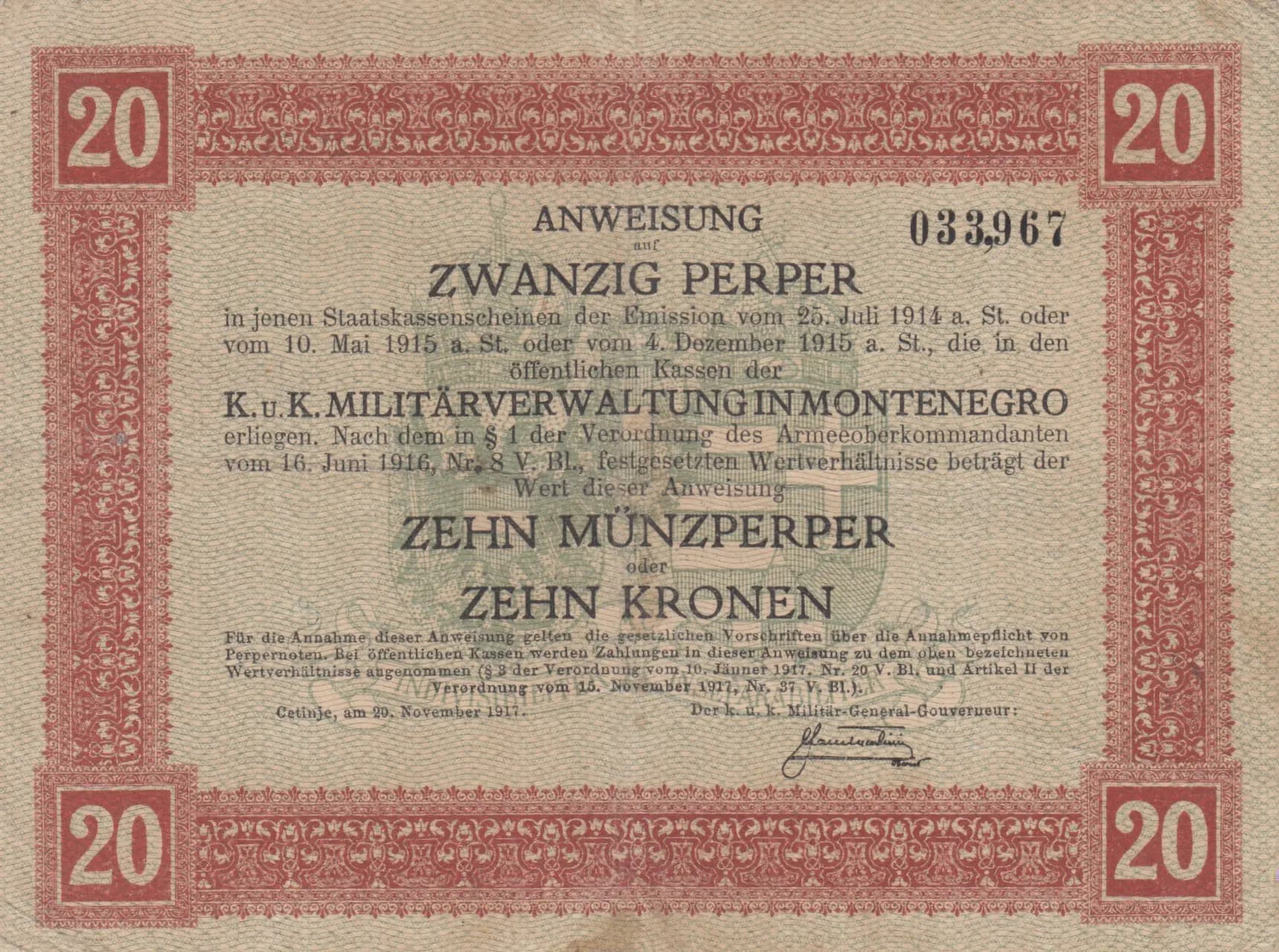
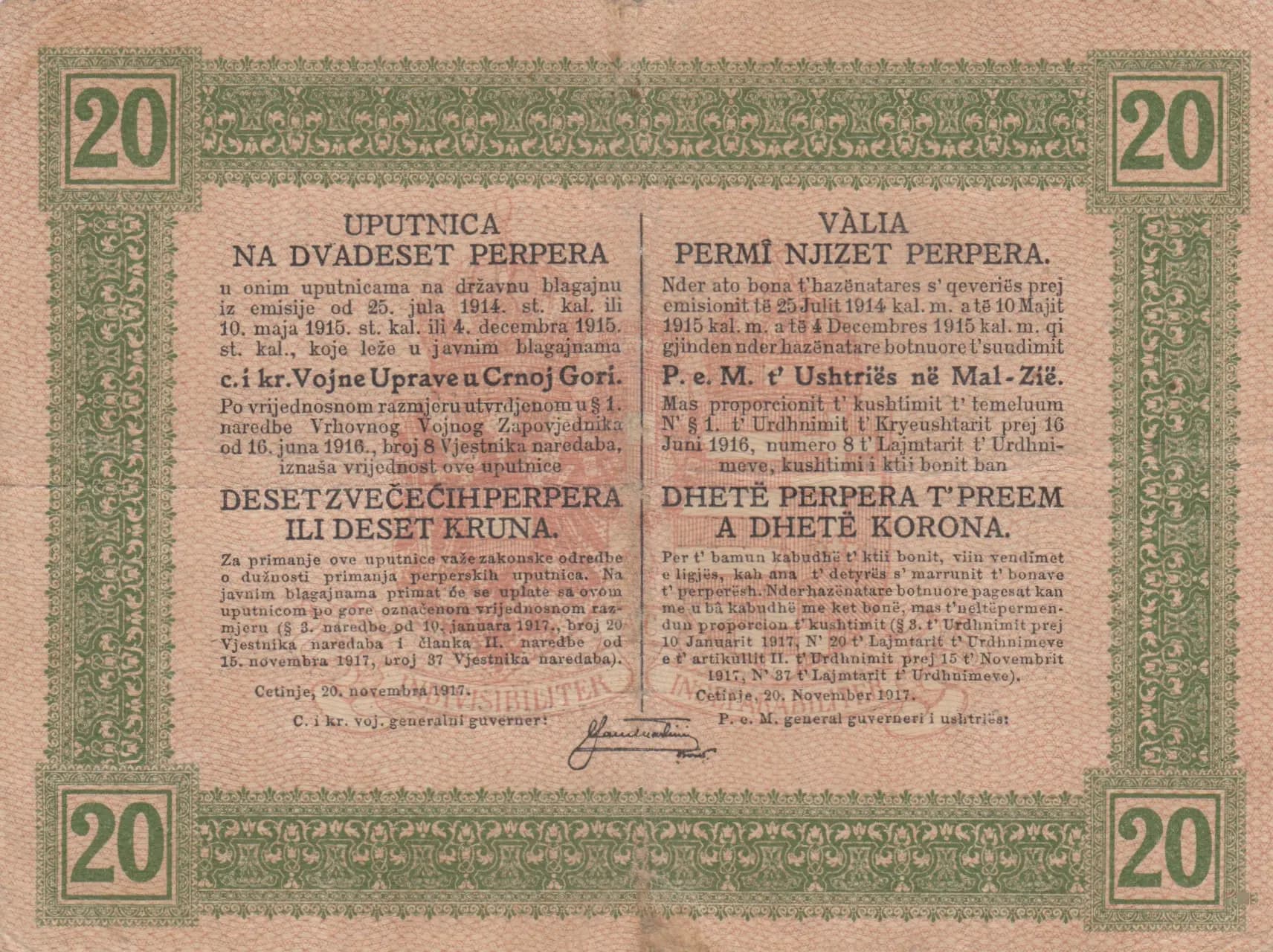
This 1917 Austrian Military Payment Note for 20 Perper represents a fascinating artifact from the Austro-Hungarian occupation of Montenegro during World War I. The note displays excellent visual preservation in VF condition with a striking red-brown obverse and green reverse, both featuring intricate ornate borders and corner denomination boxes. The German-language legal text and bilingual Serbian/Croatian and Albanian translations on the reverse make this a compelling example of multinational military currency from a complex historical period.
Common. This note appears frequently in the numismatic market, as evidenced by the eBay transaction data showing an AUNC specimen sold for $82.09 in 2015. The catalog values (VG: $15, VF: $40, UNC: $100) place it firmly in the affordable, commonly traded range. As a 1917 military payment note from a large occupation authority (Austro-Hungary issued these routinely during WWI), production was substantial. The fact that multiple examples appear regularly on major auction platforms and dealer listings indicates ready availability. VF-graded examples like this specimen are standard collector-level pieces with no premium for rarity.
This note was issued by the Militär General Gouvernement (Military General Government) in Montenegro during the Austro-Hungarian occupation (1916-1918). The document references multiple regulatory decrees from 1916-1917 and establishes the value ratio of 20 Perper = 10 Münzperper = 10 Kronen, reflecting Austria-Hungary's monetary control over occupied Montenegro. The trilingual presentation (German, Serbian/Croatian, and Albanian) reflects the ethnolinguistic complexity of the region and the empire's need to communicate official directives across diverse populations under military administration.
This is a text-heavy military administrative note rather than a traditional banknote with portraits or landmarks. The design emphasizes function over artistry, featuring a prominent ornate decorative border with intricate floral and geometric patterns rendered in red-brown on the obverse and green on the reverse. Four corner boxes display the denomination '20' in large numerals, providing rapid denomination recognition. The obverse is dominated by official German-language legal text in a formal serif typeface, centered and organized hierarchically. The reverse employs a bilingual/trilingual approach with text split between Cyrillic Serbian/Croatian (left column) and Latin-script Albanian (right section), demonstrating the military administration's need to communicate with multiple ethnic populations. A signature block appears at the bottom center of both sides. The serial number (033967) is positioned in the upper right of the obverse. The overall design reflects Austro-Hungarian administrative practice: legalistic, multilingual, and focused on regulatory transparency rather than aesthetic appeal.
FRONT (German): 'ANWEISUNG auf ZWANZIG PERPER' (Instruction for Twenty Perper). The note contains extensive legal text explaining that this directive is redeemable against state treasury certificates issued July 25, 1914; May 10, 1915; or December 4, 1915, held in public treasuries of the K.u.K. Military Administration in Montenegro. According to the value ratio established in § 1 of the Army Commander's Regulation of June 16, 1916 (No. 8 V. Bl.), the value is set at ZEHN MÜNZPERPER oder ZEHN KRONEN (Ten Coin Perper or Ten Crowns). Legal provisions require public treasuries to accept payments at this designated ratio per regulations of June 10, 1917 (No. 20 V. Bl.) and November 15, 1917 (No. 37 V. Bl.). Signed at Cetinje, November 20, 1917 by the K.u.K. Militär-General-Gouverneur. Serial number: 033967. BACK (Serbian/Croatian Cyrillic and Latin, with Albanian section): Parallel instructions titled 'UPUTNICA NA DVADESET PERPERA' (Directive for Twenty Perper), containing identical legal and regulatory text in Serbian/Croatian and Albanian translations, establishing the same value equivalencies and acceptance requirements. Signed at Cetinje, November 20, 1917.
This note was produced using letterpress (relief) printing combined with surface color printing, a standard technique for Austro-Hungarian military payment notes of the 1916-1918 period. The crisp registration of the black text and the distinct color separations visible between the red-brown and green decorative borders indicate professional printing executed at an established security printer, likely one of the imperial Austrian printing facilities. The fine line work in the ornamental border patterns suggests engraved relief plates. The visible wear patterns and registration consistency observed in the visual analysis are consistent with impressions from metal type and blocks typical of wartime military currency production.
Serial number 033967 observed on this specimen. PMG has catalogued 1 variant for Pick M152, suggesting limited known varieties for this specific denomination and issue. The note displays consistent design and regulation references across both sides, with all regulatory citations pointing to decrees from 1916-1917. No overprints, surcharges, or secondary varieties are noted on this example. The bilingual/trilingual reverse layout (German front, Serbian/Croatian + Albanian reverse) appears to be standard for this issue rather than a distinct variety.