10 perper 1917
Market Prices
14 salesAbout This Note
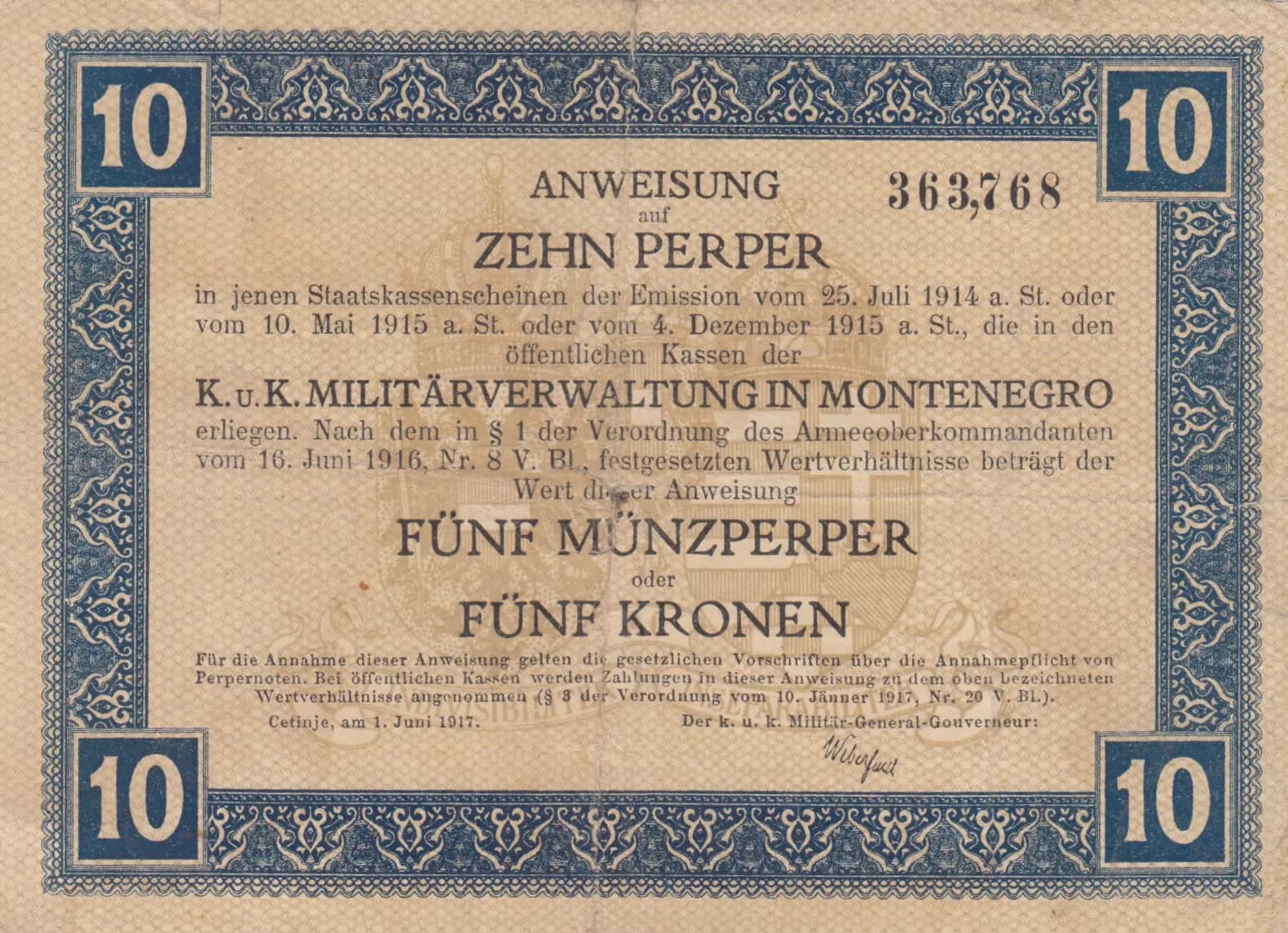
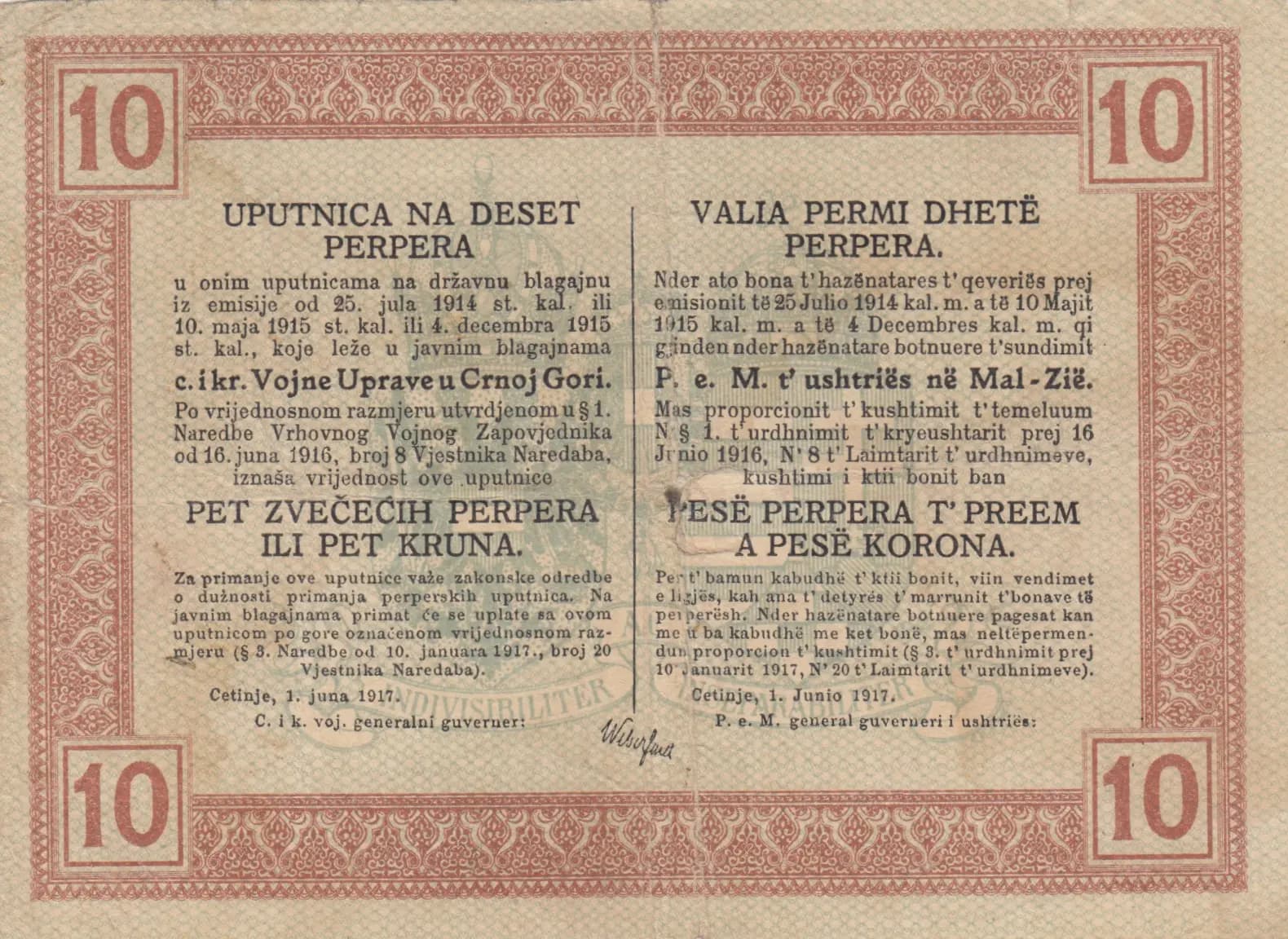
This is a VF-graded 10 Perper military payment note from Montenegro, issued by the K.u.K. Military Administration in June 1917 during the Austro-Hungarian occupation. The note features striking blue and beige coloring on the obverse with ornate geometric borders, and a distinctive red-pink reverse with parallel text in Serbian/Croatian and Albanian, reflecting the multi-ethnic composition of occupied Montenegro. The note shows authentic aging consistent with its 1917 date, including visible foxing, creasing, and period-appropriate paper discoloration, with a handwritten signature of authorization at the base.
Common. eBay sales data provided shows consistent pricing for this note across multiple condition grades over a 9-year period, with VF specimens selling in the $25-$31 range (2018-2022), closely aligning with the 2008 catalogue value of $25 VF. The frequency of sales at these modest price points indicates healthy supply. PMG population data shows this note exists in multiple certified examples across various grades. While military payment notes have collector interest, this particular denomination and issue from a short-lived occupation administration (1917 only) was evidently produced in sufficient quantities to remain accessible. No evidence of rarity factors such as low mintage, recalls, or significant grade scarcity is present.
This note represents the final year of Austro-Hungarian military administration in Montenegro, issued just months before the dissolution of Austria-Hungary in late 1918. The parallel trilingual presentation (German, Serbian/Croatian, and Albanian) on the reverse reflects the complex administrative and linguistic realities of the K.u.K. occupation, while the repeated references to value ratios and regulatory decrees from 1916-1917 document the monetary controls imposed during wartime. The note's designation as an 'Anweisung' (assignment) rather than standard currency indicates its role as a military payment instrument backed by existing state treasury notes rather than independent monetary authority.
The note features a sophisticated two-color design reflecting military administrative aesthetics of the Central Powers. The obverse employs a restrained palette of blue text and denomination boxes against a beige underprint with dark blue decorative borders featuring repeating geometric patterns in corners and margins—typical of Austro-Hungarian military payment documents. The reverse presents a bold red-pink color scheme with matching decorative geometry, but innovatively divides the design into two equal columns with Serbian/Croatian Cyrillic text on the left and Albanian script on the right, creating a symmetrical bilingual presentation that acknowledges the dual Slavic and Albanian populations of Montenegro under occupation. All four corners display prominent rectangular denomination boxes marked '10'. No portraits or specific landmarks are depicted; instead, the design relies entirely on ornate borders and typography for visual authority. The central focus is the legal text justifying the note's value and acceptance conditions, with handwritten signature authorization at the base providing personal authentication from the military governor. This approach emphasizes legal/administrative legitimacy over artistic iconography.
OBVERSE (Front - German): 'ANWEISUNG' (Assignment/Instruction); 'ZEHN PERPER' (Ten Perper); Serial number 363,768; Full text describes that this assignment is backed by state treasury notes from issues of 25 July 1914, 10 May 1915, or 4 December 1915, held in public treasuries of the K.u.K. Military Administration in Montenegro. 'FÜNF MÜNZPERPER oder FÜNF KRONEN' (Five Coin Perper or Five Crowns) - establishing the official exchange value. The note states that legal regulations for accepting perper notes apply, and public treasuries will accept payments at this stated ratio per Regulation of 10 January 1917, No. 20 Official Gazette. Signed at Cetinje, 1 June 1917 by the K.u.K. Military General Governor. REVERSE (Back - Serbian/Croatian Left Column): 'UPUTNICA NA DESET PERPERA' (Assignment for Ten Perper); parallel text describing backing by state treasury assignments from 25 July 1914, 10 May 1915, or 4 December 1915 held in public treasuries of the C.i.k. Military Administration in Montenegro; 'PET ZVEČECIH PERPERA ILI PET KRUNA' (Five Coin Perper or Five Crowns); identical legal acceptance provisions referenced to Regulation of 10 January 1917, No. 20 Official Gazette; dated Cetinje, 1 June 1917, signed by C.i.k. military general governor. REVERSE (Back - Albanian Right Column): 'VALIA PERMI DHETË PERPERA' (Assignment for Ten Perper); parallel description of backing by state treasury assignments from identical dates; 'PESË PERPERA T'PREEM A PESË KORONA' (Five Coin Perper or Five Crowns); identical legal provisions; dated Cetinje, 1 June 1917.
The note exhibits characteristics of letterpress/typographic printing combined with lithographic color elements. The dense legal text on both sides indicates primary composition through movable type, while the colored underprints (blue and red) and decorative borders show evidence of lithographic application. The two-color obverse (blue on tan) and red reverse with black text suggest separate plate impressions, consistent with early 20th-century Austrian printing practices. The ornate geometric border patterns show the crisp registration and fine detail typical of lithographic production. The handwritten signature space indicates that authorization was added manually post-printing. No specific printer attribution has been documented in standard catalogs, but the technical quality and design aesthetic are consistent with the Austro-Hungarian State Printing Office (K.k. Staatsdruckerei) or its authorized contractors.
The PMG population report indicates two catalogued varieties for this base Pick number: P-M151 (standard 'ZEHN PERPER = FÜNF MÜNZPERPER = FÜNF KRONEN') and P-M151r (variant reading 'ZEHN PERPER = FÜNF KRONEN' without the 'Münzperper' designation). The visual analysis indicates this is the standard P-M151 variety based on the complete trilingual formula on both sides. Serial number 363,768 is documented on this specific specimen. The handwritten signature, while required for authenticity, will vary by individual authorized official but does not constitute a catalogued variety distinction. No date varieties are known for the June 1, 1917 issuance.