10 pesos 1913
Market Prices
About This Note
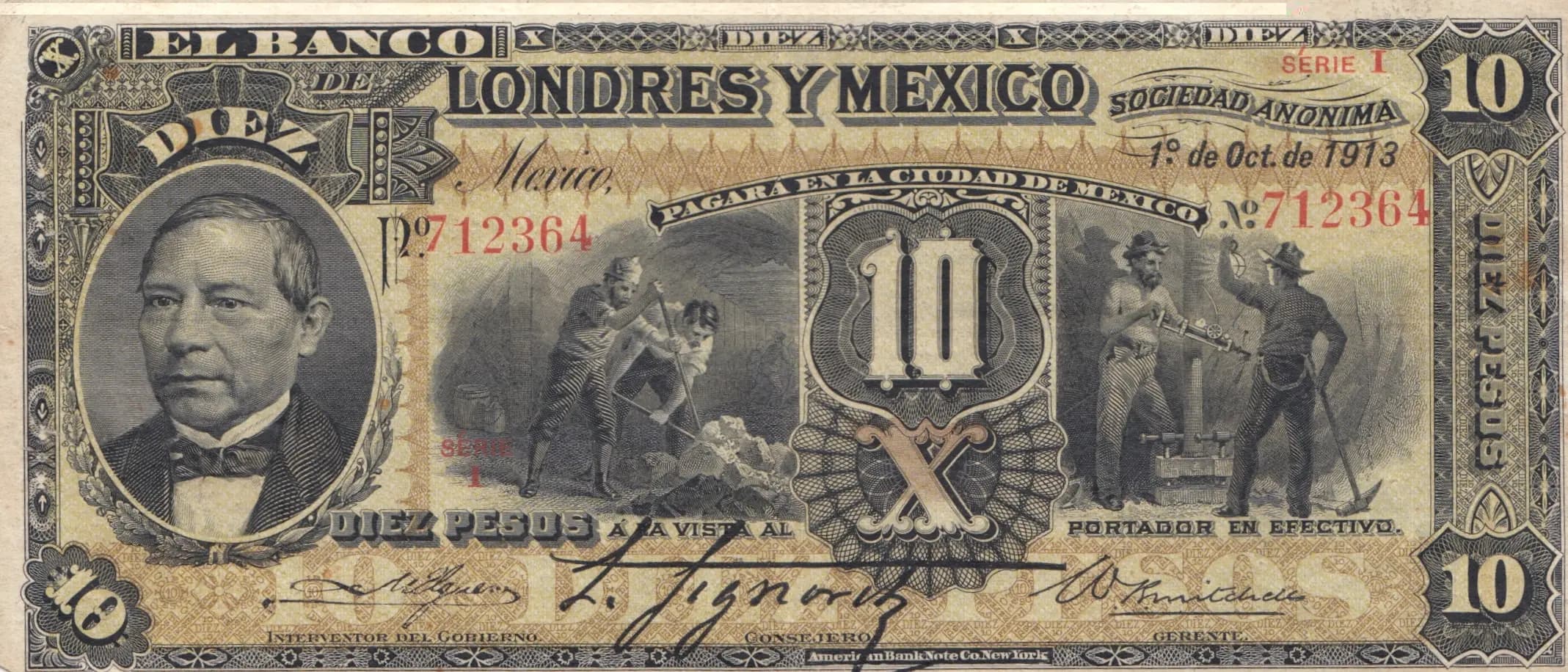
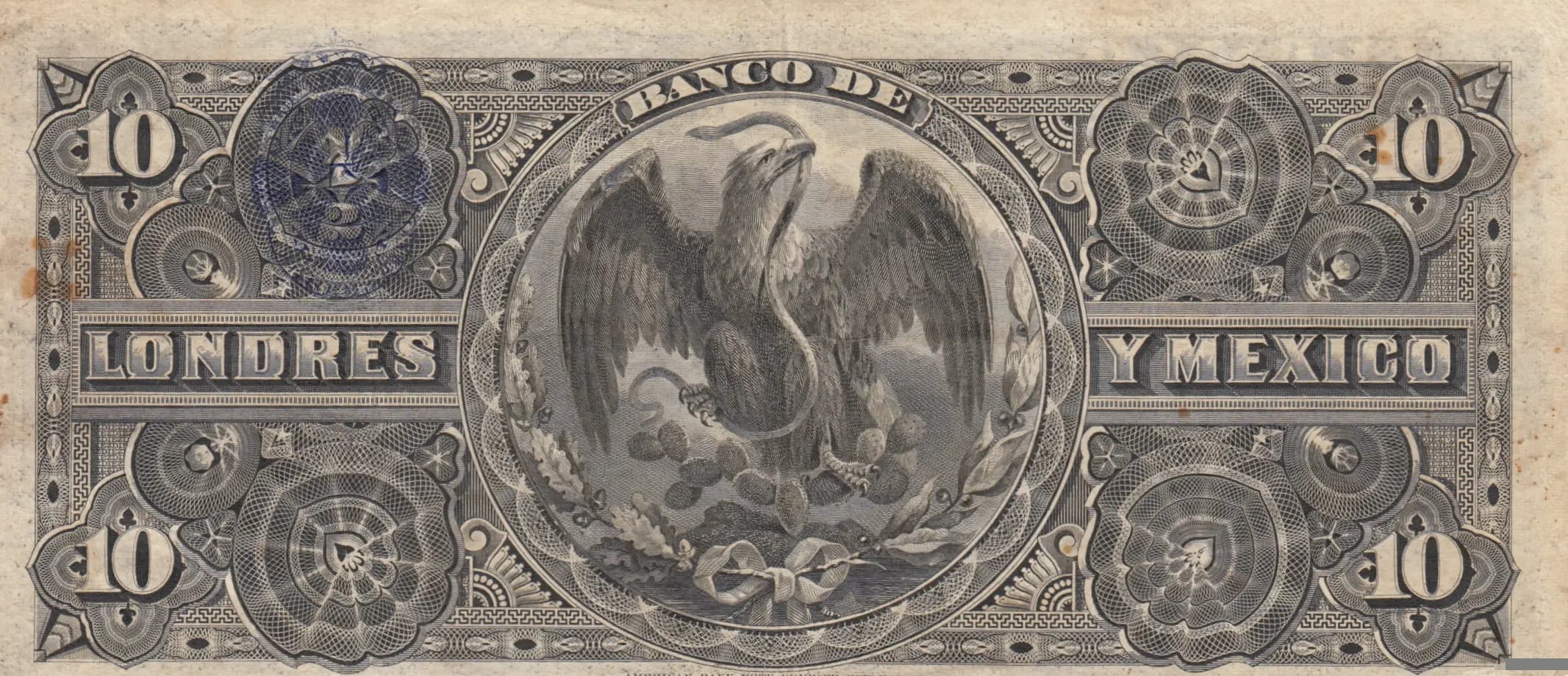
A 1913 Banco de Londres y Mexico 10 peso note (Pick S234e) in Very Fine condition, featuring a striking portrait of Pablo Benito Juárez on the left with allegorical mining and industrial scenes in the center and right vignettes. The reverse displays the Mexican national eagle in a classical engraving style. Despite moderate aging with foxing and creases consistent with circulation, the note retains crisp engraving detail and represents an important early Mexican bank note from a transitional historical period.
Common. While this is a legitimate historical note from the Mexican Revolution period, eBay market data shows this type sells across a wide range ($7.99 to $1,200 USD depending on condition and grading variability), with circulated examples regularly available at $79.99-$95.00 USD. The VF grade specimen observed falls within typical pricing for well-preserved circulated examples. The Banco de Londres y Mexico issued multiple series with substantial print runs across several years (1889-1913), and this Pick number represents a standard regular-issue currency rather than a limited or commemorative note. The presence of multiple listings and regular sales indicates adequate supply in the numismatic market.
Issued October 18, 1913, this note was produced during a turbulent period in Mexican history—the height of the Mexican Revolution—when the Banco de Londres y Mexico maintained operations despite significant political instability. The note's imagery emphasizes Mexico's economic foundations through the depiction of miners and industrial labor alongside the venerated national symbol of Benito Juárez, who had died decades earlier but remained a heroic figure representing Mexican independence and reform. The presence of both the Mexican eagle and English banking partnership reflects Mexico's complex relationship with foreign capital investment during this era.
The obverse features a profile portrait of Pablo Benito Juárez, the 19th-century Mexican statesman and national hero, positioned at the left in formal attire with bow tie. The central composition includes allegorical vignettes representing Mexico's economic activities: mining operations and industrial labor are depicted with multiple figures and architectural structures. The design incorporates elaborate ornamental borders with floral and geometric patterns throughout, corner medallions with the Roman numeral X, and wreath designs flanking the central portrait area. The reverse is dominated by the Mexican national eagle (representing the coat of arms) displayed with spread wings and a serpent in its beak, enclosed within an ornate circular wreath frame. The eagle is surrounded by decorative scrollwork, geometric patterns, and additional corner ornaments. Both sides employ the classical bank note aesthetic typical of American Bank Note Company productions of the era.
FRONT: 'EL BANCO DE LONDRES Y MEXICO' (The Bank of London and Mexico) / 'SOCIEDAD ANONIMA' (Joint-stock Company) / 'SERIE I' (Series I) / '18 de Oct. de 1913' (October 18, 1913) / 'No 712364' (Serial Number 712364) / 'DIEZ PESOS' (Ten Pesos) / 'PAGADERA EN LA CIUDAD DE MEXICO' (Payable in the City of Mexico) / 'A VISTA AL PORTADOR EN EFECTIVO' (At sight to the bearer in cash) / 'INTERVENTOR DEL GOBIERNO' (Government Intervener) / 'CONSEJERO' (Counselor) / 'GERENTE' (Manager) / 'Amer'n Bank Note Co New York' (American Bank Note Company, New York). BACK: 'BANCO DE' (Bank of) / 'LONDRES Y MEXICO' (London and Mexico) / '10' (Ten, repeated in corners).
Steel engraving/intaglio process, as evidenced by the fine line work, complex geometric patterns, and detailed portraiture visible throughout. The note was produced by the American Bank Note Company (ABNC) of New York, one of the premier security printing firms of the era. The intricate border designs, vignettes, and anti-counterfeiting elements employ traditional engraved plate methodology. The black on brown and yellow underprint color scheme is characteristic of ABNC's Mexican bank note commissions during this period.
This specimen is identified as Series I (SERIE I), dated 18 de Octubre de 1913, with serial number 712364. According to catalog data, the 10 pesos 1913 exists in multiple series variants: Series G (2.1.1913), Series H (1.10.1913), and Series I (1.10.1913). This note is the Series I variety with the October 18, 1913 date. The note bears the signature title 'Cajero' (Cashier) and shows a blue cancellation stamp on the reverse, indicating it was deaccessioned from a bank collection at some point in its history. The specific serial number and series designation help identify this as a distinct impression within the larger 1913 issue.