10 pesos 1913
Market Prices
1 saleAbout This Note
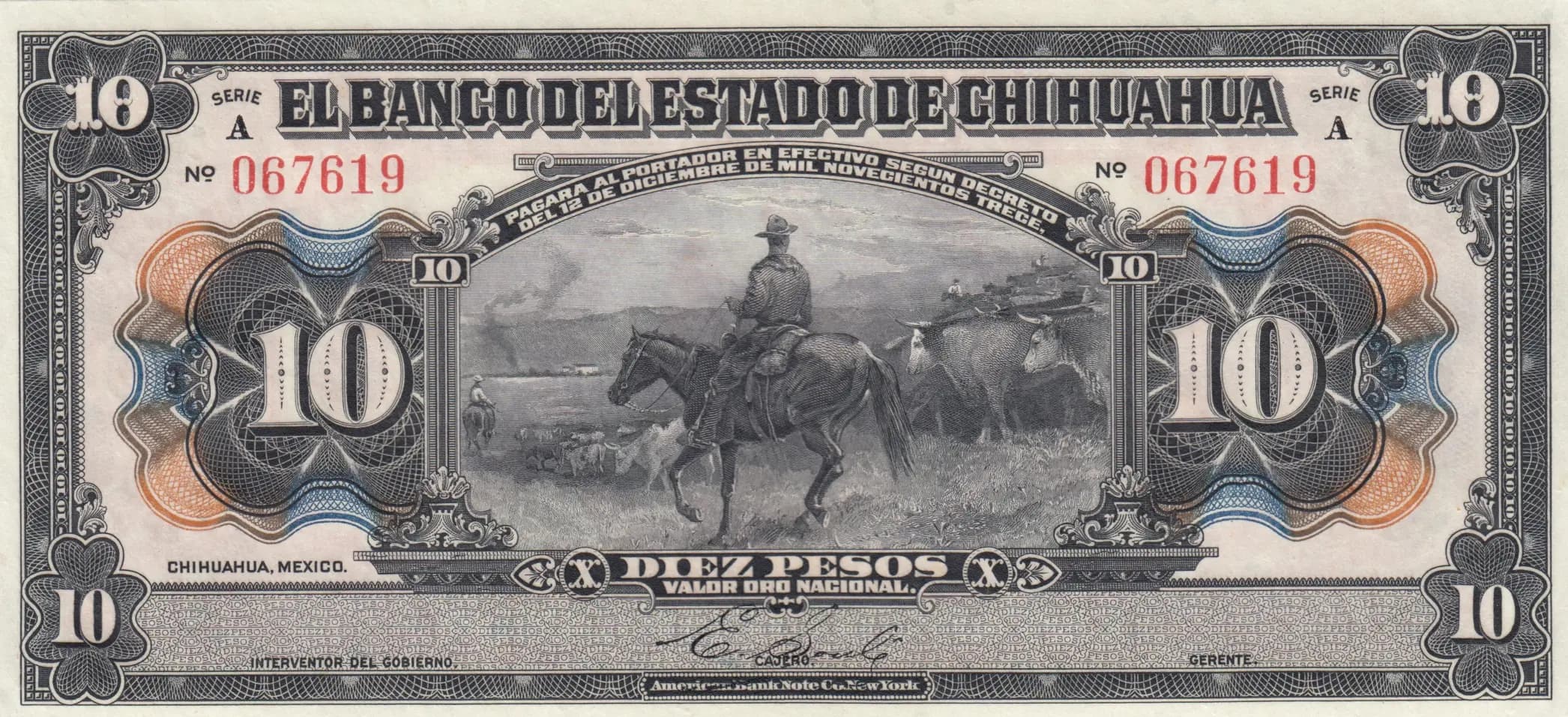
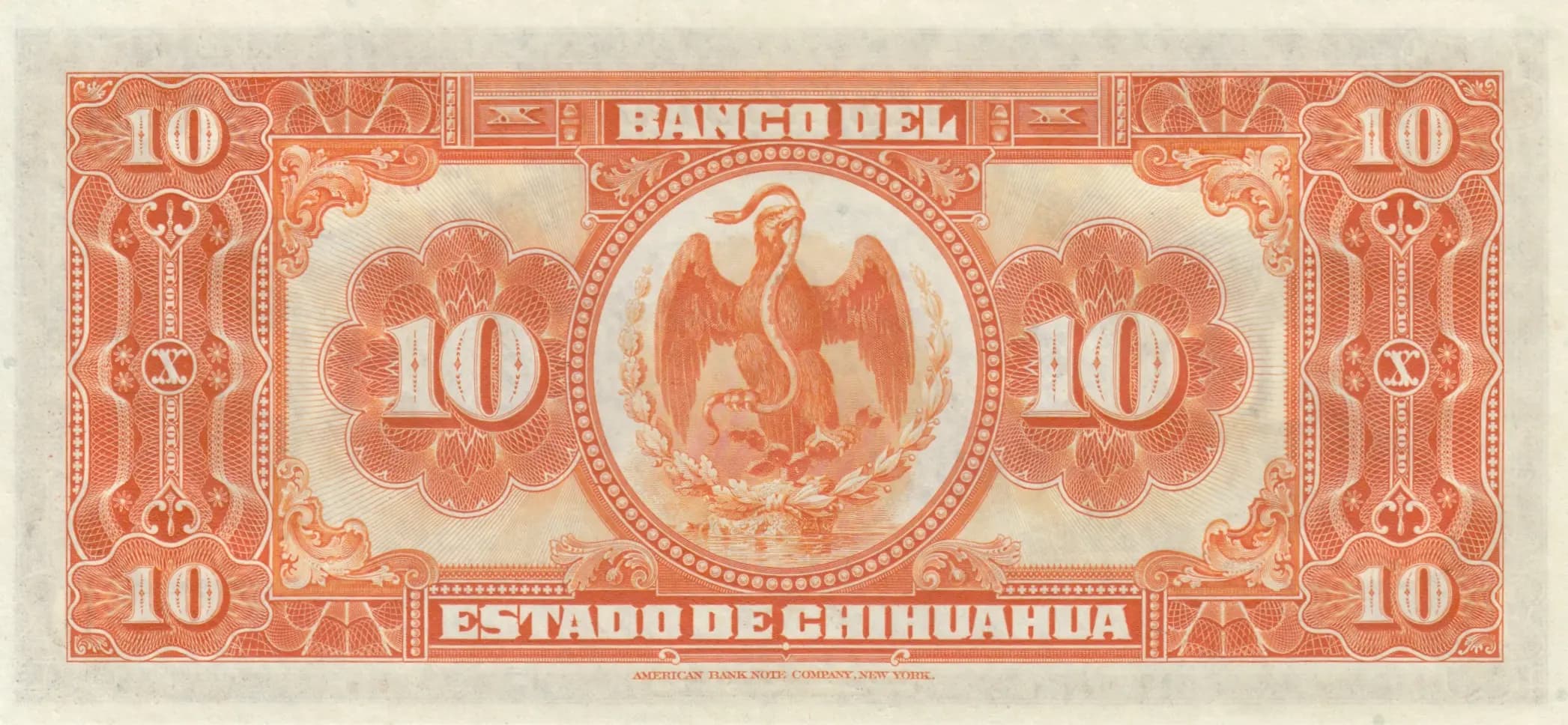
This is an outstanding example of a 1913 Banco del Estado de Chihuahua 10 pesos note in uncirculated condition, showcasing the bank's distinctive design featuring a dramatic central vignette of a mounted horseman in landscape. The note displays the crisp, clean characteristics expected of UNC grade with sharp impressions, vibrant multicolor printing on the obverse (black on orange/rust and blue accents) and striking orange back featuring the Mexican national eagle emblem. As a regional state bank issue from the early Revolutionary period, this note represents an important chapter in Mexican banking history during a period of significant monetary change.
Common. While the Banco del Estado de Chihuahua operated during the turbulent Revolutionary period, this 10 pesos denomination from 1913 was a regular issue produced by ABNC and appears with some frequency in the market. The recent eBay sale data showing a PMG 64 example selling for $111 indicates modest collector demand and availability. State bank issues from this era, while historically interesting, were produced in sufficient quantities that even uncirculated examples remain relatively accessible to collectors. No information suggests this was a short-lived issue or subject to recall, and the note does not exhibit characteristics of extreme scarcity.
Issued during the Mexican Revolution (1910-1920), the Banco del Estado de Chihuahua operated as one of Mexico's regional banks during a period when multiple financial institutions were issuing their own currency. The central vignette depicting a mounted horseman reflects the revolutionary and frontier character of Chihuahua, which was a critical theater of the Mexican Revolution. The decree date of December 24, 1912, marks the authorization for this currency issue just as the revolutionary conflict was intensifying, making this note a tangible artifact of Mexico's turbulent political and monetary landscape.
The obverse features an ornate black and white design with multicolor accents dominated by a central vignette depicting a mounted figure in military attire on horseback traversing a landscape with additional figures visible in the background—likely representing a Revolutionary-era scene. Large ornamental numerals '10' and Roman numeral 'X' are positioned in decorative cartouches at the left and right margins. Elaborate floral and scrollwork borders frame the entire design with precision engraving. The reverse is distinguished by a predominantly orange/coral field with the Mexican national coat of arms—an eagle with outstretched wings—displayed in a prominent circular medallion surrounded by a laurel wreath at center. The denomination numerals '10' appear multiple times in ornamental frames, with geometric and floral patterns creating vertical ornamental panels on either side. The intricate cross-hatching and line work throughout both sides demonstrates the high-quality engraving characteristic of American Bank Note Company production.
OBVERSE: 'El Banco del Estado de Chihuahua' (The Bank of the State of Chihuahua); 'Serie A' (Series A); 'No 067619' (Serial number 067619); 'Diez Pesos' (Ten Pesos); 'Valor Oro Nacional' (National Gold Value); 'Chihuahua, Mexico'; 'Pagará al Portador en Efectivo Según un Decreto Expedido el 24 de Diciembre de Mil Novecientos Doce' (Will pay the bearer in cash according to a decree issued on December 24, nineteen hundred twelve); 'Interventor del Gobierno' (Government Comptroller); 'Cajero' (Cashier); 'Gerente' (Manager); 'American Bank Note Co. New York'. REVERSE: 'Banco del' (Bank of the); 'Estado de Chihuahua' (State of Chihuahua); 'American Bank Note Company, New York'.
Intaglio engraving and printing by the American Bank Note Company (ABNC), New York, as indicated by the printer attribution visible on both obverse and reverse. The fine detail work, precise line work, cross-hatching effects, and complex ornamental patterns are consistent with the highest standards of intaglio security printing of the early 20th century. The multicolor printing on the obverse (black, orange/rust, and blue accents) was achieved through multiple passes of the intaglio process, a technique that was both artistically accomplished and functionally important for counterfeiting prevention.
This example is identified as Series A with serial number 067619, representing the standard regular issue variety (Pick S133). The note features one signature as noted in the catalog reference, consistent with the issued variety. No overprints or special markings are evident from the visual analysis. Series A designation appears on the obverse, and the standard decree date of December 24, 1912, is printed as issued. This represents the typical example of this Pick number without unusual varieties or variants.