10 pesos 1913
Market Prices
About This Note
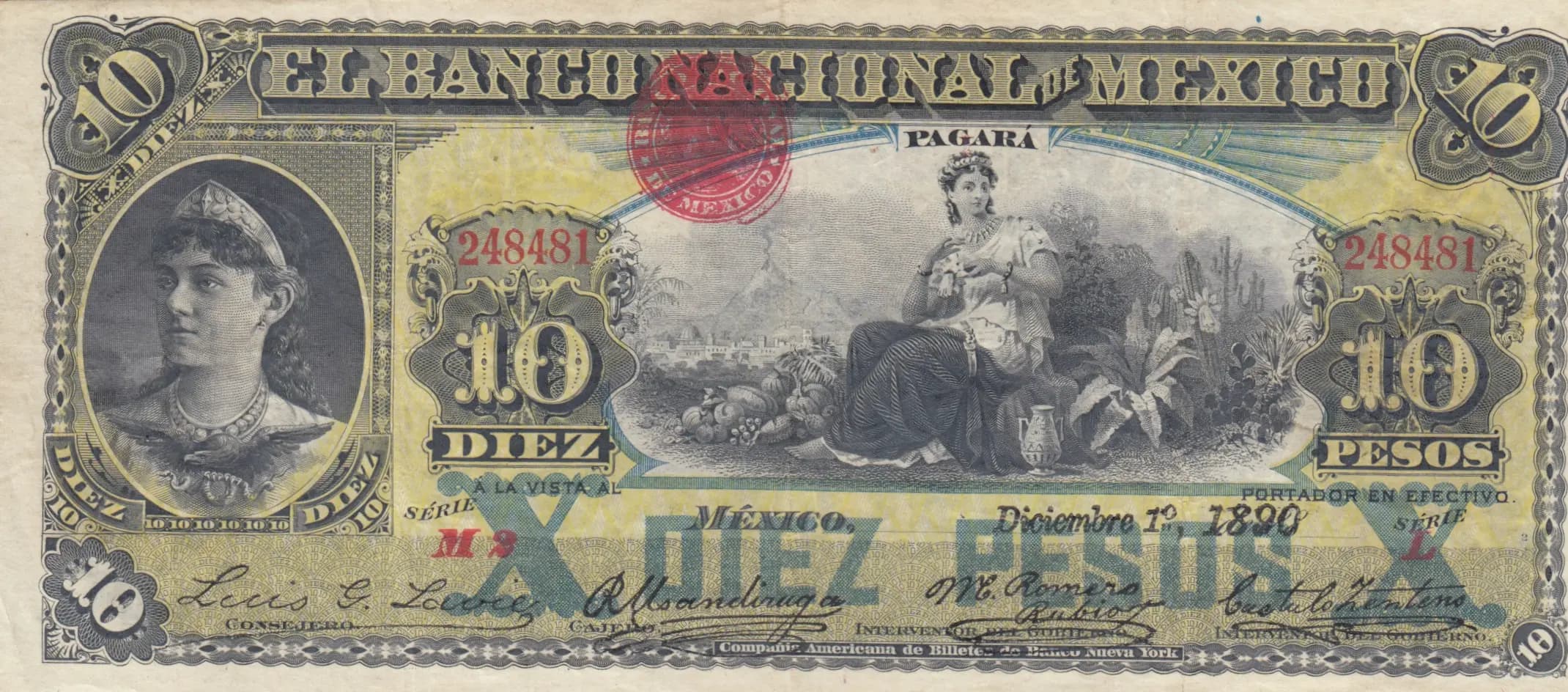
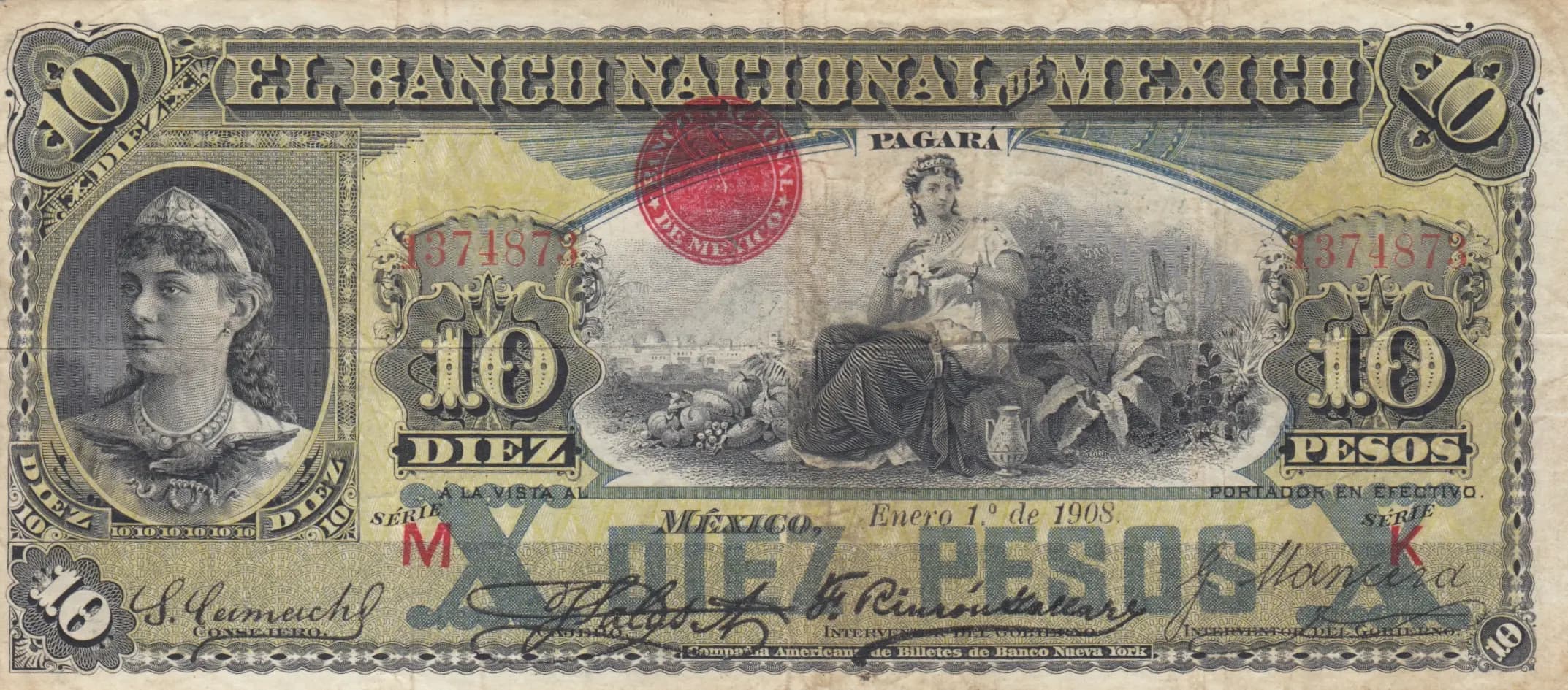
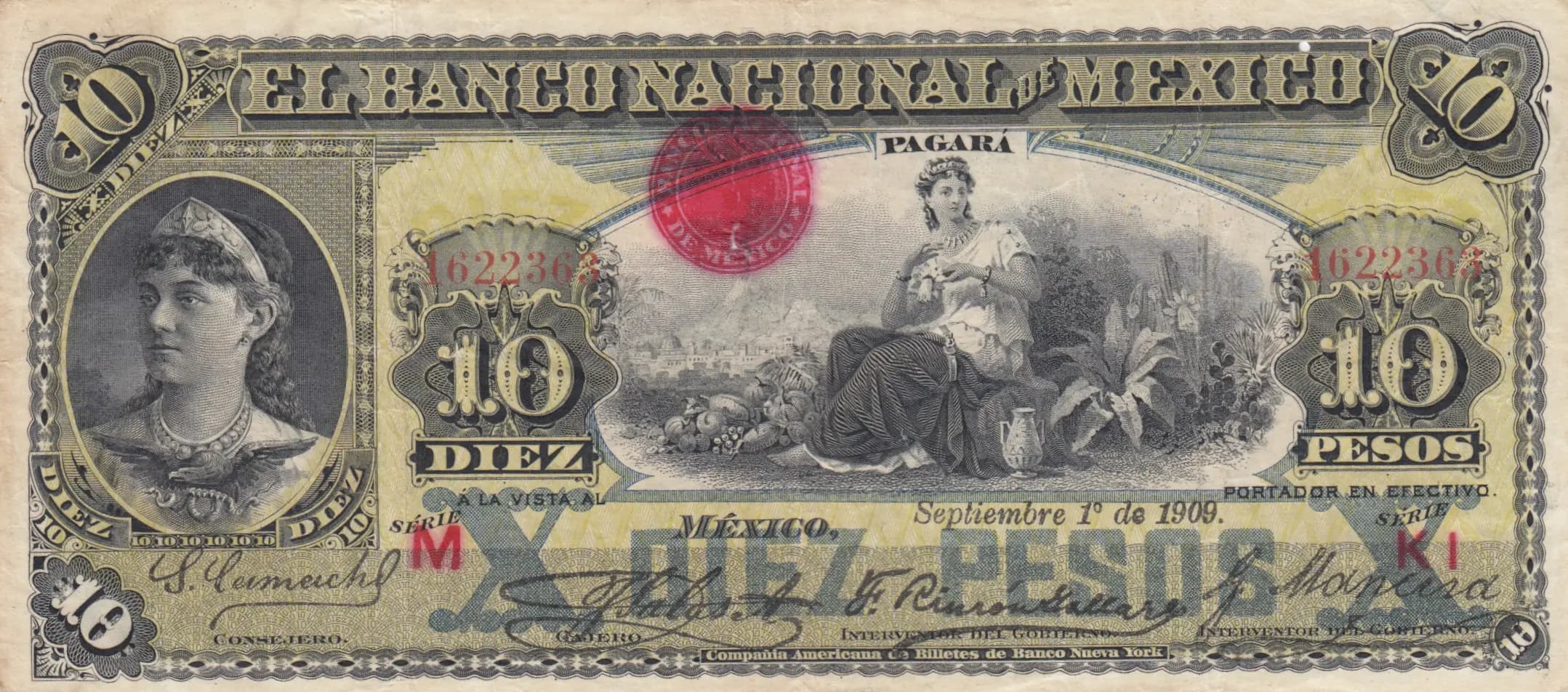
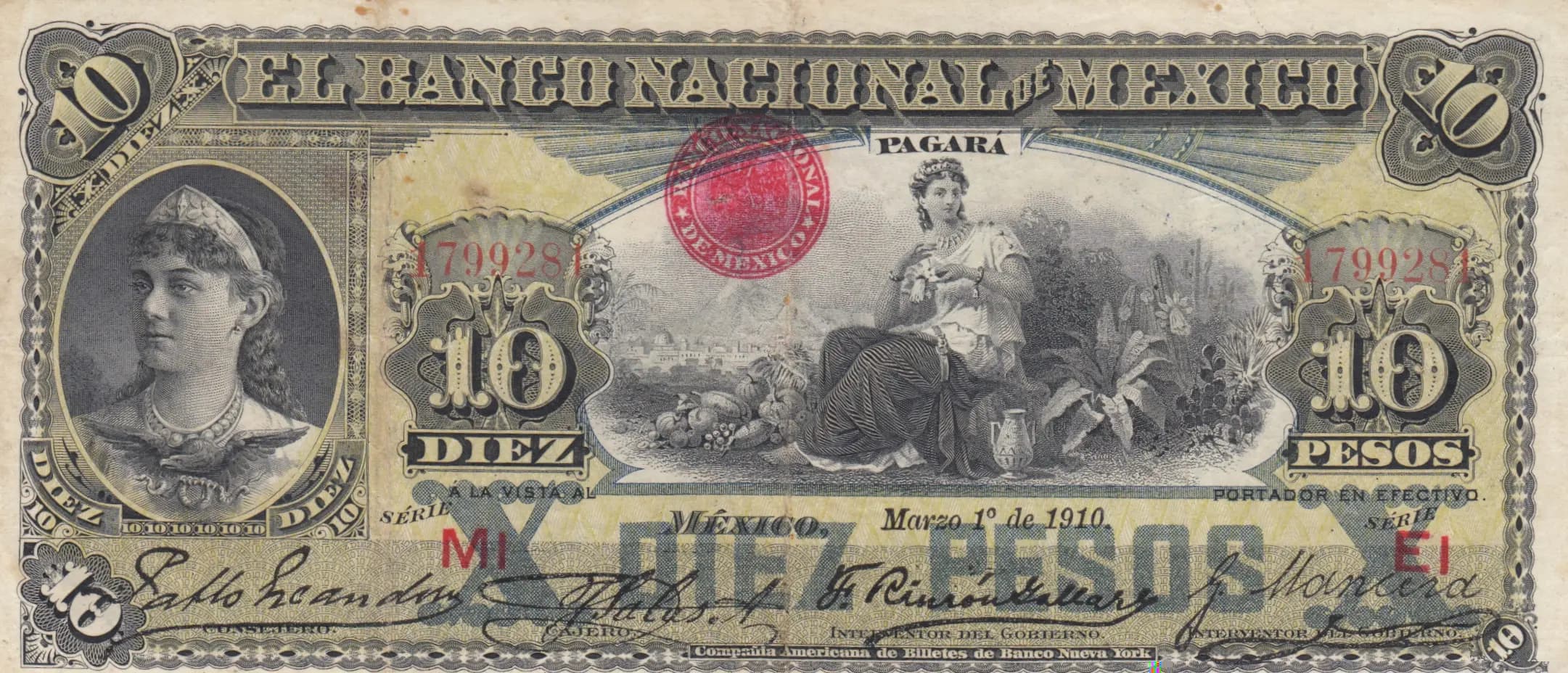
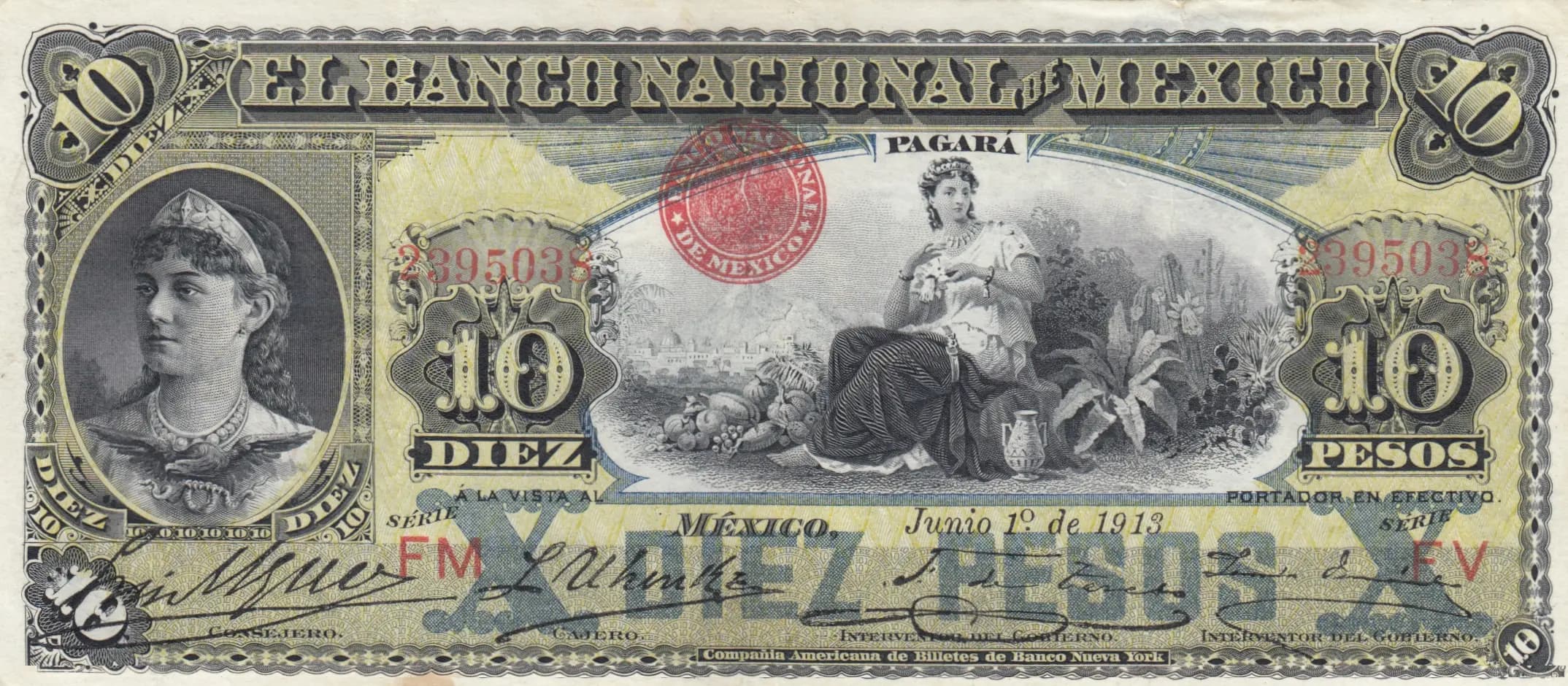
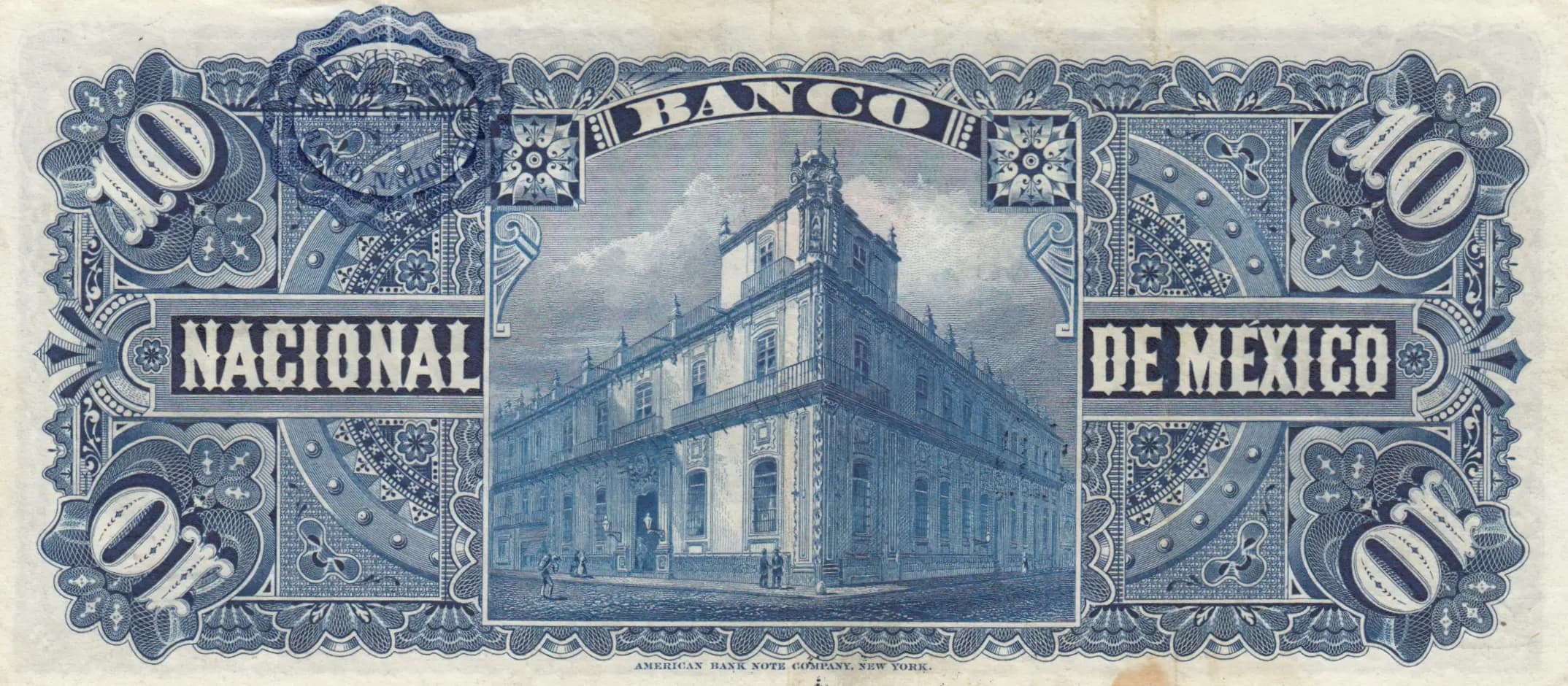
This 10 pesos note from Banco Nacional de México dated June 1, 1913 presents a stunning example of early 20th-century Mexican currency featuring classical allegorical imagery. The obverse displays an ornate composition with a portrait on the left and a seated female figure ('Tropics No. 2') in the center, rendered in gold, black, and white against a yellow and blue underprint, with a prominent red 'PAGARÁ' seal. In VF condition, this note shows moderate wear with visible creases and fold lines consistent with historical circulation, yet retains excellent detail in the intricate engraved borders and architectural rendering of the National Bank building on the reverse.
Common. While this is a historically significant note from an important Mexican bank during the Revolutionary period, eBay market data shows typical examples trading in the $25–$135 USD range, with VF condition notes generally priced around $25–$50 USD. The Print period (1909–1913) was substantial, and while the specific series 395031 specimen may be individually unique, this Pick number and denomination show consistent availability in the secondary market. The catalog notation as a regular issue (not a special or limited printing) confirms common status.
This note was issued during a tumultuous period in Mexican history, just three years into the Mexican Revolution (1910-1920), when Banco Nacional de México continued operations despite political upheaval. The allegorical imagery featuring the seated female figure with landscape elements symbolizes Mexico's natural wealth and territorial identity, while the classical architectural building depicted on the reverse emphasizes the bank's institutional stability and legitimacy. The American Bank Note Company (ABNC) printing, as inscribed on both sides, reflects Mexico's reliance on foreign expertise for high-security currency production during this era.
The obverse features a classical allegorical composition characteristic of early Mexican currency design. On the left is a portrait of a woman with long hair and ornate headpiece, representing feminine virtue or national identity. The central design showcases 'Tropics No. 2,' a seated female allegorical figure in classical dress surrounded by landscape elements including cacti and desert vegetation, symbolizing Mexico's natural resources and tropical regions. The reverse displays a meticulously engraved architectural rendering of what appears to be the Banco Nacional de México's main building—a multi-story corner structure with classical details, balconies, and fenestration typical of late 19th-century Mexican institutional architecture. Both sides are framed by elaborate ornamental borders with scrollwork and floral patterns rendered in gold/yellow and blue respectively, demonstrating the sophisticated engraving techniques employed by ABNC.
OBVERSE: 'EL BANCO NACIONAL DE MÉXICO' (The National Bank of Mexico) | 'DIEZ PESOS' (Ten Pesos) | 'PAGARÁ A LA VISTA AL PORTADOR EN EFECTIVO' (Will pay on demand to the bearer in cash) | 'MÉXICO, Junio 1º de 1913' (Mexico, June 1st, 1913) | 'SERIE 395031' (Series 395031) | 'CAJERO' (Cashier) | 'CONSEJERO' (Advisor/Counselor) | 'INTERVENTOR DEL GOBIERNO' (Government Auditor) | 'Compañía Americana de Billetes de Banco Nueva York' (American Bank Note Company, New York) | REVERSE: 'BANCO NACIONAL DE MÉXICO' (National Bank of Mexico) | '10' (Ten) | 'AMERICAN BANK NOTE COMPANY, NEW YORK'
Intaglio engraving (also known as line engraving or steel engraving), the standard security printing method for banknotes of this era. The fine line work visible in the ornamental borders, facial features, architectural details, and the intricate patterns throughout demonstrate the high-quality intaglio process. Printed by the American Bank Note Company (ABNC), New York, as credited on both sides. The color separation between the obverse (black on yellow and blue underprint) and reverse (blue) indicates multi-pass printing typical of ABNC's sophisticated production methods.
This specimen is identified as Pick P-S258e, indicating it is part of the later series of 10 pesos notes issued by Banco Nacional de México between 1909 and June 12, 1913. The specific date of June 1, 1913 places it near the very end of this issuing period. Serial number 395031 represents an individual identifier but does not denote a recognized catalogued variety. The signature varieties (CAJERO, CONSEJERO, INTERVENTOR DEL GOBIERNO positions) may vary by specimen, but without comparison examples visible in the images, the specific signature combination cannot be identified as a distinct variety. The red 'PAGARÁ' circular stamp visible in the center is standard for this issue.