10 pesos 1904
Market Prices
About This Note
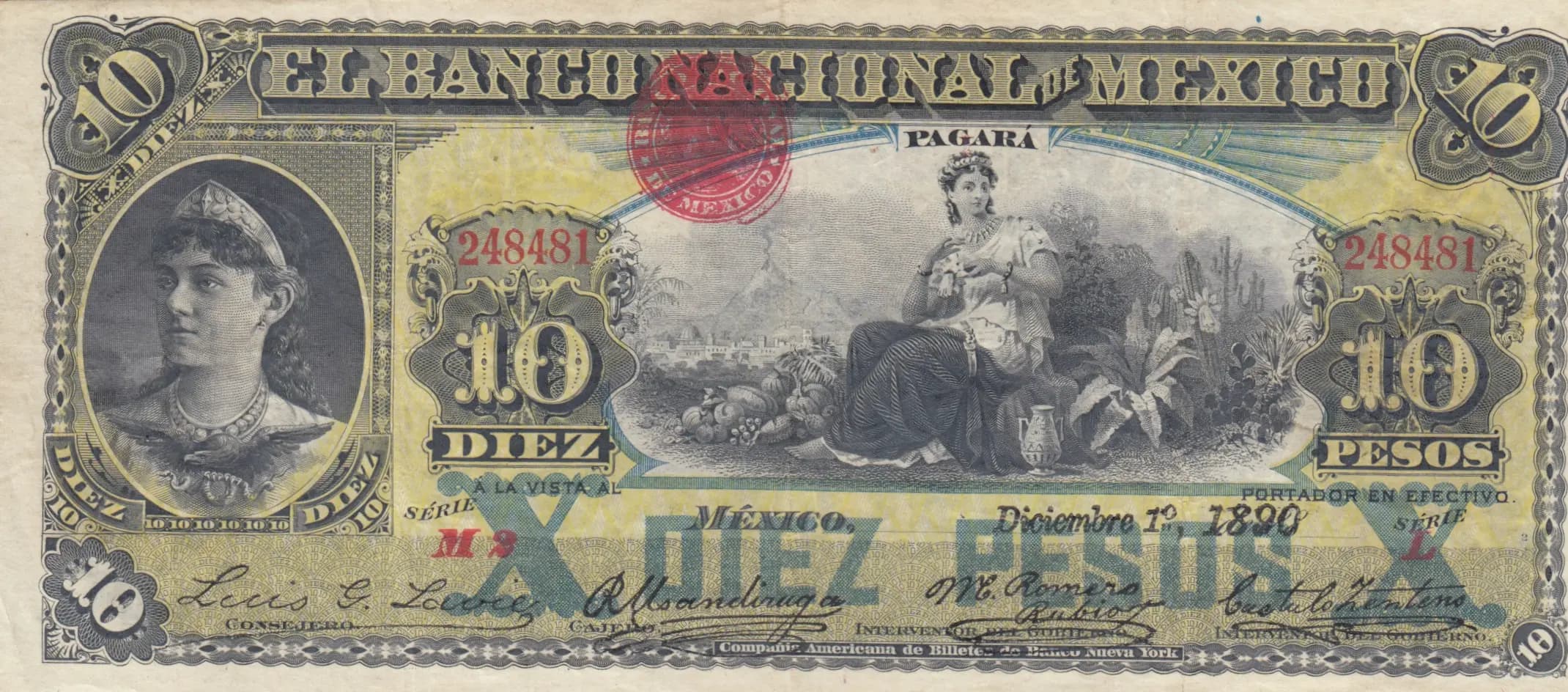
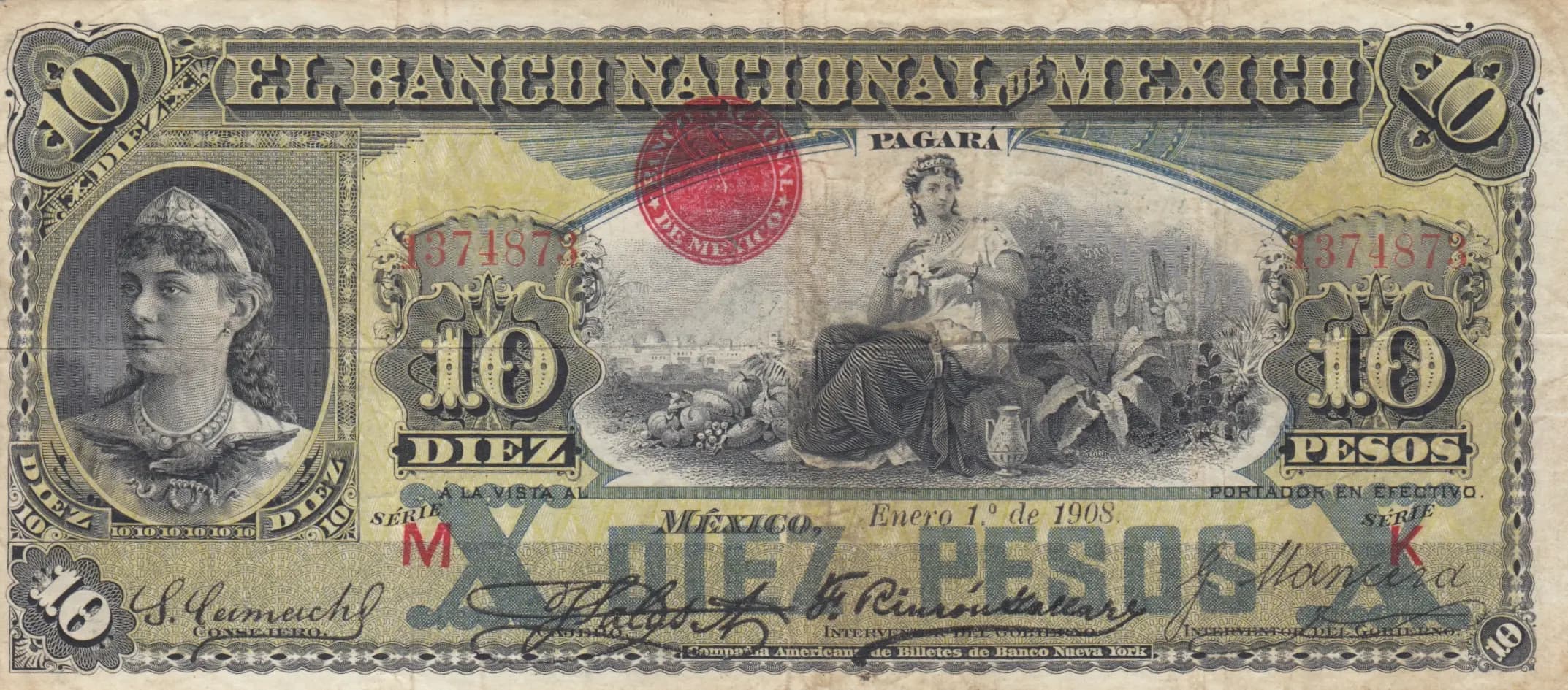
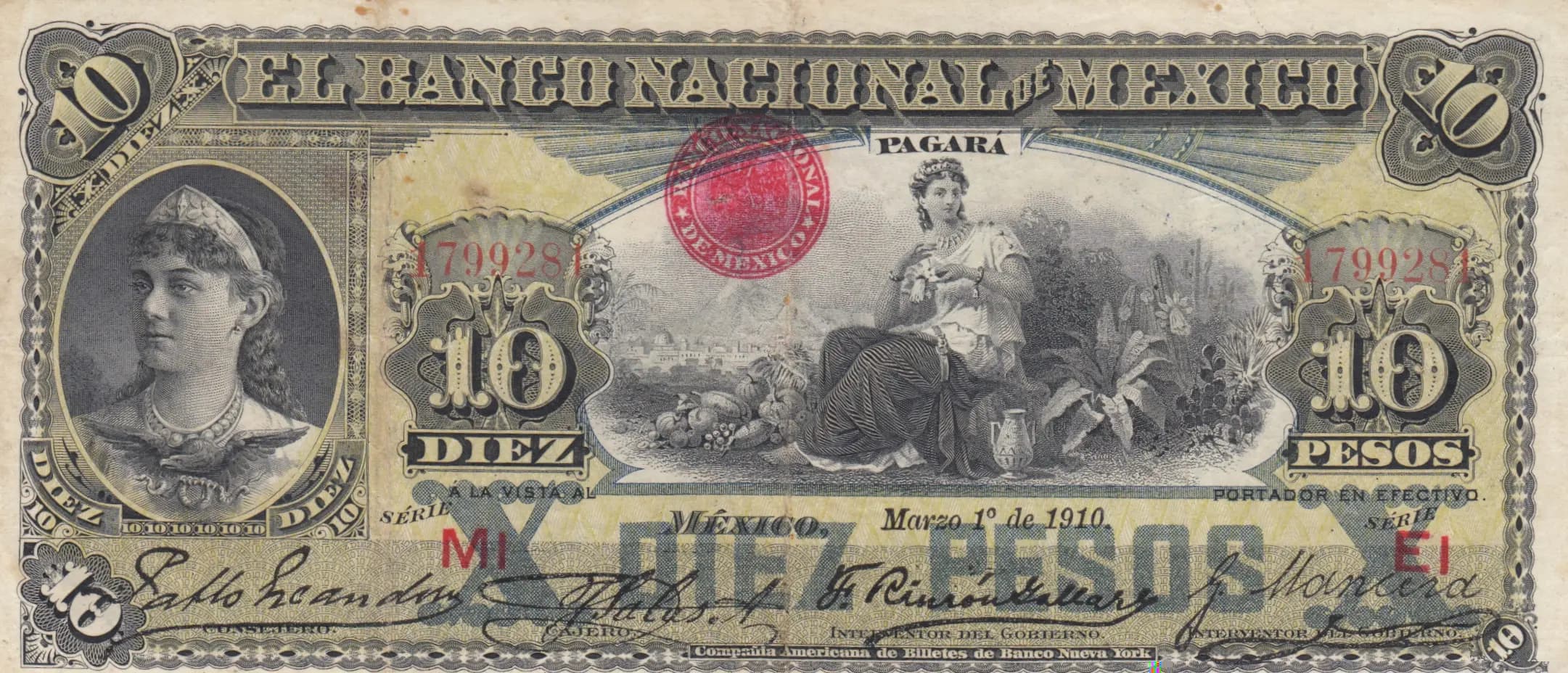
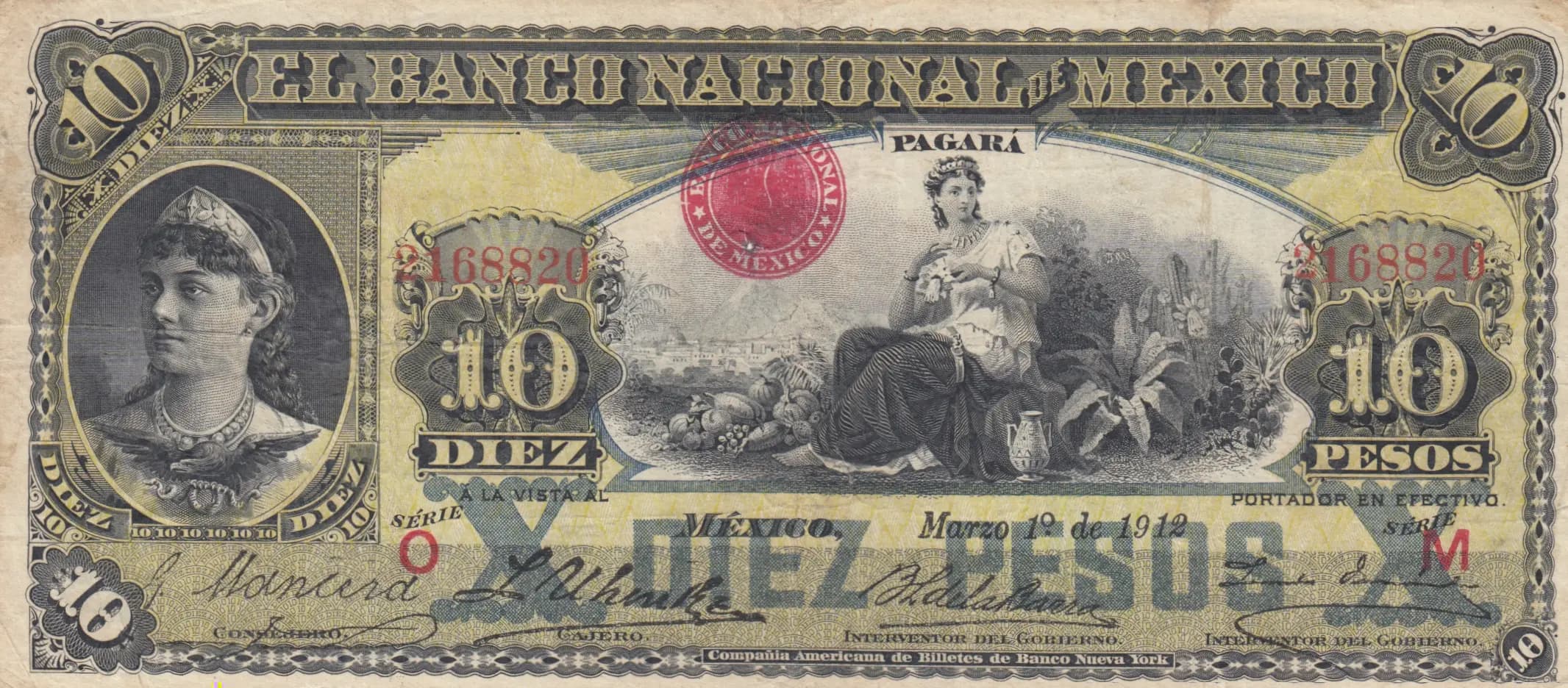
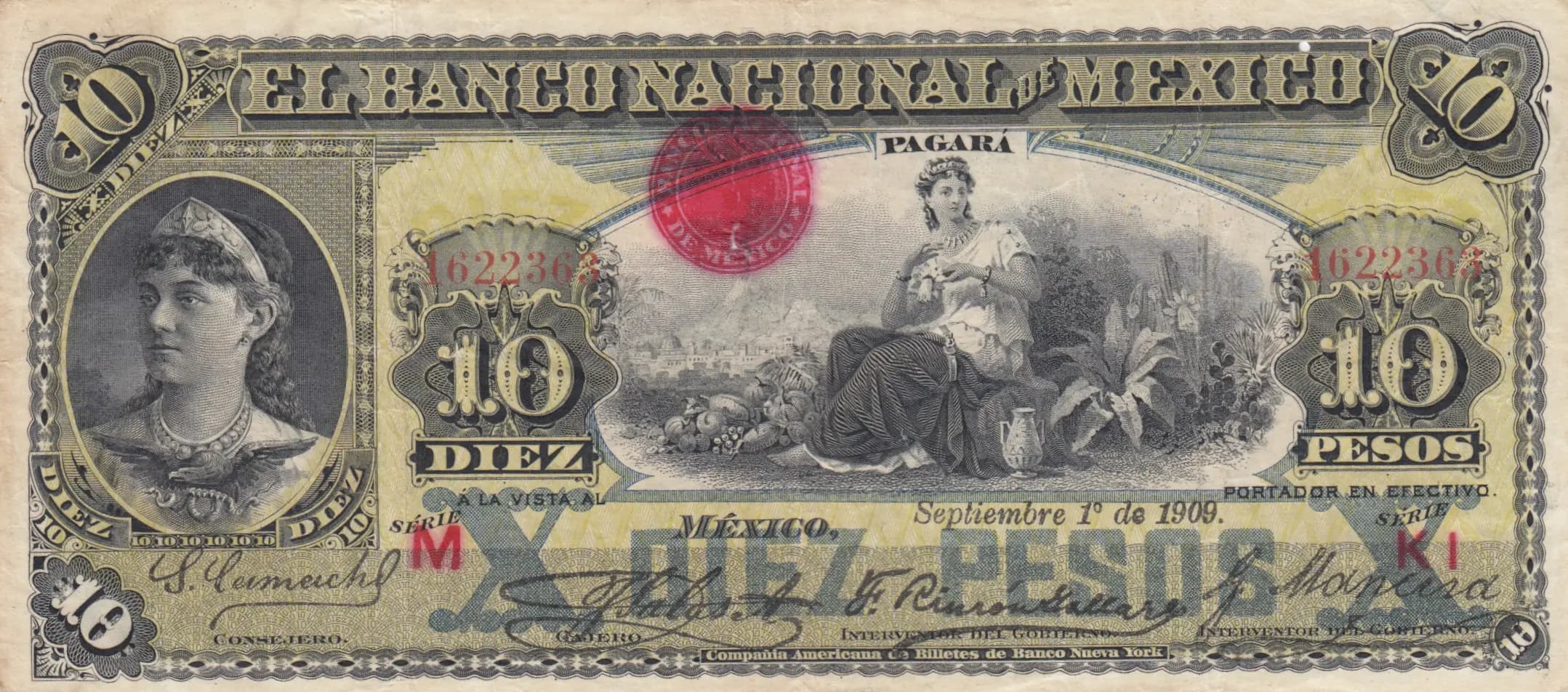
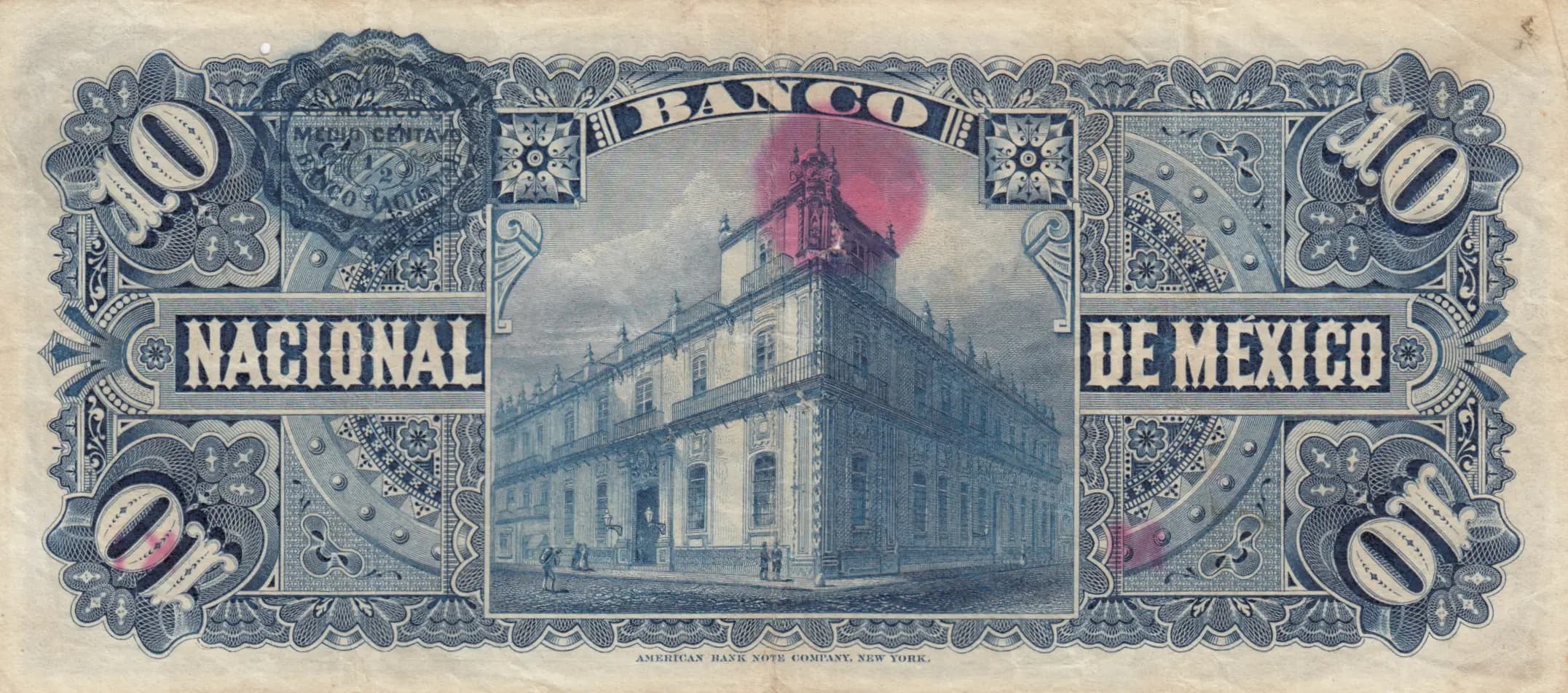
This 10 Pesos note from Banco Nacional de México represents the 1904-1913 issue series, printed by the American Bank Note Company. The note displays the characteristic design elements of this period: a portrait medallion on the left, the iconic seated female "Tropics No. 2" allegorical figure in the center, and an institutional building on the reverse. Despite VF condition with visible aging, yellowing, and red official stamps overlaid across the design, the intricate engraving work remains discernible, demonstrating the high-quality production standards of ABNC.
Common. eBay market price data indicates active market supply with multiple listings in the $25-$135 range for similar circulated grades, with some UNC examples reaching $295-$899 (reflecting condition premiums rather than rarity). The note was part of a long-running series (1885-1913) with substantial print runs typical of a major national bank's regular-issue currency. The VF grade specimen observed here, while desirable, does not command premium pricing that would indicate scarcity. Market availability and pricing patterns confirm this is a widely-traded note among collectors of Mexican banknotes.
This banknote was issued during a transformative period in Mexican financial history, specifically during the later Porfirian era (1884-1911) when the Banco Nacional de México served as the primary state bank. The neoclassical institutional building depicted on the reverse represents the architectural confidence of Mexico's modernizing financial sector, while the allegorical female figure symbolizing tropical abundance reflects the nation's economic focus on natural resource extraction and agricultural wealth during this period of development and foreign investment.
The obverse features an ornate composition with classical allegorical imagery characteristic of ABNC's prestigious banknote designs. The left side displays a female portrait in profile within a circular medallion frame, representing authority and stability. The central vignette depicts the seated female figure in classical drapery—identified as 'Tropics No. 2' in catalog references—set within a tropical landscape with palm trees and vegetation, symbolizing Mexico's natural wealth and agricultural abundance. The design employs elaborate green and gold decorative borders with scrollwork corner ornaments and prominent red denomination numerals (10) and text 'DIEZ PESOS' in symmetrical left and right positions. The reverse presents a monumental neoclassical institutional building (likely the Banco Nacional de México's headquarters or a government building) as the central vignette, featuring a distinctive red/pink domed tower or cupola, multiple stories, classical columns, and balustrades rendered in gray tones. This architectural element is framed by intricate blue and white decorative borders with ornamental corner cartouches containing the denomination numeral 10 in elaborate oval frames. The overall design emphasizes institutional permanence, national pride, and financial credibility through its neoclassical aesthetic.
FRONT: 'BANCO NACIONAL DE MÉXICO' (National Bank of Mexico) / 'DIEZ PESOS' (Ten Pesos) / 'PAGARÁ A LA VISTA' (Will Pay on Sight) / 'PORTADOR EN EFECTIVO' (Bearer in Cash) / 'SERIE' (Series) / 'CONSEJERO' (Counselor) / 'CAJERO' (Cashier) / 'INTERVENTOR DEL GOBIERNO' (Government Intervener) / 'Septiembre 1º de 1909' (September 1st, 1909) / Serial number: 162230 / Signature: S. Pimentel / 'Compañía Americana de Billetes de Banco Nueva York' (American Bank Note Company New York). BACK: 'BANCO NACIONAL DE MÉXICO' (National Bank of Mexico) / 'AMERICAN BANK NOTE COMPANY, NEW YORK' (printer attribution).
This note was produced using steel-plate intaglio engraving, the gold standard for banknote production in the early 20th century. The American Bank Note Company (ABNC), based in New York and explicitly credited on the note, executed the engraving work. The technique is evidenced by the fine, precise line work visible in the decorative borders, the subtle modeling in the allegorical figures, and the intricate detail in the architectural rendering. The color printing employed a multi-pass process using separate plates for the primary colors (black line work, green and gold on the obverse, blue on the reverse), with the red stamps and official markings applied subsequently. The technical sophistication and clarity of detail visible even in this aged, circulated specimen demonstrate ABNC's mastery of security printing technology.
This specimen is dated 'Septiembre 1º de 1909' and carries serial number 162230 with a signature identified as 'S. Pimentel.' The 1909 date falls within the documented ABNC printing period for this series (1.9.1909-6.12.1913) as noted in the RealBankNotes reference. The specific variety characteristics include the red circular 'PAGARÁ' official stamp, the red serial numbers, and the presence of governmental official signature lines (Consejero, Cajero, Interventor del Gobierno). These features are consistent with the documented P-S258e designation. The red overlay stamps and marks appear to be standard processing/validation markings applied during banking operations rather than production varieties. No significant varieties (such as overprints indicating different issuing banks or special release variants) are evident in this specimen.