10 pesos 1913
Market Prices
About This Note
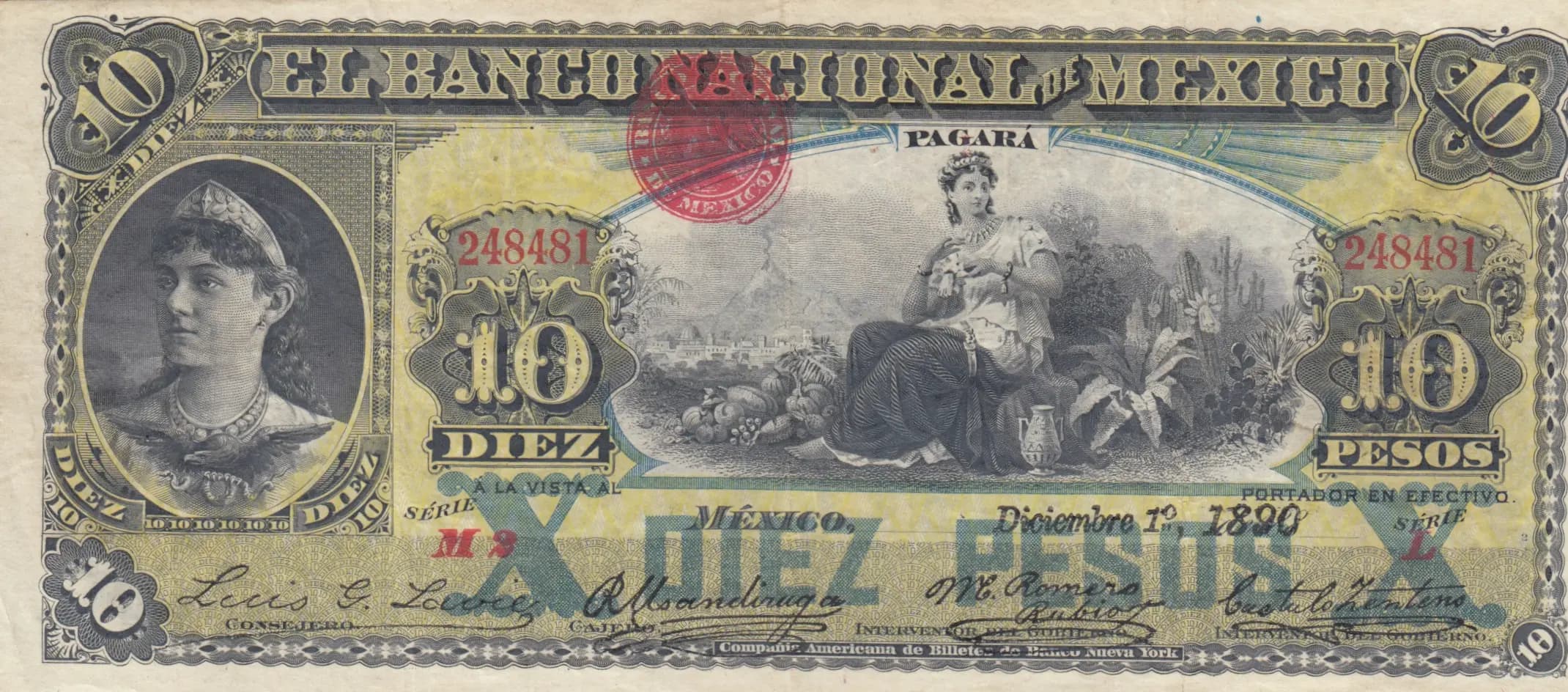
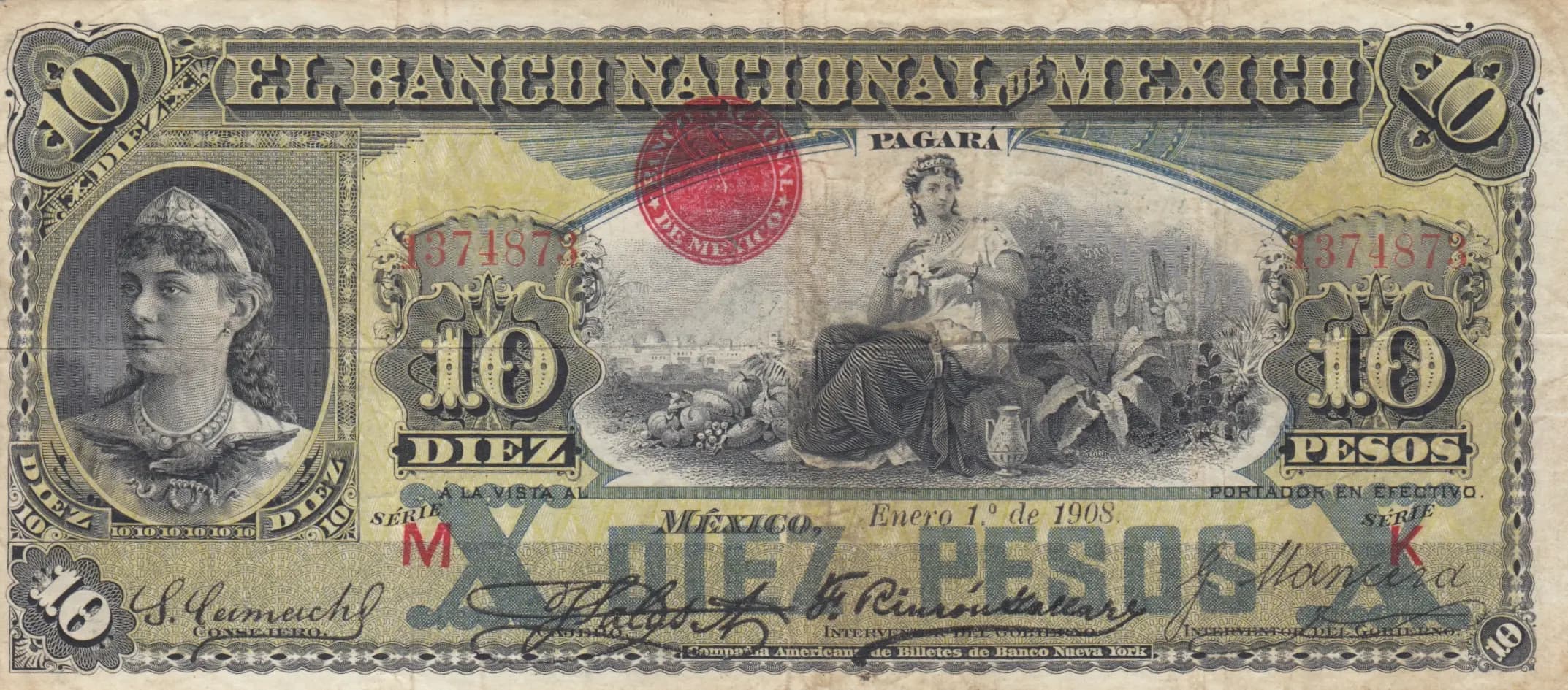
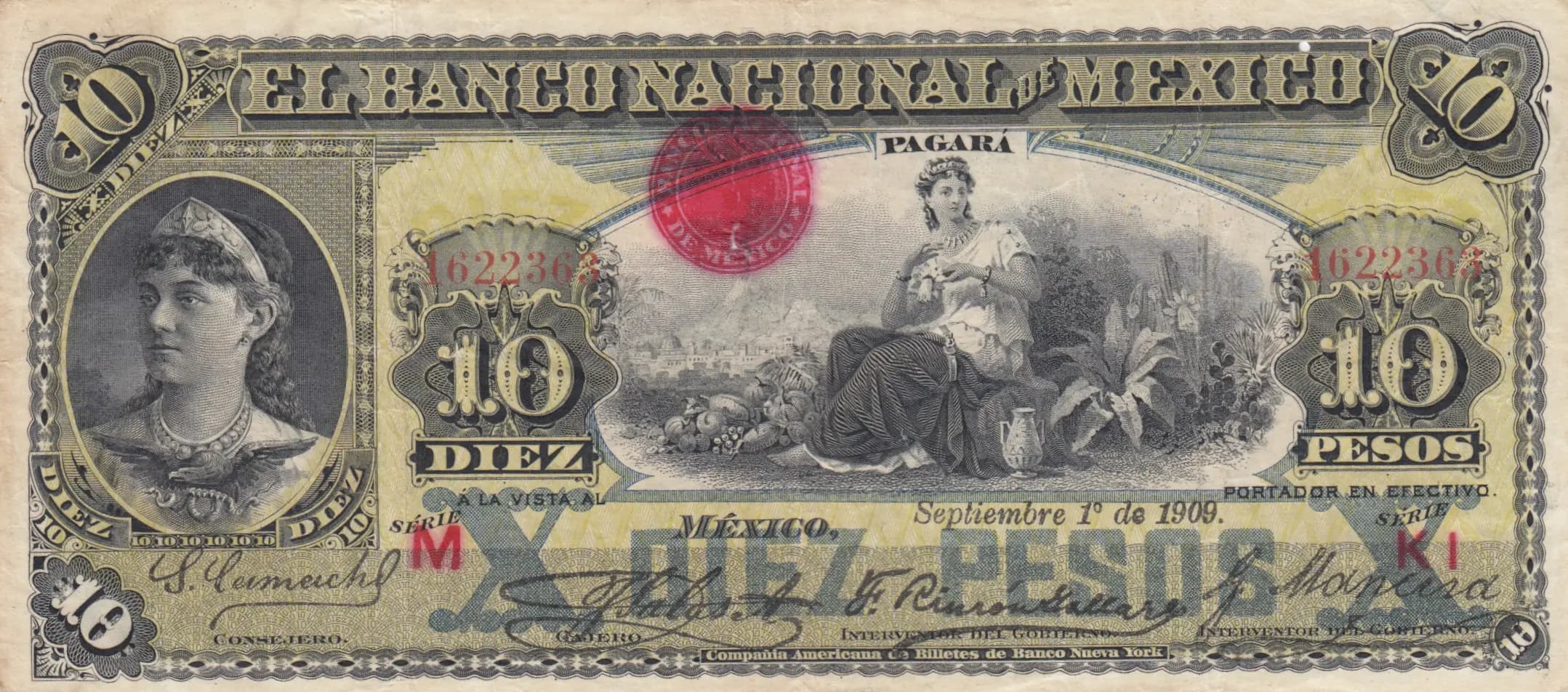
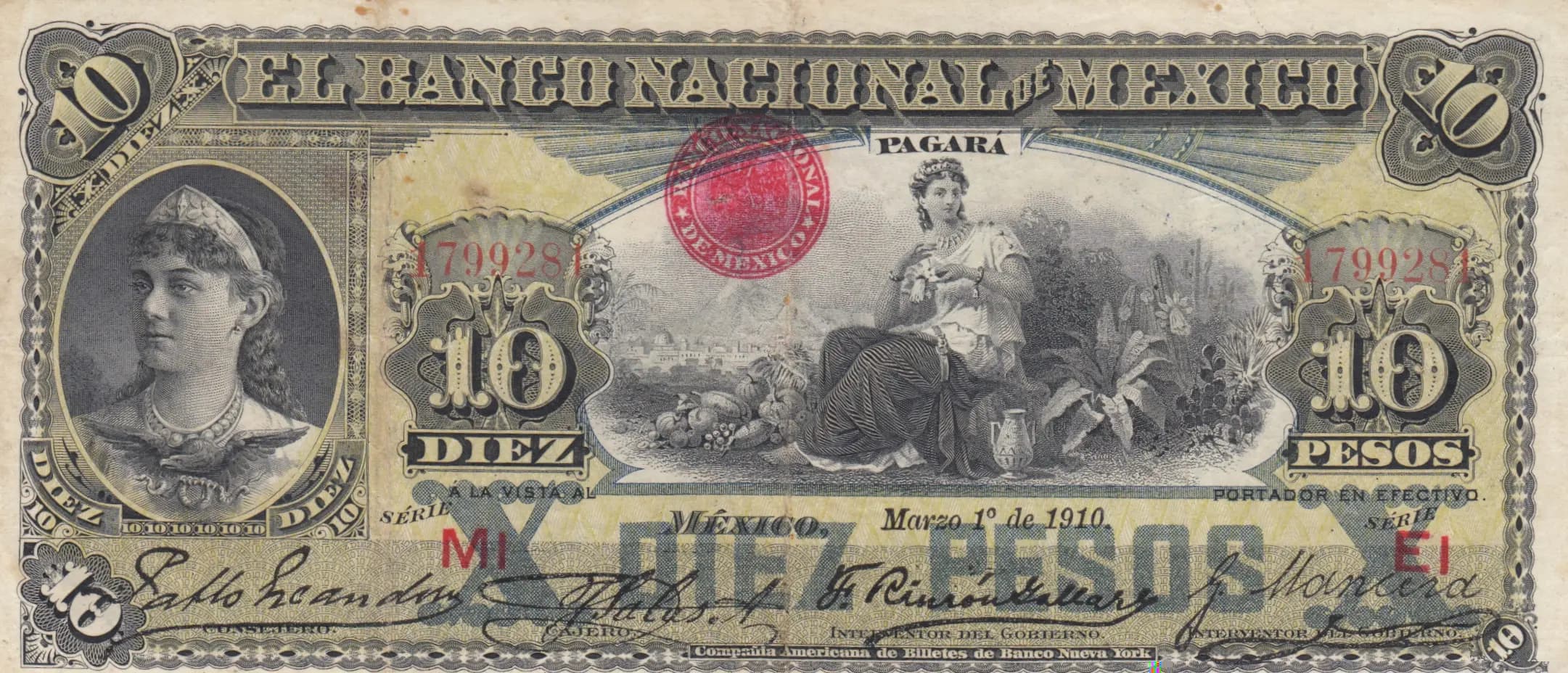
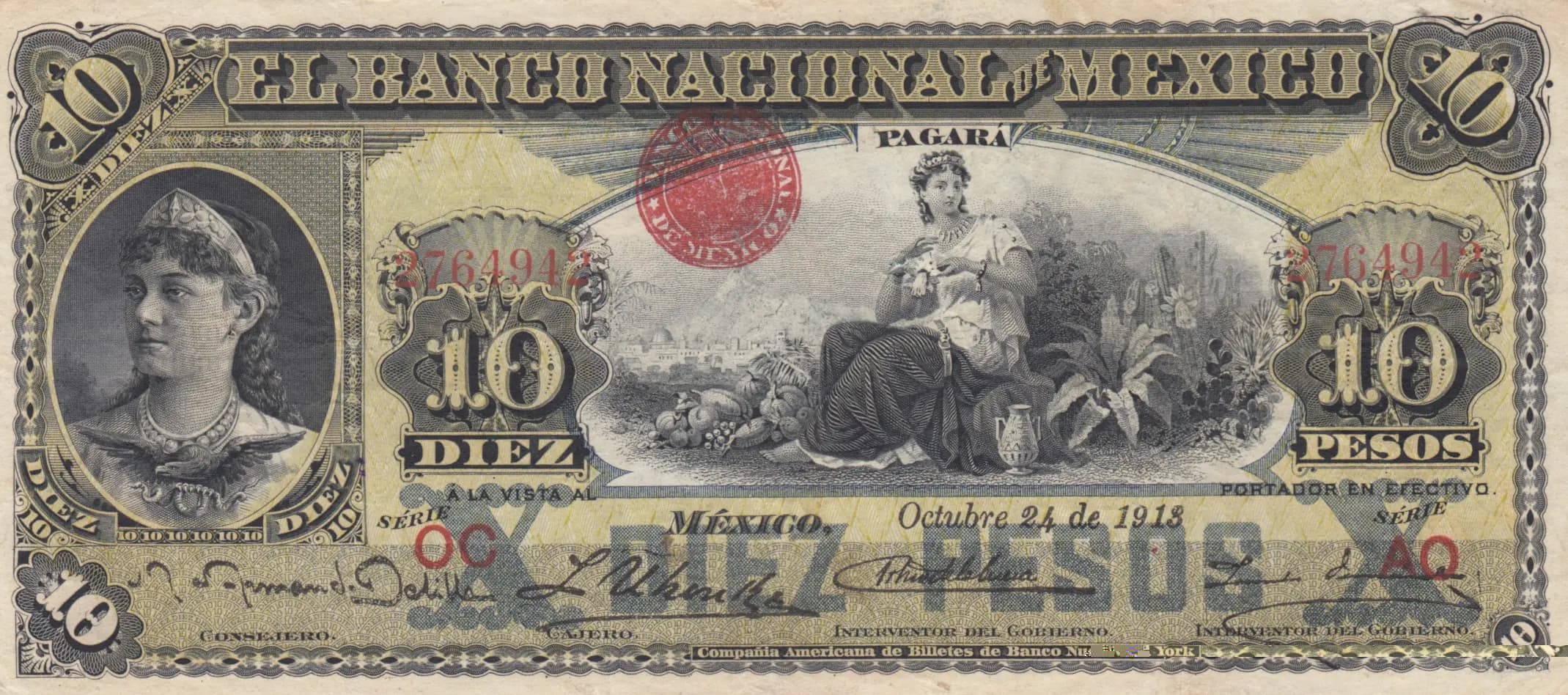
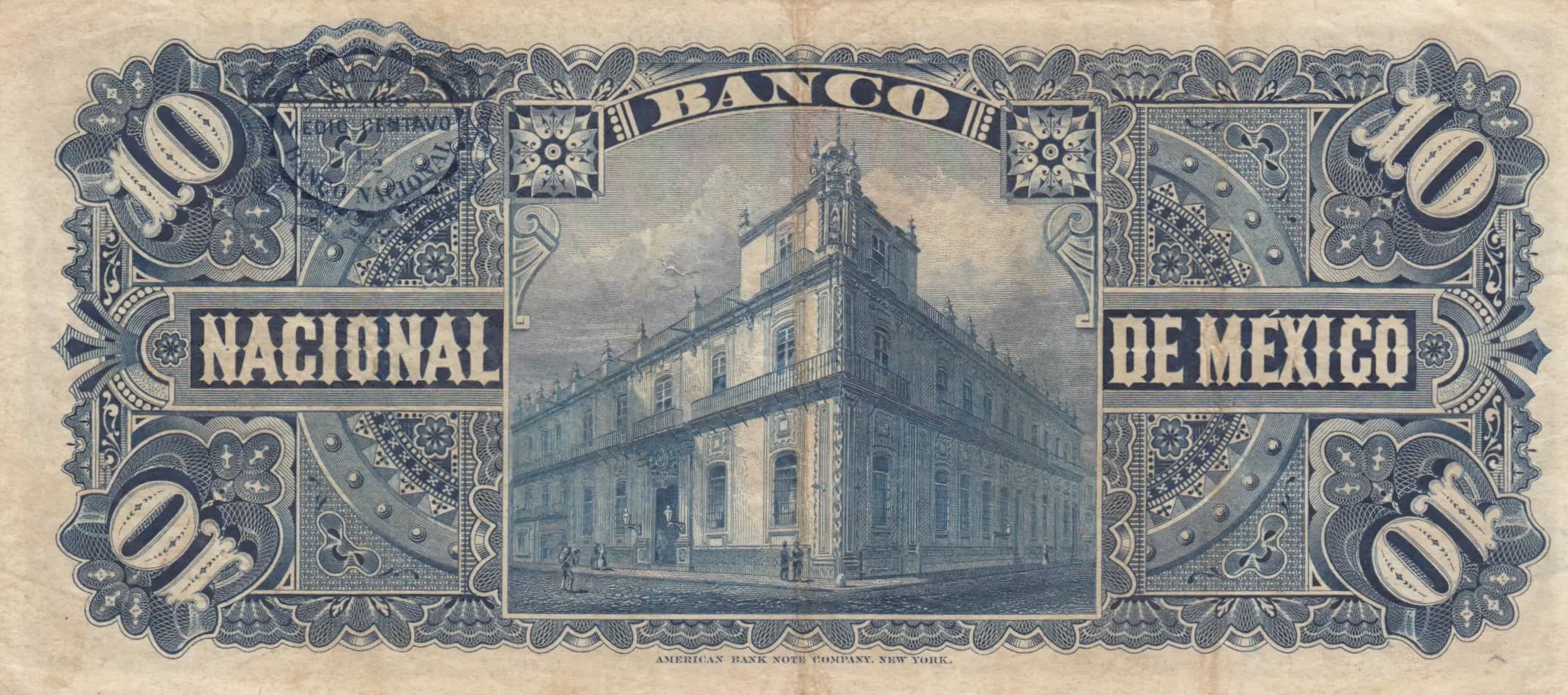
A scarce 10 pesos banknote from Mexico dated October 24, 1913, issued by Banco Nacional de México during a turbulent period in Mexican history. The note exhibits attractive engraved design work by the American Bank Note Company with allegorical female figures and the iconic bank building on the reverse, though it shows honest circulation wear consistent with its age—foxing, browning, water staining, and fading—placing it solidly in Fine condition. The presence of period-appropriate administrative stamps and signatures, combined with the historical significance of the 1913 date during the Mexican Revolution, makes this an interesting example of pre-Revolution Mexican currency.
Common. This note represents a regular issue of the Banco Nacional de México with a production period spanning from 1909 to December 6, 1913 (Pick S258e). The eBay price data shows widely ranging listings from $4.99 to $899.00 USD, but the concentration of circulated examples in the $25–$135 USD range for comparable conditions indicates these notes were produced in substantial quantities and remain readily available to collectors. The Fine condition grade observed here aligns with market pricing around $25–$50 USD, typical for circulation-worn examples of this common issue.
This 10 pesos note was issued by Banco Nacional de México during the tumultuous year 1913, amid the Mexican Revolution's escalation following the Decena Trágica (Tragic Ten Days) and the overthrow of President Madero. The allegorical imagery on the obverse—depicting prosperity and national resources through the seated female figure labeled 'Tropics No. 2' and the mountainous landscape—reflects the bank's attempt to project confidence and stability despite political chaos. The reverse's prominent rendering of the Banco Nacional de México's neoclassical building served as a symbol of institutional permanence and financial legitimacy during a period when many Mexican banks and financial institutions faced uncertainty.
The obverse features a sophisticated engraved composition with the portrait of M. García Teruel in profile on the left side wearing formal period attire, while the central right displays an allegorical female figure representing 'Tropics No. 2'—personifying Mexico's tropical wealth and natural resources—set within a landscape vignette containing mountains, vegetation, and architectural elements suggesting progress and development. The composition is framed by ornate corner decorative elements with scrollwork and filigree patterns, with denomination numerals prominently displayed in all four corners. The reverse showcases the Banco Nacional de México's headquarters building, a multi-story neoclassical structure with columns, balconies, and a distinctive corner turret, rendered in classical architectural style with street-level figures visible near the entrance. Decorative borders throughout feature repeated shell and fan motifs with heraldic emblems, demonstrating the high-quality engraving standards of the American Bank Note Company.
FRONT: 'EL BANCO NACIONAL DE MÉXICO' (The National Bank of Mexico) / 'DIEZ PESOS' (Ten Pesos) / 'PAGARÁ' (Will Pay) / 'Octubre 24 de 1913' (October 24, 1913) / 'MÉXICO' (Mexico) / 'A LA VISTA' (On Demand) / 'SERIE' (Series) / 'PORTADOR EN EFECTIVO' (Bearer in Cash) / 'CONSEJERO' (Counselor) / 'CAJERO' (Cashier) / 'INTERVENTOR DEL GOBIERNO' (Government Auditor) [appears twice] / 'Compañía Americana de Billetes de Banco Nueva York' (American Bank Note Company New York) / Serial number: 276491. BACK: 'BANCO NACIONAL DE MÉXICO' (National Bank of Mexico) / 'AMERICAN BANK NOTE COMPANY, NEW YORK' (American Bank Note Company, New York) / '10' (denomination).
Intaglio engraving (line engraving and steel plate printing), executed by the American Bank Note Company (ABNC) of New York, the premier security printer of the era. The visual analysis confirms the characteristic fine line engraving throughout, evidenced by the intricate filigree patterns, complex border designs, and detailed portraiture. Multi-color printing was employed using black ink on the obverse with yellow and blue underprinting, and blue ink dominating the reverse design—a standard technique for the period that provided both aesthetic appeal and a degree of counterfeiting resistance through color combination complexity.
This specific example is identified as Pick S258e, representing the 1909–1913 issue period of this design. The visual analysis shows this note dated October 24, 1913 (late in the series run), with serial number 276491. The noted red 'PAGARÁ' (Will Pay) stamp is consistent with period currency practices. No evidence of overprints, unusual signatures, or printing variations that would indicate a distinct variety is apparent from the visual examination; this appears to be a standard example of the regular circulating issue, though the specific serial number prefix letter (if visible) would be required to classify into the detailed series varieties documented in specialized catalogs.