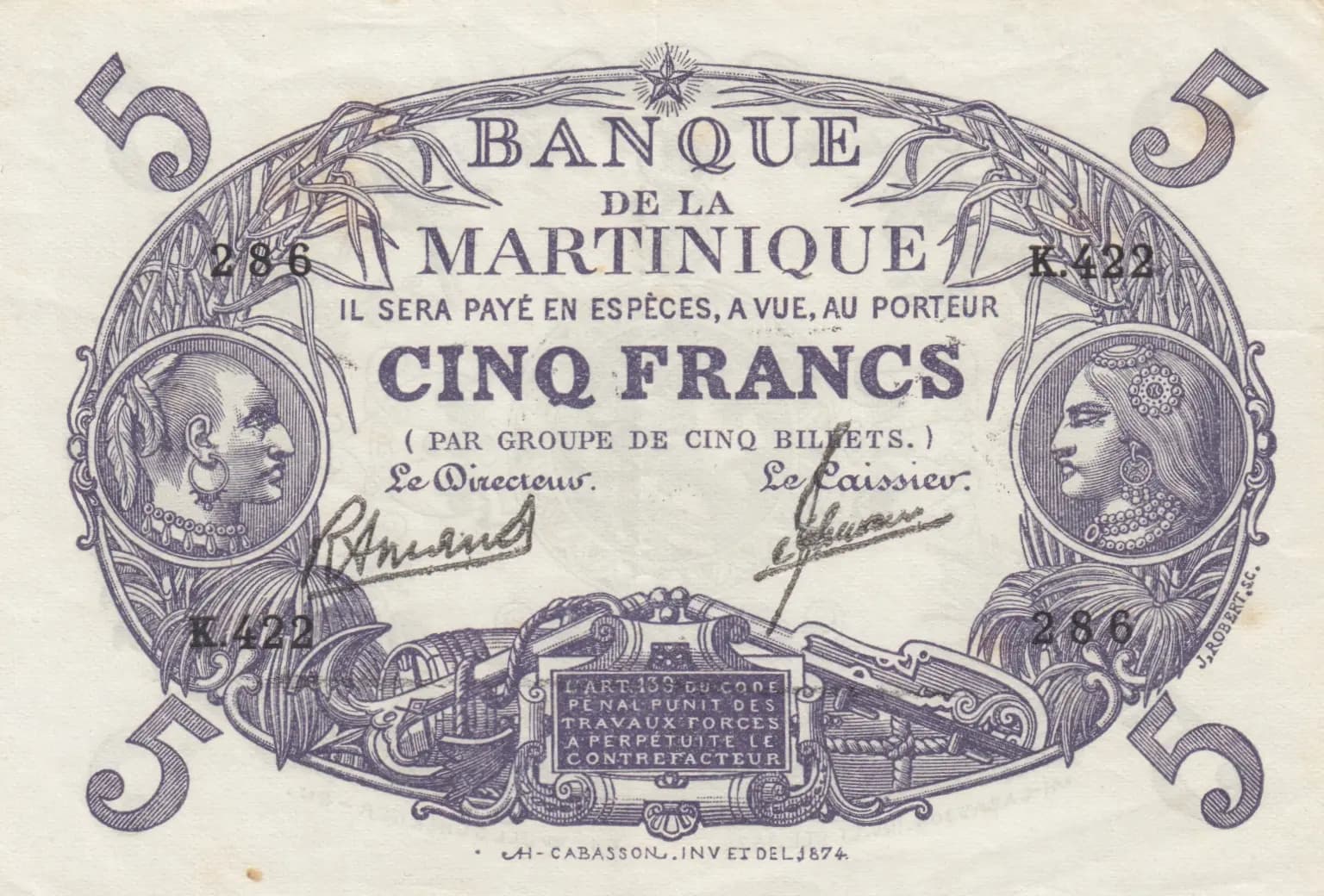
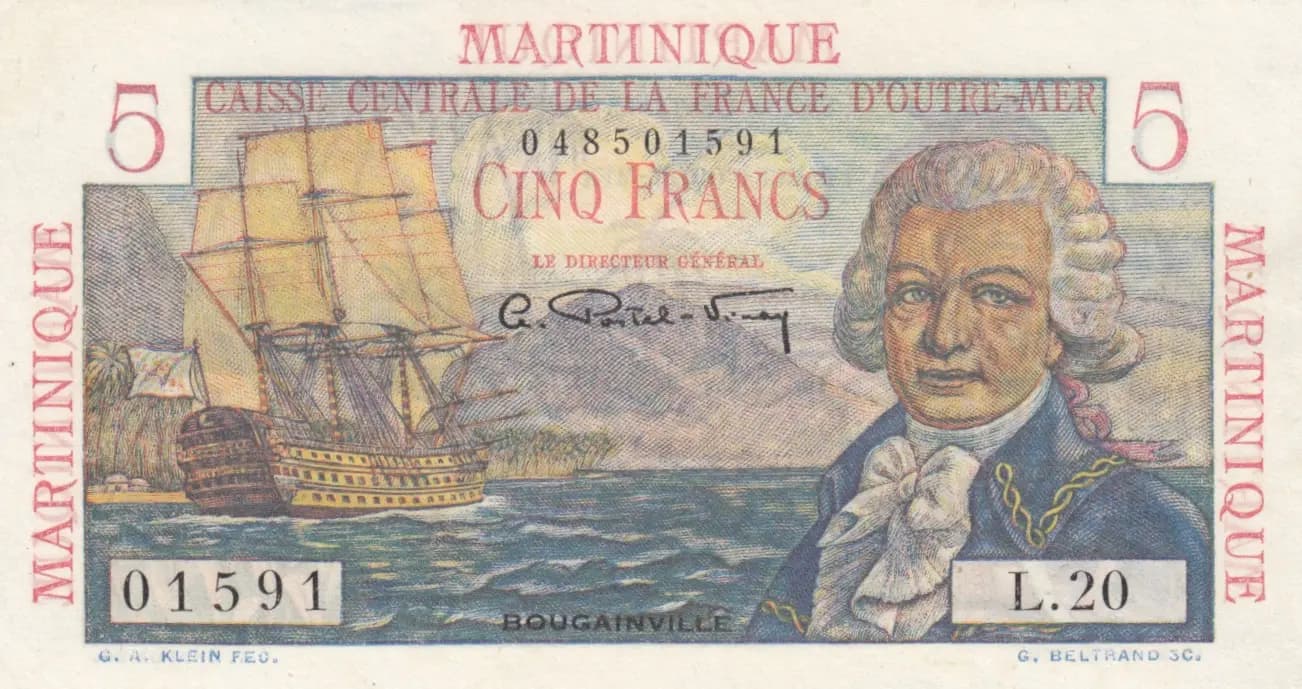
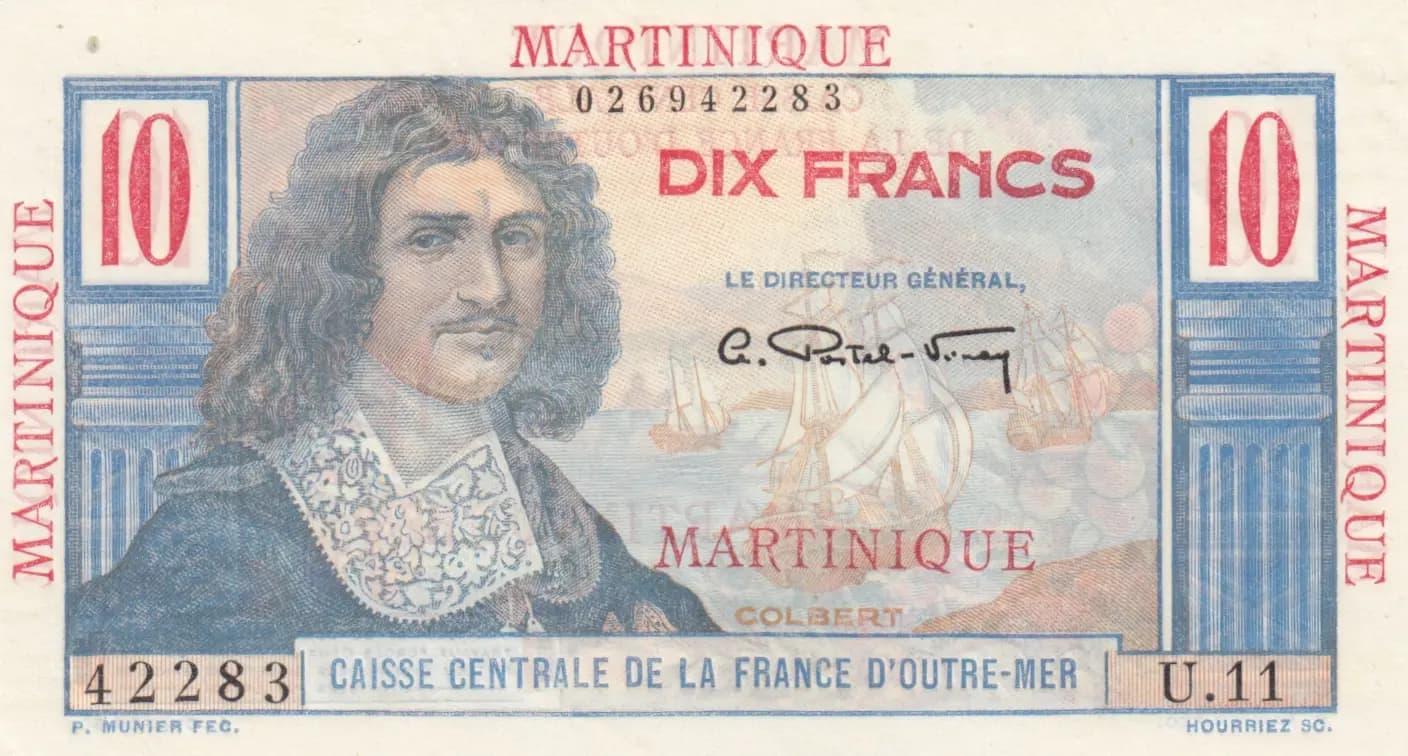
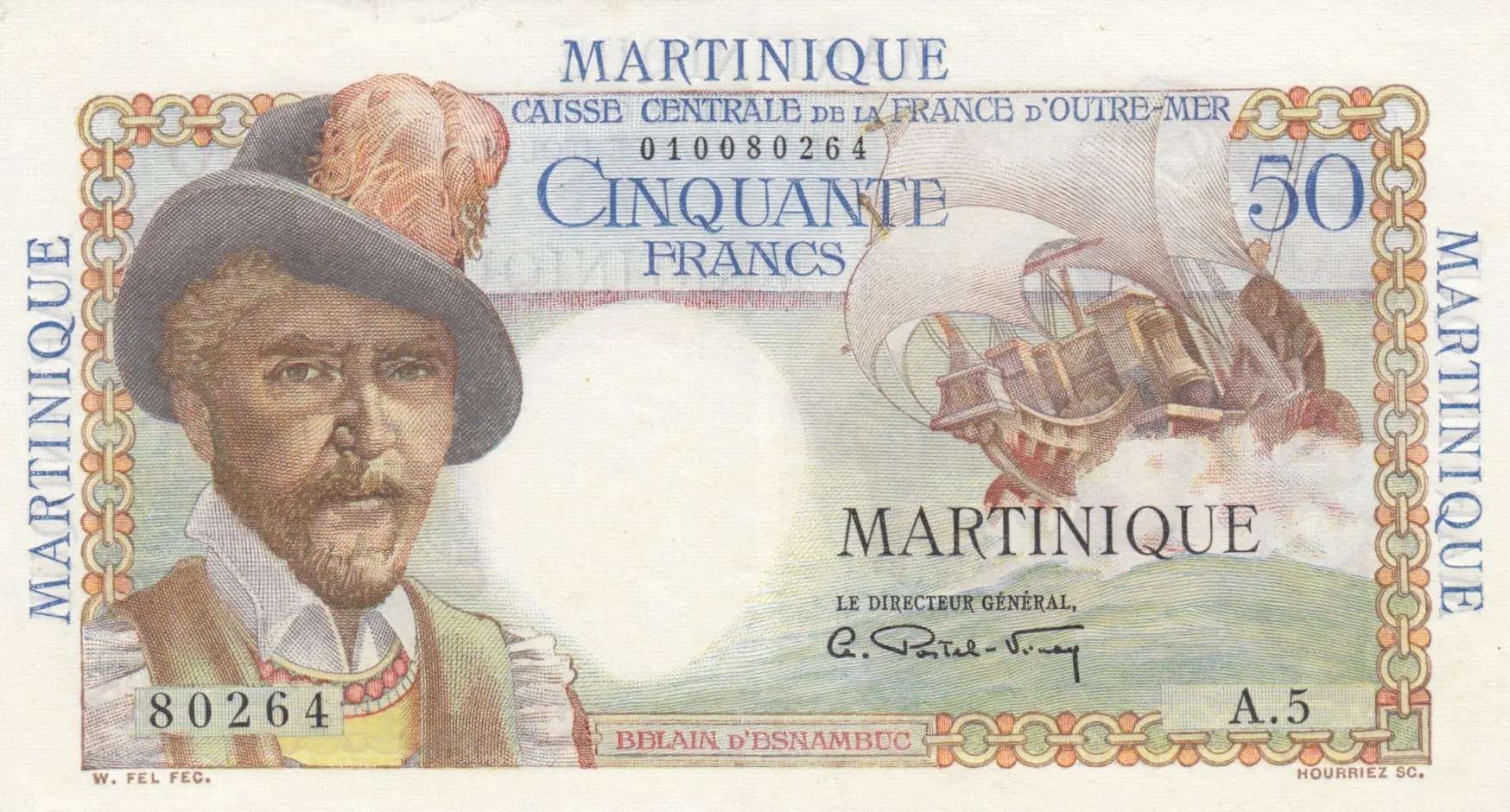
5 nouveaux francs 1963
About This Note
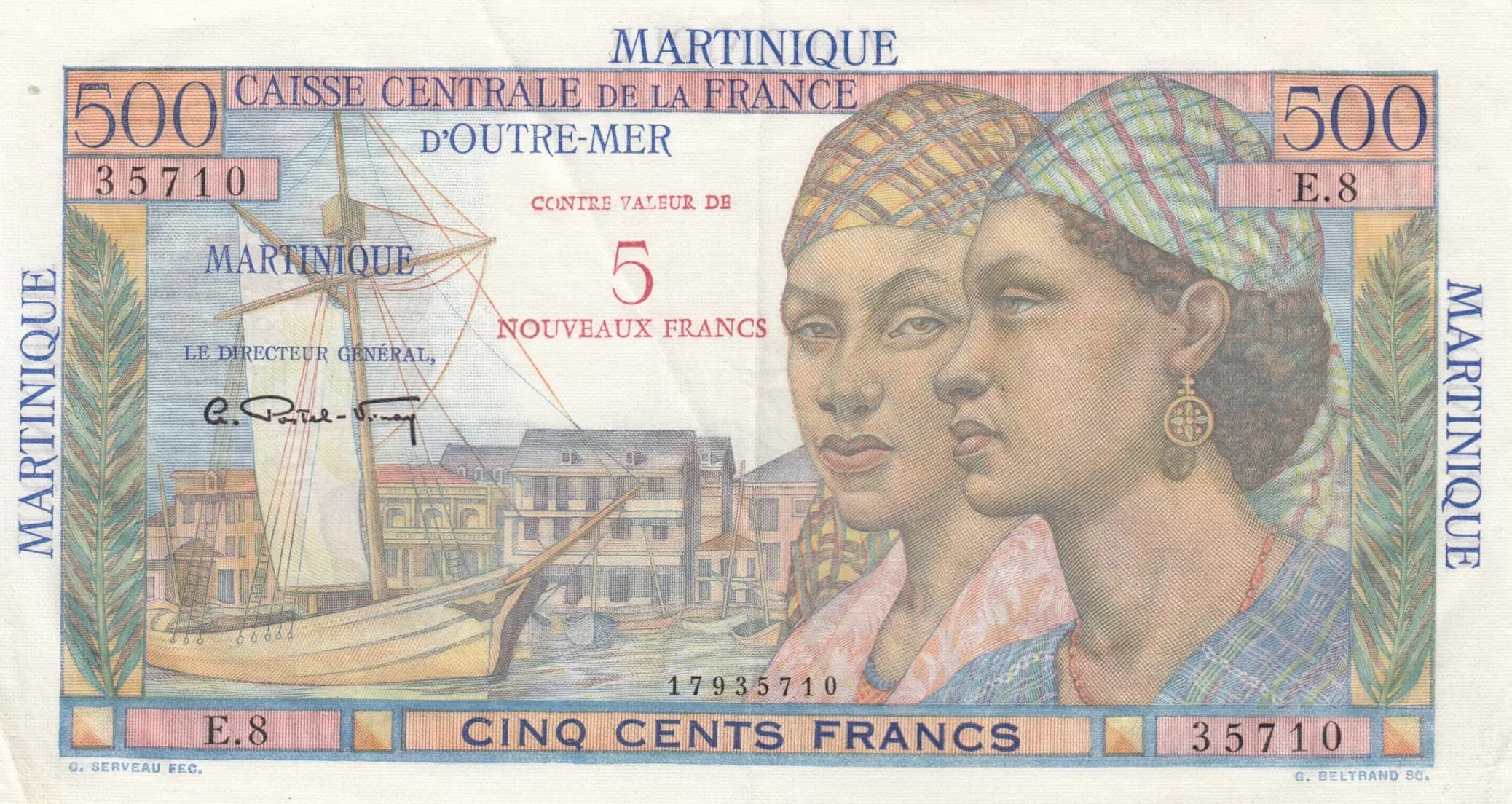
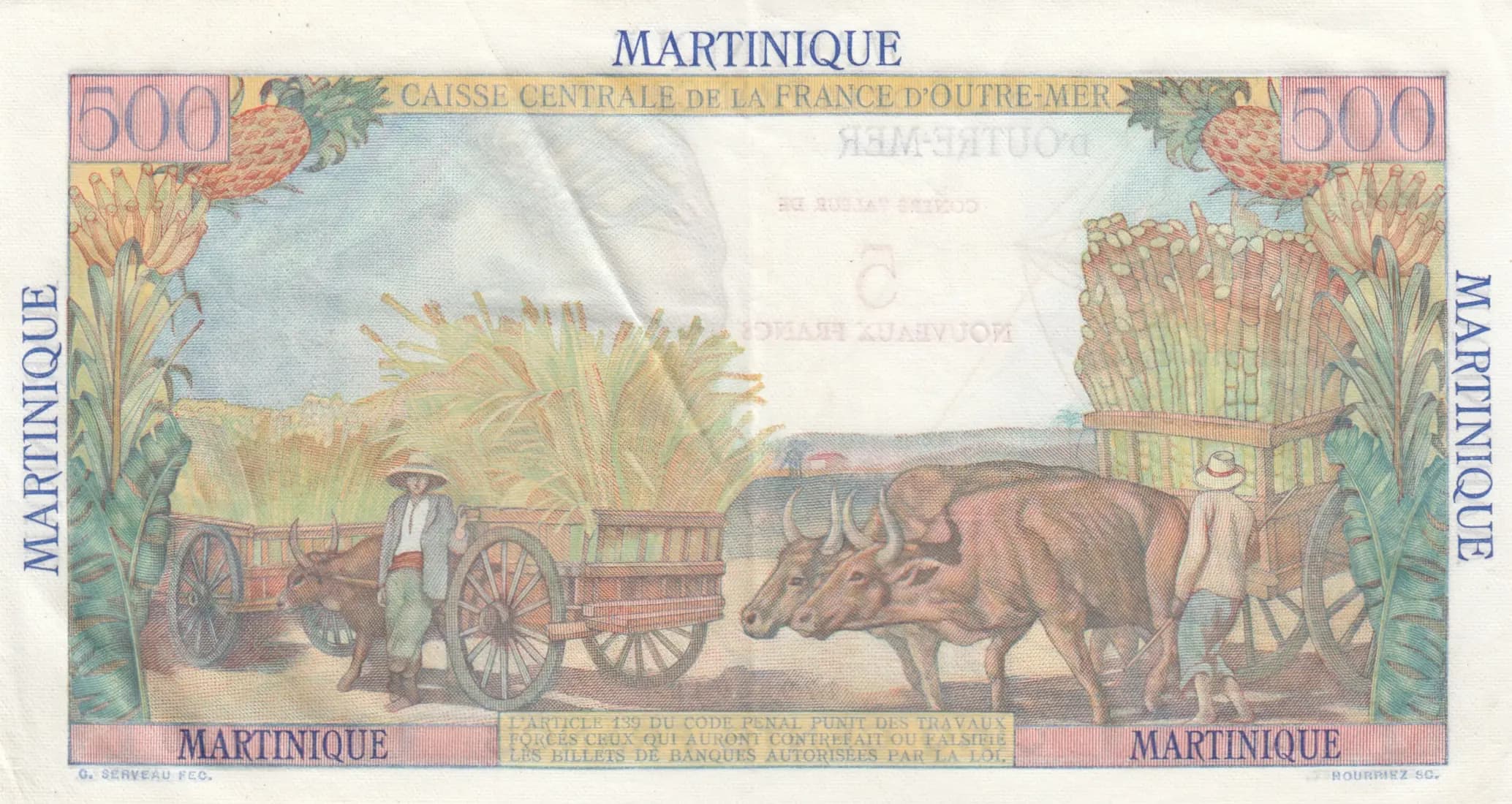
This VF-grade 500 francs banknote from Martinique (1963) represents a visually striking example of French colonial currency featuring rich tropical and cultural imagery. The note displays the characteristic fine line engraving work of its era, with vibrant multi-color printing in blues, oranges, greens, and pinks despite moderate aging and circulation creasing. The front presents two portrait busts of Martinique women in period dress alongside a colonial-era sailing ship and architecture, while the reverse depicts an agricultural scene with oxen-drawn cart and tropical vegetation, offering a compelling visual narrative of the island's colonial heritage.
common. This is a standard circulation issue from the Caisse Centrale de la France d'Outre-Mer with no indication of limited mintage, special status, or recall. French overseas colonial currency issues from the 1960s were produced in quantities sufficient for regional circulation in Martinique and remain relatively available in the modern collector market. The VF condition grade is moderate and achievable for circulation-era notes; neither exceptional nor problematic for rarity purposes.
This note was issued in 1963 by the Caisse Centrale de la France d'Outre-Mer (Central Bank of Overseas France) during a transitional period when Martinique held the status of an overseas department of France. The imagery reflects the colonial economic foundation of the island: the front honors Martinique's cultural and maritime heritage with its sailing ship and historical figures, while the reverse depicts the plantation agricultural economy (specifically sugarcane or banana cultivation with ox carts) that defined colonial Martinique's commerce and society.
The front of this note features two historically significant Martinique women depicted as busts wearing traditional patterned head wraps and period clothing characteristic of 18th-19th century Creole dress, positioned on the right side. To the left is a colonial-era sailing vessel with full rigging, rendered in the nautical tradition of French maritime design, accompanied by multi-story colonial architecture in warm earth tones suggesting the port cities of Martinique. Decorative palm frond motifs frame both sides, with geometric ornamental patterns creating depth and security. The reverse depicts a rural plantation scene central to Martinique's colonial economy: a man in period clothing with a wide-brimmed hat supervises oxen pulling a wooden cart laden with tropical agricultural produce (likely sugarcane or bananas). Tall palm trees and tropical vegetation frame this scene, with pineapple motifs decorating the corners—a symbol of tropical abundance. The overall color palette of blues, greens, oranges, and earth tones creates a cohesive Caribbean aesthetic while the intricate line work conveys both artistic value and security features.
FRONT SIDE: 'MARTINIQUE' (Martinique), 'CAISSE CENTRALE DE LA FRANCE D'OUTRE-MER' (Central Bank of Overseas France), '500' and 'CINQ CENTS FRANCS' (Five Hundred Francs), 'CENTRE VALEUR DE 5 NOUVEAUX FRANCS' (Face Value of 5 New Francs - indicating currency reform conversion), 'LE DIRECTEUR GÉNÉRAL' (The Director General), 'E.8' (series designation), serial numbers '35710' and '17935710', engraver credits 'G. SERVEAU FEC.' (G. Serveau made it/designed it) and 'G. BELTRAND SC.' (G. Beltrand engraved it). BACK SIDE: 'MARTINIQUE' (appears three times), 'CAISSE CENTRALE DE LA FRANCE D'OUTRE-MER' (Central Bank of Overseas France), '500' (denomination), 'ART. 139 DU CODE PÉNAL PUNIT DES TRAVAUX FORCÉS CELUI QUI AURA CONTREFAIT OU FALSIFIÉ LES BILLETS DE BANQUES AUTORISÉS PAR LA LOI' (Article 139 of the Penal Code punishes with forced labor anyone who counterfeits or falsifies banknotes authorized by law), engraver credits 'G. SERVEAU FEC.' (G. Serveau made it) and 'BOURRÉE SC.' (Bourrée engraved it).
This note was produced using traditional engraved intaglio printing, evidenced by the fine line work, intricate detail in portraiture and background patterns, and the characteristic texture visible in the visual analysis. The complex geometric patterns, multiple color printing layers creating depth and dimensional effects, and the quality of the portrait engraving all indicate professional bureau de gravure production. The multiple engravers credited (Serveau, Beltrand on the front; Serveau and Bourrée on the back) suggest division of labor typical of French banknote security printers of the 1960s, likely produced by Banque de France's affiliated security printing facility.
The Pick catalog records two variants under P-38: 'P-38' and 'P-38s', both listed as '5 Nouveaux Francs on 500 Francs'. The 's' suffix typically indicates a specimen note or special variety, though the visual analysis does not provide definitive indicators of specimen designation (such as 'SPECIMEN' overprints or perforations). The presence of serial numbers (35710, 17935710) and the circulation wear visible in the images indicate this is a regular issued note (P-38) rather than the specimen variety (P-38s). The engraver signatures and series designation 'E.8' are consistent with standard production variants of this issue.