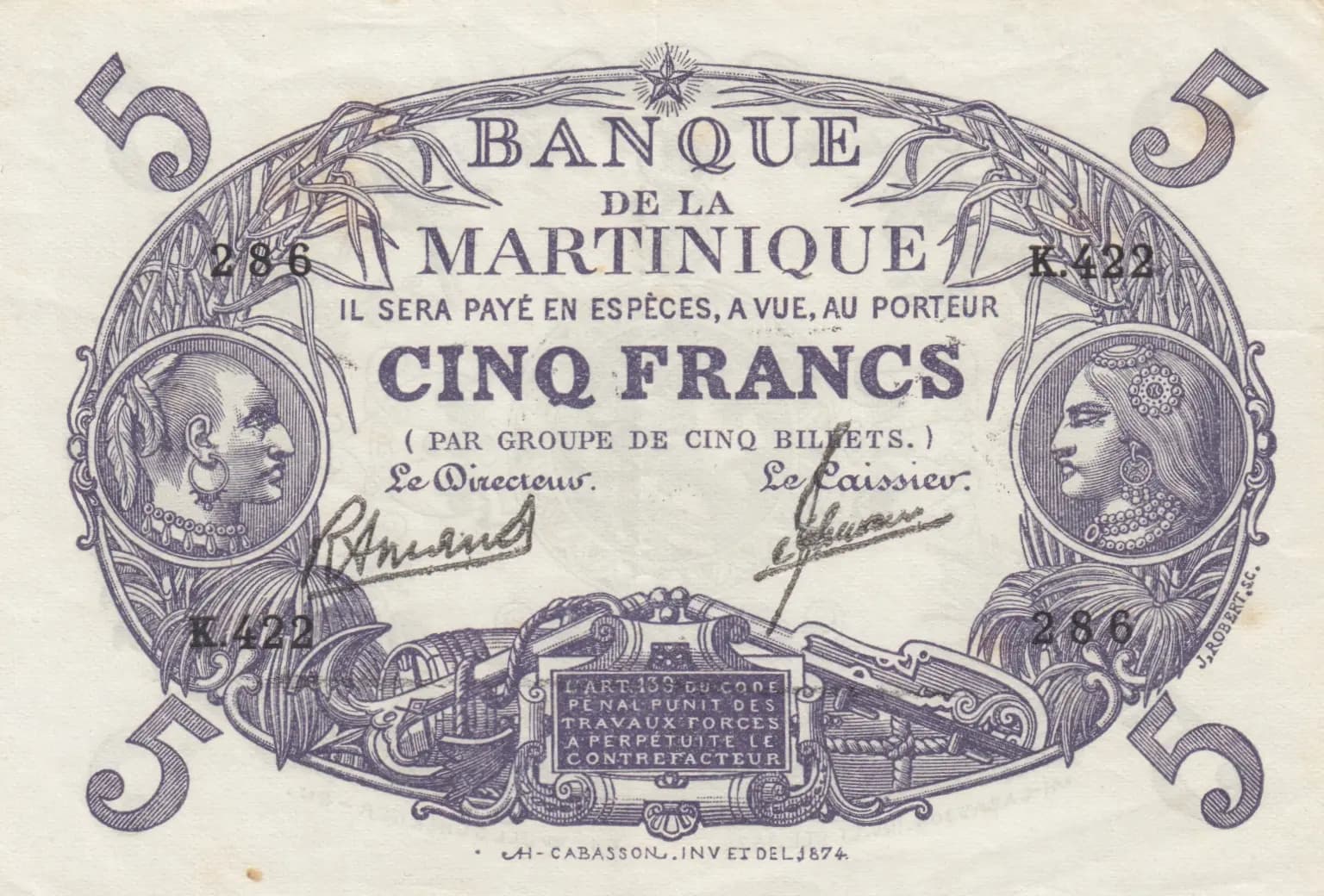
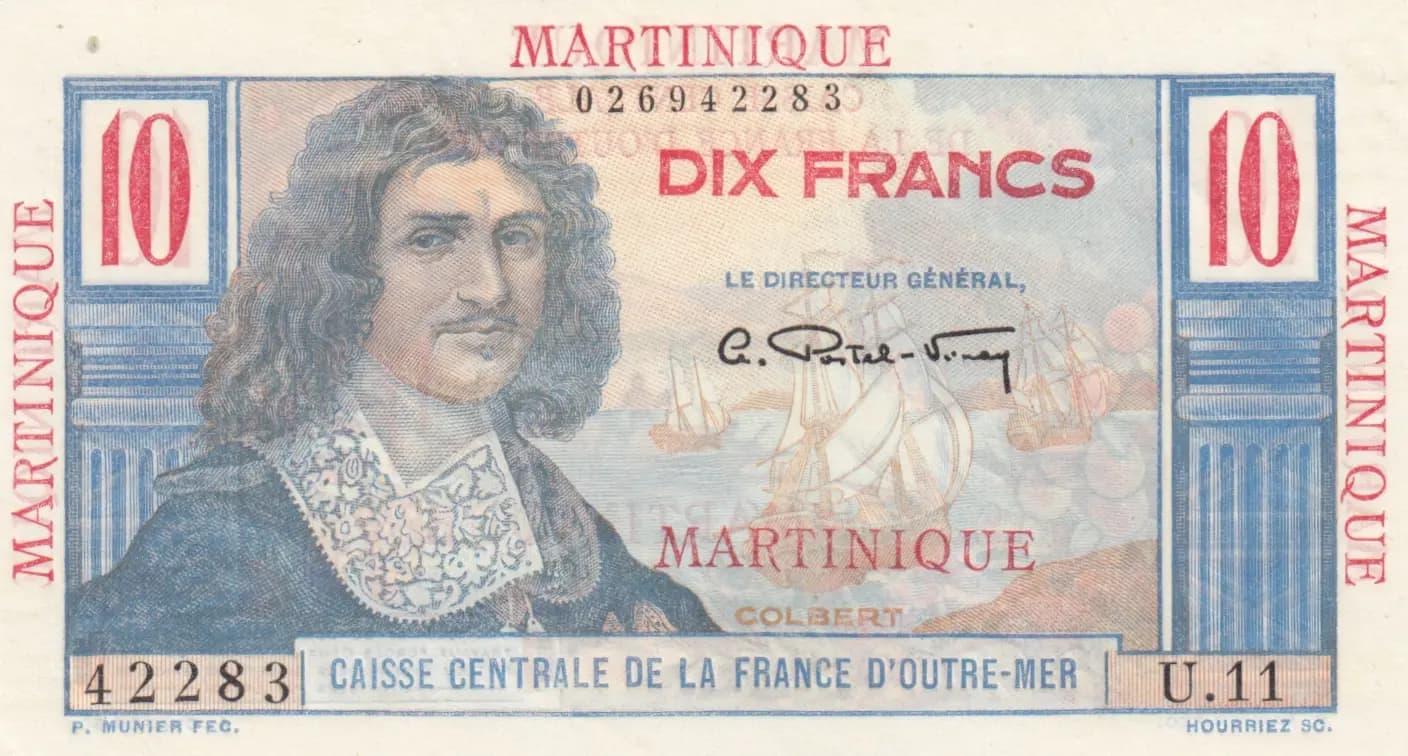
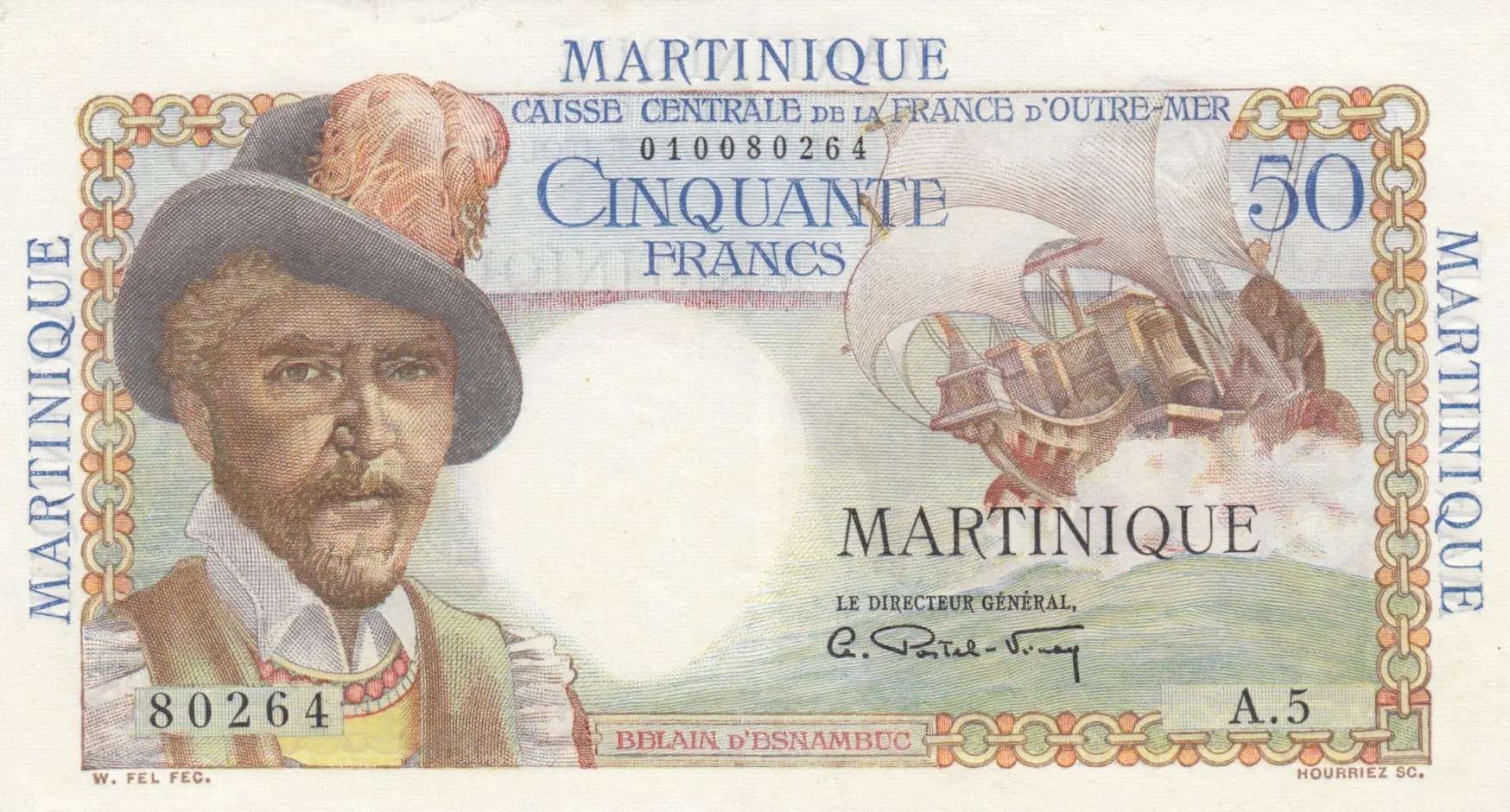
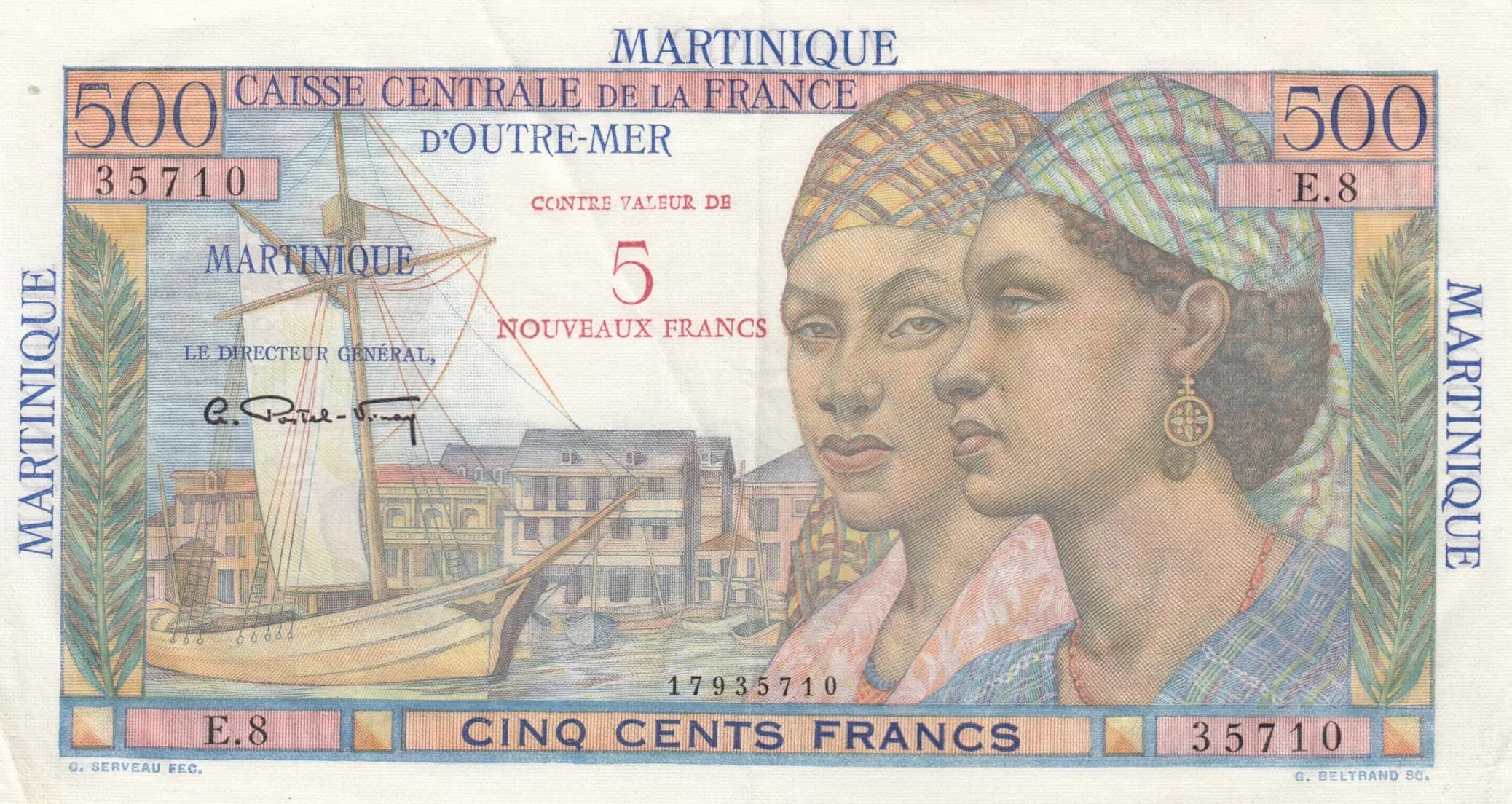
5 francs 1947
About This Note
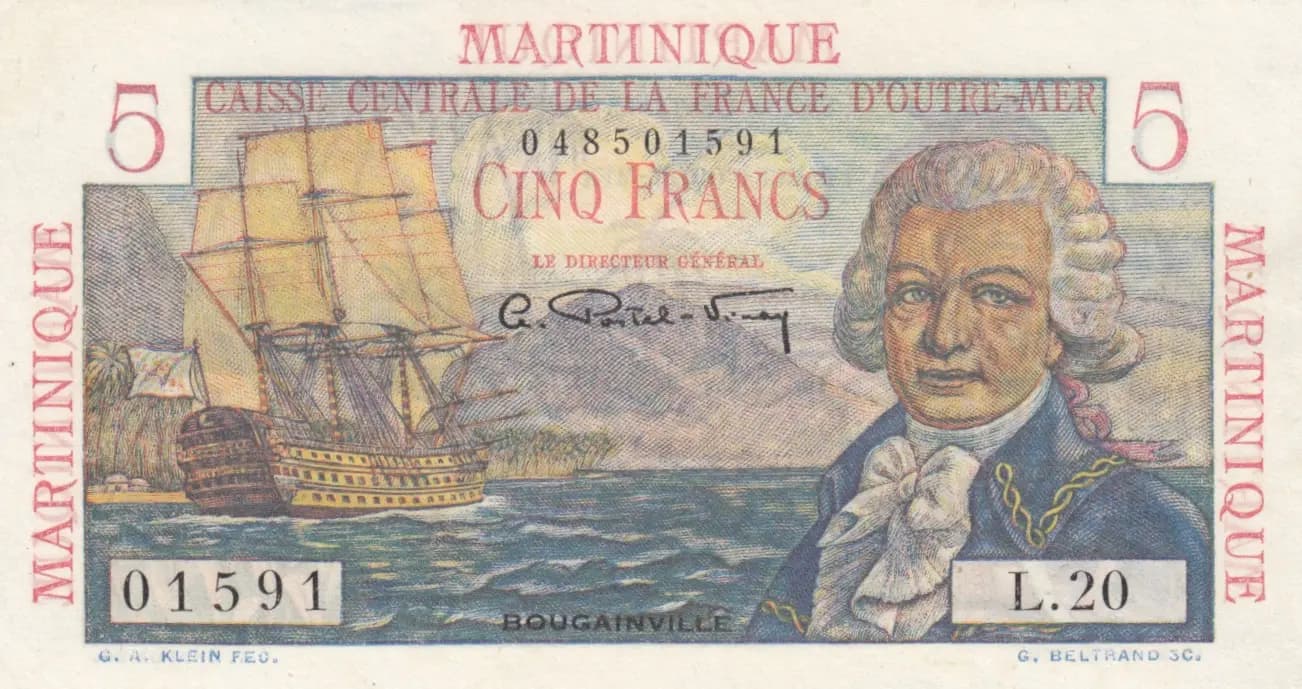
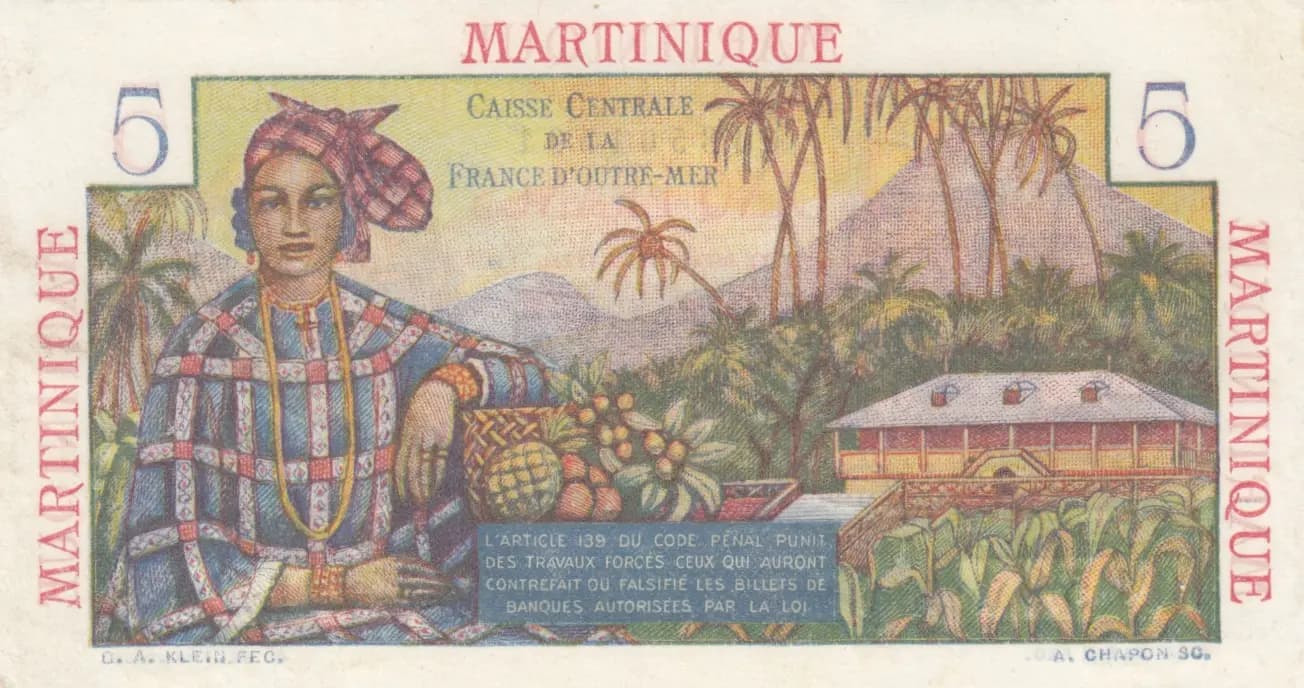
This 1947 Martinique 5 Francs note (Pick P-27) from the Caisse Centrale de la France d'Outre-Mer represents a beautifully designed colonial-era currency featuring nautical and tropical themes. The UNC graded specimen displays the characteristic pink-red and blue-gray obverse with a sailing ship and 18th-century portrait, paired with a vibrant reverse depicting traditional Caribbean life and tropical colonial architecture. Despite the catalog grade, visual inspection reveals age-appropriate handling wear including creasing and minor foxing, making this an authentic, well-preserved example of post-war French overseas currency.
Common. The 1947 Martinique 5 Francs note was produced in substantial quantities by the Caisse Centrale de la France d'Outre-Mer for general circulation in the post-war period. No evidence suggests a limited print run, early recall, or exceptional scarcity. While visually attractive and historically significant as a colonial-era note, these notes remain readily available to collectors at modest prices, typically ranging from $10-30 USD depending on condition and specific variety.
Issued in 1947 by the Caisse Centrale de la France d'Outre-Mer (Central Treasury of Overseas France), this note reflects the immediate post-World War II period when France reasserted control over its colonial territories. The obverse features a historical figure in 18th-century dress alongside a merchant sailing vessel, representing France's maritime colonial heritage, while the reverse depicts a woman in traditional Creole dress with tropical fruits and a colonial plantation house, symbolizing the economic foundation of the Caribbean colony and its cultural identity under French overseas administration.
The obverse features a historical portrait identified as depicting a notable French figure from the 18th century, shown in formal dress with powdered wig, white cravat, and blue coat with decorative chain, positioned on the right side of the note. The left side showcases a multi-masted merchant or naval sailing vessel with tan-colored sails on open ocean, representing France's maritime commercial dominance. The reverse depicts a woman in traditional Creole/Caribbean dress characterized by a colorful checkered blue and red headwrap and dress, adorned with gold jewelry and neck ornaments, positioned on the left. The central and right portions feature a colonial-era wooden plantation house with pitched metal roof set within a lush tropical landscape of towering palm trees, pineapples, bananas, and other tropical flora, with mountainous terrain visible in the background. The entire design is framed by ornate decorative borders incorporating geometric patterns and filigree work. The color palette shifts from cool pink-red and blue-gray tones on the obverse to warm yellow-green and blue-purple tones on the reverse, reflecting the transition from historical/administrative imagery to colonial economic and cultural themes.
{"front":{"primary":"MARTINIQUE / CAISSE CENTRALE DE LA FRANCE D'OUTRE-MER / CINQ FRANCS","translation":"Martinique / Central Treasury of Overseas France / Five Francs","administrative":"LE DIRECTEUR GÉNÉRAL (The Director General)","credits":"G. A. KLEIN FEC. (Engraved by G. A. Klein) / G. BELTRAND SC. (Sculpted by G. Beltrand)","identifier":"L.20 (Code designation) / Serial: 048501591 / 01591"},"back":{"primary":"MARTINIQUE / CAISSE CENTRALE DE LA FRANCE D'OUTRE-MER / 5","translation":"Martinique / Central Treasury of Overseas France / 5","legal":"L'ARTICLE 139 DU CODE PÉNAL PUNIT DES TRAVAUX FORCÉS CEUX QUI AURAIENT CONTREFAIT OU FALSIFIÉ LES BILLETS ET BANQUES AUTORISÉES PAR LA LOI.","legalTranslation":"Article 139 of the Penal Code punishes with forced labor those who have counterfeited or falsified banknotes authorized by law.","credits":"G. A. KLEIN FEC. (Engraved by G. A. Klein) / A. CHAPON SC. (Sculpted by A. Chapon)"}}
This note was produced using traditional intaglio engraving (fine line engraving) combined with multi-color letterpress printing. The complex geometric border patterns, fine detailed shading in the portrait and ship illustration, and the intricate botanical detailing visible on the reverse are characteristic of high-security intaglio work. The multiple color layers, particularly the distinct color separation between obverse and reverse, indicate sophisticated multi-plate printing coordination typical of French security printers of the 1940s era. The Banque de France or its designated security printer (likely Bradbury Wilkinson or a French equivalent) produced this note using the standards established for overseas colonial currency.
The observed specimen corresponds to Pick P-27 with the Sailing Ship watermark. PMG has catalogued two variants for this base Pick number: P-27 (standard) and P-27s (specimen). This appears to be a standard circulation note (P-27) rather than a specimen, based on the serial number (048501591) and lack of specimen overprinting visible in the images. The 'L.20' designation code appears consistent with standard 1947 issue variants. Serial number placement and format align with documented circulation examples of this series.