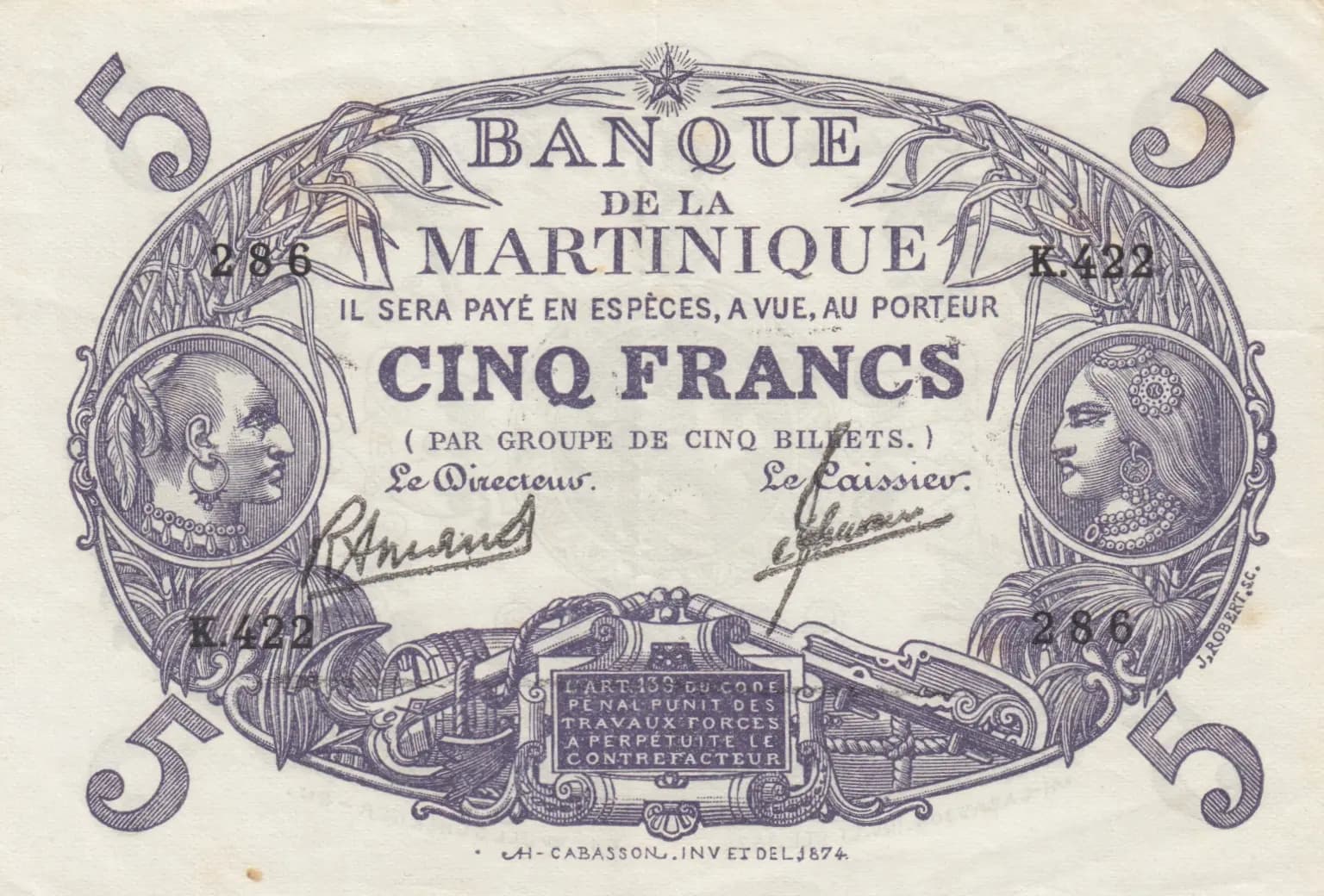
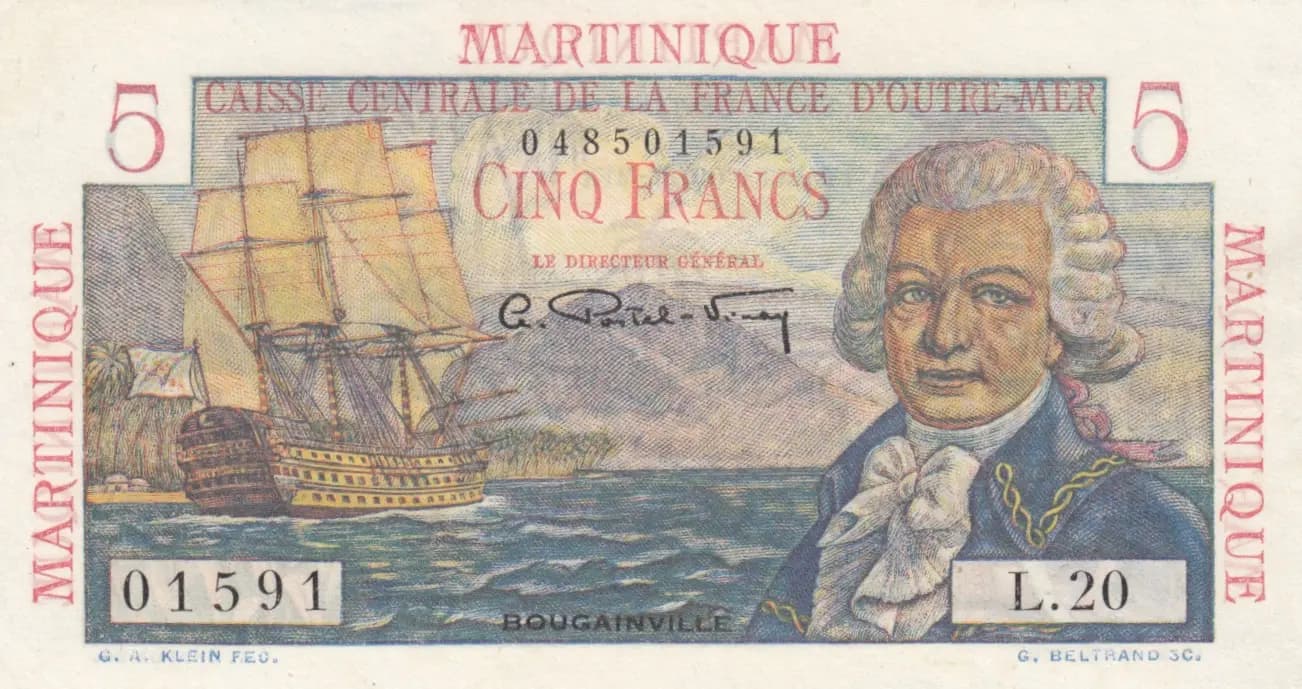
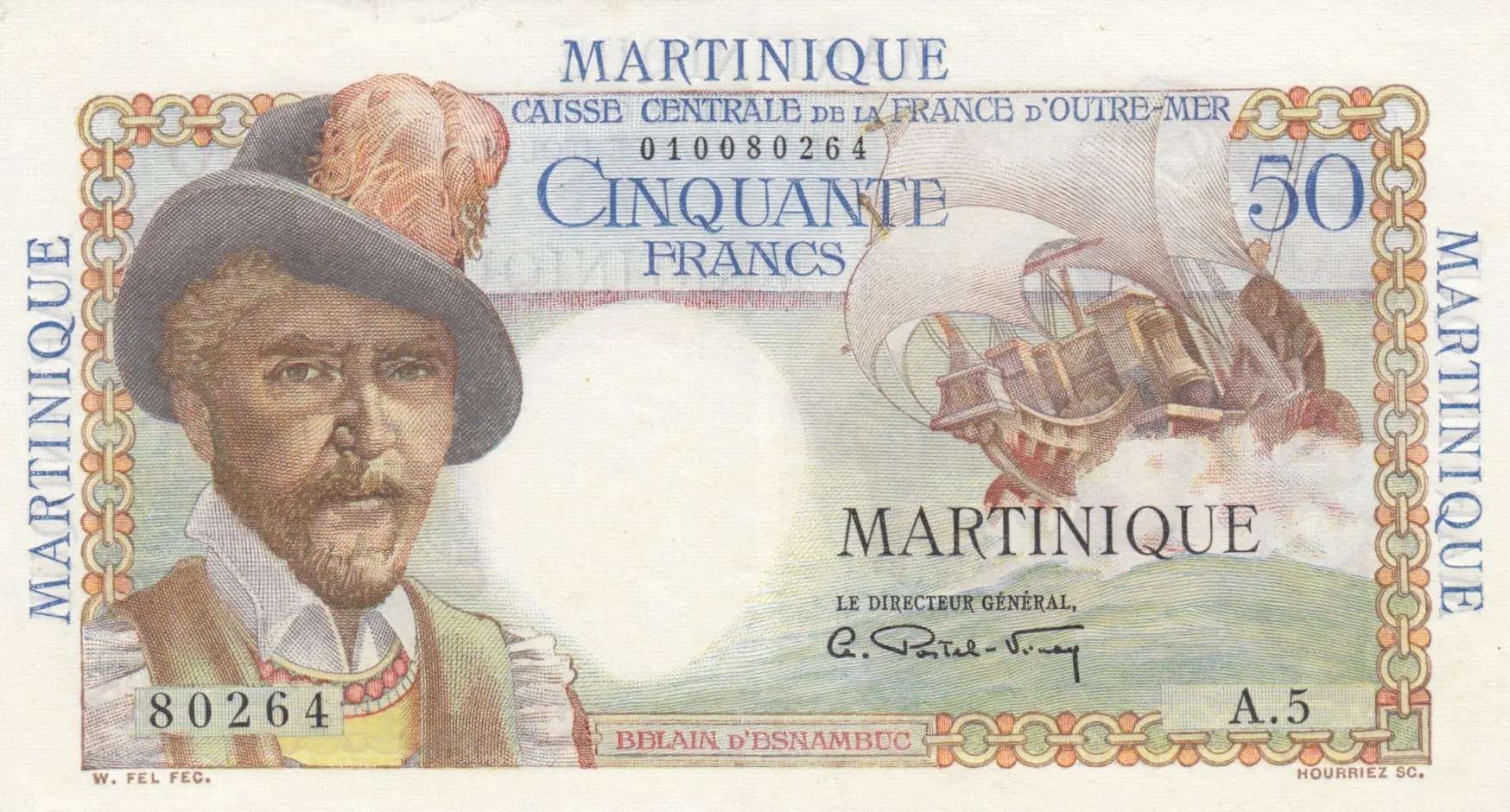
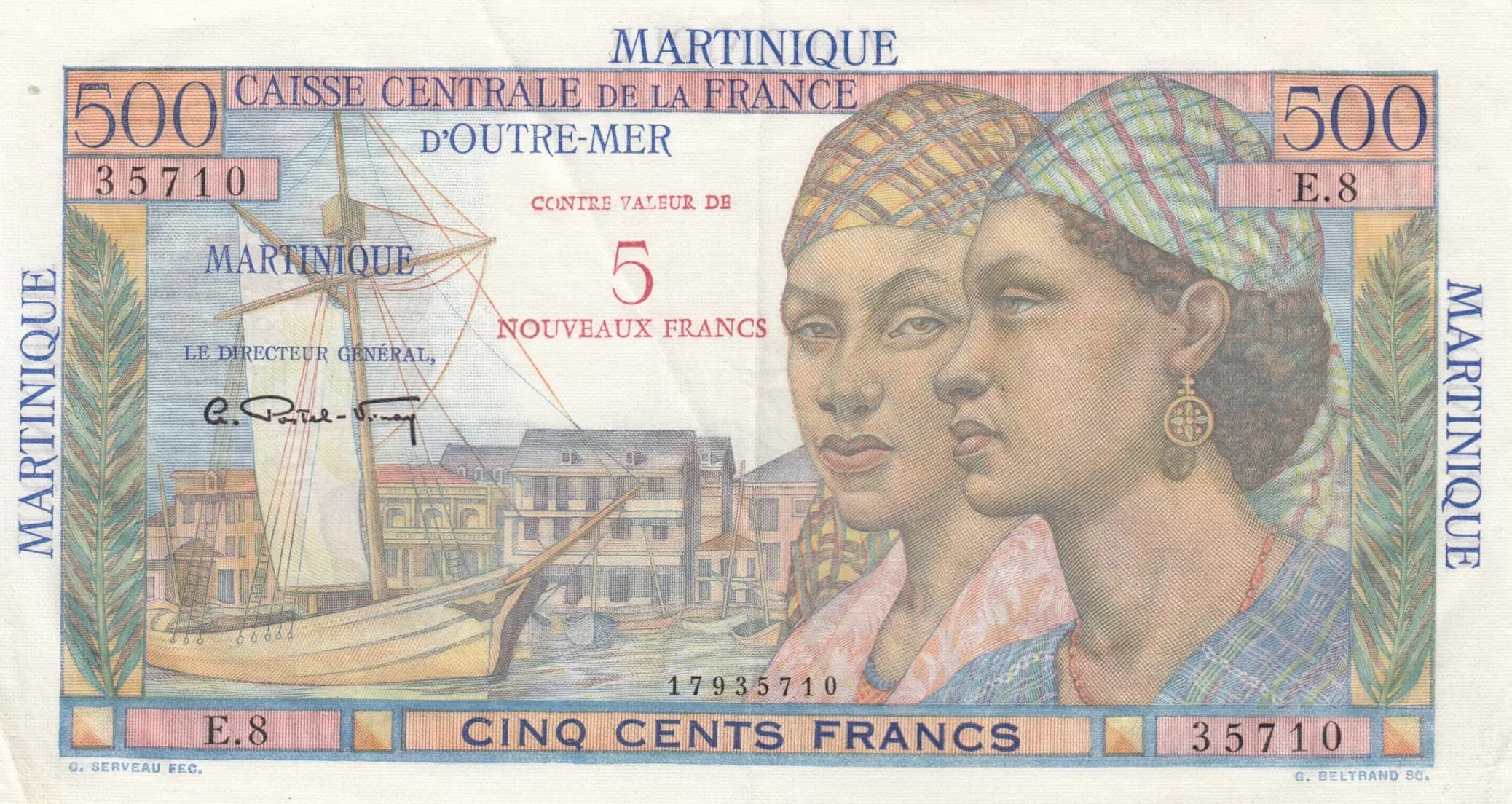
10 francs 1947
About This Note
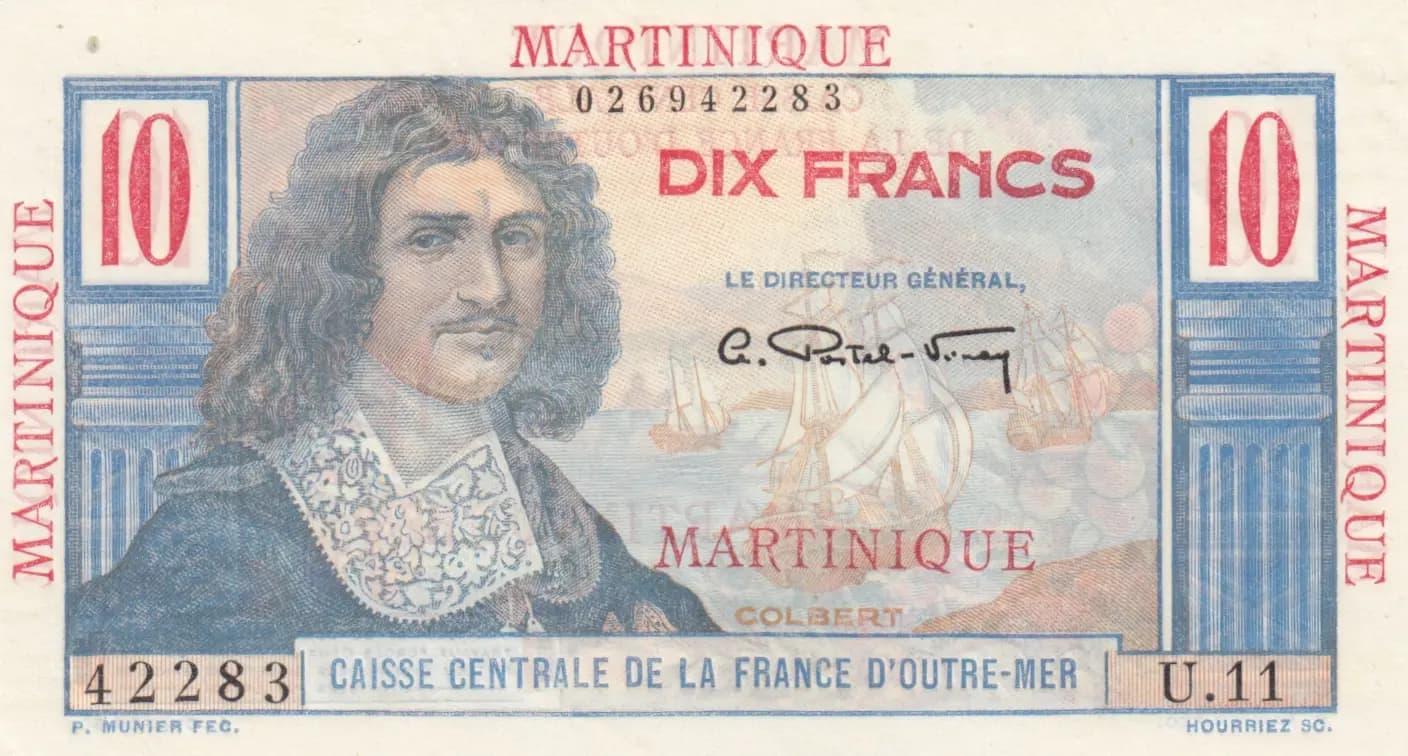
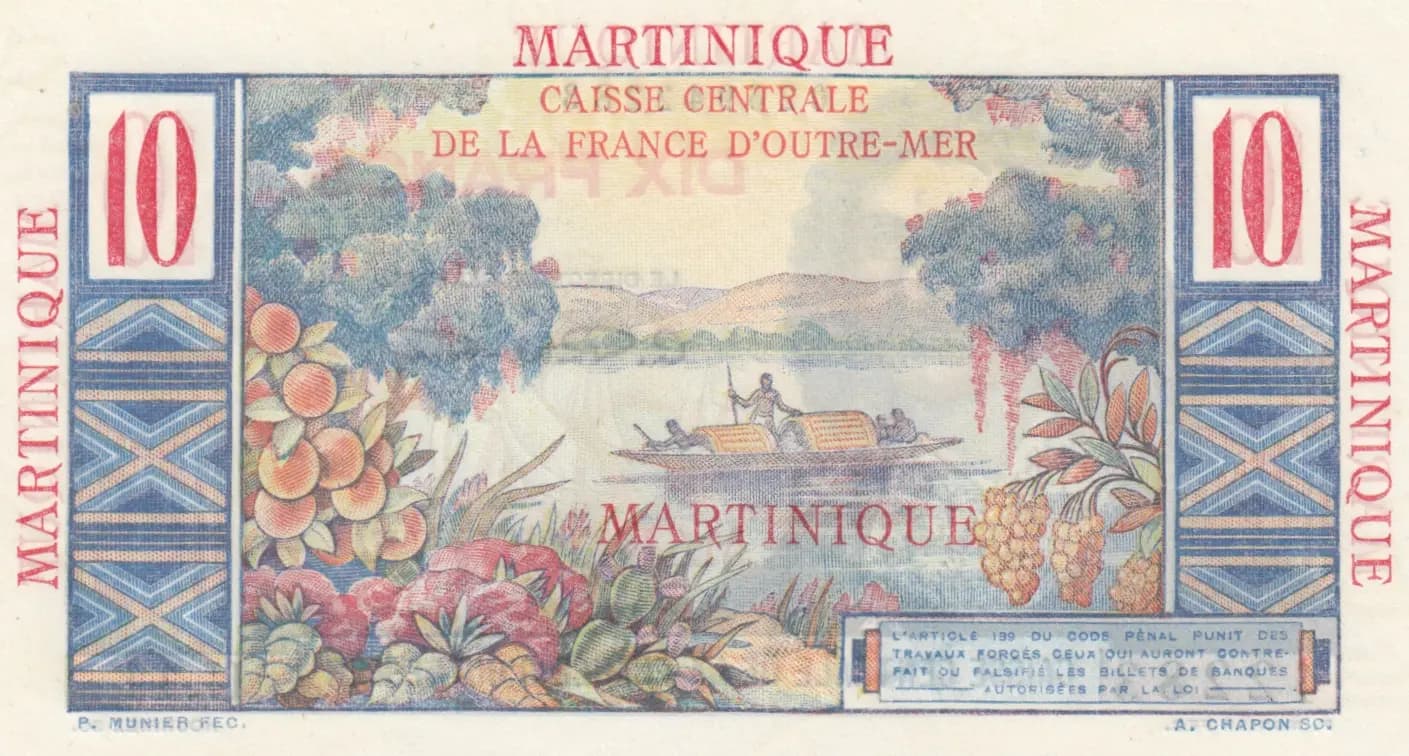
This is an exceptionally well-preserved 1947 Martinique 10 francs note issued by the Caisse Centrale de la France d'Outre-Mer, graded UNC with minimal handling marks. The front features an elegant portrait of Jean-Baptiste Colbert in 17th-century dress with characteristic long curled hair and ornate lace collar, complemented by a maritime scene with sailing ships, while the reverse depicts a romantic tropical landscape with local fruits, vegetation, and river activity. The fine engraving, bold red denomination numerals, and decorative blue borders showcase the skilled artistry of engravers P. Munier and A. Chapon, making this a visually striking and historically significant colonial-era note.
Common. The Caisse Centrale de la France d'Outre-Mer issued substantial quantities of colonial currency across all overseas territories during the 1947-1960 period. The P-28 denomination and type were produced in regular commercial quantities for everyday circulation in Martinique, and surviving examples in all grade levels remain readily available to collectors. UNC examples are moderately common in the market, with no documented scarcity or recall issues that would elevate this note's rarity status.
Issued in 1947, this note represents the post-World War II period of French colonial administration in Martinique under the centralized control of the Caisse Centrale de la France d'Outre-Mer. The portrait of Jean-Baptiste Colbert, the 17th-century French statesman and economic minister, reflects France's emphasis on colonial economic history and the administrative legacy that shaped overseas French territories. The reverse's idyllic depiction of tropical abundance—with citrus fruits, maritime trade vessels, and lush vegetation—symbolized the economic wealth and natural resources that defined Martinique's colonial significance to metropolitan France.
The obverse features a historically significant portrait of Jean-Baptiste Colbert (1619-1683), the influential French statesman whose mercantilist policies shaped colonial expansion, rendered in three-quarter view with his characteristic long curled periwig and elaborate lace-trimmed coat collar typical of 17th-century aristocratic portraiture. The background maritime vignette depicts sailing vessels on open water, symbolizing France's naval power and mercantile dominance. The reverse showcases a picturesque tropical landscape composition centered on a river or coastal waterway with small boats carrying figures, framed by lush Martinique flora including what appear to be orange or citrus fruits on the left and grape vines on the right, with distant mountains completing the idyllic colonial scene. Both sides employ a blue decorative border frame with geometric patterns (diamond and chevron motifs), while the denomination appears as large red numerals in rectangular boxes positioned at the left and right edges of the front.
FRONT SIDE: 'MARTINIQUE' (territory identification); 'DIX FRANCS' (ten francs, denomination); 'COLBERT' (portrait identification); 'CAISSE CENTRALE DE LA FRANCE D'OUTRE-MER' (Central Treasury of Overseas France, issuing authority); 'LE DIRECTEUR GÉNÉRAL' (The Director General); 'U.11' (designation code); 'P. MUNIER FEC.' (P. Munier engraved this); 'HOURRIEZ SC.' (Hourriez sculptor/engraver); Serial number: '0269442283'. BACK SIDE: 'MARTINIQUE' (repeated territory identification); 'CAISSE CENTRALE DE LA FRANCE D'OUTRE-MER' (issuing authority); 'L'ARTICLE 199 DU CODE PÉNAL PUNIT DES TRAVAUX FORCÉS, CEUX QUI AURAIENT CONTREFAIT OU FALSIFIÉ LES BILLETS DE BANQUES AUTORISÉS PAR LA LOI' (Article 199 of the Penal Code punishes by forced labor those who counterfeit or falsify banknotes authorized by law); 'P. MUNIER FEC.' (engraver mark); 'A. CHAPON SC.' (A. Chapon sculptor/engraver); Denomination: '10' (repeated).
This note was produced using traditional intaglio (engraved) printing, evident from the fine line work, cross-hatching patterns, and relief-printed characteristics visible throughout the design. The dimensional depth of the portrait, the precise detail in the maritime and landscape scenes, and the crisp geometric borders all indicate steel plate engraving. The color work—red, blue, green, orange, and brown hues—suggests multi-plate printing or supplementary color application typical of high-security banknote production. The engravers credited (P. Munier, Hourriez, and A. Chapon) were skilled artisans whose signatures appear as authentication marks.
This note is identified as Pick-28 (P-28) with the Sailing Ship watermark as documented in the PMG population report. The visual analysis confirms the expected design elements for this standard issue. The serial number observed (0269442283) and the designation code 'U.11' are consistent with regular production examples. PMG catalogues one primary variant (P-28) and one specimen variant (P-28s) for this base Pick number, indicating minimal variety differentiation within the standard circulation issue.