5 francs 1934
About This Note
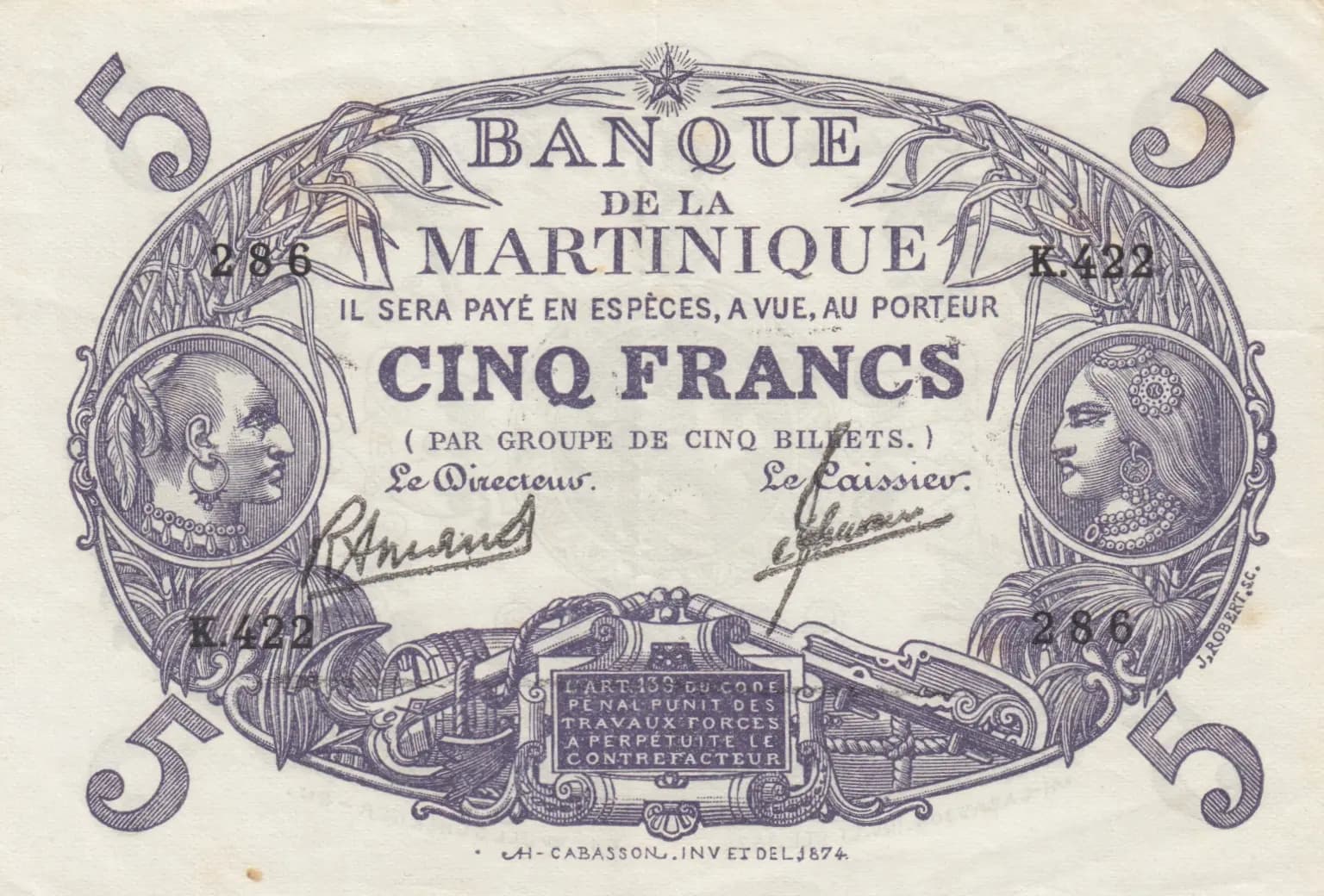
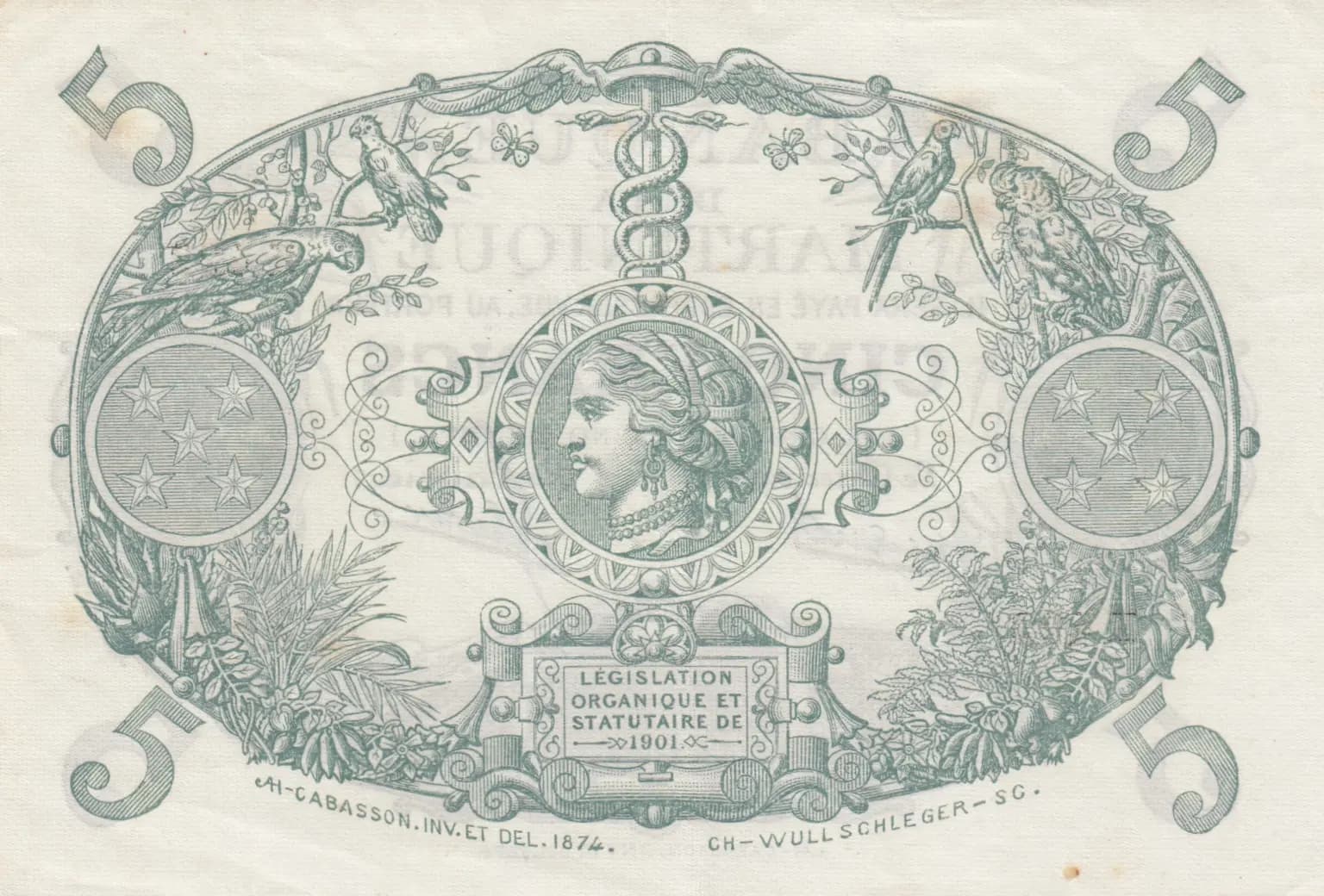
This VF-grade 5 Francs note from Banque de la Martinique (1934, Pick P-6) showcases fine engraved design work characteristic of early 20th-century French colonial banking. The obverse features dual portrait medallions in purple ink with ornate leafy borders, while the reverse displays an allegorical female profile and tropical imagery in green ink, reflecting Martinique's colonial aesthetic. Though showing natural aging with light foxing and cream-toned paper, the note retains excellent clarity and contrast, making it an attractive historical specimen of Caribbean colonial currency.
Common. The 5 Francs denomination from Banque de la Martinique (Pick P-6) represents standard circulating currency from a colonial banking institution. No documented evidence of extremely limited print runs, early recall, or short-lived issue periods suggests scarcity. While pre-World War II colonial banknotes have historical interest and are less frequently encountered than modern currency, they were issued in substantial quantities for circulation in Martinique's economy. VF-condition examples remain attainable in the collector market at moderate prices typical of common historical banknotes.
This note was issued by Banque de la Martinique during the interwar period, a time when French colonial territories maintained their own currency-issuing institutions. The allegorical female figure and caduceus on the reverse symbolize commerce and prosperity under French colonial administration, while the reference to '1901 Legislation' on the back reflects the administrative framework governing the island's banking operations. The design incorporates tropical elements—parrots and flowering plants—emphasizing Martinique's colonial identity and natural wealth within the French empire.
The obverse features two classical portrait medallions set within an ornate decorative border: a male profile (left) and female profile (right), both rendered in fine engraving with period dress and jewelry. The central text proclaims the issuing authority and redemption promise. A central star crowns the decorative scheme with elaborate leafy vine motifs framing the entire composition. The reverse displays a neoclassical allegorical female figure (likely representing Liberty, Commerce, or Prosperity—a common motif in French colonial currency) in a prominent circular medallion, flanked by four-pointed stars and tropical botanical imagery including parrots and flowering plants. A caduceus (winged staff with entwined serpents) at the top reinforces themes of commerce and trade. The engraved designs were created by artist A.H. Cabasson (originally designed 1874) and sculptor Ch. Wullschleger, reflecting the classical European design tradition adapted for colonial circulation.
FRONT SIDE: 'BANQUE DE LA MARTINIQUE' (Bank of Martinique); 'IL SERA PAYÉ EN ESPÈCES, A VUE, AU PORTEUR' (It will be paid in cash, on sight, to the bearer); 'CINQ FRANCS' (Five francs); 'PAR GROUPE DE CINQ BILLETS' (By group of five bills); 'Le Directeur' (The Director); 'Le Caissier' (The Cashier); 'L'ART.433 DU CODE PÉNAL PUNIT DES TRAVAUX FORCÉS A PERPÉTUITÉ LE CONTREFACTEUR' (Article 433 of the Penal Code punishes counterfeiting with perpetual hard labor); 'AH-CABASSON, INVET DEL 1874' (A.H. Cabasson, invented and drew, 1874); Serial notations '2886' and 'R 422'. REVERSE SIDE: 'LÉGISLATION ORGANIQUE ET STATUTAIRE DE 1901' (Organic and statutory legislation of 1901); 'AH-CABASSON, INV. ET DEL. 1874' (A.H. Cabasson, invented and drew, 1874); 'CH-WULLSCHLEGER-SC' (Ch. Wullschleger, sculptor).
Intaglio engraving (fine line engraving), the standard security printing method for banknotes of this era. The purple ink used on the obverse and green ink on the reverse are characteristic of early 20th-century colonial French banknote production. The note exhibits the deep, crisp line work and fine detail typical of intaglio printing, which served as the primary anti-counterfeiting measure. The specific engraver attributions suggest production by a specialized security printer associated with the Banque de la Martinique, likely a French or Franco-Antillean printing facility.
The catalog identifies two variants (P-6 and P-6A) for this denomination. This specimen appears to be P-6 based on standard design characteristics. Variety determination would require comparison of signature styles, date variations, or serial number prefixes with documented P-6 versus P-6A specifications. The observed serial notation 'R 422' may represent a series identifier. Collectors should consult current Pick catalogs or PMG population data to definitively identify variant status and relative scarcity between P-6 and P-6A.