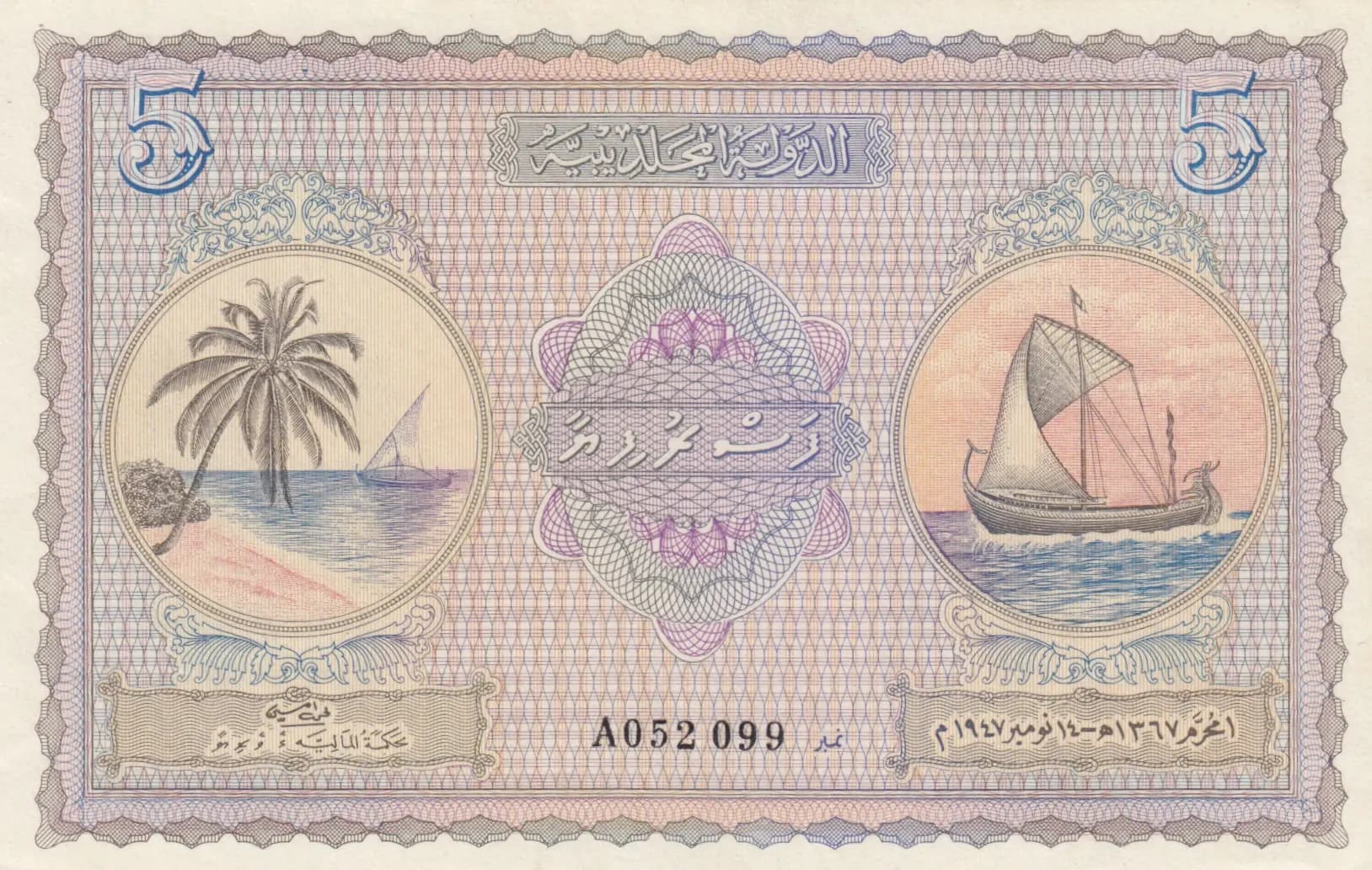
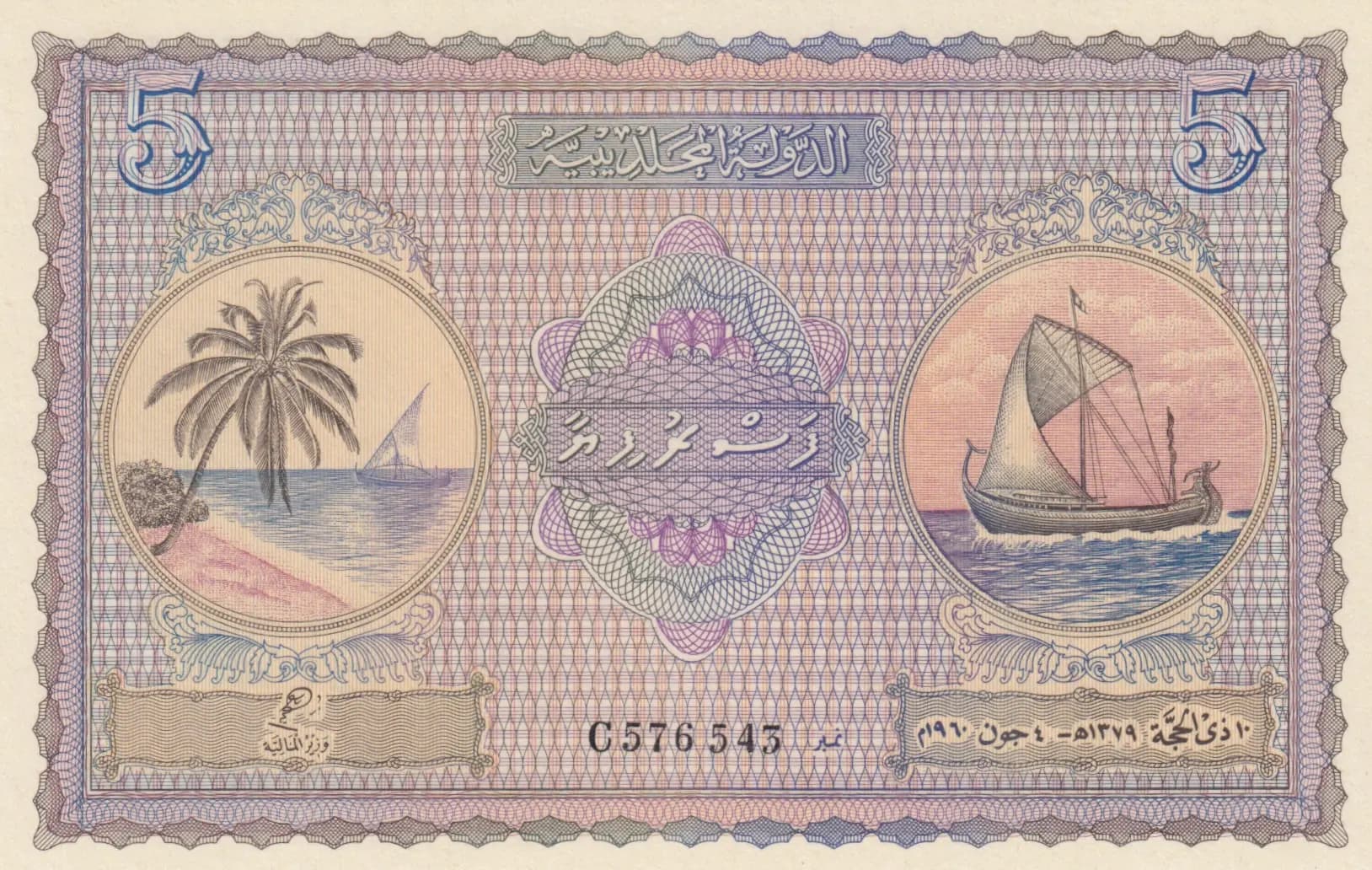
5 rupees 1960
Market Prices
25 salesAbout This Note
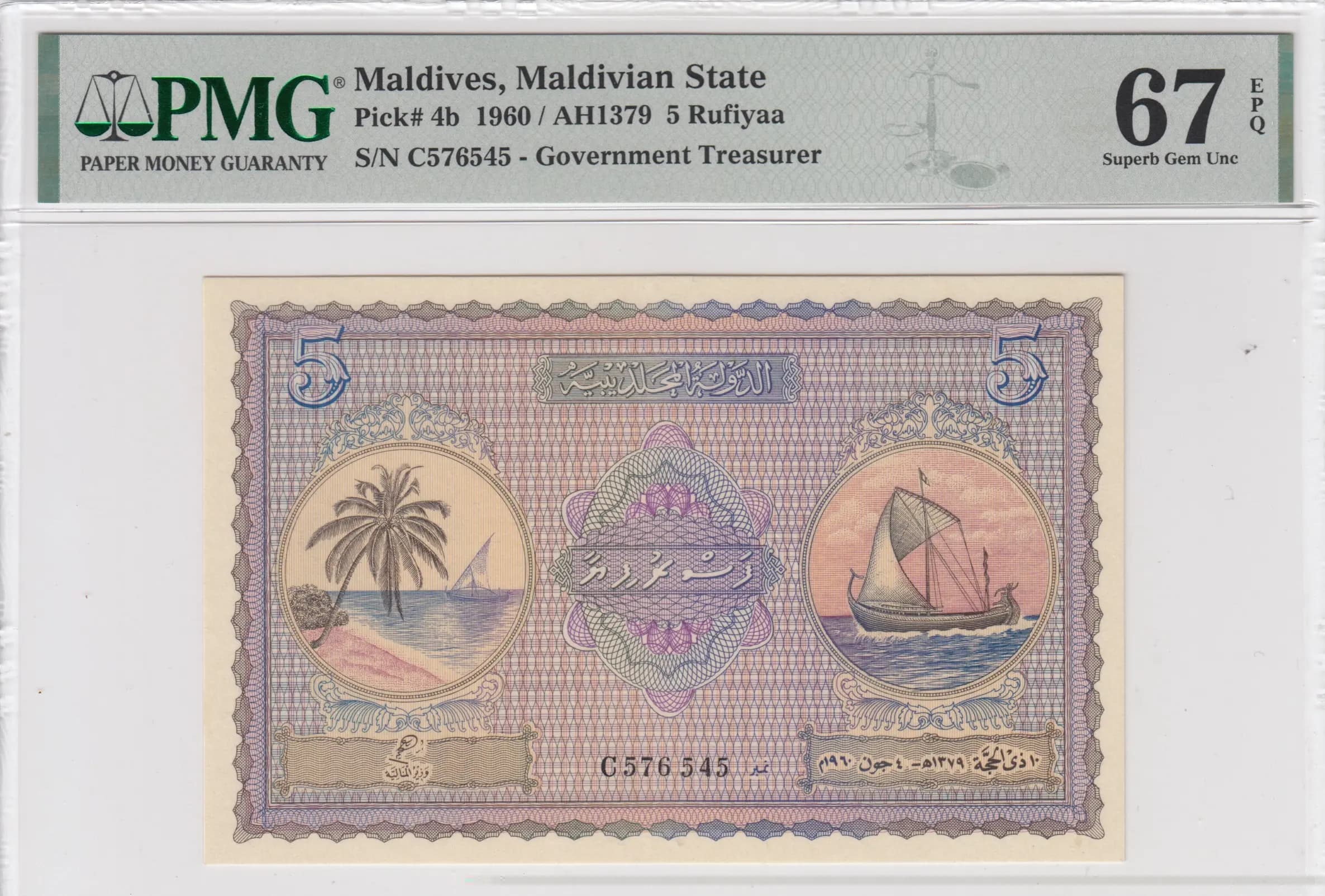
This is a PMG 67 EPQ example of the 1960 Maldivian 5 Rufiyaa (Pick P-4b), representing an early issue from the newly independent nation. The note displays exceptional preservation with vibrant purple and pink coloration, sharp printing throughout, and pristine paper condition showing no signs of circulation. The dual vignettes of a palm tree and traditional dhow sailing vessel on the obverse, coupled with the architectural gateway depicted on the reverse, make this an aesthetically significant piece of Maldivian numismatic history.
Common. While early Maldivian currency is increasingly scarce in high grades, eBay market data shows consistent sales activity for this Pick number across multiple condition grades, with PMG 67 examples regularly realizing prices between $50–$115 USD in recent years (2019–2024). The 2016 catalog valuation of $15 UNC reflects broad collector availability, and the absence of evidence of severe print run restrictions, recalls, or short-lived issuing status indicates this was a standard circulation issue. This grade's market performance ($53–$113.50 range in recent comparable sales) confirms it as a desirable but not genuinely scarce variety.
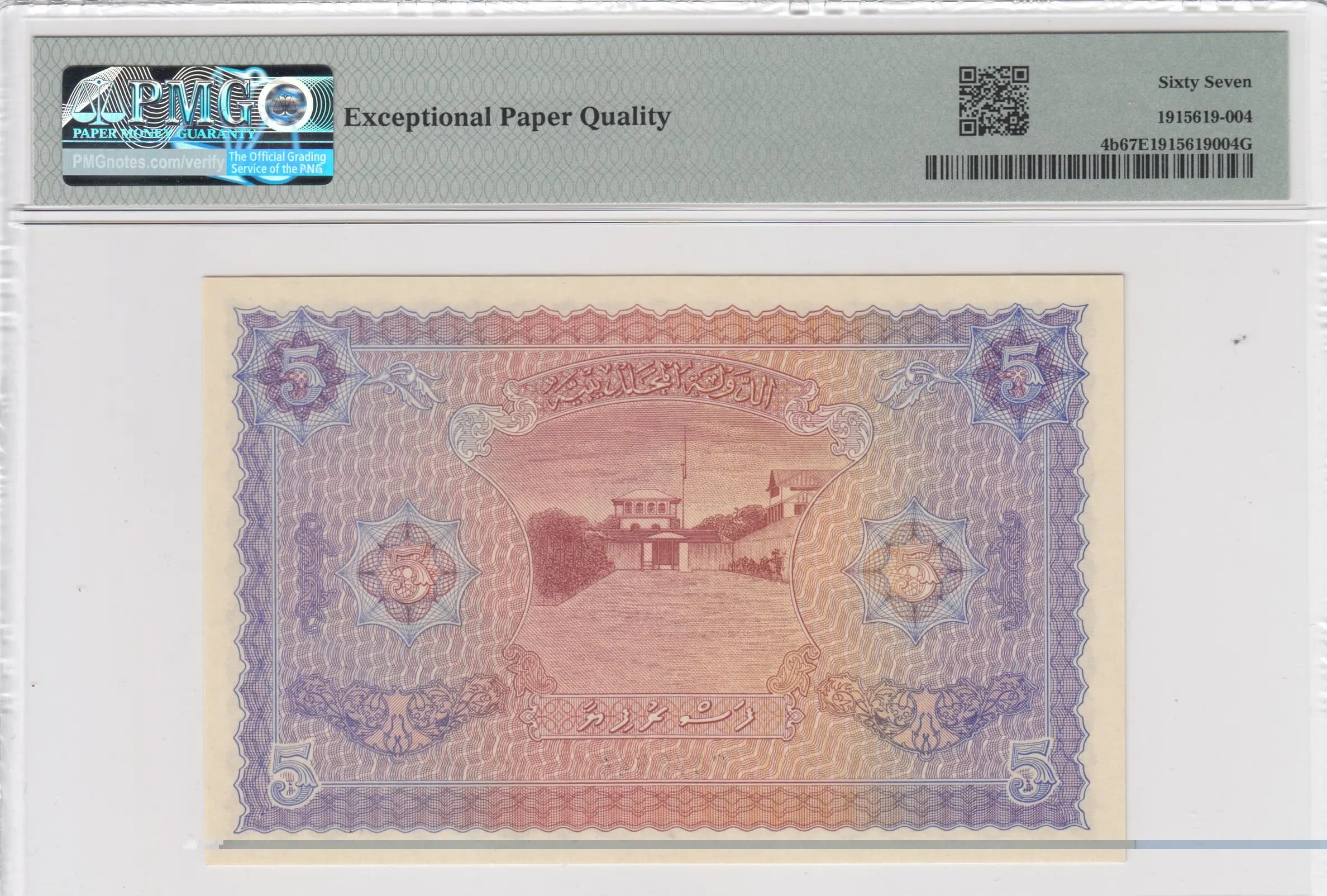
Issued in 1960 by the Maldivian State Treasury, this banknote commemorates the Maldives' transition to independence and establishment of its own currency system. The imagery—featuring the palm tree and dhow (traditional sailing vessel)—reflects the maritime and tropical character fundamental to Maldivian identity and economy. The architectural vignette on the reverse, identified as the Sakkaranya gate of the Sultan's palace court (Eterekoilu), symbolizes the sultanate's enduring institutional authority during this pivotal period of nation-building.
The obverse features a carefully balanced composition with two circular vignettes: the left vignette depicts a coastal palm tree scene representative of the Maldives' tropical island environment, while the right vignette showcases a traditional dhow (the iconic sailing vessel of the Indian Ocean trade). These are framed by an ornate geometric medallion at the center and surrounded by intricate Islamic geometric border patterns characteristic of early Maldivian currency design. The reverse presents the Sakkaranya gate—a principal architectural entrance to the court of the Eterekoilu (Sultan's palace)—rendered as the dominant central vignette against a landscape background. The overall design employs sophisticated Islamic geometric motifs throughout the decorative borders and corner ornaments, with denomination markers '5' placed in all four corners within decorative frames.
Front side: 'الجمهورية المالديفية' (Maldivian Republic), denomination markers '5' in decorative corner frames, Islamic calendar date '١٣٧٩' (AH 1379), Gregorian calendar year '١٩٦٠' (1960), and serial number 'C576545'. Back side: 'الجمهورية المالديفية' (Maldivian Republic) and denomination '5' in corner ornaments. All inscriptions employ both Arabic script and Arabic numerals consistent with the nation's cultural and administrative conventions of the period.
This note was produced using intaglio engraving and letterpress printing methods, evident from the fine detail work, complex cross-hatching patterns, and crisp line reproduction visible throughout both sides. The intricate geometric patterns, fine line work in the vignettes, and sophisticated security printing designs characteristic of 1960s British currency production standards suggest this issue was likely produced by a leading London-based security printer, though specific attribution requires archival confirmation. The multi-color printing technique employed for the purple, pink, brown, and accent colors indicates separate engraved plates for each color application.
This note is cataloged as Pick P-4b, one of five documented variants for the base Pick number 4 (variants include P-4a, P-4as, P-4b, P-4bs, and P-4s). The 'b' designation indicates this is a specific variant within the 1960 series, likely distinguished by printer marks, signature varieties, or date variations. The serial number C576545 and the documented date of 1960/AH1379 are consistent with regular issue parameters for this variety. No overprints, signatures, or other distinguishing modifications are evident on this example.