1/2 rupee 1960
Market Prices
2 salesAbout This Note
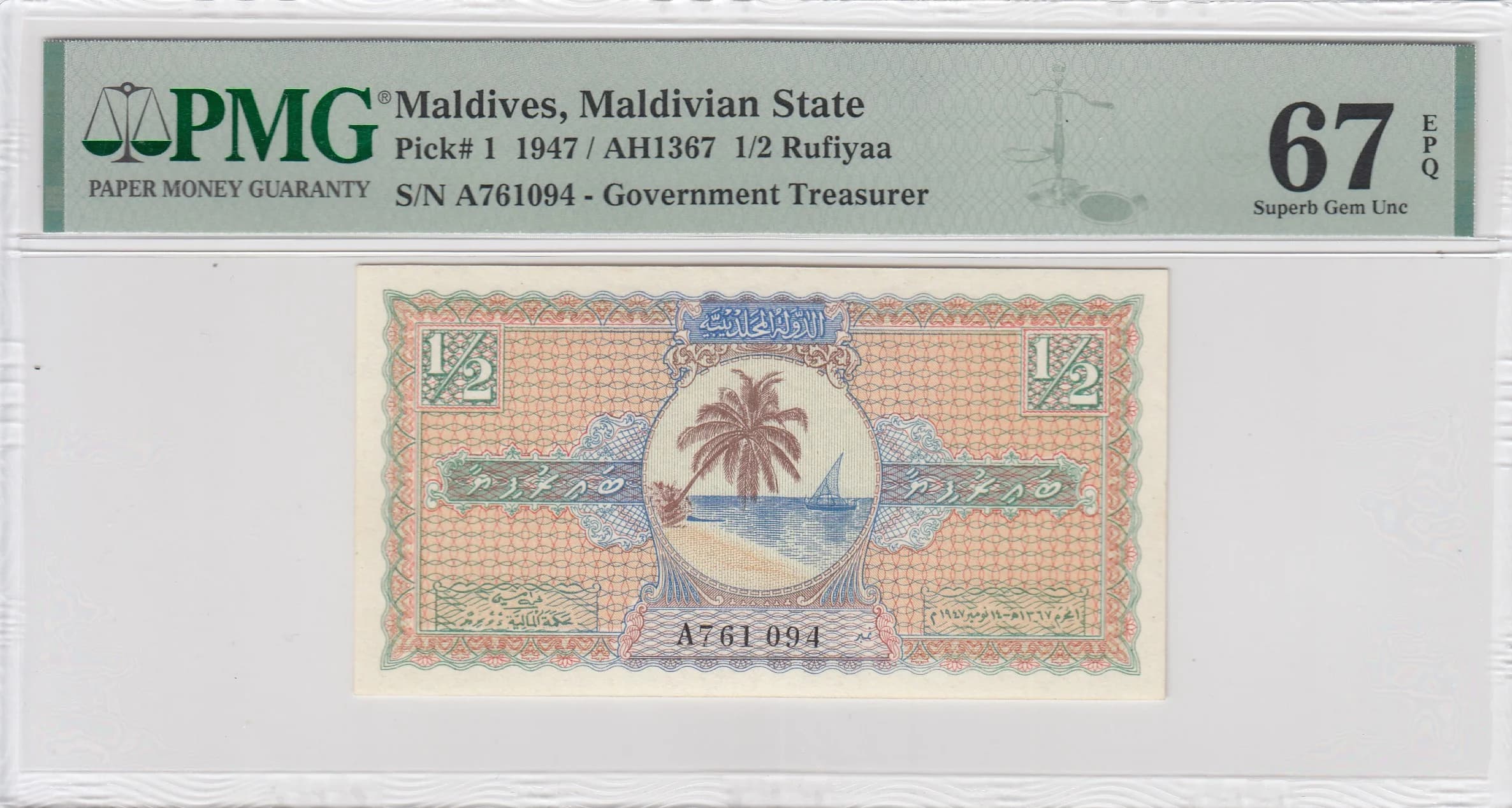
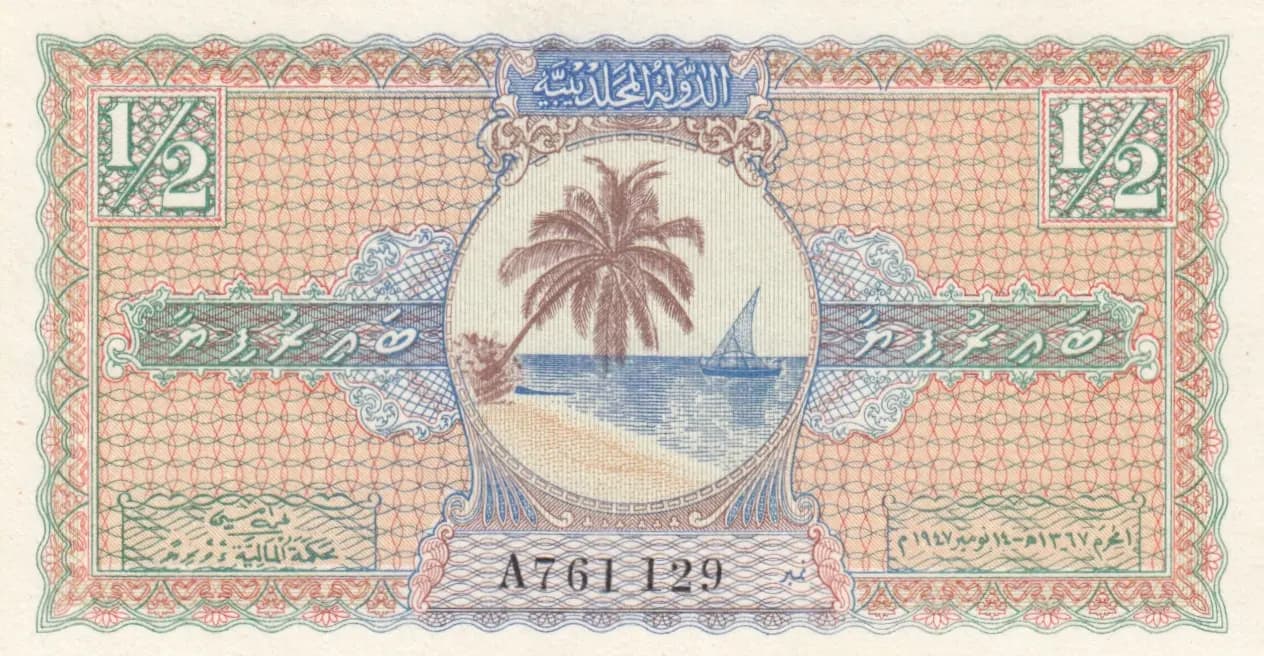
This 1/2 Rufiyaa note from 1960 represents an early and historically significant issue of the Maldivian State Treasury, presented here in uncirculated condition with exceptionally crisp paper and vibrant colors. The obverse features an ornately decorated composition centered on a circular medallion depicting a palm tree on a sandy beach with a traditional sailing vessel (dhow) on the ocean beyond—imagery that distinctly captures the maritime and tropical character of the Maldives. The note exhibits fine security printing throughout with intricate geometric and floral border patterns, denomination markers in both numerals and Dhivehi script, and Arabic inscriptions, representing an early example of Maldivian currency design.
Common. While the eBay pricing data shows healthy market values (VG $30-36, VF $100-637, UNC $325), the consistent appearance of this denomination in catalogs and PMG's inclusion of a variant (P-1s) indicates adequate circulation in the numismatic market. The note is from the first regular issue of an independent nation's currency system, and though it has historical significance, the print run for this denomination appears sufficient to classify it as common rather than scarce. The UNC condition observed here commands catalog value reflective of quality preservation rather than rarity of issue.
Issued in 1960 by the Maldivian State Treasury during a formative period in the nation's post-colonial monetary development, this banknote reflects the Maldives' cultural and economic identity through its deliberate imagery. The palm tree and traditional dhow depicted in the central medallion symbolize the nation's reliance on agriculture, coconut cultivation, and maritime trade—the economic foundations of the mid-20th century Maldives. The inclusion of both Arabic and Dhivehi (Thaana script) inscriptions underscores the Islamic cultural context and the establishment of a national monetary system distinct from colonial-era currencies.
The obverse of this 1/2 Rufiyaa displays a masterfully composed vignette centered within a circular medallion frame. The central design depicts a naturalistic scene of a coconut palm tree standing on a sandy beach with the Indian Ocean stretching beyond, where a traditional two-masted dhow (the iconic sailing vessel of Indian Ocean trade) is rendered on the seascape. This imagery is framed by an elaborate decorative border composed of interlocking geometric patterns and floral motifs in a classical banknote engraving style. The color palette employs greens (for foliage and ocean areas), coral-red and pink tones (in decorative elements), blues (water), and tan/beige (sand), creating visual harmony while maintaining security through fine-line engraving detail. The reverse appears blank or minimally decorated, which is consistent with many early issues from developing nations' central banks.
Front side: Arabic script at top center reads 'الدولة الإسلامية' (Al-Dawla Al-Islamiyya / Islamic State), reflecting the formal name of the issuing authority. Denomination '1/2' appears in English numerals in upper left and right corners. Currency name 'ރުފިޔާ' (Rufiyaa) appears in Dhivehi script (Thaana). Serial number 'A7611129' is visible at bottom center. Back side: No visible inscriptions detected in the visual analysis.
The note exhibits characteristics of traditional intaglio (engraved steel plate) printing, evidenced by the fine line work visible throughout the ornamental border, the precision of the circular medallion frame, and the intricate geometric micropattern background that serves as a security measure. The clarity of the denomination numerals and the crisp, well-defined edges of all design elements confirm professional security printing. The printer for P-1 is not explicitly documented in the provided PMG population report, though the quality suggests work by an established international security printer of the period.
This note is catalogued as P-1 (1/2 Rufiyaa) with a known starred variant P-1s documented by PMG. The observed specimen with serial number A7611129 and the 'A' prefix should be cross-referenced against PMG population data to determine if it corresponds to a specific printing variety. The note exhibits no visible overprints, date variations, or signature variants that would indicate a distinct sub-variety; however, collectors should verify whether printer identification marks (visible under magnification) correspond to known varieties documented for this Pick number.