10 rupees 1960
Market Prices
13 salesAbout This Note
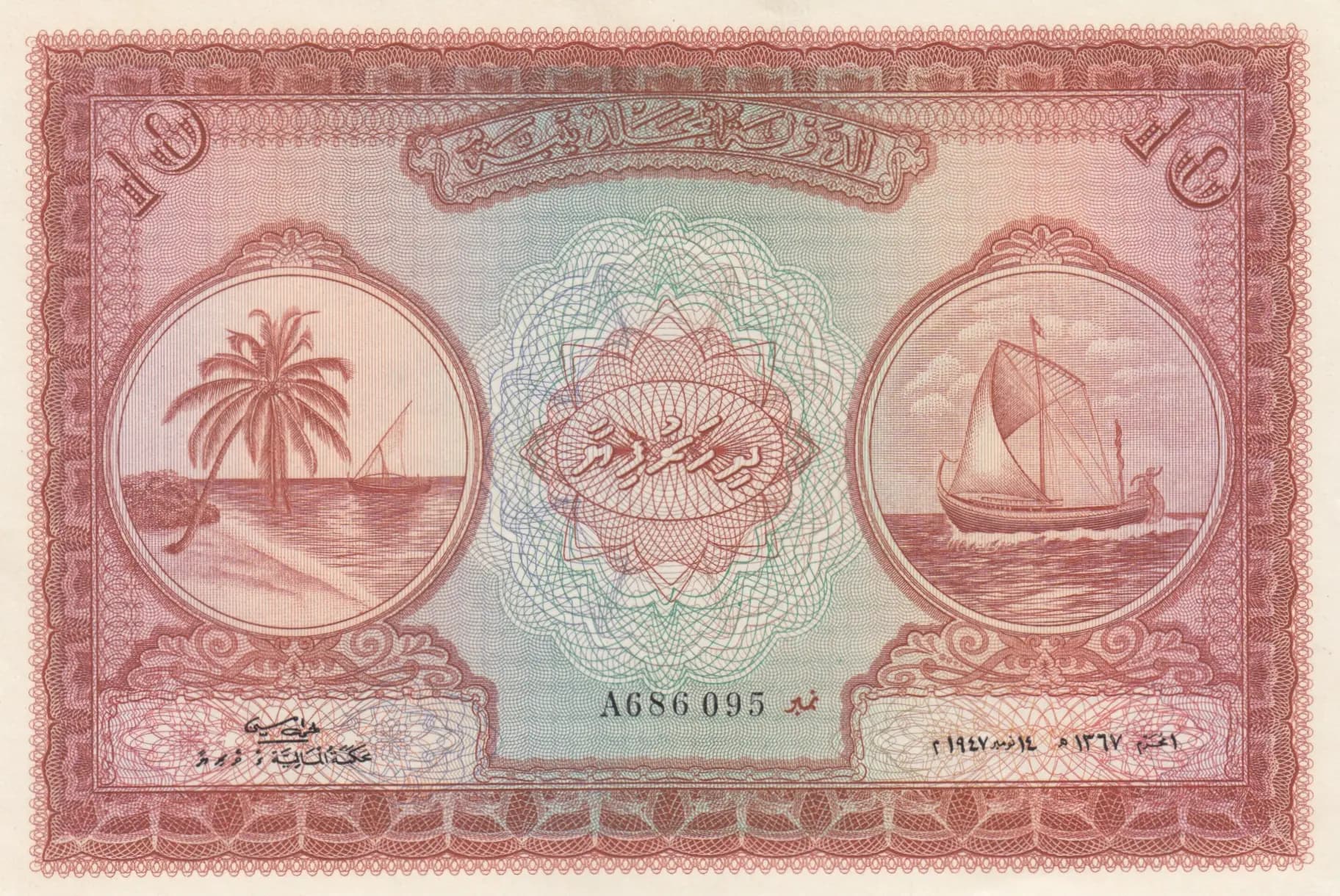
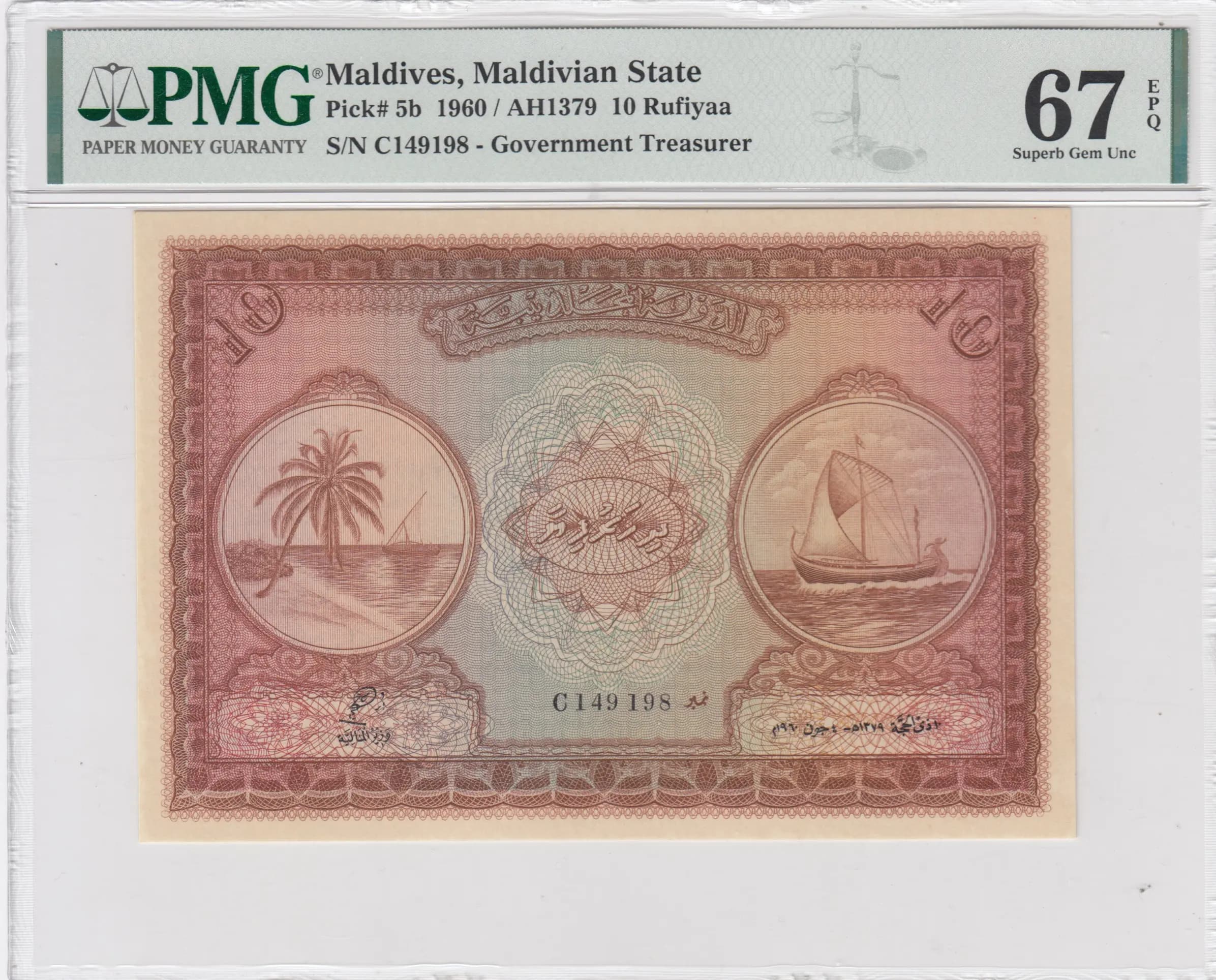
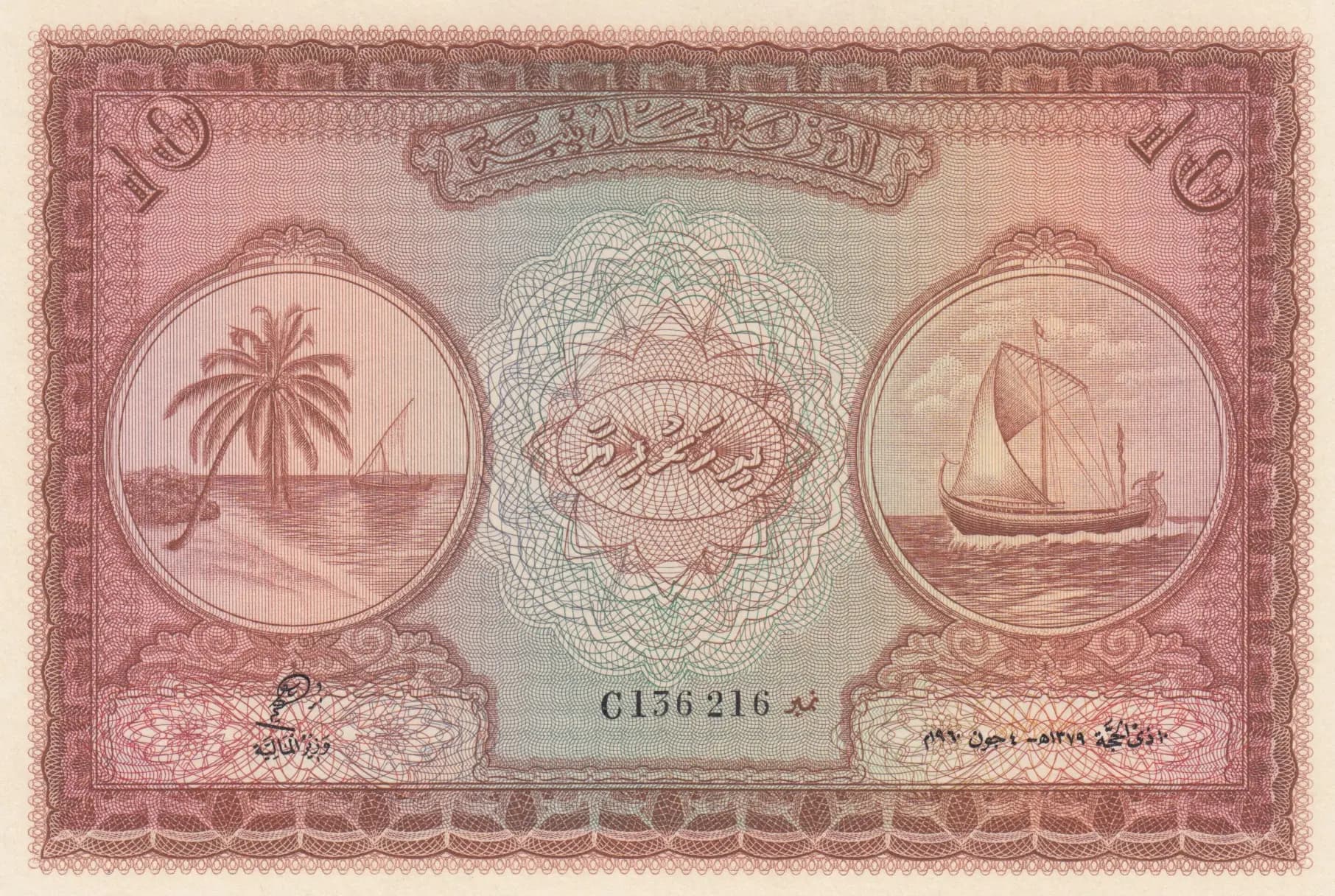
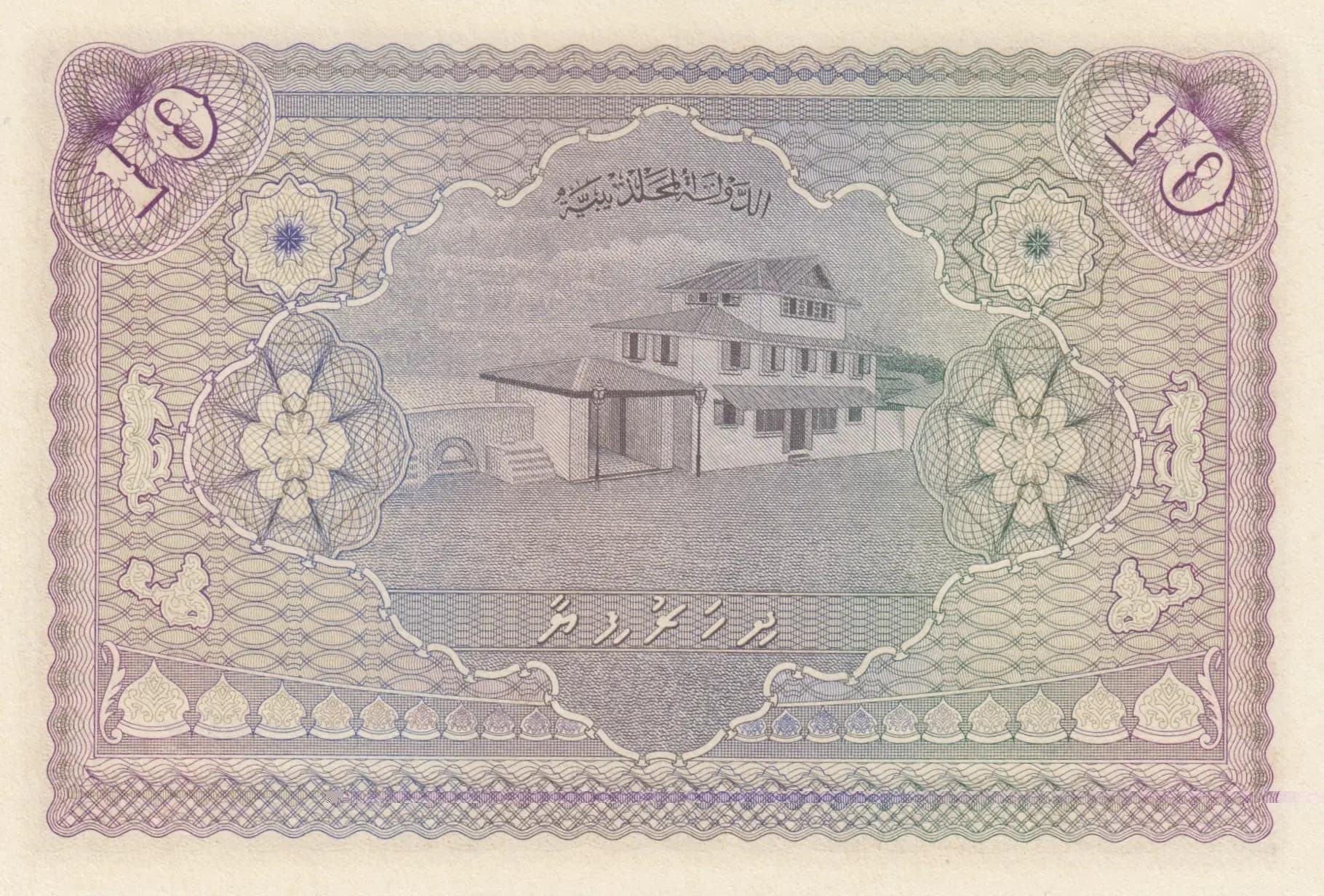
This is an exceptional example of the Maldives 10 Rufiyaa Pick-5b from 1960, presented in pristine uncirculated condition. The note features elegant ornamental design with three circular medallions on the obverse—a palm tree coastline scene at left, an intricate geometric mandala pattern at center, and a traditional dhow sailing vessel at right—all rendered in rose/mauve pink and cream tones with fine guilloche engraving. The reverse displays a colonial-era stone building (the Veyodorhu Ganduvaru Mathige militia headquarters) in purple and green tones, surrounded by sophisticated decorative border work that exemplifies early post-independence Maldivian currency design.
Common. While this note is scarce in the highest professional grades (PMG 68 examples command $150+), the denomination and widespread circulation history make it common in general collector terms. Secondary market data shows consistent availability with regular eBay sales activity dating back over a decade, with UNC examples selling in the $50–$100 range, indicating steady but not exceptional demand. The 2016 catalog value of $35 UNC confirms this is a standard issue without significant rarity premium. The existence of three catalogued varieties (P-5a, P-5b, P-5s) across the 10 Rufiyaa denomination further indicates substantial production runs.
Issued in 1960 by the Maldivian State Treasury as the newly independent nation was establishing its monetary identity, this note reflects the Maldives' cultural heritage and political symbols during a pivotal period. The depiction of the dhow—a traditional Arabian sailing vessel central to Maldivian maritime culture—and the palm tree emphasize the islands' tropical geography and seafaring traditions. The reverse's prominence of the militia headquarters building signals the new nation's focus on defense and sovereignty during the early post-colonial era.
The obverse presents a tripartite medallion composition in a classical ornamental framework. The left medallion depicts a palm tree silhouetted against a coastal landscape, symbolizing the Maldives' tropical island environment. The center medallion contains an intricate geometric mandala or star pattern, serving both decorative and security functions. The right medallion illustrates a traditional dhow under sail on open water, representing the nation's maritime heritage and the centrality of seafaring to Maldivian identity. The reverse features the Veyodorhu Ganduvaru Mathige (Defense Headquarters of the Militia), a colonial-era stone structure with multiple windows, verandah, and pitched roof, positioned prominently at center with landscaping details. The entire design is framed by ornate borders incorporating floral arabesques, geometric guilloche patterns, and botanical motifs in the corner ornaments, reflecting Islamic artistic traditions adapted for modern currency.
Front side: Arabic script in curved banner style at top center (precise text not clearly legible in image but consistent with standard currency denominations and issuer identification); Serial number 'C156216' in Latin numerals at center. Back side: Arabic script in horizontal banner at top center (standard issuer/denomination text, not clearly legible); Numeral denomination markers in decorative circular frames at upper left and right corners; Text below the building in Thaana script (the official script of the Maldives) identifying the depicted structure, likely reading 'Veyodorhu Ganduvaru Mathige' or similar official designation (not clearly legible in image).
Intaglio engraving (steel engraving/copperplate printing), evidenced by the fine line guilloche patterns, detailed cross-hatching in backgrounds and circular medallion fields, sharp definition of the complex geometric mandala pattern, and the crisp precision of the ornamental border work throughout. The production quality and security features suggest work by an established European security printer, likely De La Rue or similar firm that produced Commonwealth and newly independent nation currencies during this period. The multi-color register visible in the underprint suggests combination intaglio with additional color printing.
This note is catalogued as Pick-5b, representing one of three documented varieties of the 1960 10 Rufiyaa issue (P-5a and P-5s also exist). The 'b' designation typically indicates a specific signature variety or minor design variant distinguishing it from P-5a, though precise identifying characteristics are not detailed in available references. The serial number prefix 'C' may indicate a specific print batch or series. No overprints or date variations are evident on this example. The dual Islamic calendar reference (AH1379 / 1960 CE) is consistent with standard Maldivian currency practice of this era.