50 francs 1969
Market Prices
28 salesAbout This Note
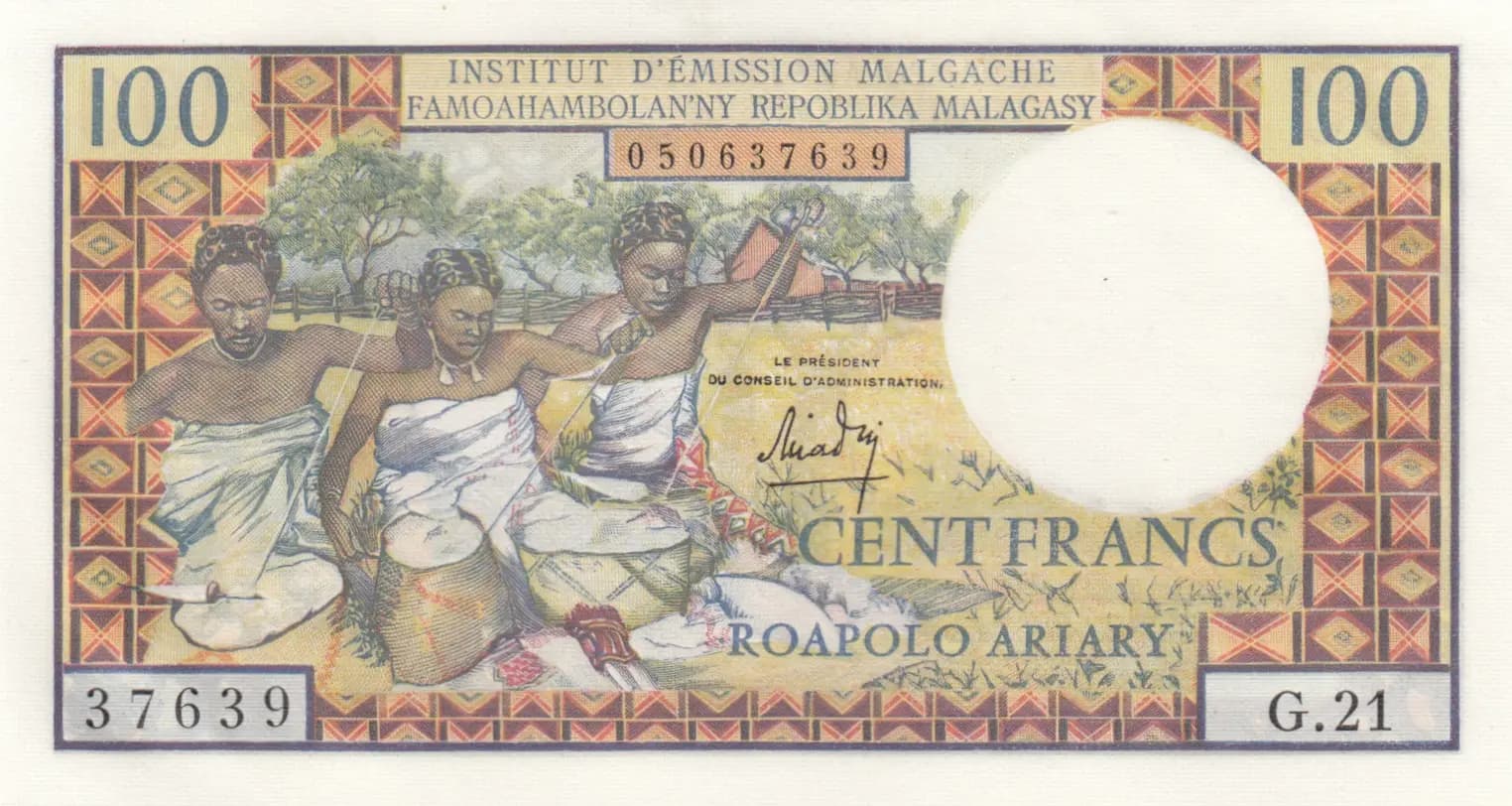
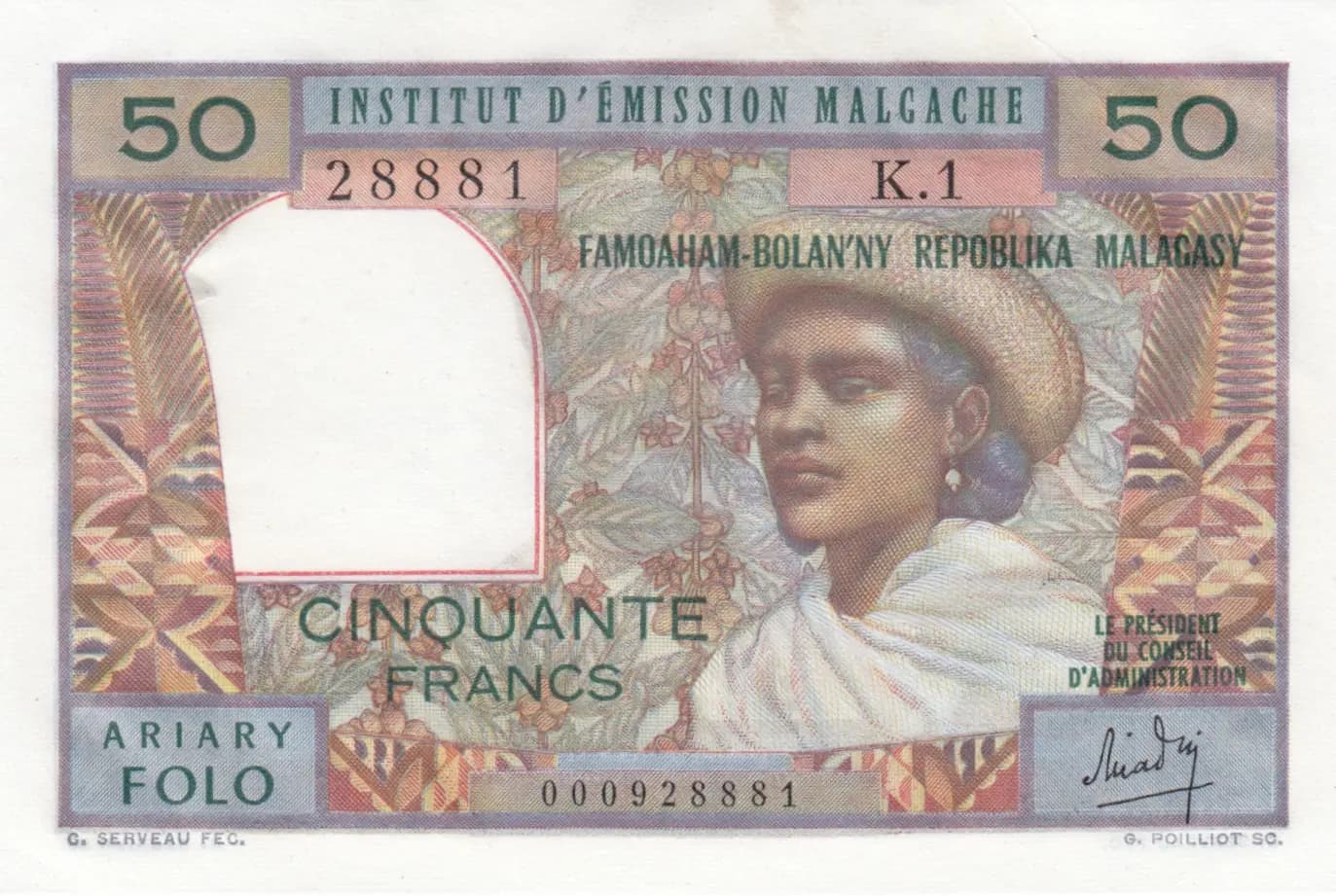
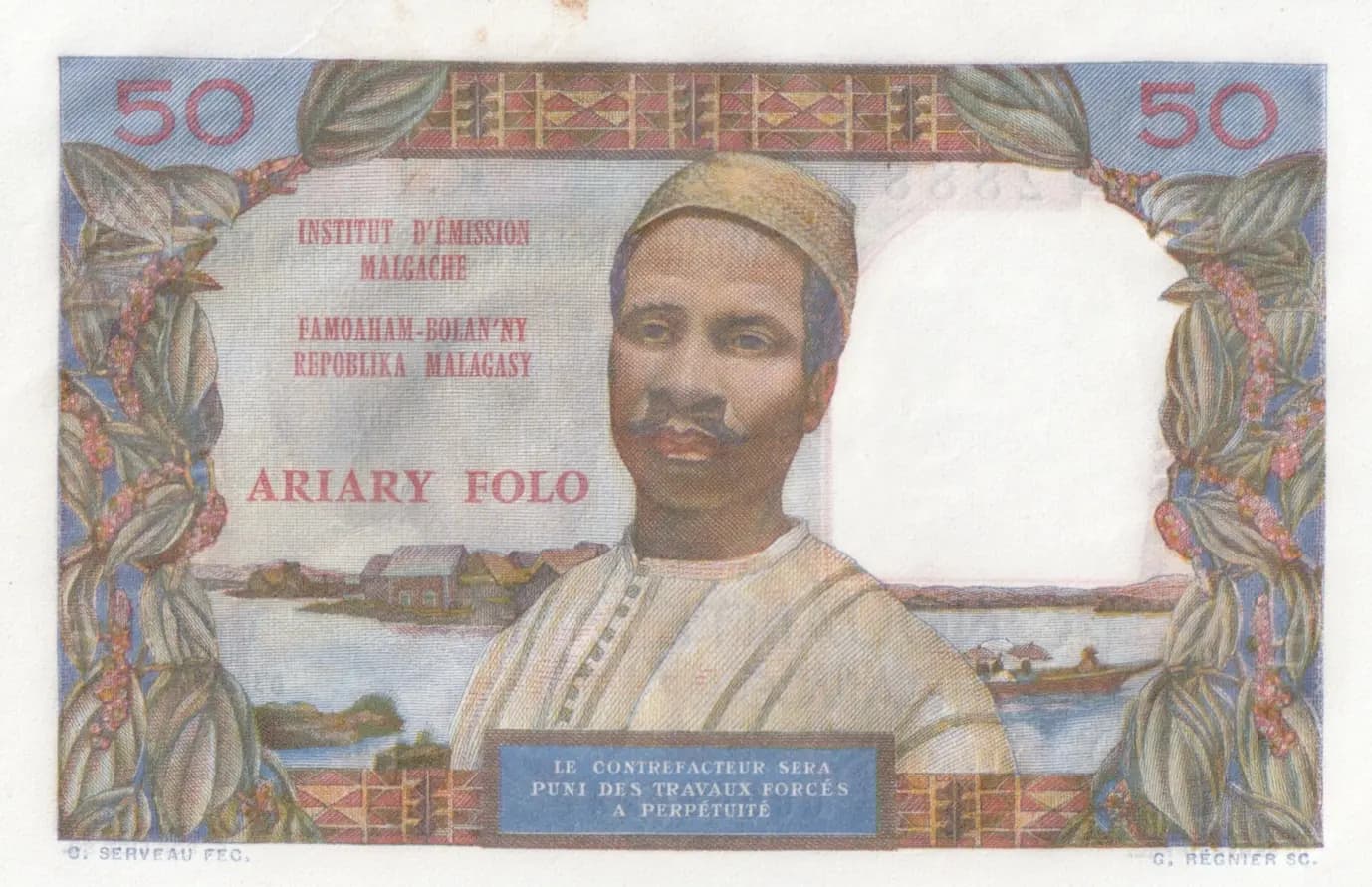
This is a Madagascar 50 Francs (10 Ariary) banknote from 1969, issued by the Institut d'Emission Malagache, presented in uncirculated condition. The note features vibrant multicolored engraving with portraits of a woman in traditional dress on the obverse and a man in striped clothing on the reverse, framed by ornate geometric and botanical border designs. The visual examination reveals minimal wear with excellent color retention and crisp detail throughout, making this an attractive example of post-independence Madagascar currency design.
Common. Secondary market eBay data shows consistent sales across multiple grades ranging from $6.38 to $156.50 (for graded specimens), with UNC examples regularly trading in the $25-48 range. The 2019 catalogue valuation of $25 for UNC condition aligns with observed market activity. The wide availability of sales data across multiple years and conditions, combined with relatively modest pricing even for premium grades, indicates this was a standard circulation issue with substantial print run. No evidence of rarity or scarcity is present in the market data or historical record.
This note was issued in 1969, during the early years of the Democratic Republic of Madagascar (established 1975), reflecting the nation's transition period and cultural identity through its depiction of Malagasy people in traditional clothing. The dual-language inscriptions in French and Malagasy, along with the portraits of ordinary citizens rather than political figures, emphasize the republic's emphasis on national identity and the common people during this era of political reorganization. The maritime and landscape scenes on the reverse allude to Madagascar's island economy and agricultural heritage.
The obverse features a woman in right-facing profile wearing traditional Malagasy attire including a white wrap/shawl and decorative hat, positioned on the right side of the note. She is framed within an ornate border of geometric patterns rendered in green, purple, rust, and cream tones. The denomination '50' appears in the upper corners in green numerals. A large white rectangular area (likely a watermark or security feature) occupies the center-left. The reverse depicts a man from the shoulders up, wearing traditional striped Malagasy cloth and a woven cap, positioned left-center. Behind him are landscape scenes featuring water, boats, and village structures, suggesting Madagascar's maritime and rural economy. Botanical border designs with leaves and flowering plants frame the composition. The color scheme shifts to blue and cream tones with rust accents. Both sides display intricate engraved patterns characteristic of high-quality currency production.
FRONT: Institut d'Emission Malgache (Malagasy Emission Institute) | Famoaham-Bolan'ny Republika Malagasy (Democratic Republic of Madagascar) | Cinquante Francs (Fifty Francs) | Ariary Folo (Ten Ariary) | Le Président du Conseil d'Administration (The President of the Board of Administration) | G. Serveau Fec. (G. Serveau made it - engraver) | G. Poilliot Sc. (G. Poilliot sculpted it - engraver). BACK: Institut d'Emission Malgache (Malagasy Emission Institute) | Famoaham-Bolan'ny Republika Malagasy (Democratic Republic of Madagascar) | Ariary Folo (Ten Ariary) | Le Contrefacteur sera puni des travaux forcés à perpétuité (The counterfeiter will be punished with forced labor for life) | G. Serveau Fec. (G. Serveau made it) | G. Régnier Sc. (G. Régnier sculpted it - engraver).
This note was produced using intaglio (engraved) printing, evidenced by the detailed line work, precise borders, and crisp portrait rendering visible throughout both sides. The multiple engravers credited (G. Serveau, G. Poilliot, and G. Régnier) indicate a collaborative high-security engraving process typical of 1960s-era European banknote production. The color registration and multi-color printing suggest the use of a specialized security printer, likely a major European facility given the French language inscriptions and engraver signatures. The intricate geometric and botanical patterns served both aesthetic and security functions.
This is the standard 1969 issue (Pick P-61). The visual analysis confirms the 'ARIARY FOLO' inscription at bottom left rather than a signature line, which is consistent with later printings of this design (the catalog reference notes P-51 as an earlier variety with the bank name as overprint). The serial number visible on this example (00092881, series K.1) and the signature designation 'LE PRÉSIDENT DU CONSEIL D'ADMINISTRATION' are consistent with the documented standard variety. No significant varieties (such as printer variations, overprints, or printing errors) are evident from the images provided.