100 francs 1966
Market Prices
41 salesAbout This Note
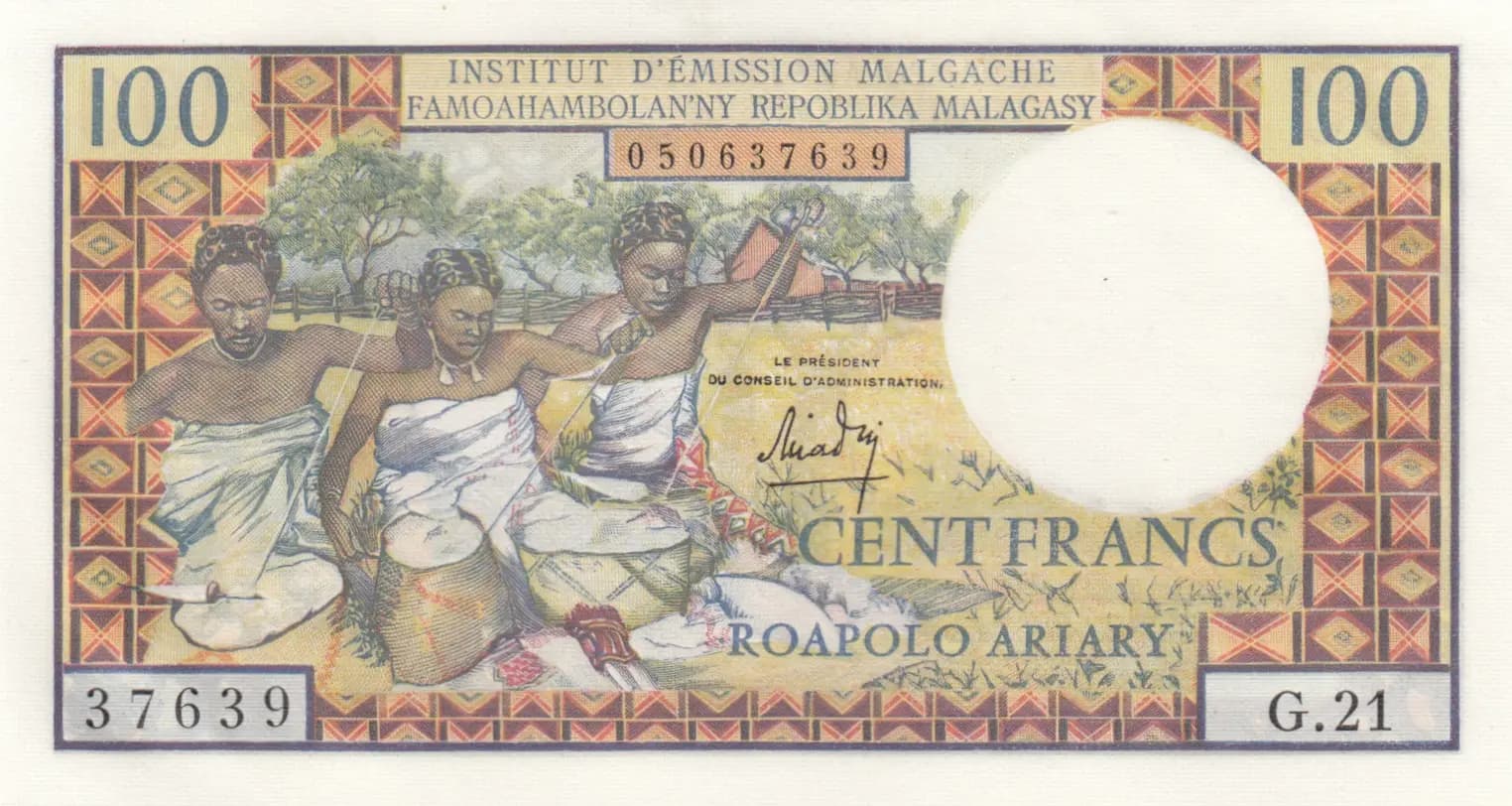
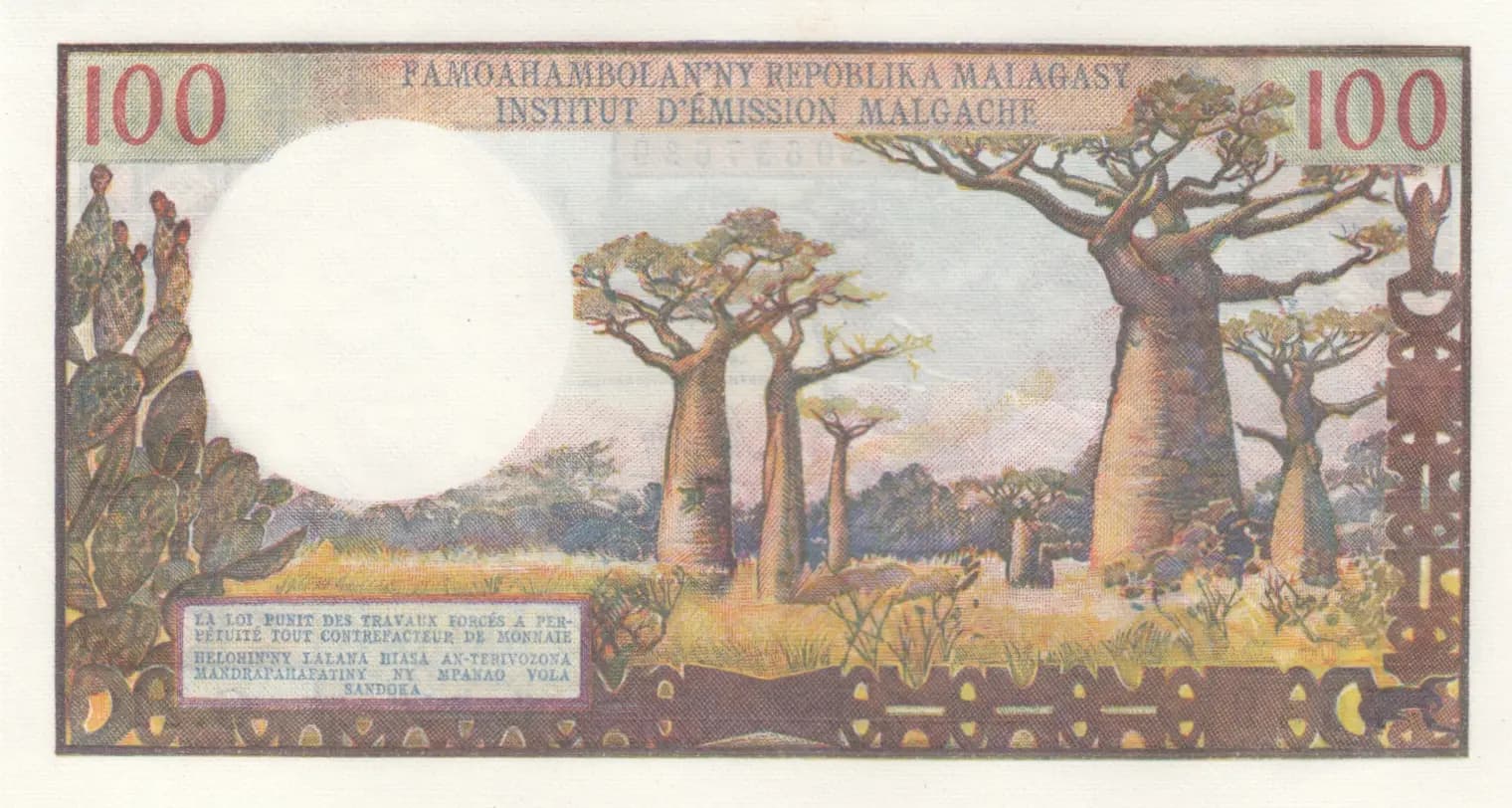
This Madagascar 100 Francs from 1966 presents an exceptional example of mid-20th century African currency design, rendered in uncirculated condition with crisp, vibrant colors and sharp detail throughout. The note showcases dual-language bilingual design reflecting Madagascar's Franco-Malagasy cultural heritage, featuring an engaging front illustration of three figures in traditional dress engaged in domestic activity and a reverse dominated by iconic baobab trees characteristic of Madagascar's savanna landscape. With pristine margins, no visible wear, and well-preserved security features including the distinctive circular watermark, this specimen represents an excellent example of Institut d'Émission Malgache craftsmanship from the post-independence era.
Common. Historical eBay market data shows consistent sales across all condition grades from 2012-2026, with UNC specimens regularly selling between $30-72 USD but more commonly in the $40-60 range. The consistent presence of multiple sales annually at modest valuations, combined with the note's straightforward non-commemorative status as a standard regular issue from a major denomination during a stable 11-year issuance period (1966-1977 for this design), indicates robust circulation and printing quantities. This is a frequently encountered note in the secondary market with no reported print run limitations, design variations that would affect scarcity, or recall issues.
Issued in 1966, just six years after Madagascar gained independence from France in 1960, this banknote reflects the newly established Malagasy Republic's efforts to assert national identity while maintaining cultural and economic ties with France. The bilingual inscriptions in French and Malagasy, combined with imagery celebrating traditional domestic life (the spinning women on the obverse) and Madagascar's distinctive natural heritage (the baobab trees on the reverse), underscore the nation's bridging of colonial heritage with indigenous cultural pride during the early post-independence period.
The obverse features an engraved illustration of three figures in traditional Malagasy dress—two seated and one standing with raised arm—engaged in what appears to be a cultural or domestic activity, likely representing traditional textile production or spinning, set against a rural landscape with trees and wooden fencing. The design is framed by ornamental geometric borders composed of burgundy/red and yellow diamond and cross motifs in the corners and sides, typical of African banknote ornamentation of the era. The reverse presents a detailed landscape composition showcasing multiple baobab trees (Adansonia digitata), Madagascar's iconic endemic species, rendered with varying proportions and positioned throughout a savanna setting with additional vegetation including cacti and shrubs characteristic of Madagascar's dry deciduous forest regions. Both sides display the dual-language text required of the post-independence nation and include decorative geometric border patterns. A prominent circular watermark area appears on both sides as a security feature.
FRONT SIDE: Institut d'Émission Malgache / Famoahambolán'ny Repoblika Malagasy (Institute of Malagasy Emission / Bank of the Malagasy Republic); 100 Cent Francs / Roapolo Ariary (100 Francs / 20 Ariary); Le Président du Conseil d'Administration (The President of the Board of Administration); Series designation G.21 and serial number 050637639. REVERSE SIDE: Famoahambolán'ny Repoblika Malagasy / Institut d'Émission Malgache (Bank of the Malagasy Republic / Institute of Malagasy Emission); 100; La Loi punit des travaux forcés l'imitation tout contrefacteur de monnaie / Belomippy ialana hiasa an-terivozoza mandrapahafatiny ny mpanao vola sandula (The law punishes with forced labor the imitation and any counterfeiter of currency / [Malagasy equivalent emphasis on severe punishment of counterfeiters]).
Intaglio engraving (line engraving), the standard security printing method for banknotes of this era. The detailed portraiture, fine line work throughout the landscape compositions, geometric border patterns, and ornamental elements are characteristic of traditional intaglio processes. The crisp detail visible in the uncirculated specimen, including fine line definition in vegetation and facial features, confirms high-quality engraved plate work. The printer for Institut d'Émission Malgache notes of this period was typically De La Rue or similar European security printers specializing in Commonwealth and former colonial territory currency production.
Pick-57a designation indicates this is part of a two-signature variety set for this issue (signatures of the President of the Board of Administration vary). The observed specimen shows one signature variant. Serial number prefixes and series designations (such as the visible G.21) may indicate different printing runs but do not constitute major cataloged varieties. No known major overprints, date variations, or other significant variety markers are documented for this Pick number in standard references. The note represents the standard circulating version issued by Institut d'Émission Malgache.