500 litu 1924 specimen
Market Prices
1 saleAbout This Note
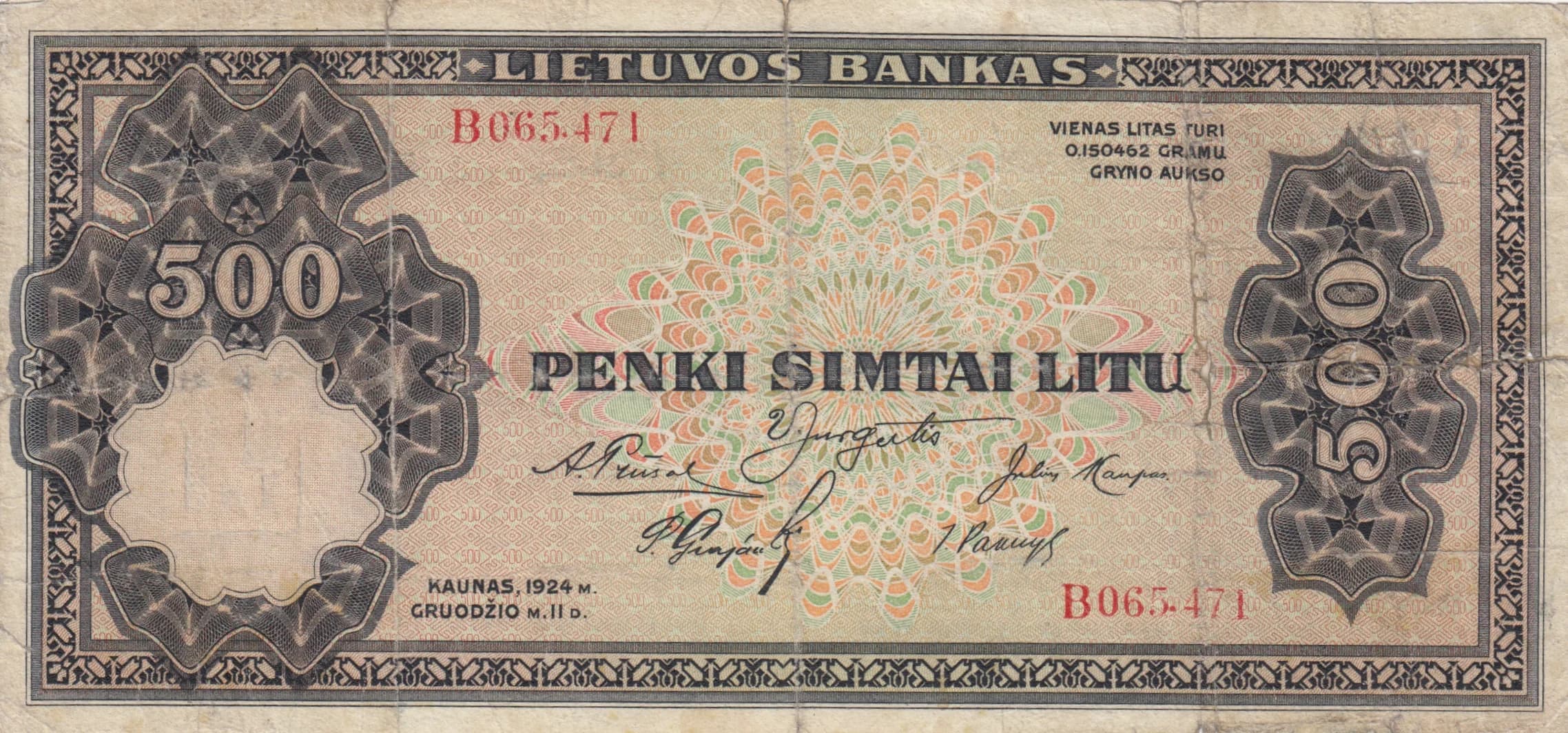
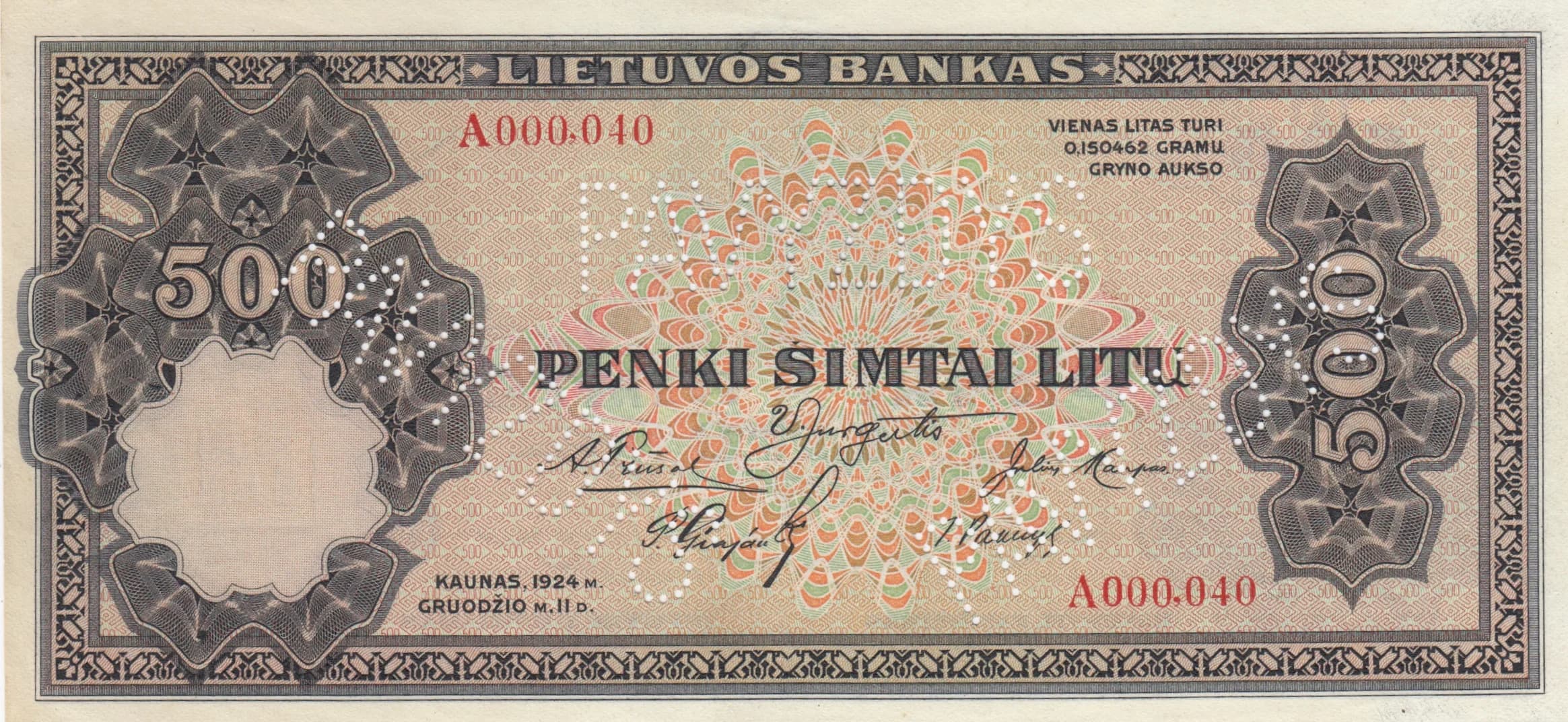
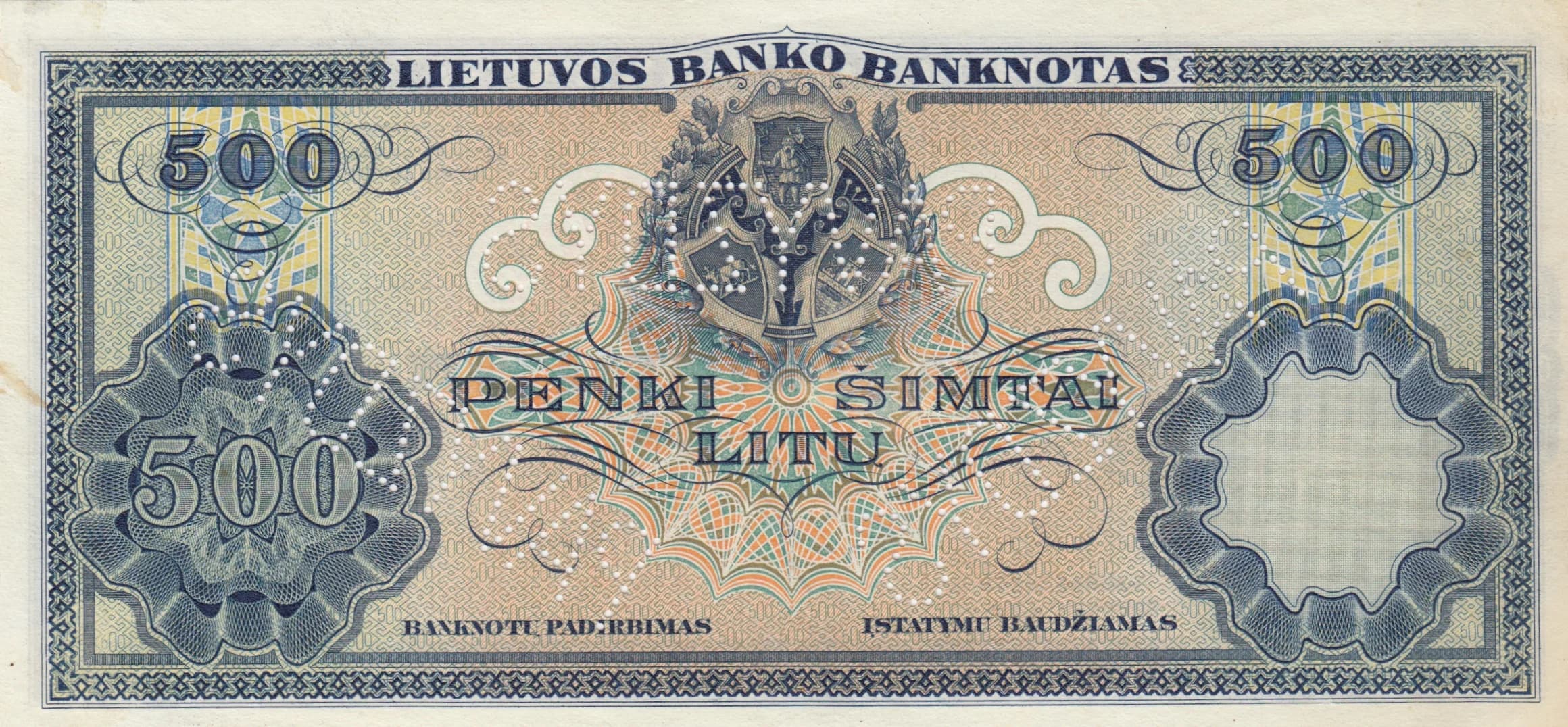
This is a stunning 500 Litu specimen note from Lithuania's first banknote issue, dated December 11, 1924, graded AU and cataloged as Pick P-21s. The note showcases exceptional craftsmanship with vibrant multicolored design elements including an elaborate central sunburst pattern on the obverse and a prominent heraldic coat of arms on the reverse, both rendered in red, orange, green, and blue inks. As a specimen issue with no visible wear and pristine print clarity, this represents an early and desirable example of independent Lithuanian currency during the interwar period.
Common. While this is a historically significant first-issue Lithuanian banknote and specimen examples have inherent collector appeal, the catalog price data from realbanknotes.com (2016 valuations: VG $500, VF $900, UNC $1800) and recorded eBay sales indicate reasonable market availability. The specimen designation (P-21s) suggests this was part of a distributed specimen set issued to banks and government institutions, creating a larger surviving population than regular circulation notes. The AU condition grade and specimen status command a premium over circulated examples, but the denomination remains in the 'uncommon to scarce' range rather than rare, with estimated print runs supporting moderate availability in the collector market.
The 500 Litu note was issued by Lietuvos Bankas on December 2, 1924, marking Lithuania's establishment of independent monetary sovereignty following World War I and separation from Russian imperial currency. The note's design elements—including the coat of arms and ornate geometric patterns characteristic of Art Deco aesthetics—reflect the nation's desire to establish a modern, internationally credible financial identity during the newly independent Lithuanian state. The gold standard notation (0.150462 grams of pure gold per lita) printed on the obverse underscores the currency's backing in precious metals, a critical feature for international recognition during the 1920s gold standard era.
The obverse features a harmonious composition with ornate geometric cartouches containing large '500' numerals positioned in the left and right margins. The dominant design element is a radiant sunburst or stylized flower pattern in the center, executed in warm tones (red, orange) against a cream background, surrounded by intricate geometric border ornamentation in brown and black line work. The reverse presents the coat of arms of Lithuania—a heraldic emblem rendered in blue, orange, and tan—as the central focal point, again flanked by ornamental '500' cartouches in the corners and framed by geometric borders. Both sides demonstrate fine engraved linework typical of high-security banknote production, with the multicolor lithographic printing creating visual complexity intended to prevent counterfeiting.
FRONT SIDE: 'LIETUVOS BANKAS' (Bank of Lithuania); '500' (denomination in numerals); 'DENKI SIMTAI LITU' (Five Hundred Litu in words); 'VIENAS LITAS TURI O.150462 GRAMU GRYNO AUKSO' (One lita contains 0.150462 grams of pure gold); 'KAUNAS 1924 m. GRUODZIO m. II d.' (Kaunas, 1924, December 2nd); Serial number 'A000040'. BACK SIDE: 'LIETUVOS BANKO BANKNOTAS' (Bank of Lithuania Banknote); '500' (denomination in numerals); 'DENKI SIMTAI LITU' (Five Hundred Litu); 'BANKNOTU PAD.RBIMAS' (Banknote production); 'ISTATIMU BAUDZIAMAS' (Legally punished/Protected by law).
This note was produced using multicolor lithography, a technique allowing simultaneous printing of multiple ink colors in registration. The fine line engraving visible in the borders, cartouches, and central designs indicates that the original artwork was engraved on steel or copper plates before transfer to lithographic stones. The printer for P-21a and P-21s1 variants is documented as BWC (Banknote World Company or similar security printer), reflecting standard international practice for newly independent nations commissioning modern currency designs from established European security printing houses during the 1920s.
This note is cataloged as Pick P-21s (specimen variant). The PMG population report identifies two documented variants for this base Pick number: P-21a (regular issue, BWC printer) and P-21s1 (specimen, BWC printer). The specimen designation is confirmed by the pristine uncirculated condition and absence of circulation wear. The serial number 'A000040' visible on this note may indicate position within the specimen distribution sequence. No overprints or anomalies suggesting printing varieties are apparent from the visual analysis; this appears to be a standard specimen striking of the standard design.