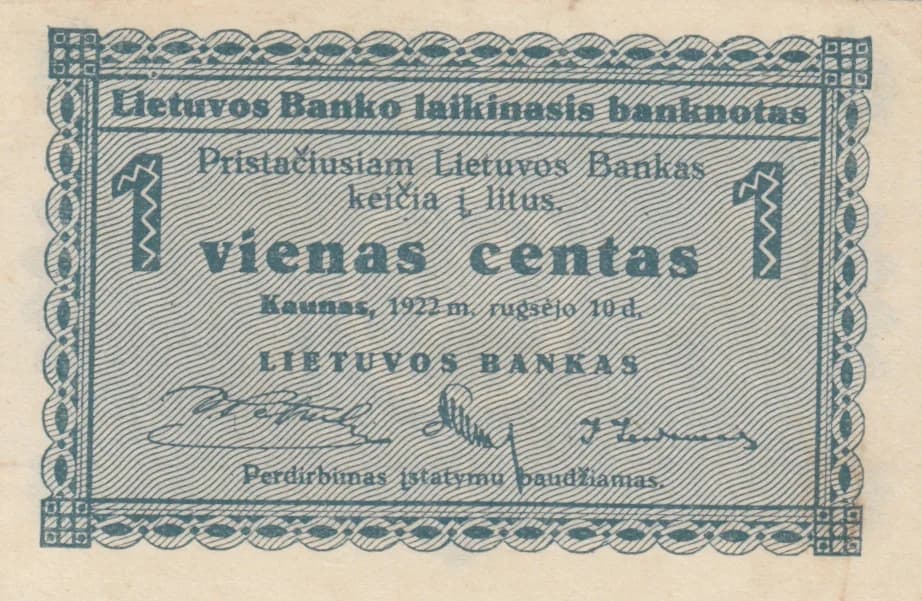
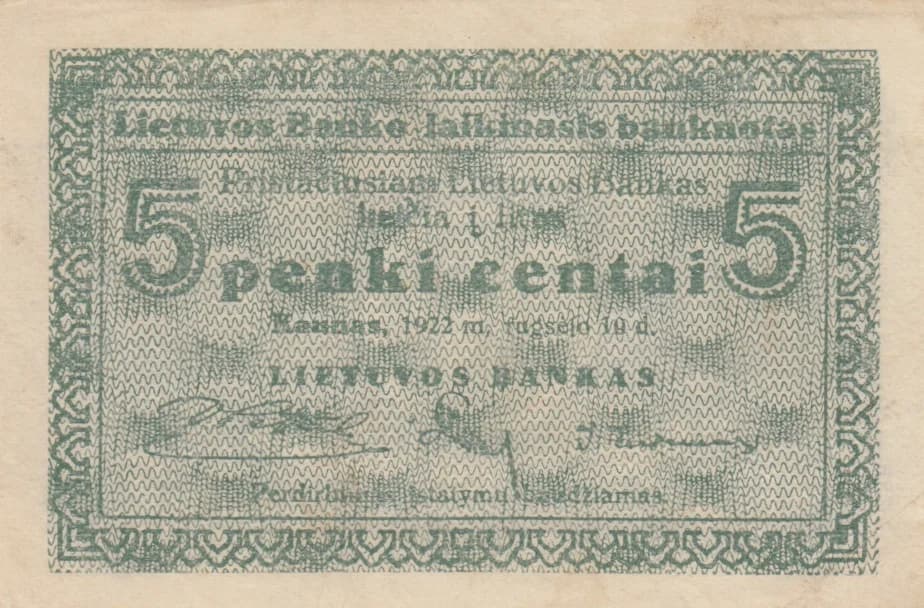
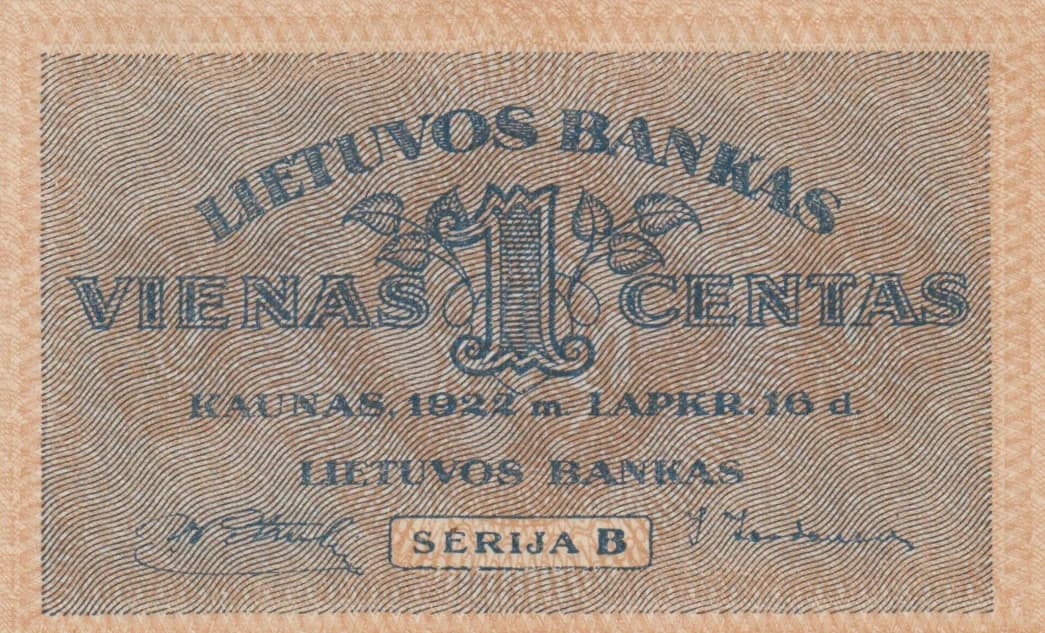
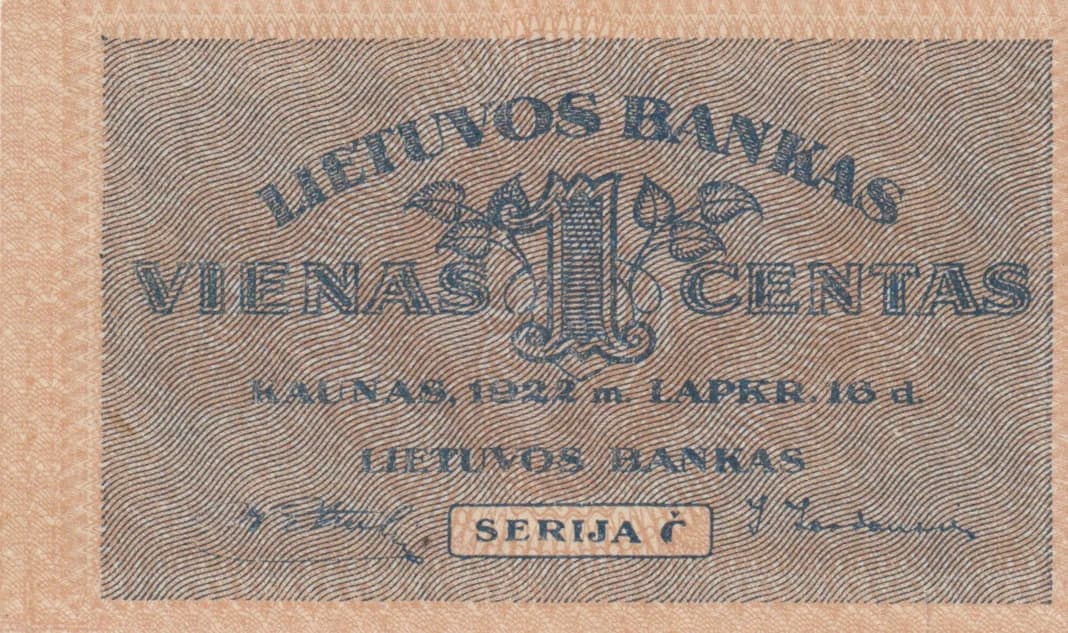
20 centu 1922
Market Prices
2 salesAbout This Note
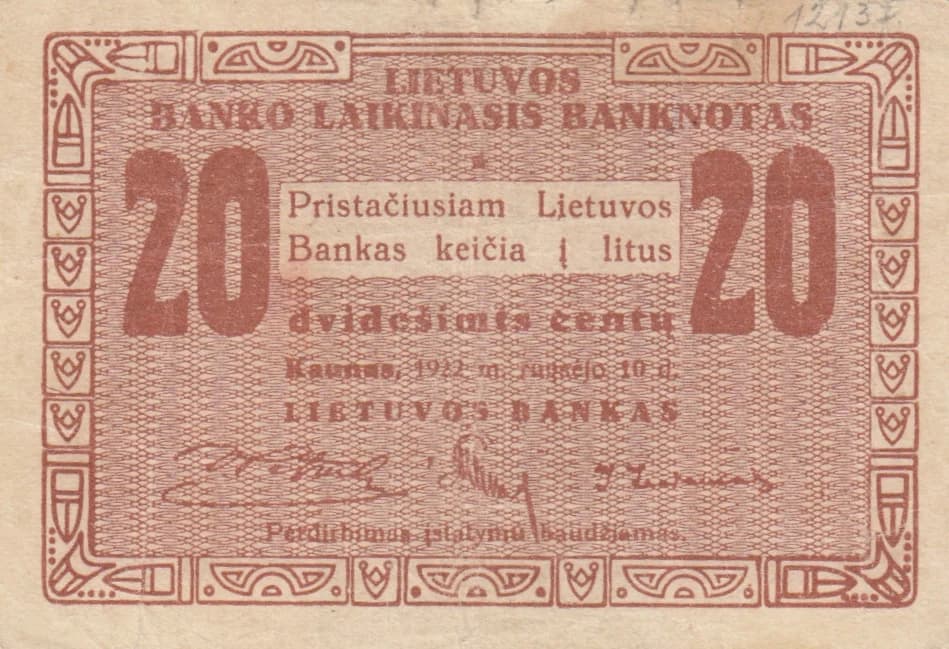
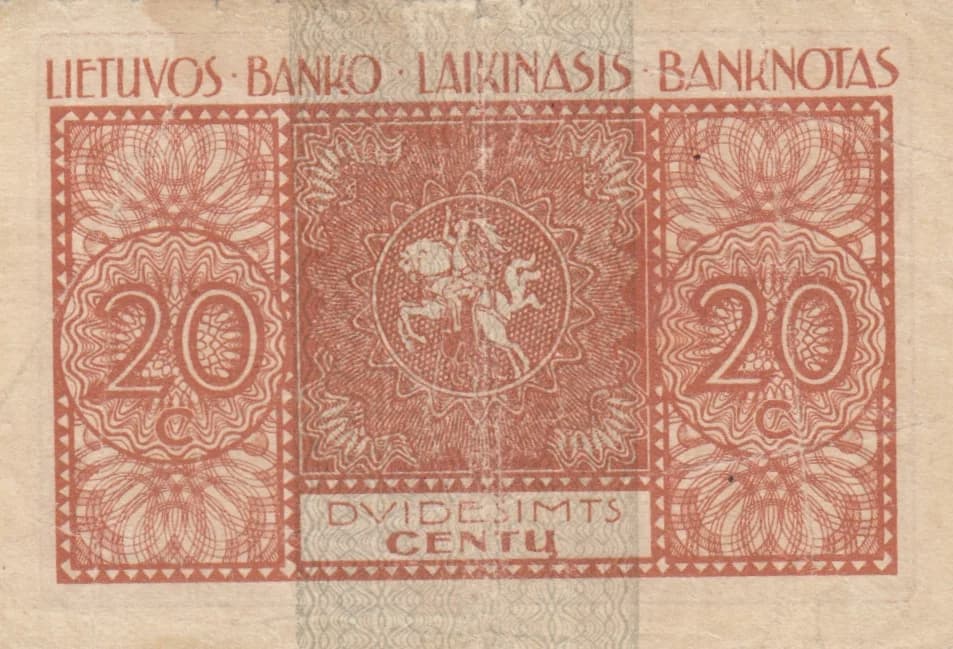
This is a 20 Centų temporary banknote from Lithuania's 1922 emergency currency series, issued by Lietuvos Bankas on July 3rd, 1922. The note features a striking reddish-brown color with elaborate Art Deco geometric and floral ornamental borders framing large denomination numerals on both front and back. In Fair condition as cataloged, the note exhibits expected aging characteristics including foxing and faint creases consistent with a banknote over 100 years old, yet retains good legibility and detail in its intricate central coat of arms design.
Common. While this is a historically interesting note from an early independence period, the 20 Centų denomination from the 1922 Laikinosios Banknotes series appears regularly in the collector market. Market data from realbanknotes.com shows examples in Fair condition selling for approximately $165 at auction with solid bidding (17 bids), and catalog values for the grade (2016) set Fair at $50-100 range, consistent with reasonably available notes. The PMG population data shows multiple variants of Pick-3, indicating substantial surviving circulation.
This temporary banknote (laikinaisis banknotas) was issued during Lithuania's early independence period following World War I, when the newly formed nation required emergency currency before establishing permanent denominations. The note's existence reflects the transitional economic circumstances of 1922, when Lithuania was stabilizing its monetary system and establishing the Lietuvos Bankas as the central authority. The inscription indicating exchange for litas demonstrates the transitional role of these centų notes in the emerging Lithuanian monetary system.
The 20 Centų note showcases a symmetrical Art Deco design with a reddish-brown base color and tan/beige background. The front features ornate geometric and floral border patterns forming a rectangular frame around the central text area, with large '20' numerals positioned on both left and right margins. The reverse side mirrors this aesthetic, with the central focal point being an elaborate circular coat of arms or national emblem rendered in intricate detail, flanked again by large denomination numerals within ornamental frames. The repetitive decorative motifs throughout suggest a security-conscious design approach typical of early 20th-century Eastern European central banks.
Front side: 'LIETUVOS BANKO LAIKINAISIS BANKNOTAS' (Lithuanian Bank Temporary Banknote); 'Pristačiusiam Lietuvos Bankas keičia į litus' (The Lithuanian Bank exchanges it for litas); 'dvideštmis centų' (twenty cents); 'Kaunas, 1922 m. liepą mėn. III d.' (Kaunas, July 3rd, 1922); 'LIETUVOS BANKAS' (Lithuanian Bank). Back side: 'LIETUVOS BANKO LAIKINASIO BANKNOTAS' (Lithuanian Bank Temporary Banknote); 'DVIDESIMTS CENTŲ' (Twenty Cents). Denomination numerals '20' appear prominently on all sides.
Intaglio engraving, utilizing steel plate printing typical of banknote production in this era. The intricate geometric patterns, fine-line ornamental borders, and detailed central coat of arms design reflect the precision achievable through engraved plate printing, which was the standard security measure for temporary Lithuanian currency during 1922.
This note is Pick-3, part of the early Lithuanian emergency series. The specific variety designation within Pick-3 may relate to signature variants, watermark type (the PMG data notes variants with 'Sculptured Chain' watermark for P-3a), or printing characteristics. The visual analysis does not reveal sufficient detail to definitively assign a sub-variety (3a, 3b, etc.), but the presence of the coat of arms on the reverse and the noted date of July 3rd, 1922 (liepą mėn. III d.) aligns with the standard issuance characteristics of this Pick number.