500 litu 1924
Market Prices
1 saleAbout This Note
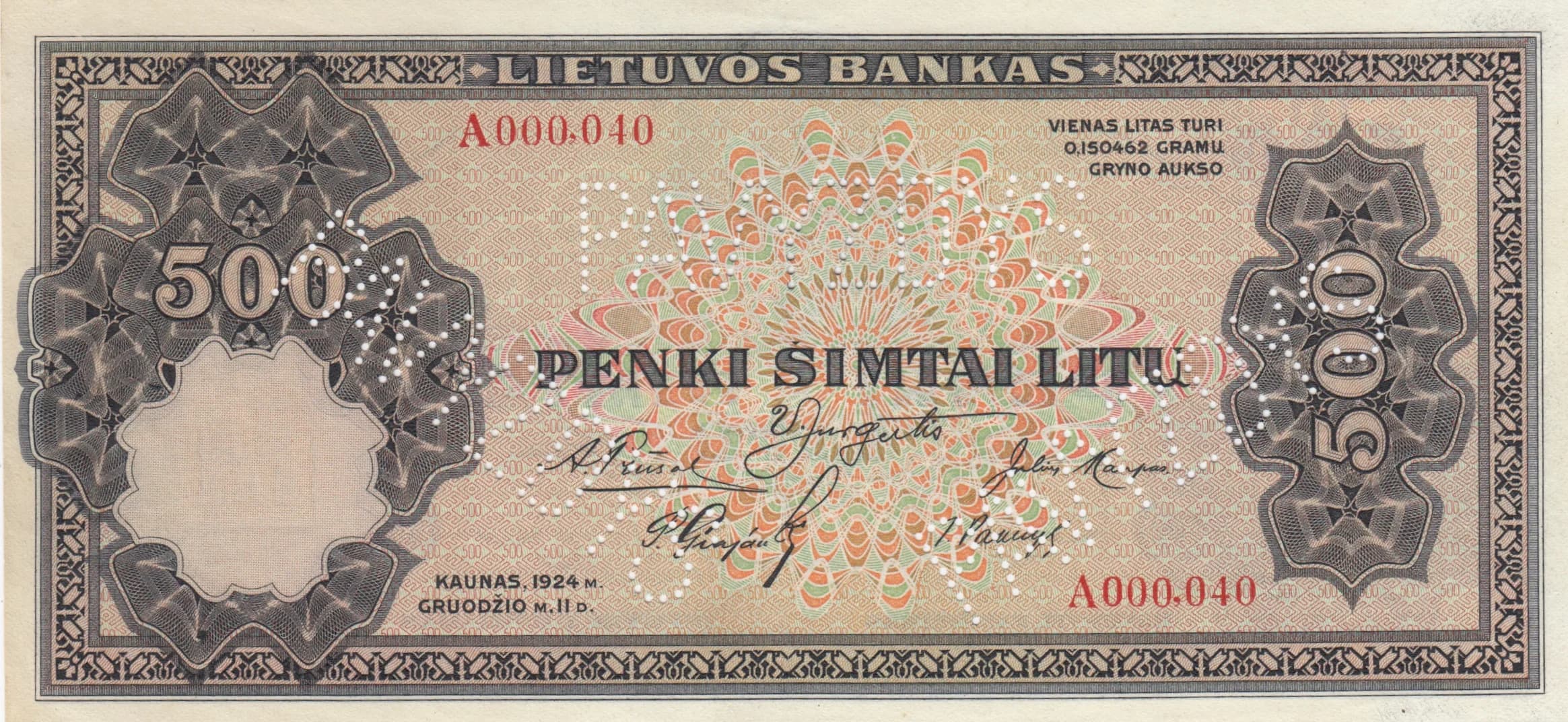
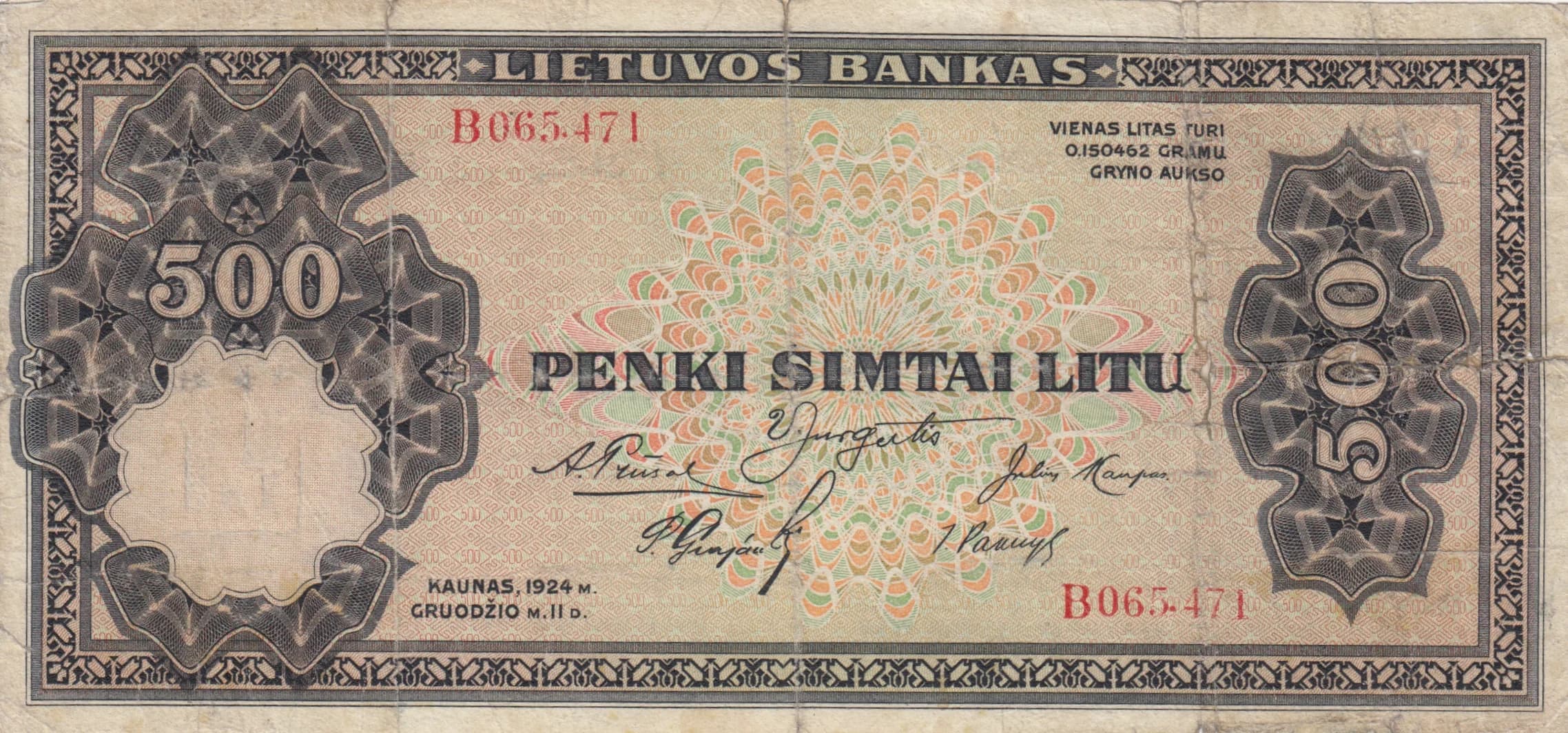
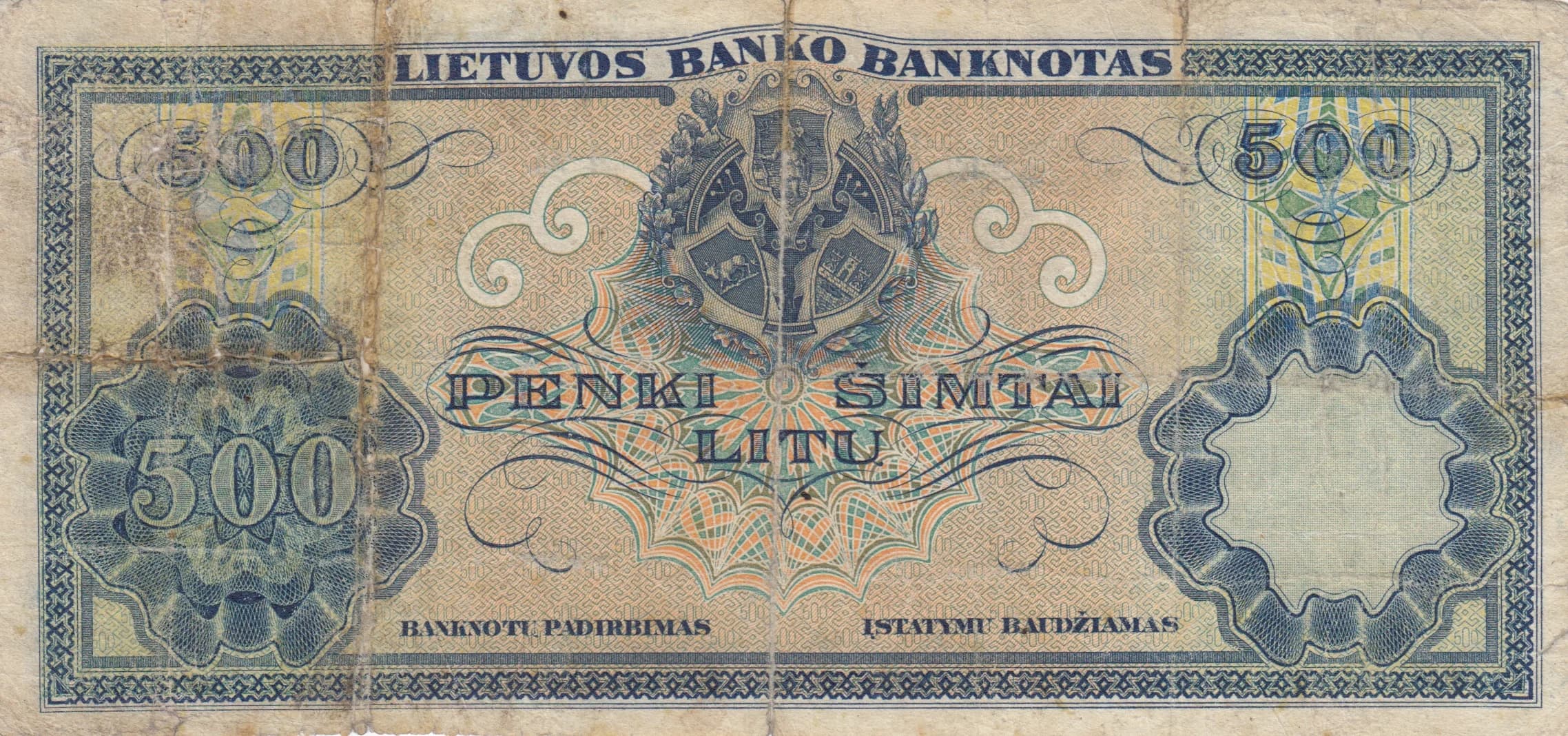
This 500 Litu banknote from Lithuania's first independent currency period (1924) displays the characteristic ornate Art Deco design typical of interwar European banknotes, featuring a prominent double-headed eagle coat of arms and intricate geometric borders in multiple colors. The note exhibits well-worn condition with visible creasing, foxing, and age-related discoloration consistent with nearly a century of potential circulation, though no major tears are present. As a high denomination note from Lithuania's brief pre-Soviet period, this Pick-21 remains a notable example of early Lithuanian monetary design and historical significance.
Common. While this note represents an early period of Lithuanian independence and possesses historical significance, it was part of a regular issue with substantial print runs sufficient to maintain circulation until currency reform. The eBay market data indicates pricing consistent with common interwar banknotes in comparable condition (F-grade example sold for $560 in 2015), and catalog values show steady but not exceptional appreciation. No evidence of short print runs, early withdrawal, or scarcity signals typical of rare issues exists for this Pick number.
Issued on December 11, 1924, by Lietuvos Bankas (Bank of Lithuania), this banknote represents the early consolidation of Lithuania's monetary sovereignty following independence from the Russian Empire and the subsequent Lithuanian-Soviet War. The double-headed eagle coat of arms depicted on both sides reflects Lithuania's heraldic traditions and national identity during the interwar period. The gold standard notation (0.150462 grams of pure gold per litas) inscribed on the obverse demonstrates Lithuania's commitment to the gold standard system prevalent among European central banks in the 1920s.
The obverse features a symmetrical design centered on an ornate rosette or sunburst motif rendered in green and red-orange tones, flanked by the denomination '500' in elaborate cartouches. The reverse displays the Lithuanian double-headed eagle coat of arms with a central shield, surrounded by ornamental scrollwork and heraldic flourishes, with the denomination repeated in cartouches on either side. Both sides employ a consistent geometric border pattern incorporating Byzantine or Art Deco influences typical of 1920s European banknote design. The color palette transitions between the two sides—the obverse emphasizing warm tones (beige, red, orange, green) while the reverse incorporates cooler tones (blue, yellow-green) alongside the earth tones. Text appears in both Cyrillic and Latin scripts, reflecting Lithuania's multilingual population during the interwar period.
FRONT SIDE: 'LIETUVOS BANKAS' (Bank of Lithuania); '500' (denomination); 'PENKI SIMTAI LITU' (Five Hundred Litu); 'VIENAS LITAS TURI O.150462 GRAMU GRYNO AUKSO' (One Litas contains 0.150462 grams of pure gold); 'KAUNAS, 1924 m.' (Kaunas, 1924); 'GRUODZIO m.II d.' (December 2nd); Serial number 'B065471'. BACK SIDE: 'LIETUVOS BANKO BANKNOTAS' (Bank of Lithuania Banknote); '500' (denomination, repeated); 'PENKI SIMTAI LITU' (Five Hundred Litu); 'ISTATYMU BAUDZIAMAS' (Punishable by law [counterfeiting warning]).
This note was produced using fine line engraving on steel plates, characteristic of security printing by Brockhaus & Co. (BWC), the identified printer for P-21a variants. The intricate rosette design, geometric borders, and detailed heraldic imagery are rendered through classical intaglio printing techniques, which provide both aesthetic appeal and security against counterfeiting through the difficulty of reproducing fine line work. The multi-color printing across both obverse and reverse required careful registration and sequential plate application.
This note corresponds to Pick-21a, produced by Brockhaus & Co. (BWC). The PMG population report indicates two catalogued variants (P-21a and P-21s1), both printed by BWC. The observed serial number B065471 and the confirmed December 11, 1924 issue date are consistent with the standard issue. No overprints, signatures variations, or other distinguishing features indicating a specific sub-variety are evident from the visual analysis, though the presence of known P-21s1 specimen notes suggests possible specimen-marked variants exist in the series.