50 litu 1928
Market Prices
12 salesAbout This Note
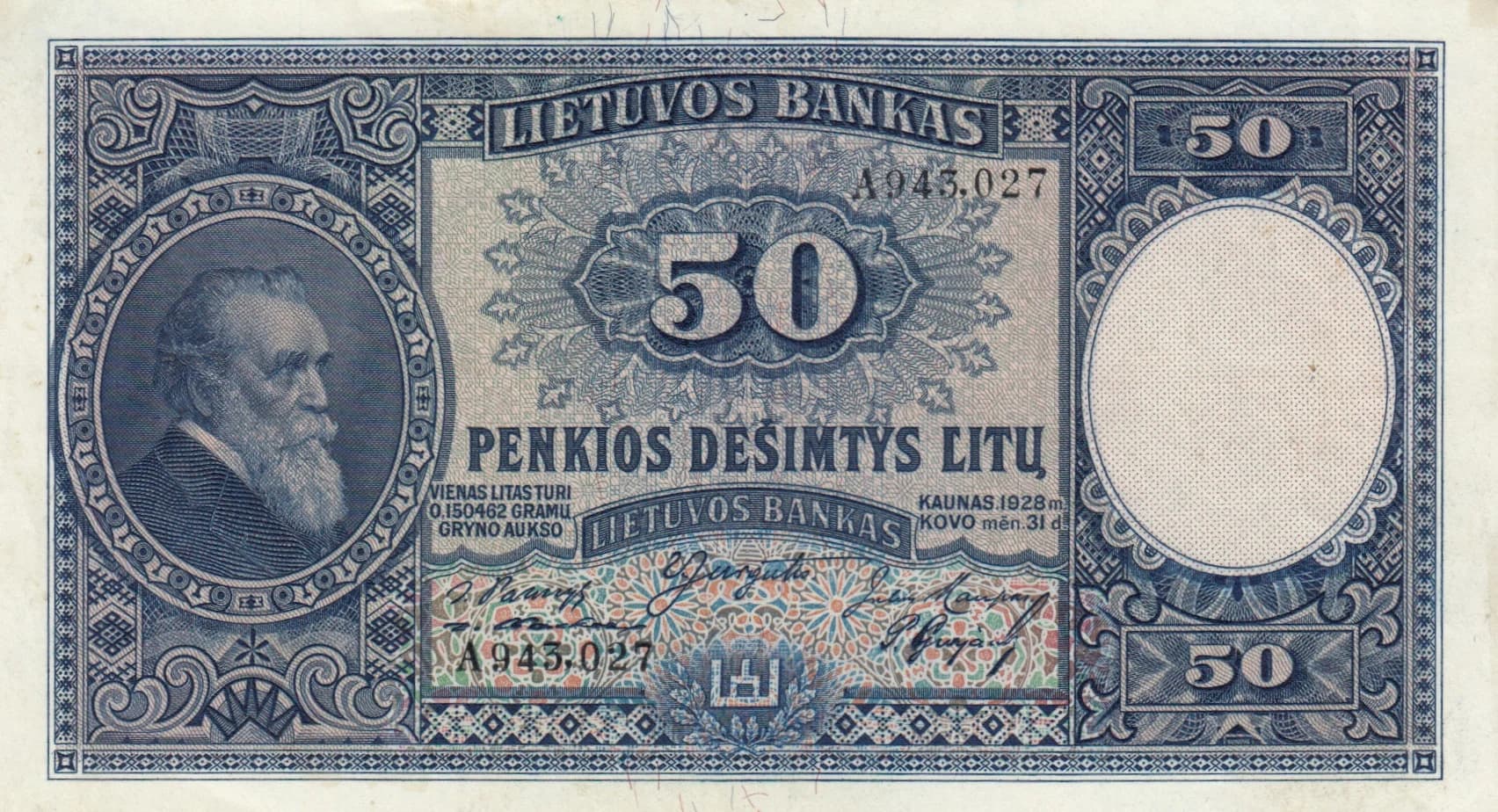
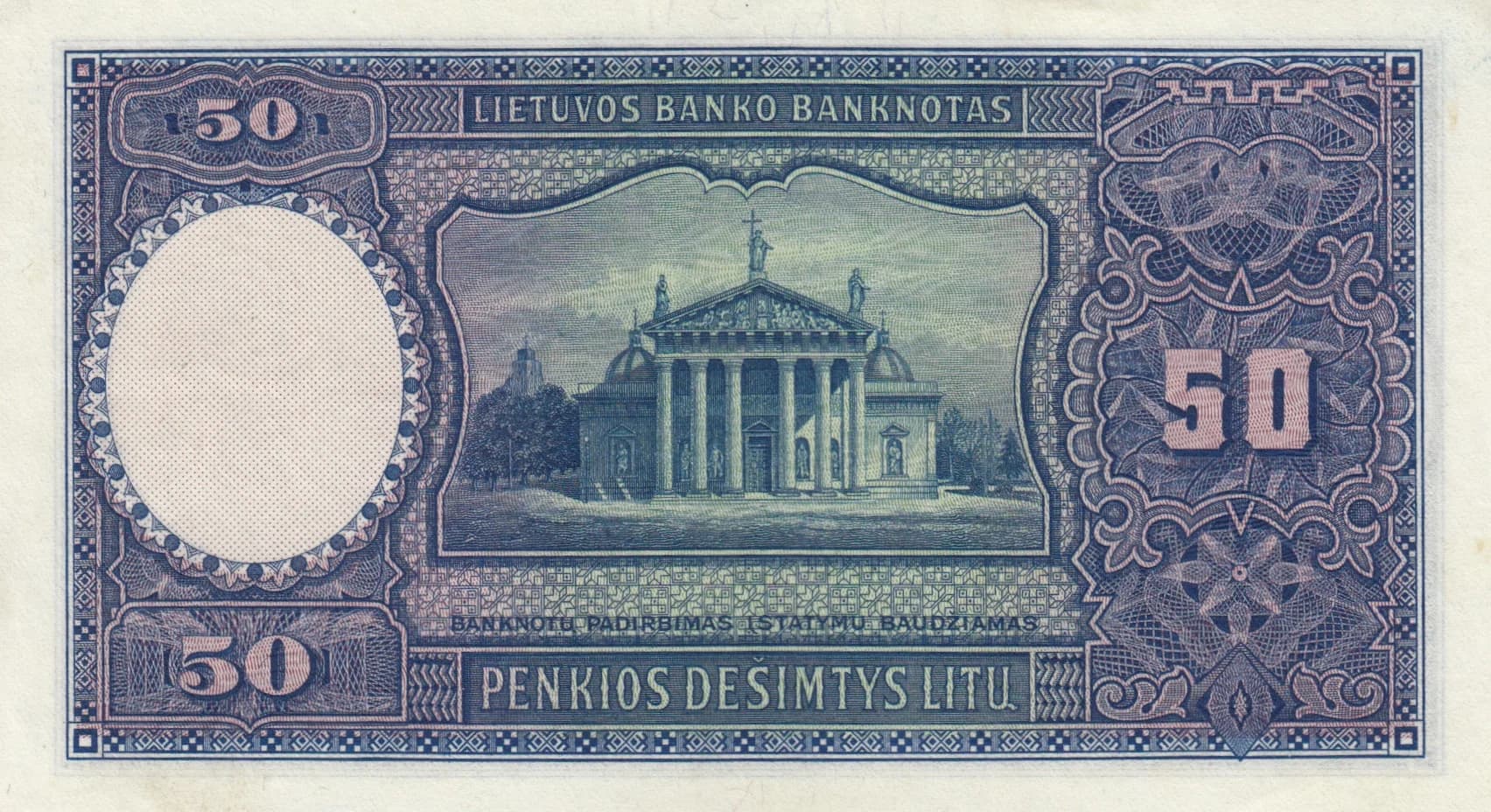
This 50 Litu banknote from 1928 represents a significant piece of Lithuanian monetary history, featuring the portrait of Dr. Jonas Basanavicius on the obverse and the neoclassical Vilnius Cathedral on the reverse. The note displays AU-grade condition with visible but moderate age-related wear including creasing and minor foxing, consistent with nearly a century of existence. The fine engraving quality and dual-language inscriptions reflect the sophistication of interwar Lithuanian banking and the note's gold-backed currency status.
Common. While the denomination and era suggest historical significance, eBay auction data shows consistent sales activity with VF examples regularly selling in the $25-$60 range and F examples in the $15-$50 range across a 12-year period (2010-2021). The 2016 catalog value of $140 for VF and $250 for UNC reflects market appreciation, but the steady trading volume and affordable price points indicate this is a readily available note to collectors. The AU grade of the present example places it above average condition, but the denomination was part of a standard circulation series with no evidence of limited mintage or recall that would elevate rarity status.
Issued on March 31, 1928, by Lietuvos Bankas (Bank of Lithuania) during the interwar period, this banknote commemorates the nation's early independence and modernization efforts. Dr. Jonas Basanavicius, depicted on the obverse, was a key figure in the Lithuanian National Renaissance and independence movement, symbolizing national pride during this formative era. The Vilnius Cathedral featured on the reverse represents the historical and cultural significance of Lithuania's capital, while the inscription specifying the gold content (0.150462 grams of pure gold per litas) underscores the currency's backing during the gold standard era.
The obverse features a formal three-quarter profile portrait of Dr. Jonas Basanavicius, the renowned Lithuanian patriot and cultural figure, rendered in fine engraved line work within an ornate circular frame. Basanavicius appears in formal attire typical of the period, positioned on the left side with the denomination '50' prominently displayed in the upper and lower right corners. The reverse showcases a detailed neoclassical architectural engraving of Vilnius Cathedral, characterized by its columned facade, triangular pediment, and symmetrical European architectural tradition. Both sides employ complex geometric ornamental borders, shield-like emblems in the corners, and decorative scrollwork typical of high-security banknote design of the era. The dominant color scheme of dark blue, gray, with pink/red accents on the reverse provides distinction between the sides while maintaining the formal aesthetic appropriate to a gold-backed currency.
FRONT SIDE: 'LIETUVOS BANKAS' (Bank of Lithuania) - header text; '50' (50) - denomination; 'PENKIOS DESIMTYS LITU' (Fifty Litas) - full denomination in words; 'VIENAS LITAS TURI 0.150462 GRAMU GRYNO AUKSO' (One Litas contains 0.150462 grams of pure gold) - currency backing specification; 'KAUNAS 1928 m KOVO men 31 d' (Kaunas 1928 March 31) - place and date of issue; Serial number 'A943.027'. BACK SIDE: 'LIETUVOS BANKO BANKNOTAS' (Bank of Lithuania Banknote) - header; '50' (50) - denomination; 'PENKIOS DESIMTYS LITU' (Fifty Litas) - denomination in words; 'BANKNOTAS PADIRBIMAS IS SKYRIU AUDIJAMAS' (Banknote manufacture from respective departments) - manufacturing notation.
Intaglio engraving (line engraving and recess printing), the standard security printing method for banknotes of this period. According to PMG cataloging data, the P-24a variant was produced by BWC (Bradbury Wilkinson and Company), a renowned British security printer. The detailed portraiture, fine geometric patterns, and complex ornamental elements visible in the visual analysis are characteristic of high-quality intaglio work. The paper itself shows watermark areas consistent with security paper manufacture of the era.
This note corresponds to Pick P-24, with known variants including P-24a (BWC printer) and P-24s2 (watermark: Man's Head). Based on the visual analysis showing the ornate circular portrait frame and the printer information from PMG cataloging, this example appears consistent with the P-24a variant produced by Bradbury Wilkinson and Company. The serial number A943.027 and March 31, 1928 issue date are consistent with the standard issue series. No overprints or special markings indicating specimen notes or trial impressions are visible in the images.