5 litai 1922
Market Prices
3 salesAbout This Note
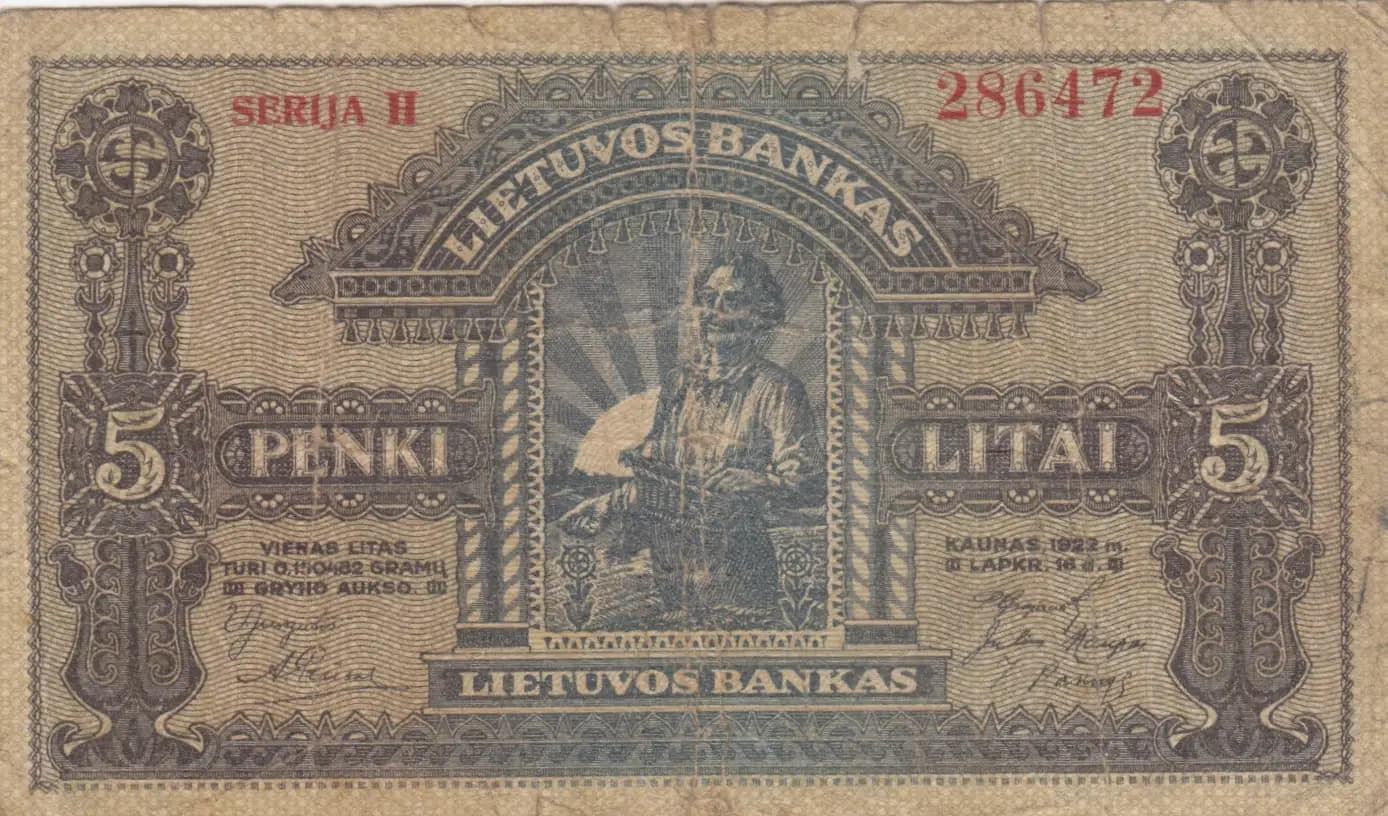
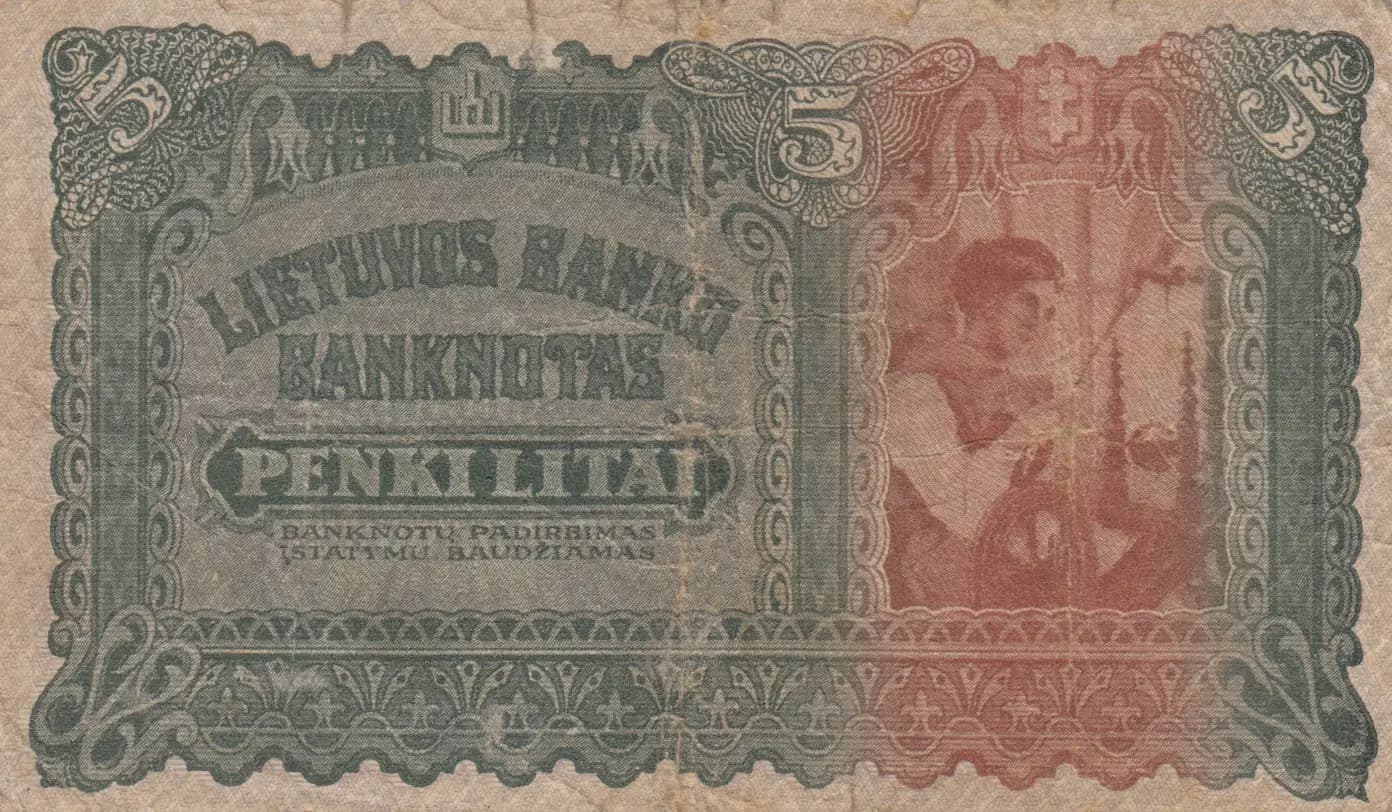
This is a 1922 5 Litai note from Lithuania's Lietuvos Bankas, featuring a portrait of a bearded man in traditional Lithuanian dress on the obverse and an architectural scene split between green and rose tones on the reverse. The note shows moderate circulation wear consistent with its Fair condition grade, with visible creases, folds, and age-related discoloration typical of early 20th-century currency that saw extended use. The fine engraving detail and dual-color printing technique are characteristic of this iconic early Lithuanian currency issue.
Common. The 1922 5 Litai P-16 is a regular-issue banknote from Lithuania's first currency series with substantial print runs intended for general circulation. Market data shows consistent availability in the secondary market, with Fair condition examples selling in the $300-360 range historically and catalog values for this grade around $350-400. The note was widely circulated and surviving examples, while not plentiful, appear regularly in collector channels. No evidence suggests a limited print run, recall, or excessive rarity.
Issued on November 16, 1922, this note represents Lithuania's early independence period following World War I and the Russian Revolution, when the newly sovereign nation established its own monetary system under Lietuvos Bankas. The portrait likely represents a significant figure in Lithuanian culture or independence, while the architectural scene on the reverse may depict an important civic building in Kaunas, which served as the temporary capital during this period. The note's design incorporates security features typical of interwar European currency, reflecting the economic stabilization efforts of the young Baltic republic.
The obverse features a formal portrait of a bearded man in profile facing right, rendered in classical engraving style with fine line work detailing his traditional Lithuanian costume with embroidered or patterned sleeves. The portrait is framed within an ornate rectangular cartouche with Art Nouveau-style corner embellishments on both sides, including what appear to be ornamental crosses or heraldic symbols. The denomination appears in dual-language format on both left and right margins. The reverse displays a significant architectural landmark rendered in split-color technique—a multi-story civic or government building depicted in green on the left portion and rose/red on the right portion, suggesting either a printing technique or intentional color separation. Ornate decorative borders with intricate scrollwork frame the entire design. The cream/beige base stock with brown and gray tones complements the fine line hatching that provides security through detailed engraving throughout.
FRONT SIDE: 'SERIJA II' (Series II); '286172' (Serial number); 'LIETUVOS BANKAS' (Bank of Lithuania); '5 PŪNKI LITAI' (Five Litai); 'VIENAS LITAS TURI O,ISODES GRAMIL III GRYNO AUKSO JI' (One lita contains [specified amount] grams of pure gold); 'KAUNAS, 1922 M. D-LAPKR. 18 J. 35' (Kaunas, 1922, November 18). BACK SIDE: 'LIETUVOS BANKAS' (Bank of Lithuania); 'PENKIS LITAI' (Five Litai); '5' (Denomination numeral); 'BANKNOTO KOPIRBIMAS DRAUDŽIAMAS' (Counterfeiting of banknotes is prohibited).
This note was produced using intaglio (engraved steel plate) printing combined with dual-color lithographic or separate plate printing techniques. The fine line patterns, detailed portrait engraving, and intricate border work are characteristic of high-security intaglio production. The split-color design on the reverse—with distinct green and rose/red zones—suggests either simultaneous multi-color intaglio printing or sequential color application. This was standard practice for European central banks of the interwar period, particularly for newly independent nations seeking to establish credible currency with modern security features.
This example is identified as Series II (SERIJA II) as marked in red on the obverse. According to PMG population data, this Pick number has at least two documented variants: P-16a and P-16s1. The catalog reference notes that P-15 represents a similar design with letters 'S' and 'D' on the upper left and right, while P-17 features a similar design with green serial numbers instead of red. This particular note displays red serial number '286172' in the upper right and red 'SERIJA II' designation in upper left, consistent with standard P-16 characteristics as distinguished from P-15 and P-17 variants.