5 centai 1922
“serie B”
Market Prices
6 salesAbout This Note
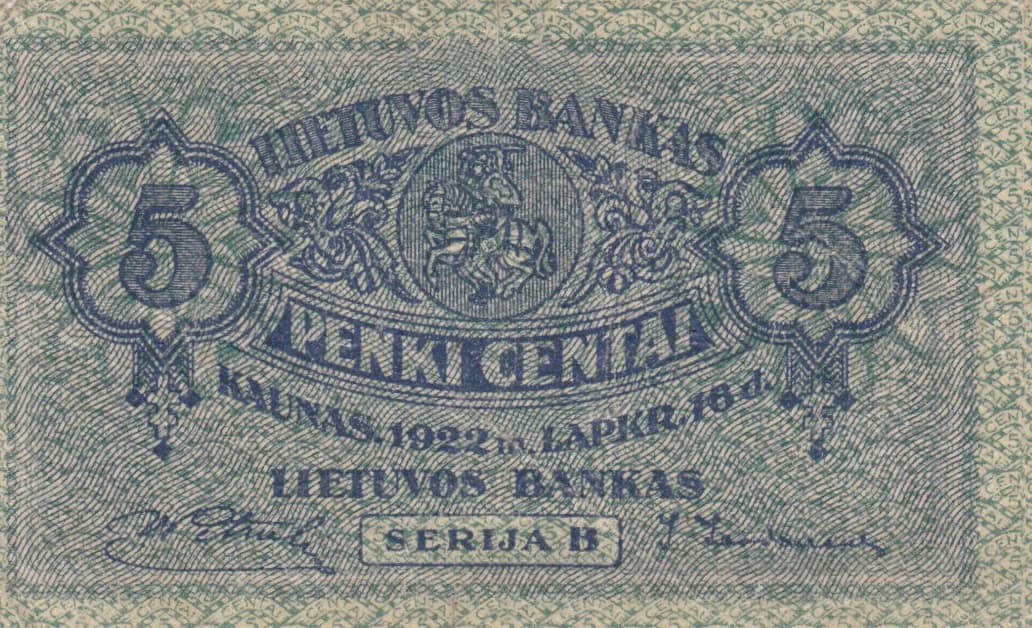
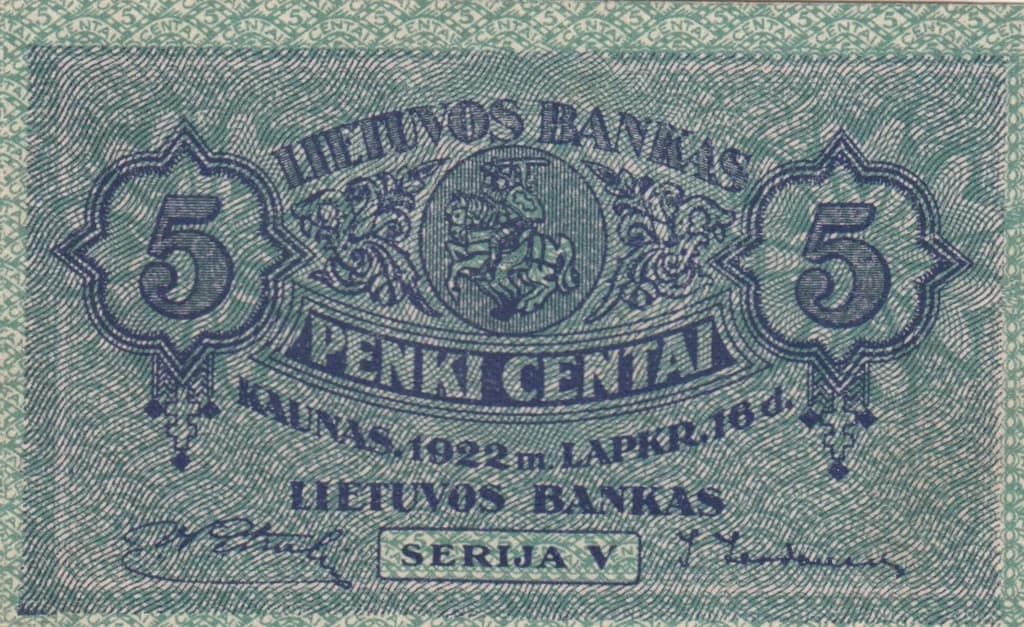
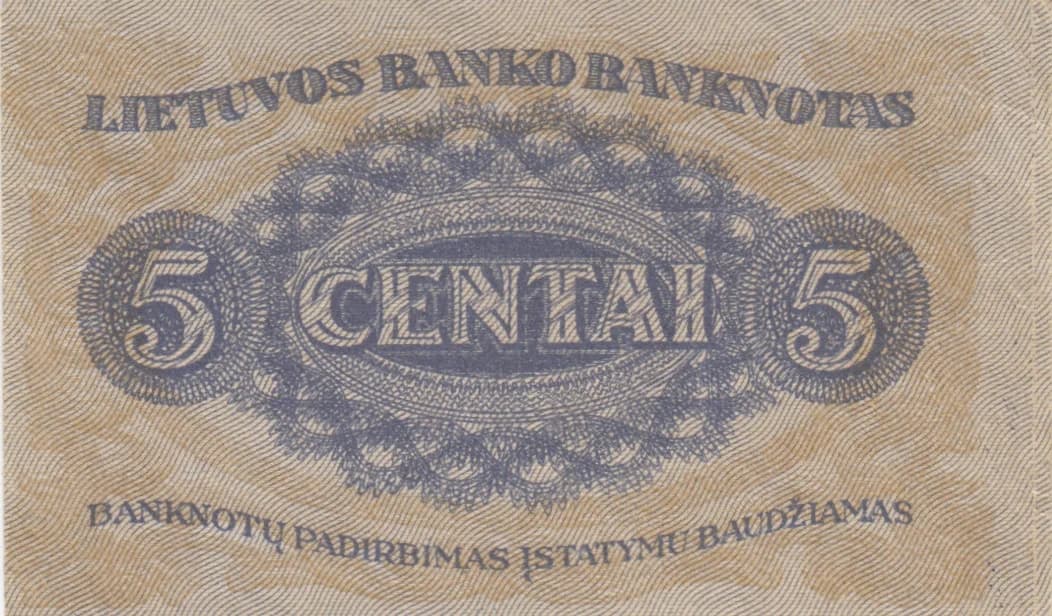
This 1922 Lithuanian 5 centai note (Pick-9, Series B) presents an exceptional example of early independence-era currency design in EF condition. The reverse displays masterfully executed ornate filigree patterns, heraldic symbolism, and baroque-style decorative elements rendered in teal/green and navy inks with sharp, crisp engraving throughout. The note shows no visible wear, creases, or foxing, representing a well-preserved specimen of Lithuania's first decade of monetary independence.
Common. The 5 centai 1922 (Pick-9) was part of Lithuania's initial currency issuance during the early independence period and saw significant circulation. No evidence of restricted print runs, recalls, or extreme scarcity exists for this denomination and pick number in standard condition grades. EF examples are desirable to collectors but not rare; similar notes regularly appear in numismatic markets at moderate valuations consistent with common early 20th-century European minor denominations.
Issued by Lietuvos Bankas in 1922, this denomination reflects Lithuania's establishment as an independent nation following World War I and the collapse of the Russian Empire. The heraldic coat of arms and ornamental design elements visible on the reverse embody the nationalist symbolism adopted by the newly formed Lithuanian state, while the formal banking inscription 'LIETUVOS BANKO BILIETAS' asserts monetary sovereignty during a period of significant European political reorganization.
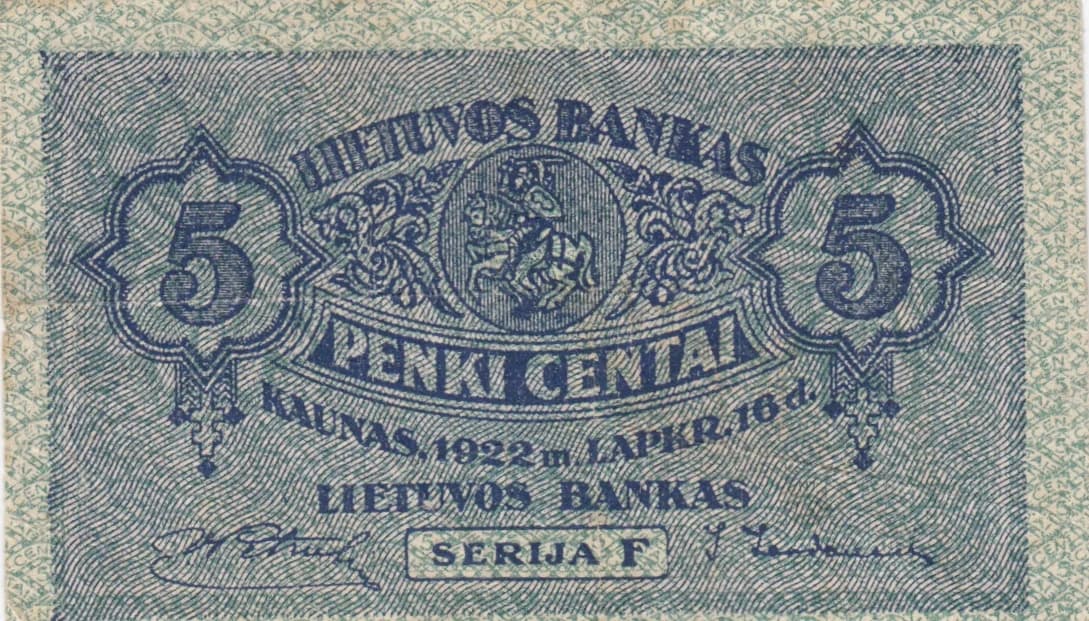
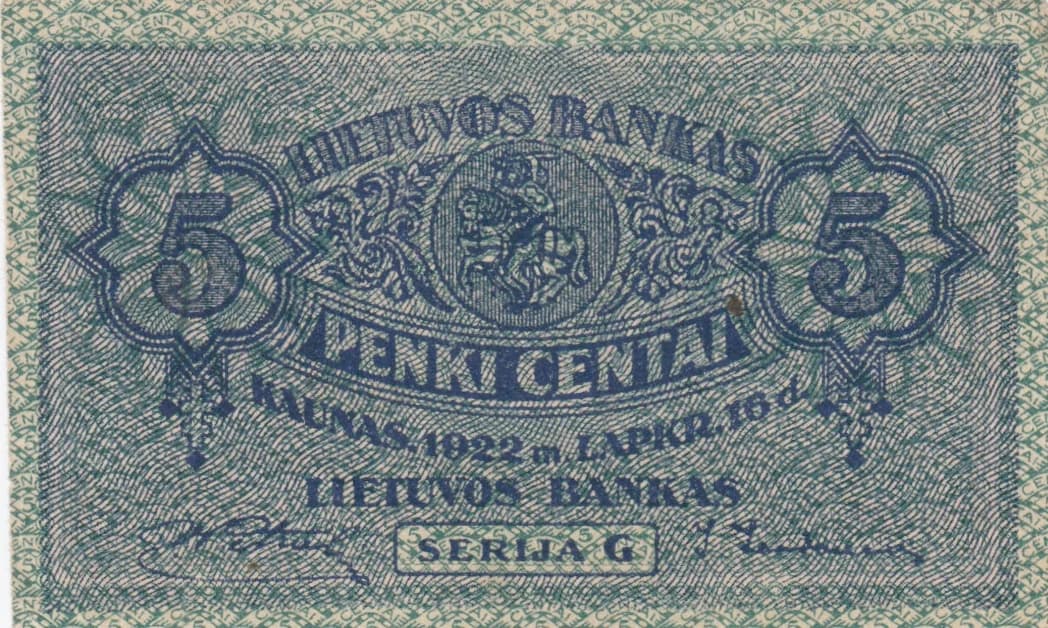
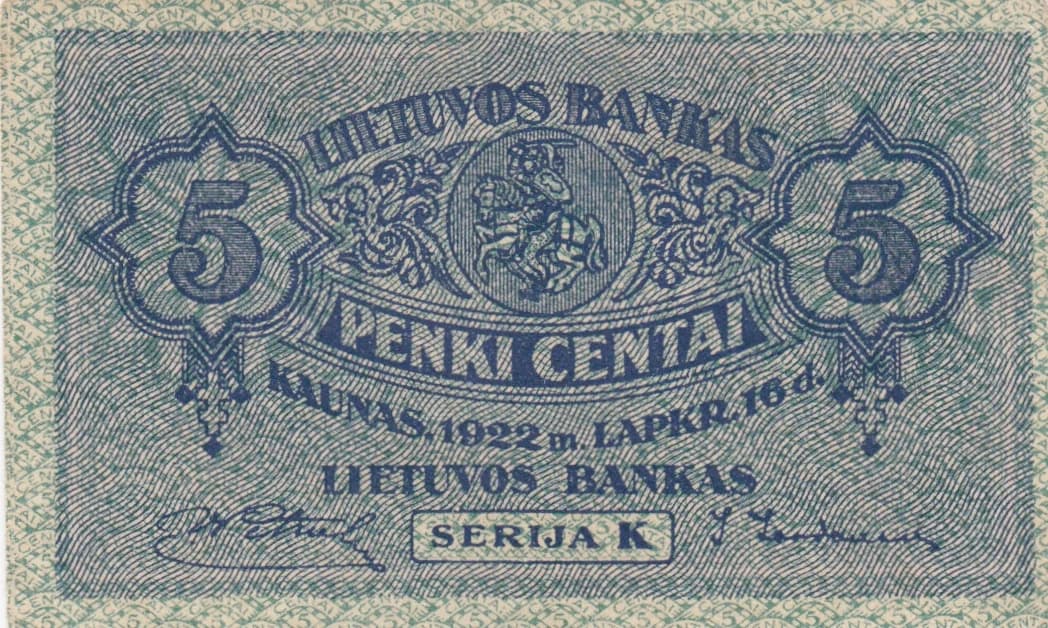
The reverse features a symmetrically composed design centered on an oval heraldic medallion containing Lithuania's coat of arms, likely the Vytis (the armored knight on horseback that represents Lithuanian heraldry). This central symbol is framed by elaborate guilloche patterns and baroque-style filigree flourishes extending to the upper and lower borders. Large ornamental shields containing the numeral '5' flank the central composition on both left and right sides. The denomination 'CENTAI' appears within a decorative oval frame in the central zone. The overall design exemplifies the high-quality security printing standards of early 20th-century European central banks, with text arranged in curved banners emphasizing the note's official authority.
Reverse side inscriptions: 'LIETUVOS BANKO BILIETAS' (Lithuanian Bank Banknote) — the formal issuing authority; 'CENTAI' (Centai) — denomination name; '5' (5) — numerical denomination; 'BANKNOTU PARIBIMAS ISTADYMI BAUDZIAMAS' (Counterfeiting of banknotes is punished by law) — legal warning against counterfeiting; 'SERIJA V' (Series V) — series designation (note: catalog indicates Series B, suggesting possible series variety); 'LIETUVOS BANKAS' (Lithuanian Bank) — issuer name.
Intaglio engraving (line engraving), the standard security printing method for banknotes of this era. The fine line work, complex guilloche patterns, and baroque decorative elements were produced through traditional copperplate engraving techniques. The sharp detail reproduction and depth visible in the crisp imagery indicate professional security printing by a specialized banknote printer; for early Lithuanian currency, this was typically produced by established European banknote manufacturers such as Giesecke+Devrient or similar firms contracted by Lietuvos Bankas.
Series B is noted in the collector notes; the visual analysis references 'SERIJA V' (Series V) in inscriptions, suggesting potential series variety or transcription variance between catalog data and the actual note observed. Early Lithuanian banknotes were issued in multiple series (A, B, C, V, etc.). This Series B specimen should be confirmed against Pick catalog specifications for series designations. No other notable varieties (signature variations, overprints, or date variants) are evident from the visual analysis of this reverse image alone; front-side examination would be necessary to assess complete variety attribution.