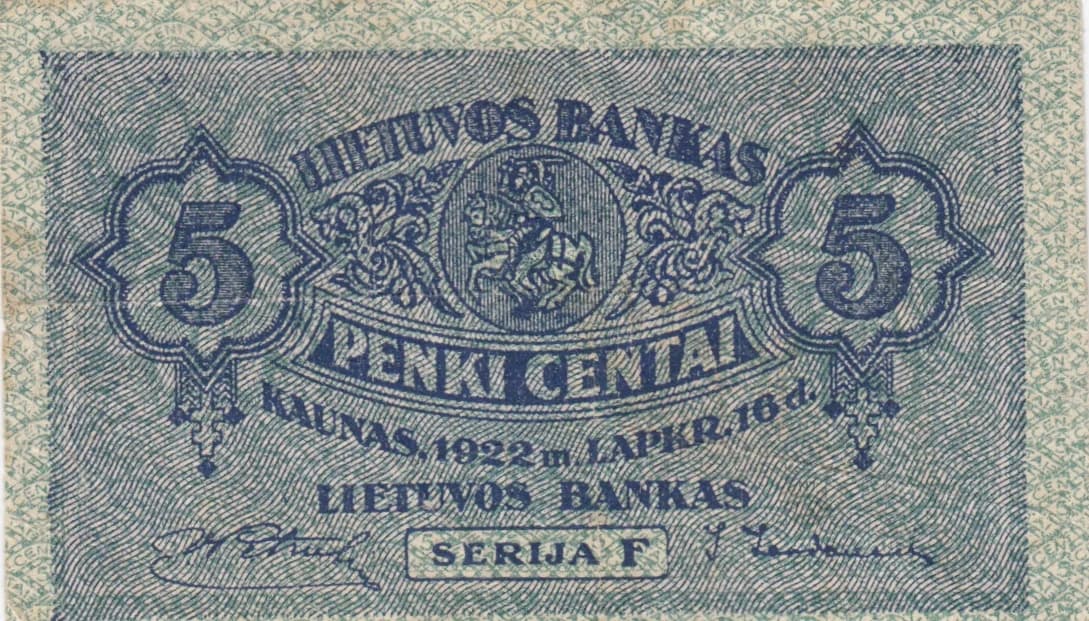
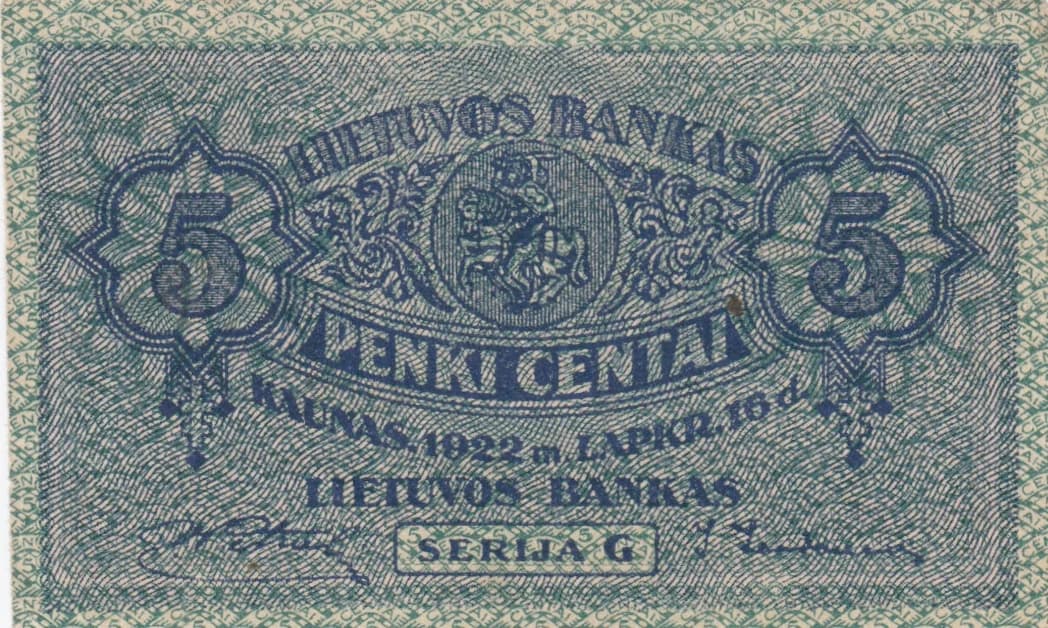
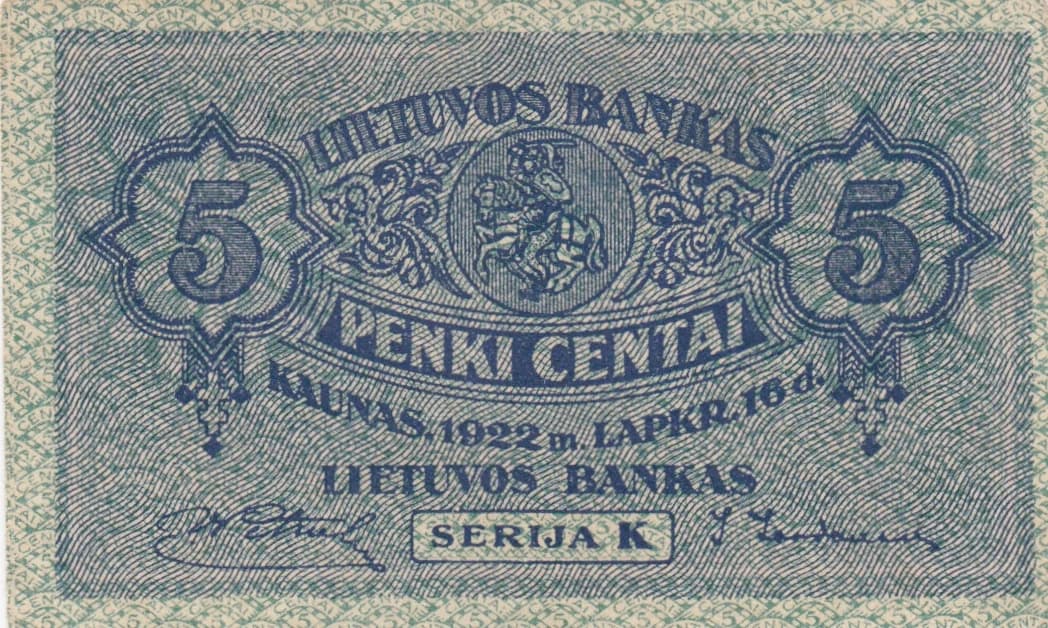
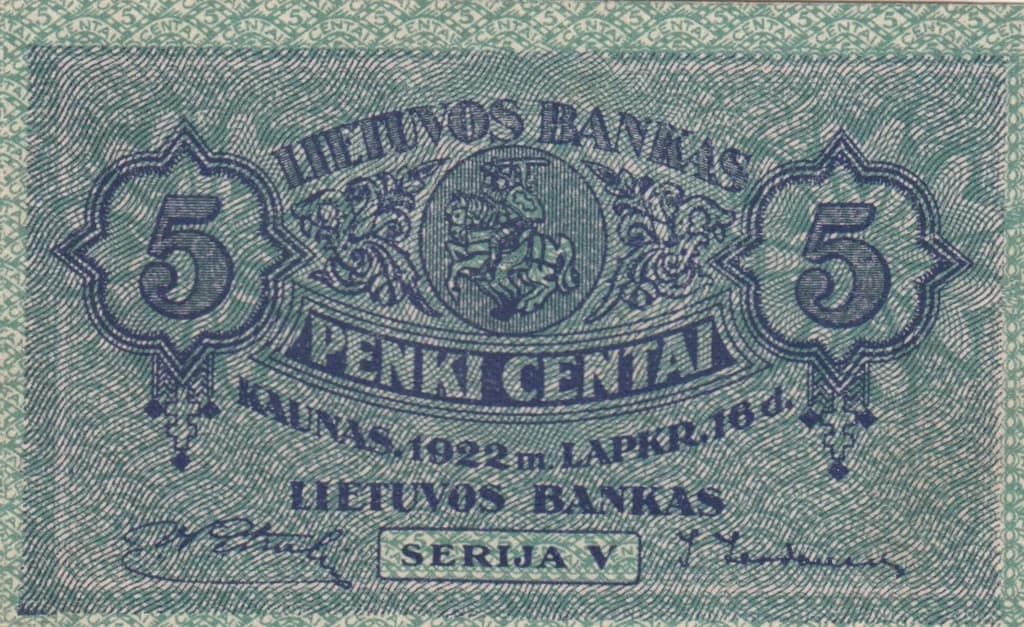
5 centai 1922
“serie B”
Market Prices
6 salesAbout This Note
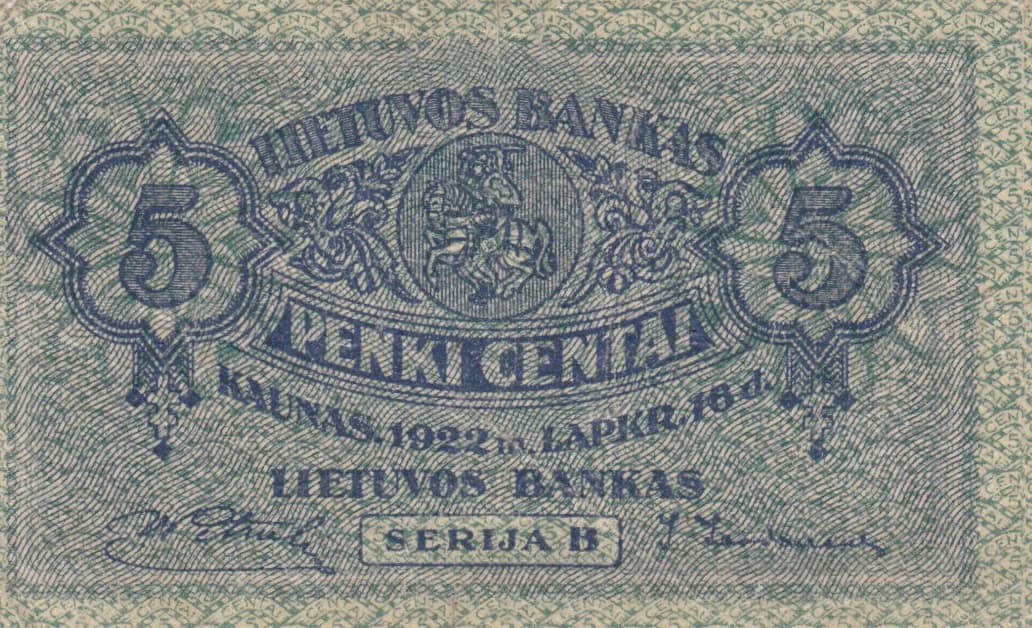
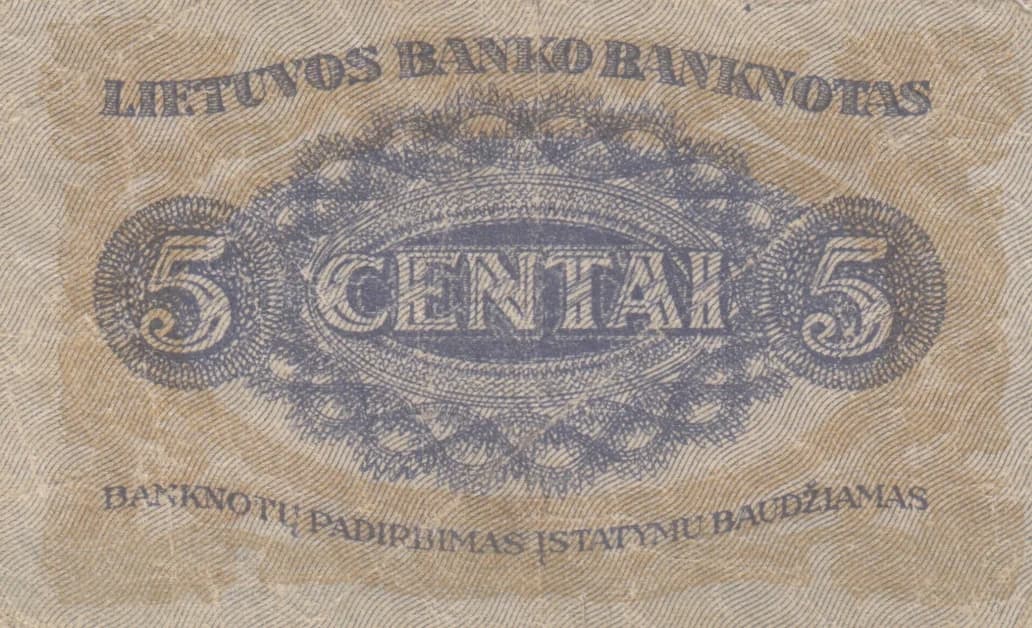
This Lithuania 5 Centai from 1922 (Pick P-9) presents an exceptionally clean example of Lietuvos Bankas's early currency issue, featuring intricate guilloche patterning and a central heraldic medallion. The note displays Series B designation and exhibits the light tan/beige coloring typical of this denomination, with minimal wear consistent with its F (Fine) condition grade. The extensive fine-line engraving work and ornate decorative framing showcase the security printing standards of Lithuania's early independent banking period.
Common. Market evidence strongly supports this assessment: eBay sales data shows consistent and frequent sales across multiple condition grades, with F-grade examples selling in the $37-$182.50 range from 2015-2020, and VG examples at $14. The 2016 catalog value of $60 for VF condition places this note in the affordable, regularly traded category. As a regular issue of Lithuania's primary central bank with no recorded short print run or recall, this Pick number remains readily available to collectors.
Issued on November 16, 1922, this 5 Centai note represents Lithuania's first independent monetary issue following the country's declaration of sovereignty in 1918 and recognition by the League of Nations. The Lietuvos Bankas (Bank of Lithuania) and its heraldic coat of arms depicted in the central oval medallion symbolized the newly established nation's financial authority during the post-World War I period of Baltic state formation and stabilization.
The 5 Centai note features a symmetrical layout with denomination numerals '5' displayed in ornate frames on both the left and right margins of both sides. The front presents a central oval frame containing 'CENTAI' text with regulatory inscriptions flanking the denomination area. The reverse showcases a more elaborate design with a central oval heraldic medallion containing the coat of arms of Lithuania, surrounded by elaborate scrollwork and flourishes. The entire surface is covered with fine parallel-line guilloche patterning in blue-gray ink on a light tan/beige background, a security feature standard for high-quality bank note engraving of the period. No portraits appear on this denomination; the heraldic imagery serves as the primary symbol of state authority.
Front side: 'LIETUVOS BANKO NOTAS' (Lithuanian Bank Note), 'CENTAI' (centai), 'BANKNOTI PADIDIMAS ISTATO BAUDIZIJAUS' (Legal text regarding banknote regulations), and denomination numeral '5'. Back side: 'LIETUVOS BANKAS' (Bank of Lithuania), 'PENKINI CENTAI' (Five centai), year '1922', and 'SERIJA B' (Series B).
Intaglio (steel engraving) printing method, evidenced by the precise fine-line guilloche patterns and the detailed engraved coat of arms with elaborate scrollwork. The extensive parallel-line security work and ornate decorative borders are characteristic of the highest quality security printing available to newly independent European states in the early 1920s. The printer for this issue is not definitively established from catalog data, though early Lithuanian banknotes were produced by established European security printers.
This note is identified as Pick P-9a variant (5 Centai), with PMG records indicating three additional catalogued variants (P-9cts and P-9s3) for this base Pick number. The observed example bears Series B designation as noted in collector records. The specific date of November 16, 1922, combined with the Series B notation, should be cross-referenced against known serial number range studies for precise variety identification within the P-9a classification.