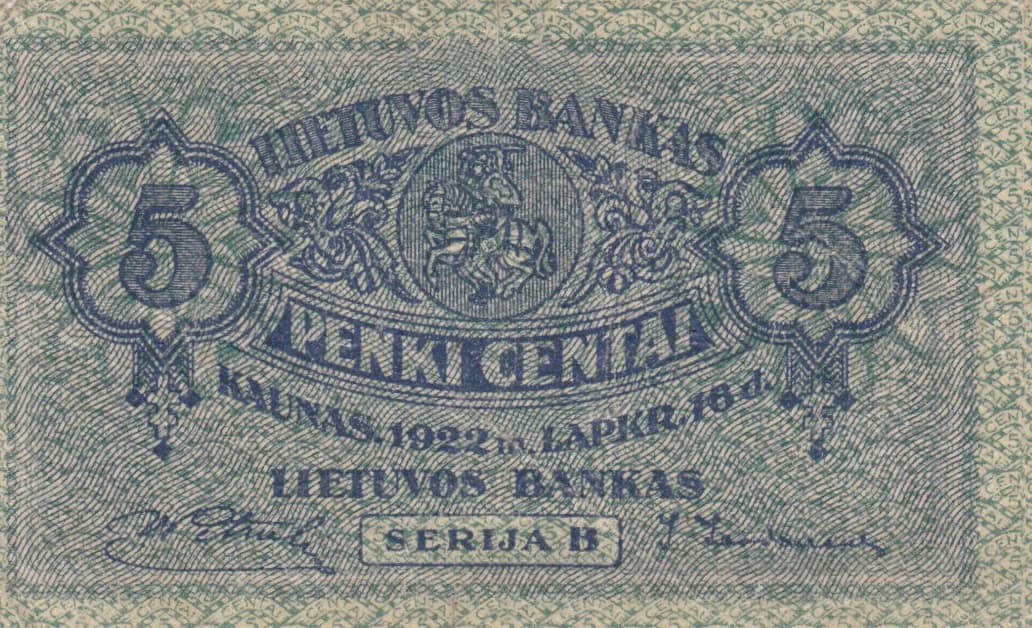
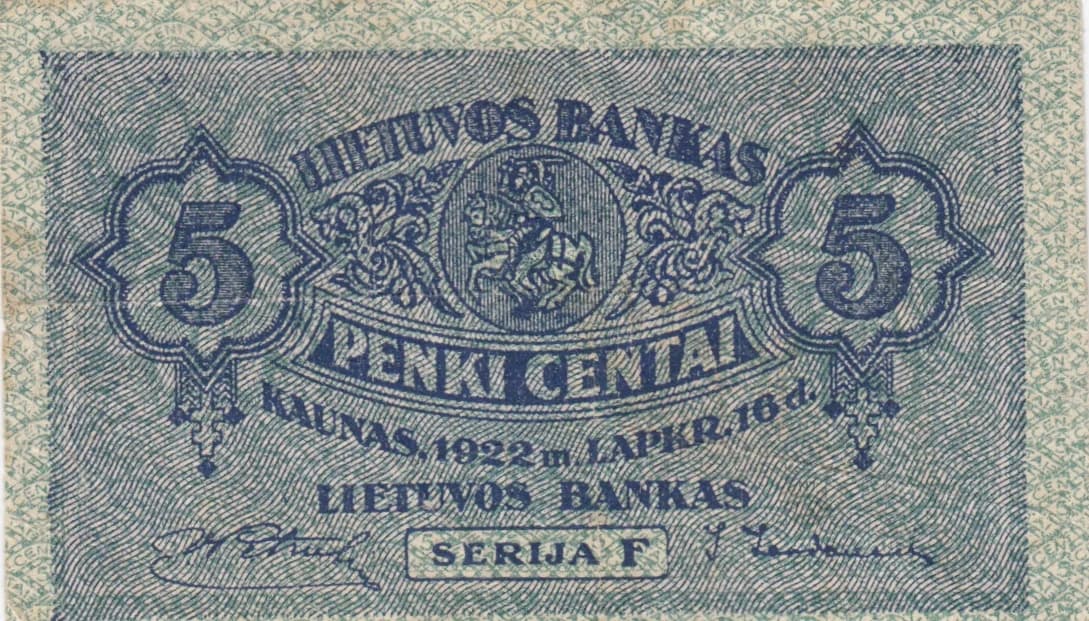
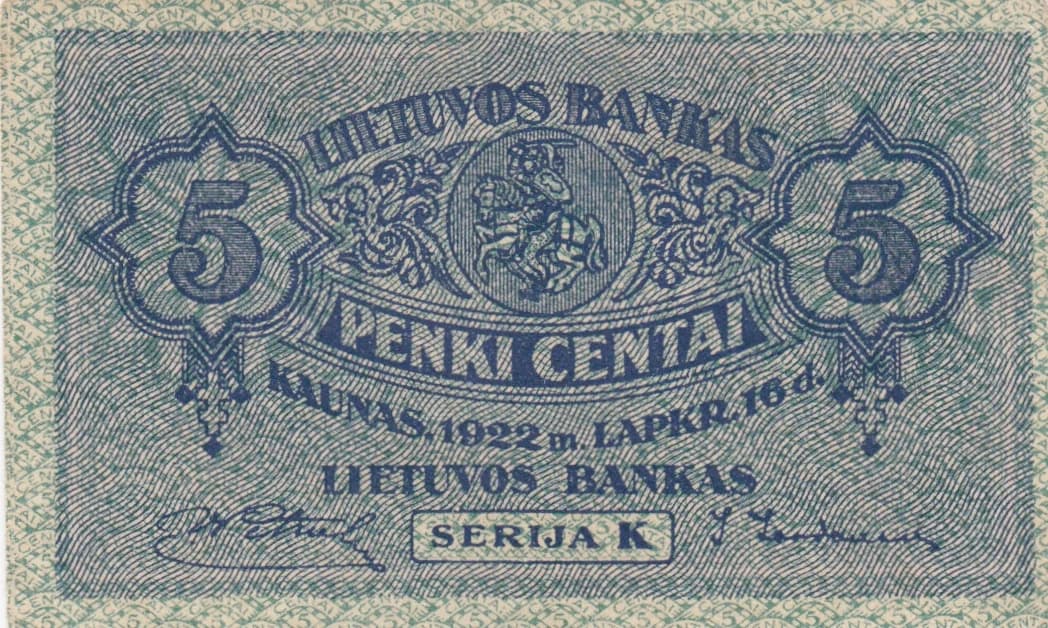
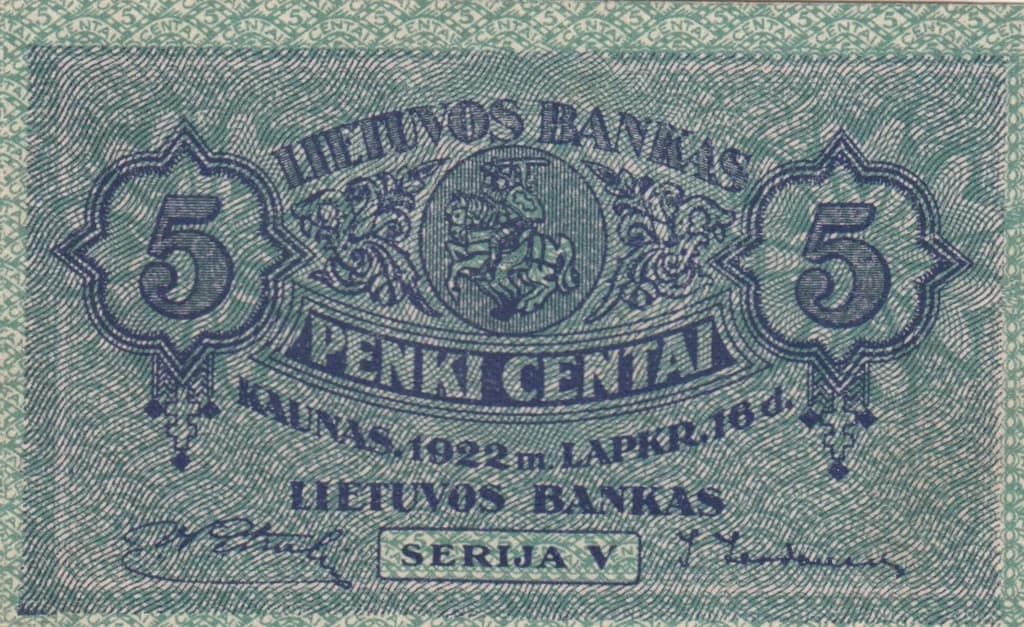
5 centai 1922
“serie G”
Market Prices
6 salesAbout This Note
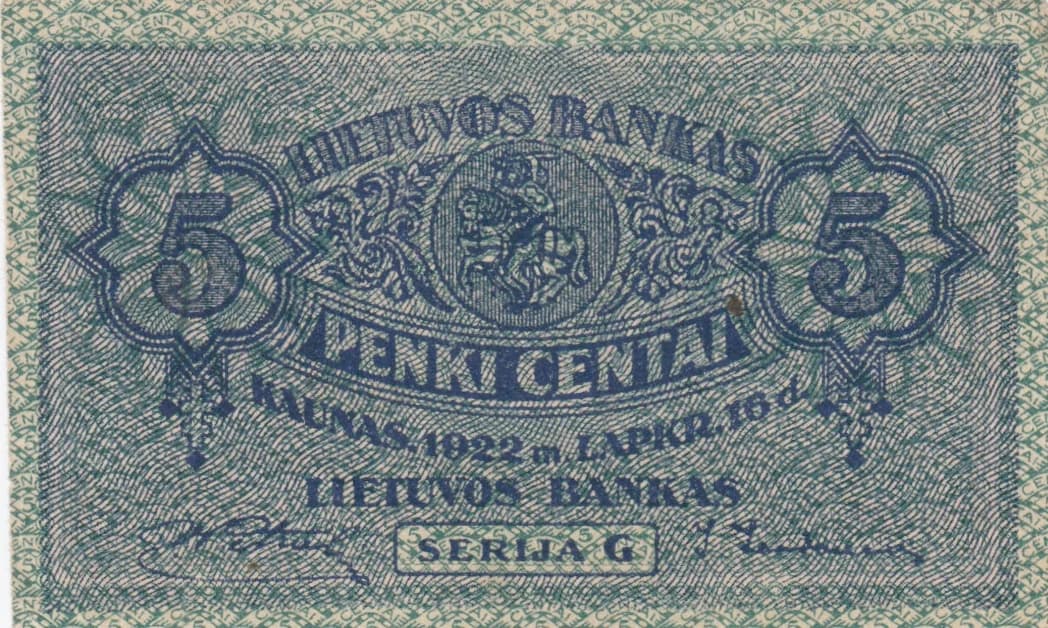
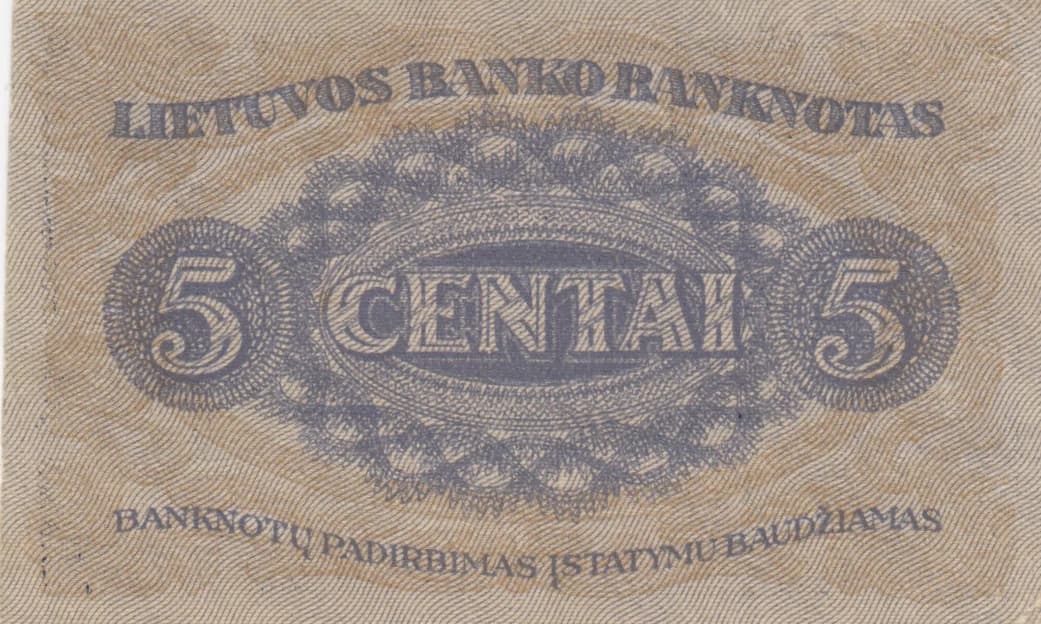
This is a Lithuanian 5 centai banknote from 1922, issued by Lietuvos Bankas during the early years of Lithuanian independence. The note is graded EF (Extremely Fine) and displays crisp, sharp printing with no visible wear, creases, or damage. It features an ornamental design with a central heraldic medallion on the reverse and fine line engraving throughout, representing a key example of Lithuania's first national currency.
Common. This note, while historically significant as part of Lithuania's early currency, is relatively common in the numismatic market. eBay sales data shows consistent trading activity with VF notes selling for approximately $197 and F notes for $37-$56, indicating healthy collector demand but without the dramatic premiums associated with rare notes. The 1922 5 centai was produced in sufficient quantities for regular circulation, and surviving examples remain available to collectors.
Issued on November 16, 1922, this note represents Lithuania's early monetary independence following the restoration of the Lithuanian state after World War I. The heraldic coat of arms and Lithuanian language inscriptions ('Lietuvos Bankas,' 'Penki Centai') symbolize the nation's sovereignty and establishment of its central banking institution. The denomination reflects the practical currency denominations needed for everyday transactions in the newly independent republic during the early 1920s.
The obverse features a central oval medallion with ornamental borders containing the denomination, flanked by large numerals '5' on both sides, with a fine wavy line background pattern in tan and gray-blue colors. The reverse displays a more elaborate decorative design dominated by an ornamental central medallion containing Lithuania's heraldic coat of arms, with intricate line work patterns and geometric designs covering the background in dark blue and cream/pale green tones. Large ornamental numerals '5' appear on both sides of the reverse. The design emphasizes national symbolism through heraldic imagery while employing sophisticated engraved patterns typical of early 20th-century banknote design.
Front side: 'Lietuvos Banko Notas' (Bank of Lithuania Note), 'Centai' (Centai), 'Banko Direktoriaus ir Valdymo Raštininkas' (Bank Director and Management Secretary). Back side: 'Lietuvos Banko' (Bank of Lithuania), 'Penki Centai' (Five Centai), 'Serihs' (Series), 'Menus Pane' (additional reference marking).
Intaglio engraving (line engraving), evidenced by the fine, crisp line work visible throughout both sides of the note. The detailed wavy line patterns, intricate medallion designs, and sharp printing quality are characteristic of intaglio printing used for high-security banknote production. This printing method was standard for Lietuvos Bankas during the 1920s.
Series G as noted in the collector notes. The PMG population report indicates multiple cataloged variants exist for this Pick number (P-9a and P-9cts identified as variants of the 5 centai denomination), though the visual analysis does not reveal additional distinguishing characteristics such as signature variations or watermark differences that would definitively establish this note's specific variety designation within the Pick catalog system.