5 centai 1922
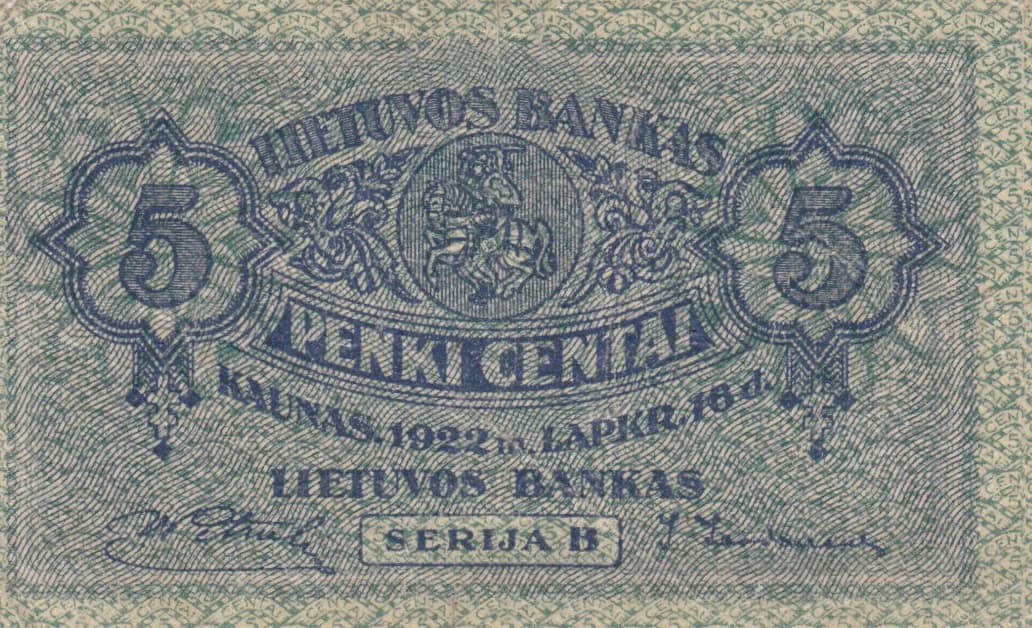
“serie B”
Market Prices
6 salesAbout This Note
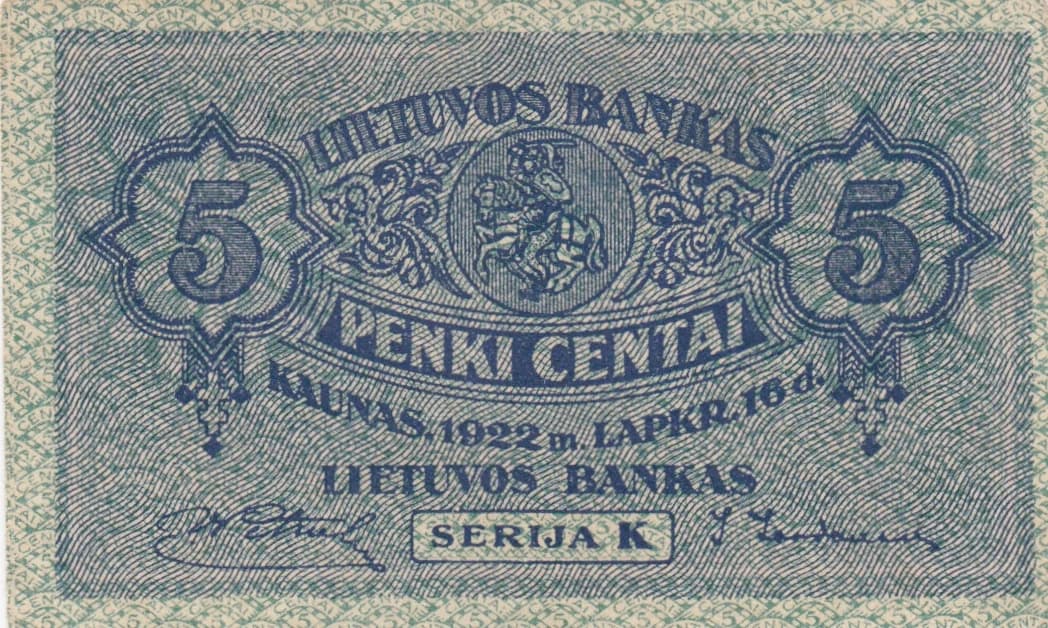
This 1922 Lithuanian 5 centai banknote (Pick P-9, Series B) presents an excellent example of early interwar Eastern European currency design. The note displays sharp, well-preserved engraving throughout with no visible wear, tears, or creases, consistent with an EF grade. The elaborate filigree patterns, guilloche backgrounds, and heraldic symbolism reflect the sophisticated security printing standards of Lietuvos Bankas during Lithuania's first years of independence.
Common. The 5 centai denomination from 1922 was a standard circulating issue of Lietuvos Bankas with substantial print runs typical of everyday low-denomination currency. While Lithuanian independence-era notes have collector interest, this Pick number does not exhibit characteristics suggesting limited distribution, recalls, or short-lived status. EF condition examples remain relatively available in the collector market at moderate valuations.
Issued in 1922 by Lietuvos Bankas during Lithuania's newly established independence, this 5 centai note represents the country's early monetary sovereignty following World War I and separation from the Russian Empire. The ornate heraldic coat of arms displayed in the central oval medallion symbolized the nation's assertion of independent statehood, while the baroque-style decorative elements were typical of the period's European currency design philosophy, which emphasized both aesthetic prestige and security against counterfeiting.
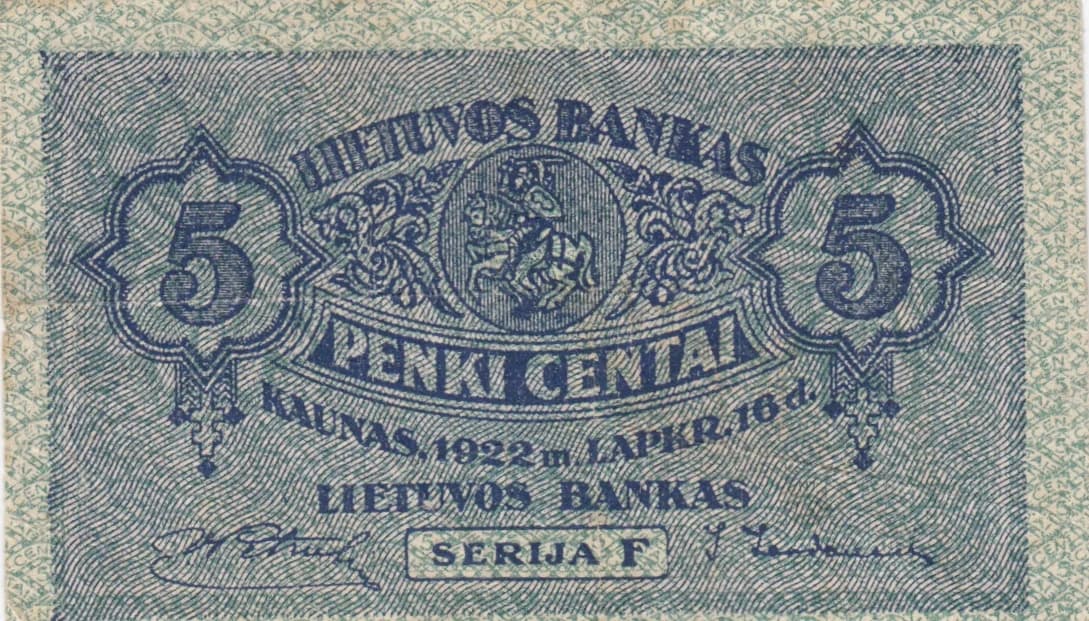
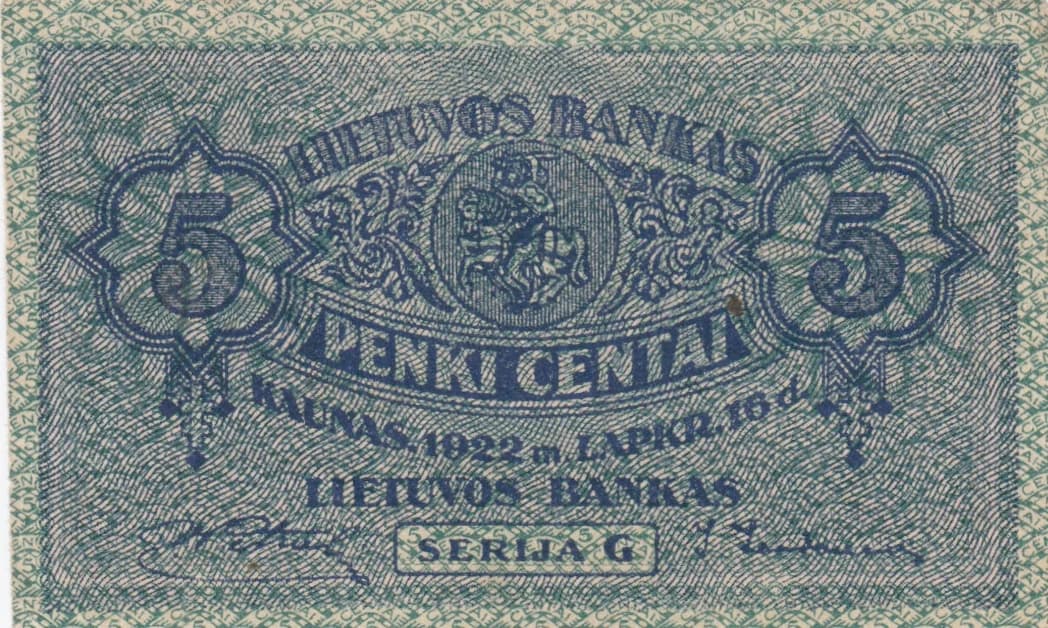
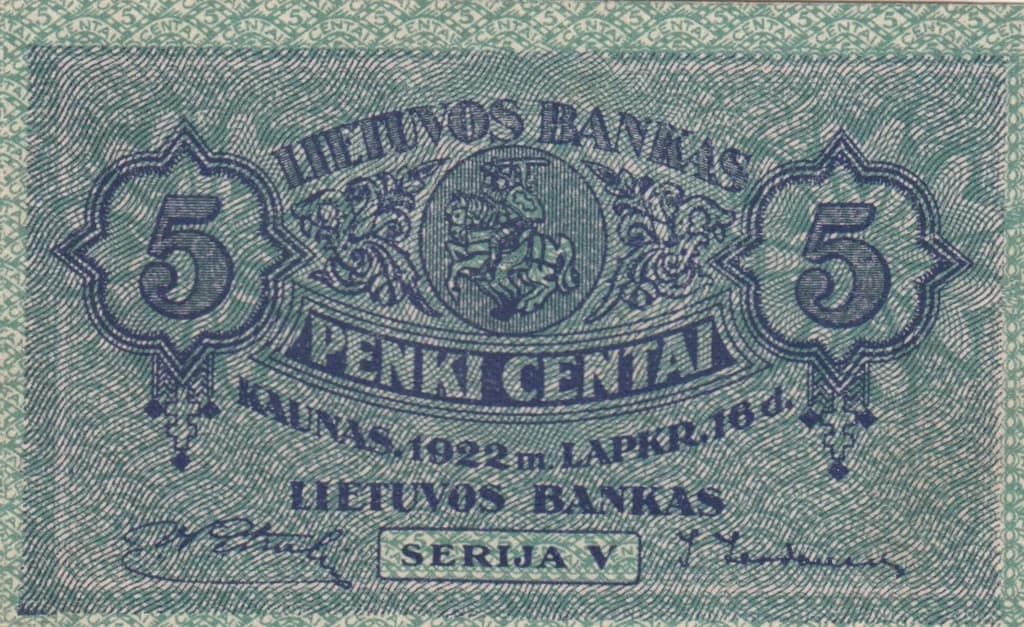
The 5 centai note features a symmetrical design centered on a heraldic coat of arms within an ornamental oval medallion, representing the Lithuanian state emblem. The denomination appears in decorative shields on both left and right sides with large numerals '5'. Elaborate filigree patterns and guilloche work cover the upper and lower portions of both sides, creating a complex baroque-style frame. The color scheme employs teal/green and navy blue inks on tan/beige paper stock. All text is arranged in curved banners and decorative cartouches, with 'LIETUVOS BANKO BILIETAS' (Lithuanian Bank Banknote) and the anti-counterfeiting warning prominently displayed.
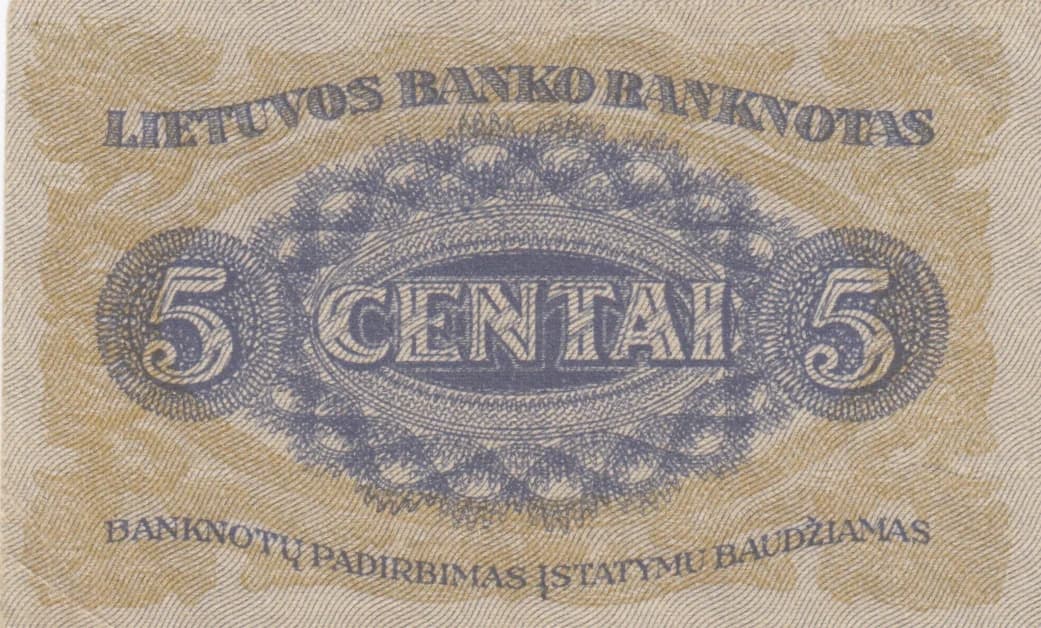
Back side: 'LIETUVOS BANKO BILIETAS' (Lithuanian Bank Banknote); 'CENTAI' (Centai); '5' (denomination); 'BANKNOTU PARIBIMAS ISTADYMI BAUDZIAMAS' (Counterfeiting of banknotes is punished by law); Additional text elements include 'SERIJA V' (Series V) and references to the issuing authority. The inscriptions are arranged in curved banners and decorative frames typical of the note's design scheme.
Intaglio (steel engraving) printing, evidenced by the fine line engraving, complex guilloche patterns, and sharp definition of decorative elements throughout. The note exhibits the hallmark characteristics of high-security currency production from this period, with multiple passes of engraved plates creating the layered decorative effects. The printer information is not definitively indicated in the visual analysis, though Lithuanian banknotes of this era were typically produced by established European security printers.
This example is identified as Series B (Serija B) based on catalog notation and visual evidence. The series designation represents a printing variety distinction for this issue. Additional varieties may exist based on signature combinations, printer marks, or serial number ranges, though the visual analysis does not provide sufficient detail to distinguish among known sub-varieties. Collectors should cross-reference specific serial number ranges and series letters against specialized Lithuanian currency catalogs for precise variety identification.