20 litu 1930
Market Prices
12 salesAbout This Note
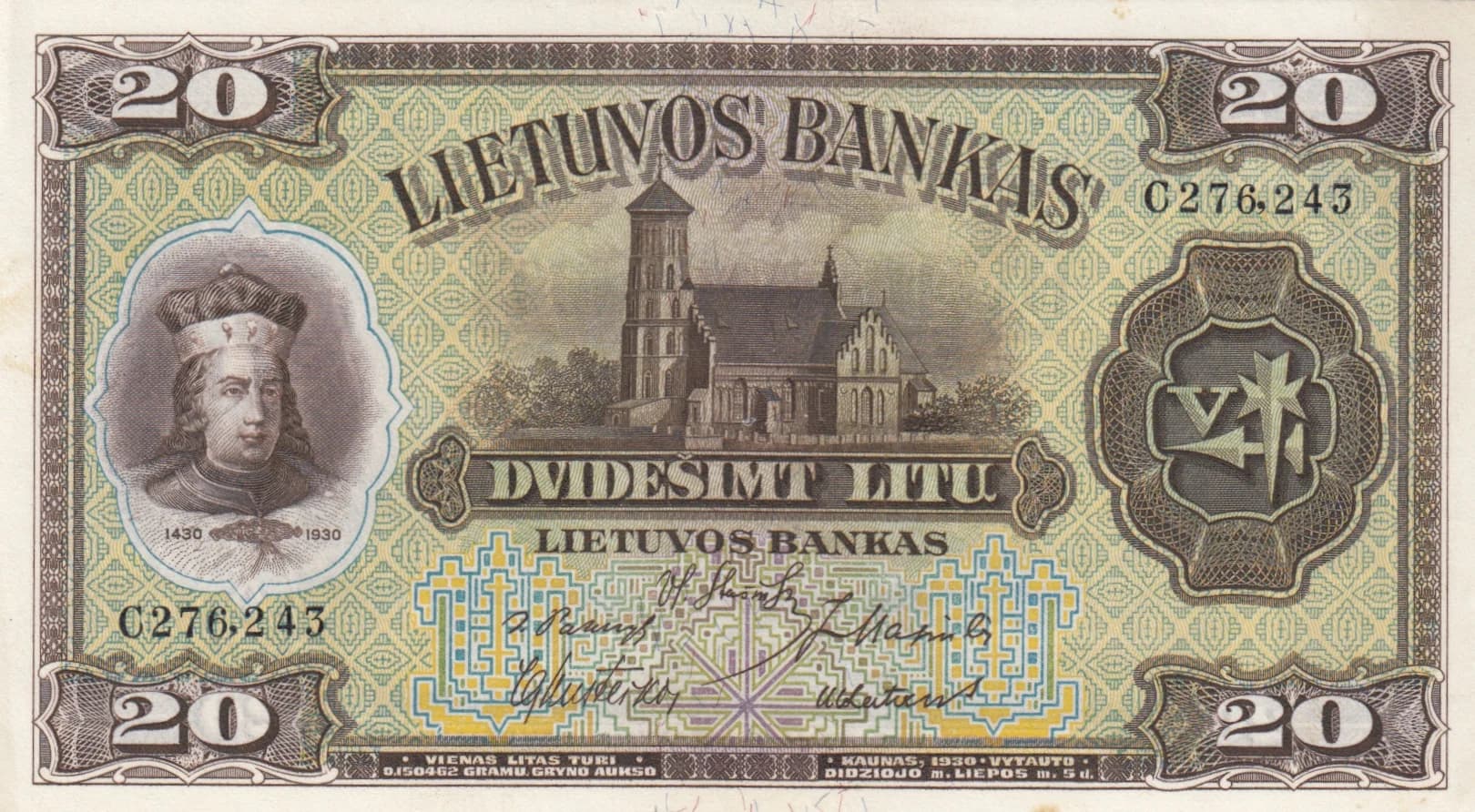
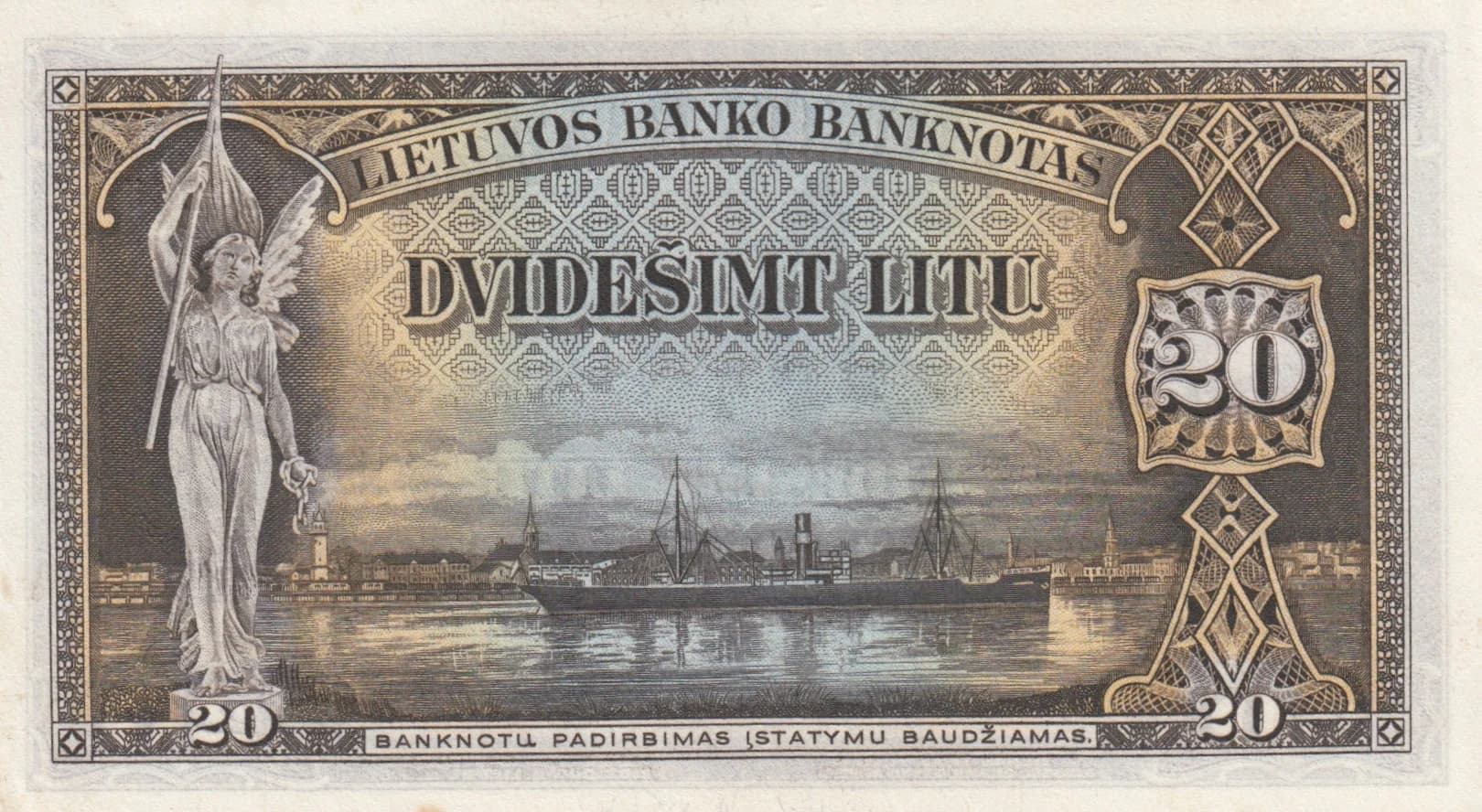
This is a striking commemorative 20 Litu note from Lithuania's 1930 issue celebrating the 500th anniversary of Grand Duke Vytautas the Great. The obverse features a crowned portrait of Vytautas in an ornate oval frame alongside the magnificent Vytautas Church, rendered in cream, brown, and green tones with exceptional fine-line engraving. The reverse depicts an allegorical winged Liberty figure and a detailed harbor scene with the ship Prezidentas Smelona, exemplifying the high-quality banknote artistry of interwar Lithuania. This UNC example exhibits sharp, clear impressions throughout with minimal aging, making it a desirable piece of Lithuanian numismatic history.
Common. Although this is a commemorative note with limited appeal beyond Lithuanian collectors, eBay auction data from 2010-2021 shows consistent sales in VF condition ranging from approximately $40-$100, with VG examples selling for $17-$90 and UNC catalogue values around $300. The relatively modest prices and regular auction appearances indicate this note was produced in sufficient quantities for circulation and remains readily available to collectors. No significant print run restrictions, recall history, or scarcity factors are documented for P-27.
This note was issued on July 5, 1930, to commemorate the 500th anniversary of Vytautas the Great's rule (1430-1930), a pivotal figure in Lithuanian history who expanded the Grand Duchy to its greatest territorial extent. The inclusion of Vytautas Church on the obverse and the harbor scene depicting Klaipeda/Memel on the reverse reflect Lithuania's cultural and economic priorities during the interwar independence period, celebrating both national heritage and the country's maritime aspirations as a newly sovereign nation. The allegorical Liberty figure on the reverse symbolized the nation's hard-won independence and modernization following the 1918 declaration of independence.
The obverse features a finely engraved portrait of Grand Duke Vytautas the Great in left profile, crowned and framed within an ornate oval cartouche, positioned in the left portion of the note. Centrally placed is the Vytautas Church (Vytauto Didžiojo bažnyčia), a Gothic structure with a tall ornate spire, symbolizing the nation's religious and cultural heritage. The design incorporates elaborate guilloche patterns, decorative geometric borders, and an ornamental shield with a cross in the upper right corner. The reverse depicts an allegorical winged female figure (representing Liberty or National Prosperity) standing prominently on the left, holding a torch or staff. The right side features a detailed maritime harbor scene—likely representing Klaipeda—with steamships, sailing vessels, and dock infrastructure reflected in calm waters, representing Lithuania's economic aspirations and connection to the Baltic Sea. The color scheme of cream, brown, and green provides excellent contrast and visual balance characteristic of high-quality 1930s Central European banknote design.
FRONT: '20' (denomination), 'LIETUVOS BANKAS' (Lithuanian Bank/Bank of Lithuania), 'DVIDESIMT LITU' (Twenty Litu), 'C276.243' (serial number), '1430 1930' (commemorative years marking Vytautas's reign). BACK: 'LIETUVOS BANKO BANKNOTAS' (Lithuanian Bank Note), 'DVIDESIMT LITU' (Twenty Litu), '20' (denomination), 'BANKNOTŲ PADIRBIMAS STATYMU BAUSZIAMAS' (Counterfeiting punishable by law).
Intaglio engraving (recess printing) executed by Banknote World Company (BWC), a leading security printer of the interwar period. The sharp detail visible in the fine-line work, guilloche patterns, ornamental frames, and portrait rendering are characteristic of master intaglio engravings. The multi-color printing (brown, green, and blue underprints) required careful register alignment and sequential plate passes, demonstrating the technical sophistication of 1930s Lithuanian banknote production.
This example appears to be the P-27a standard variety based on Pick catalog designation. PMG has catalogued P-27s2 as a commemorative variant, suggesting signature or overprint differences may exist. The serial number visible (C276.243) and lack of visible overprints on this specimen indicate the standard P-27a variety. The handwritten annotations in purple/violet ink visible on the front are collector marks rather than an official variety marker. Investigation of signature varieties and potential overprint differences would require comparison with documented specimens in professional collections.