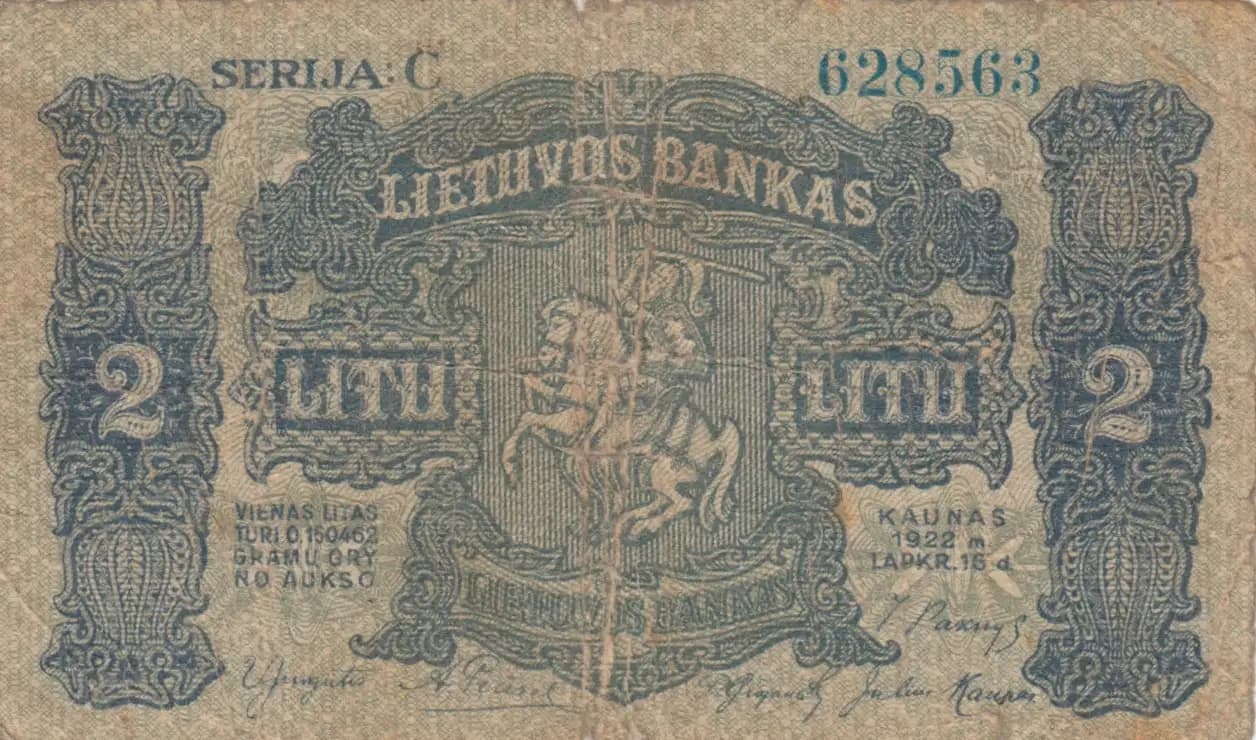
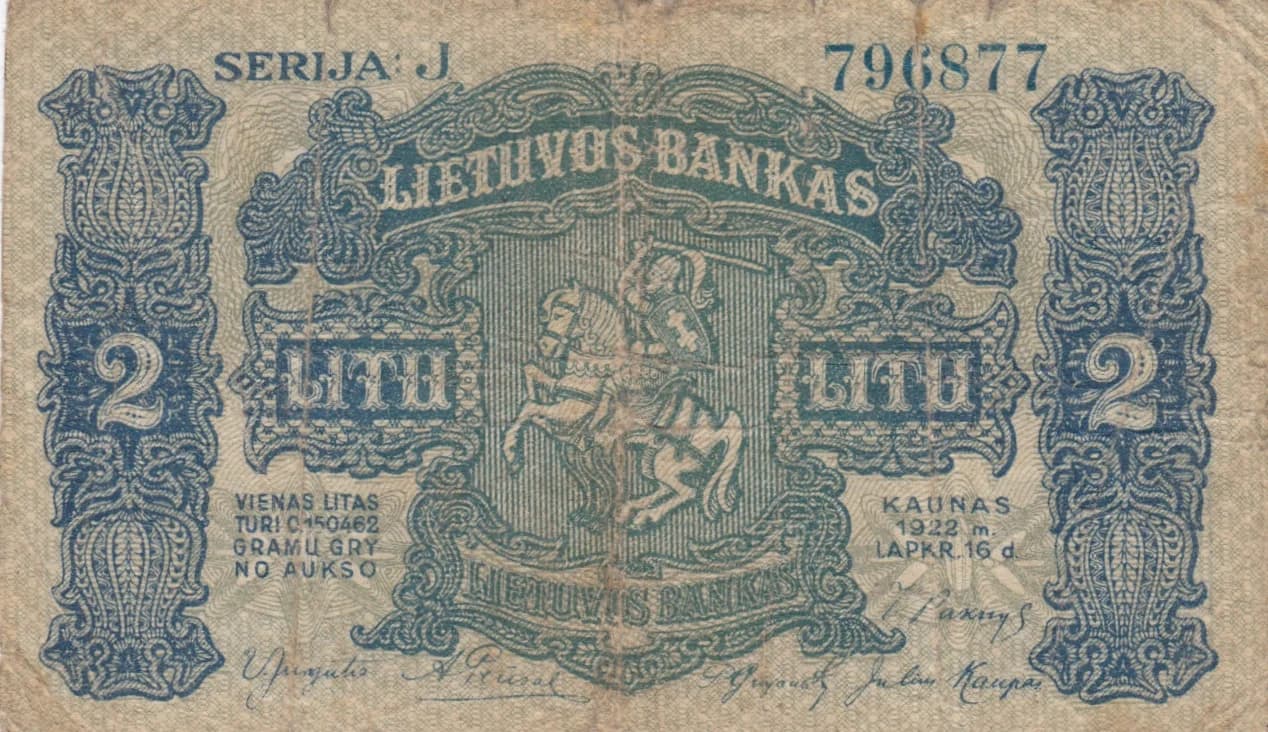
2 litu 1922
“serie E”
Market Prices
4 salesAbout This Note
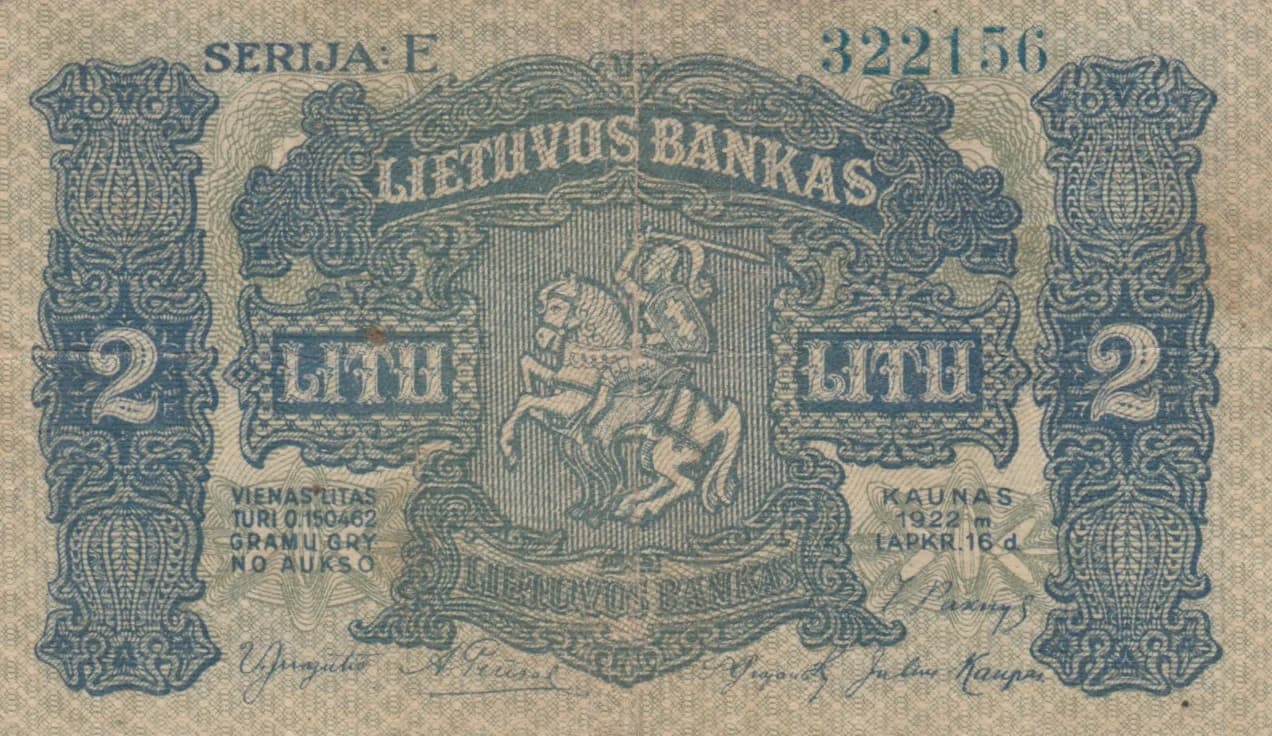
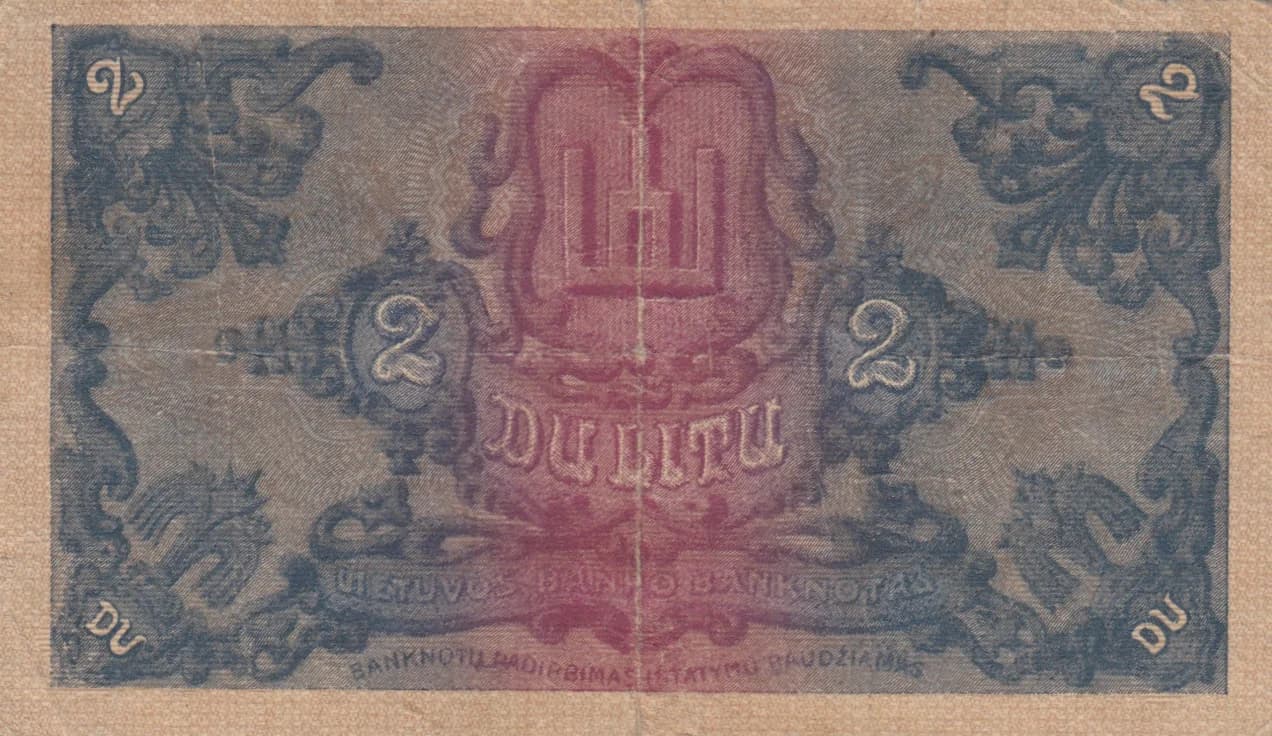
This is a VF-grade 2 Litu note from Lithuania's first independent banknote issue, dated November 16, 1922, from Series E. The note displays the classical allegorical designs characteristic of Lithuania's early currency, with ornate decorative borders, architectural imagery, and two-color printing. Despite approximately 100 years of circulation and storage, the note retains good structural integrity with visible aging, creasing, and color fading but no major tears—making it a solid example of interwar Baltic numismatics.
Common. While this is an early issue from Lithuania's independence period and carries historical significance, the 2 Litu P-14 remains common in the collector market. eBay sales data shows notes in VF condition selling in the $78-$182 range (2011-2020), with 2016 catalog values of $350 for VF grade. The relatively high number of notes in circulation, stable supply at auction, and accessible pricing all indicate common availability. The note is historically important but not scarce in numismatic terms.
This note was issued during Lithuania's critical first years of independence following World War I and the Russian Revolution. The classical architectural and allegorical imagery on the front reflects the new nation's aspiration to connect with European cultural heritage and legitimacy. The prominent display of 'Lietuvos Bankas' and the specific date (November 16) commemorate Lithuania's declaration of independence, embedding nationalist symbolism into the currency itself.
The front features a classical allegorical scene set within columned architecture, depicting multiple classical figures in an ornate neoclassical composition—likely representing virtues such as prosperity, justice, or national strength. The design is framed by elaborate floral and scrollwork borders in teal and blue-green inks on a light beige background. The top corners display heraldic coat of arms emblems (the Lithuanian national arms or banking insignia). The back showcases a symmetrical design with the large denomination '2' prominently displayed in red/magenta within a decorative shield or cartouche, flanked by additional heraldic emblems and mythological/classical figures in blue-gray. The overall composition emphasizes classical European banking tradition and Lithuanian national identity.
Front side: 'LIETUVOS BANKAS' (Bank of Lithuania); '2' and 'LITAI' (2 Litu denomination); 'SERIJA E' (Series E); Serial number '322156'; 'VIENAS TŪKSTANTIS PENKI ŠIMTAI ŠEŠIASDEŠIMT ANTRAIS METAIS' (In the year one thousand nine hundred twenty-two); 'KAUNAS' (Kaunas, the temporary capital); 'LAPKR. 16 d.' (November 16); '1922 m.' (year 1922). Back side: '2' (denomination); 'DU LITAI' (Two Litu in written form).
This note was produced using the intaglio engraving (recess printing) method, as evidenced by the fine-line detail throughout the decorative patterns, the crisp impression of complex scrollwork, and the two-color printing technique visible on the reverse (red/magenta and blue-gray elements). The security printer for Lithuanian banknotes of this era was typically a European establishment such as Thomas De La Rue or a similar security printer contracted by Lietuvos Bankas. The intricate engraving and multi-color application served as the primary security measures against counterfeiting.
This specimen is identified as Series E (SERIJA E) with serial number 322156. The PMG population report indicates two known varieties for Pick-14: P-14a and P-14s3 (the 's3' likely indicating a specimen note with three perforations or overprints). This particular note is a standard circulation issue (P-14a) rather than a specimen variety. The Series E designation places it within the known circulation series for this denomination, and the November 16, 1922 date matches the official issue date recorded in catalog references.