2 centu 1922
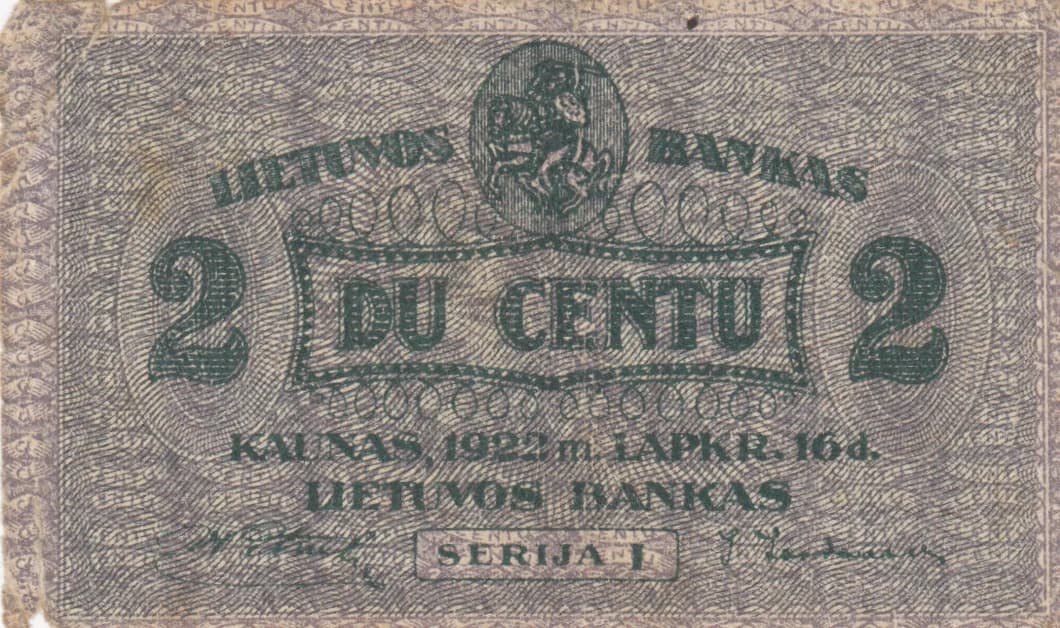
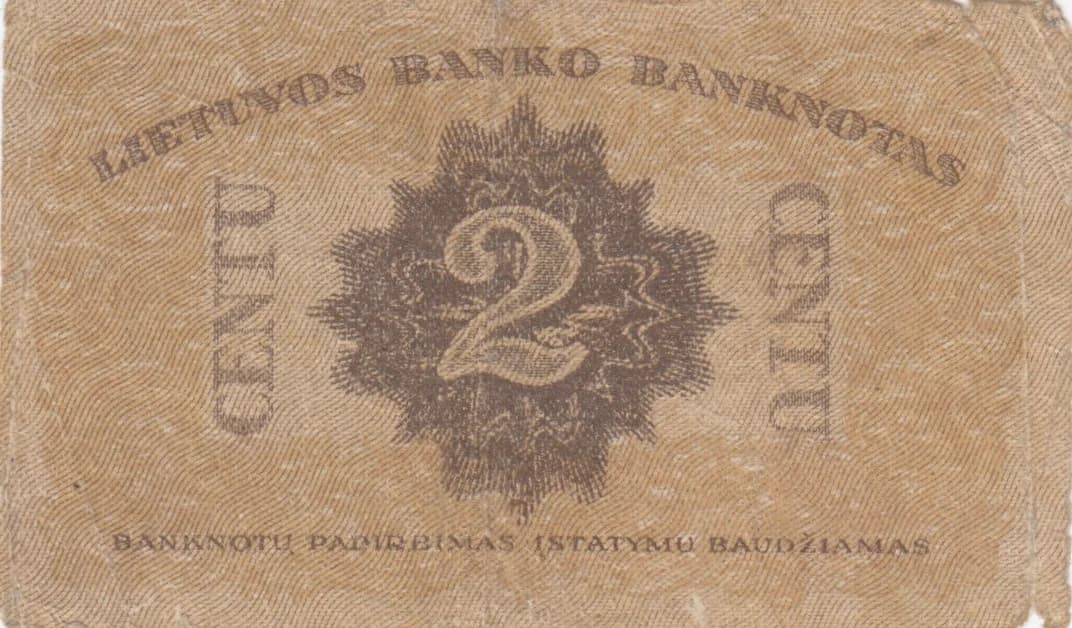
“serie I”
Market Prices
7 salesAbout This Note
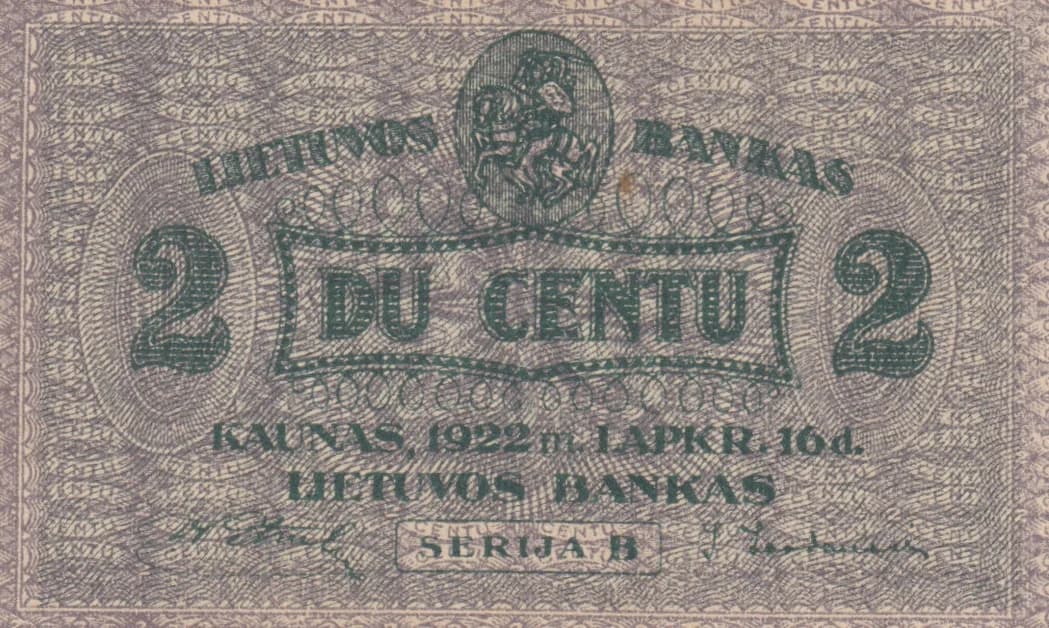
This is a VG-grade 2 Centu note from Lithuania's 1922 Lietuvos Bankas issue, featuring the distinctive memento mori imagery of a skull and crossbones on the obverse and a heraldic lion head on the reverse. The note exhibits significant age-related wear with browning, foxing, and staining throughout, consistent with a century-old circulated specimen. Series I designation and fine line engraving security patterns are clearly visible, making this an interesting early Lithuanian independence-era currency piece.
Common. eBay market data shows consistent sales in the $16.50–$122.50 range across multiple condition grades from 2013–2021, with VG-graded examples selling for approximately $20 (2019). The 2016 catalog value for VG was $30. The relatively modest realized prices and regular appearance in sales indicate this is a commonly available note among collectors of early Lithuanian currency. Print runs for this early Lietuvos Bankas issue were substantial enough to ensure regular circulation and modern availability.
Issued on November 16, 1922, during Lithuania's early years of independence following World War I and the Russian Revolution, this 2 Centu note represents the nation's first autonomous currency. The skull and crossbones motif on the obverse is an unusual choice for national currency, possibly reflecting the hardship and mortality of the post-war period, while the lion head on the reverse invokes Lithuania's traditional heraldic symbol of sovereignty and national identity. This denomination and issue date fall within Lietuvos Bankas's inaugural currency series, marking a crucial moment in Lithuanian nation-building.
The obverse features a centered memento mori composition with a skull and crossbones as the primary motif, flanked by ornamental design elements, with the denomination '2' repeated in corners. The reverse displays Lithuania's national heraldic symbol—a detailed lion head with elaborate mane-like feathering—with the numeral '2' integrated into the central design. Both sides employ dense horizontal line patterns throughout the background as a security measure against counterfeiting. The color palette of green/teal and tan/beige on the obverse shifts to tan, brown, and cream tones on the reverse, typical of early 20th-century banknote engraving practices.
FRONT: '2' (denomination numeral, left and right sides); '2 DU CENTAI' (Lithuanian: 'Two Cents'); 'SERIJA I' (Lithuanian: 'Series I'); 'KAUNO DIRBTUVIŲ IŠLEIDO BANKAS' (Lithuanian: 'Issued by Kaunas Factory Bank'). BACK: 'LIETUVOS BANKO BANKNOTE' (Lithuanian: 'Lithuanian Bank Banknote'); '2' (denomination numeral); 'BANKNOTI PAPIEROS ISTATYMU BAUDŽIAMAS' (Lithuanian: 'Banknote paper regulated by statute with penalties').
This note was produced using intaglio (engraved) printing, evidenced by the fine, precise line work visible in both the skull motif and lion head design. The dense horizontal line patterns forming the background are characteristic of fine-line security engraving used to prevent counterfeiting. The note was printed by the Kaunas Factory (Kauno Dirbtuvės), as indicated in the inscription, utilizing detailed plate engraving with multiple color registration typical of 1920s European currency production.
Pick catalog lists this as P-8a (2 Centu variant). The PMG population report indicates three variants under base Pick number P-8: the 75 Mark with Contoured Chain watermark, P-8a (2 Centu), and P-8s3 (2 Centu specimen). The note observed is P-8a, identifiable by denomination and design. Series I is confirmed by the 'SERIJA I' inscription visible on the obverse. No signatures or date variants are apparent in the visual analysis. The specific printer attribution to Kauno Dirbtuvės distinguishes this from other Lithuanian issues of the period.