2 centu 1922
“serie B”
Market Prices
7 salesAbout This Note
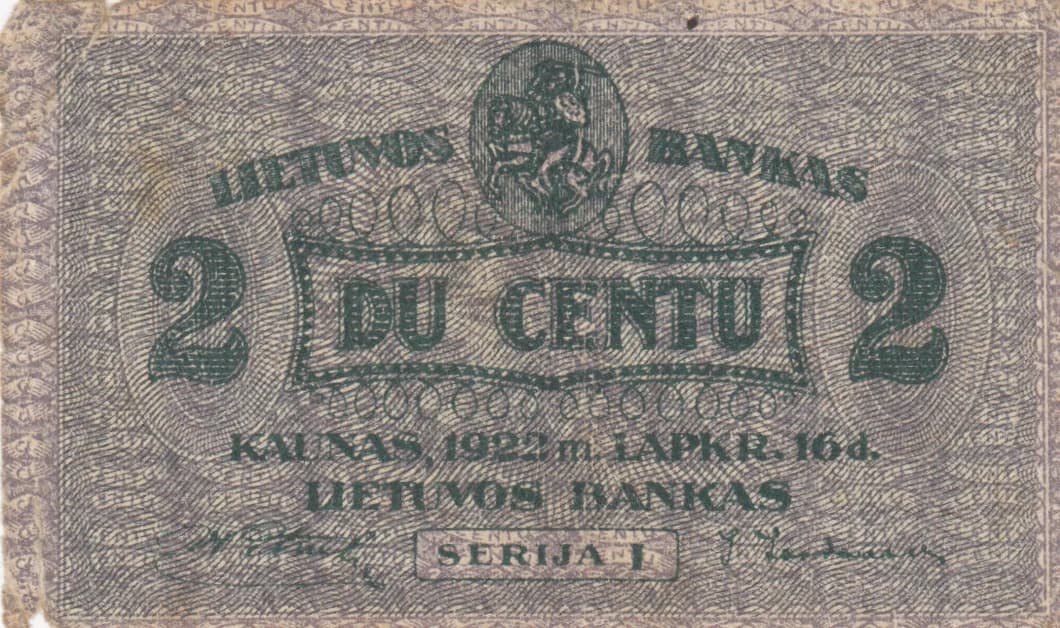
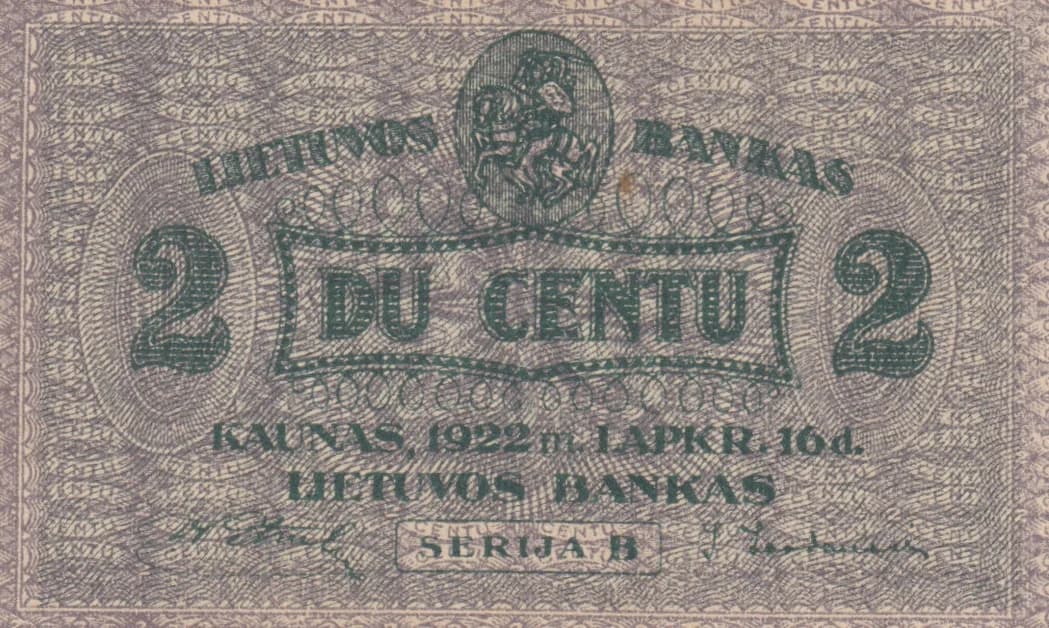
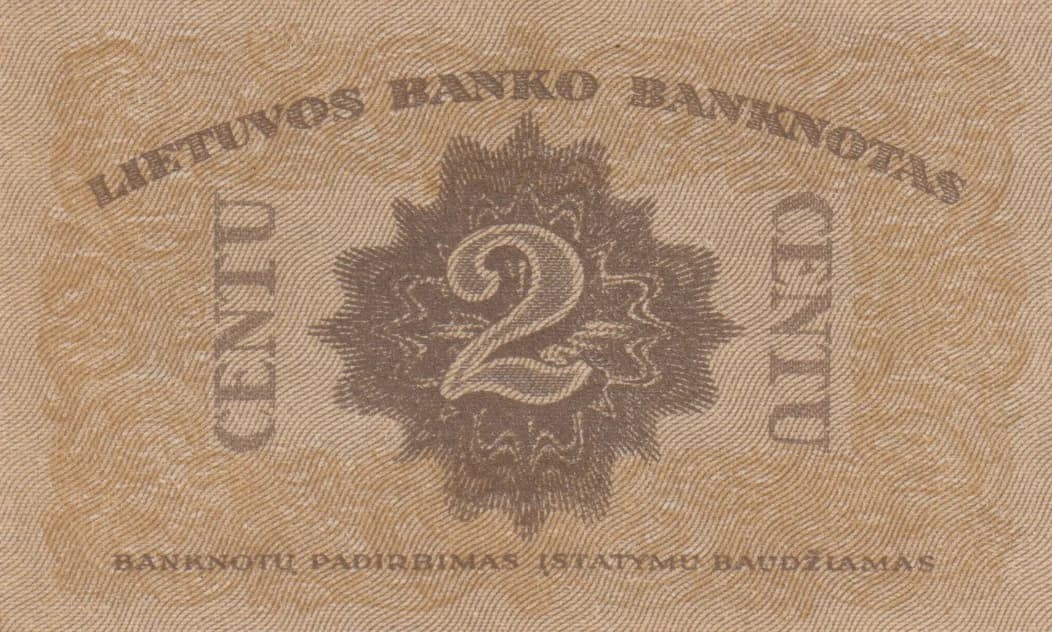
This is a 1922 Lithuanian 2 Centu note issued by Lietuvos Bankas, graded UNC from Series B. The front features a classical male portrait bust in profile within an ornamental oval frame, rendered in green and gray-brown tones with fine crosshatch security patterning throughout. The back displays Lithuania's heraldic coat of arms featuring a stylized beast (likely the Vytis or Lithuanian dragon) with the denomination '2' integrated into the design. Despite the catalog grade of UNC, the visual analysis reveals significant aging with faded inks, discoloration, and foxing suggesting extensive circulation history—a discrepancy worth noting for collectors.
Common. This is a regular issue note with substantial circulation evidence visible in the physical condition (fading, discoloration, foxing) despite the UNC grade designation. eBay price data from 2013-2021 shows examples in Fine condition selling for $16.50-$89 USD, with catalog values (2016) placing UNC specimens at approximately $90. The wide range of sold examples (VG at $20 through EF at $122.50) and consistent market availability across multiple years indicates this is a commonly encountered note among collectors. The series designation 'B' and year 1922 were likely produced in significant quantities for a newly independent nation establishing its currency infrastructure.
This note was issued on November 16, 1922, during Lithuania's early period as an independent nation following World War I and the dissolution of the Russian Empire. The heraldic arms on the reverse—featuring the national beast symbol—represent the newly sovereign Lithuanian state's assertion of independence and national identity through currency design. The use of classical portraiture and elaborate engraving techniques reflects the formal monetary standards of early 20th-century European banking, positioning Lithuania among established nations despite its recent independence.
The note features a classical European banknote design typical of early 20th-century Baltic currency. The obverse showcases a male portrait bust (identity not definitively established from visual analysis alone, but consistent with Lithuanian national figures of the period) in right-facing profile within a decorative oval cartouche. The reverse features Lithuania's national heraldic emblem—the Vytis (the armed knight/beast symbol that serves as the state coat of arms)—prominently displayed with fine line engraving work and ornamental detailing. The denomination '2' appears in multiple locations across both sides. Security patterning consists of fine crosshatch on the obverse and wavy line patterns on the reverse, rendered in green and brown inks. The overall design reflects high-quality intaglio craftsmanship typical of Central European state printers of the 1920s.
FRONT SIDE: '2' (denomination in Arabic numerals, top left and right corners); 'DU CENTUI' (Lithuanian: 'Two Cents'); 'LIETUVOS BANKAS' (Lithuanian: 'Bank of Lithuania'); 'SERIJA B' (Lithuanian: 'Series B'); 'KAINAS 1922 MAERKER 104' (Lithuanian/Mixed: 'Price 1922 Marker 104'). BACK SIDE: 'LIETUVOS BANKAS BANKNOT' (Lithuanian: 'Bank of Lithuania Banknote'); '2' (denomination in Arabic numerals); 'BANKO PASIGYIMAS 191[?] METAI BANKO LAMAS' (Lithuanian: 'Bank Issue 191[?] Year Bank Lamas'—text partially unclear in source image).
Intaglio/line engraving on both obverse and reverse, characterized by the fine crosshatch background pattern on the front and wavy line security patterning on the back. The classical portrait and heraldic arms are rendered in traditional line engraving with stippling and detailed ornamental work. The printer for early Lithuanian Lietuvos Bankas notes of this period was typically a Central European security printer, though specific attribution requires further archival research. The high quality of line work and security feature integration suggests state-of-the-art printing technology for the era.
This specimen is identified as Pick P-8a (2 Centu variant), which distinguishes it from the P-8 (75 Mark with contoured chain watermark) and P-8s3 (specimen note) variants catalogued under the same base Pick number. The notation 'SERIJA B' (Series B) visible on the front represents the series identifier. The specific date 16.11.1922 places this within the first emission period. No evidence of signatures, overprints, or other secondary varieties is discernible from the visual analysis provided, suggesting this represents the standard regular-issue type for this Pick number and date.