10 litu 1927
“serie A”
Market Prices
3 salesAbout This Note
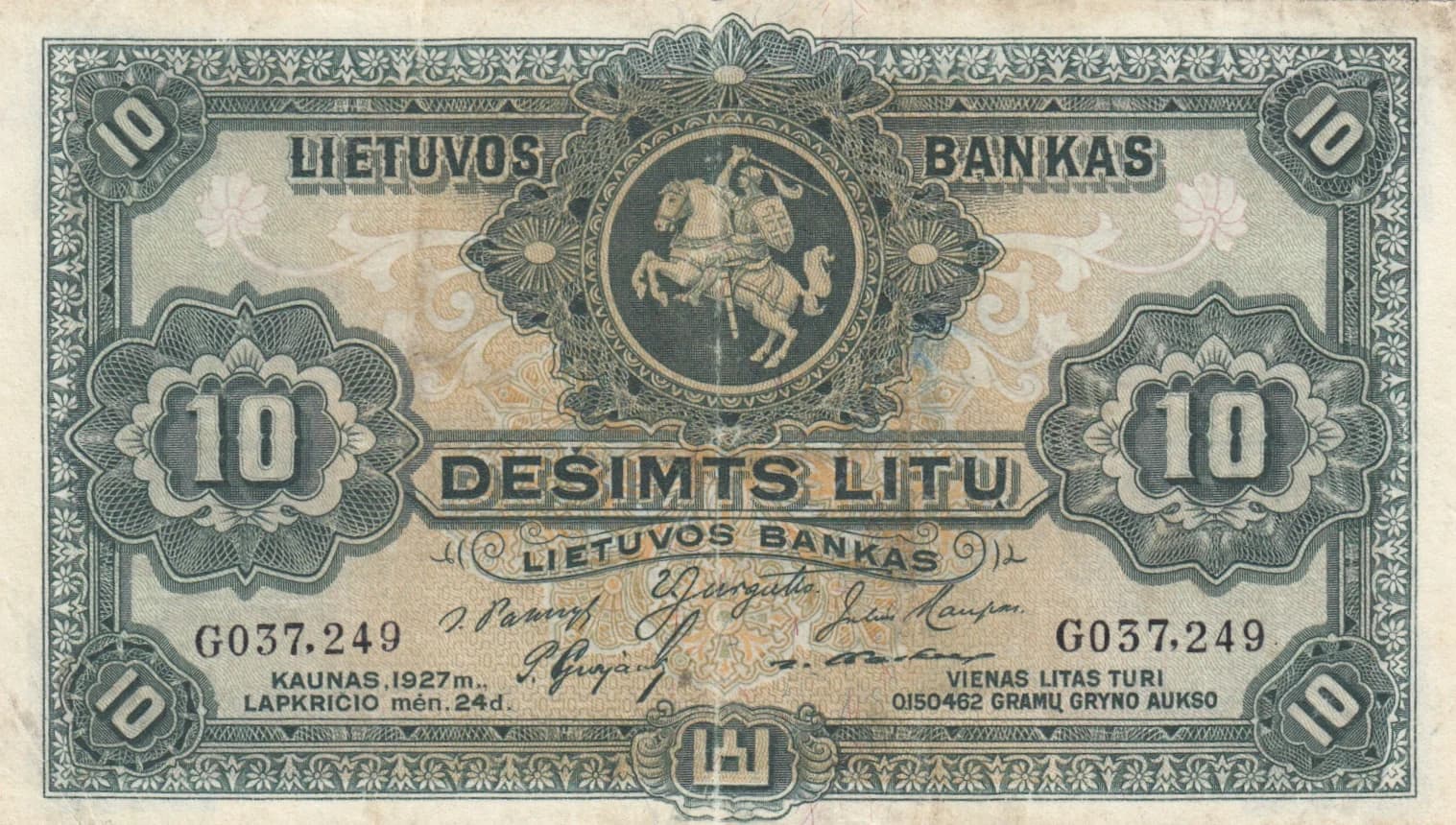
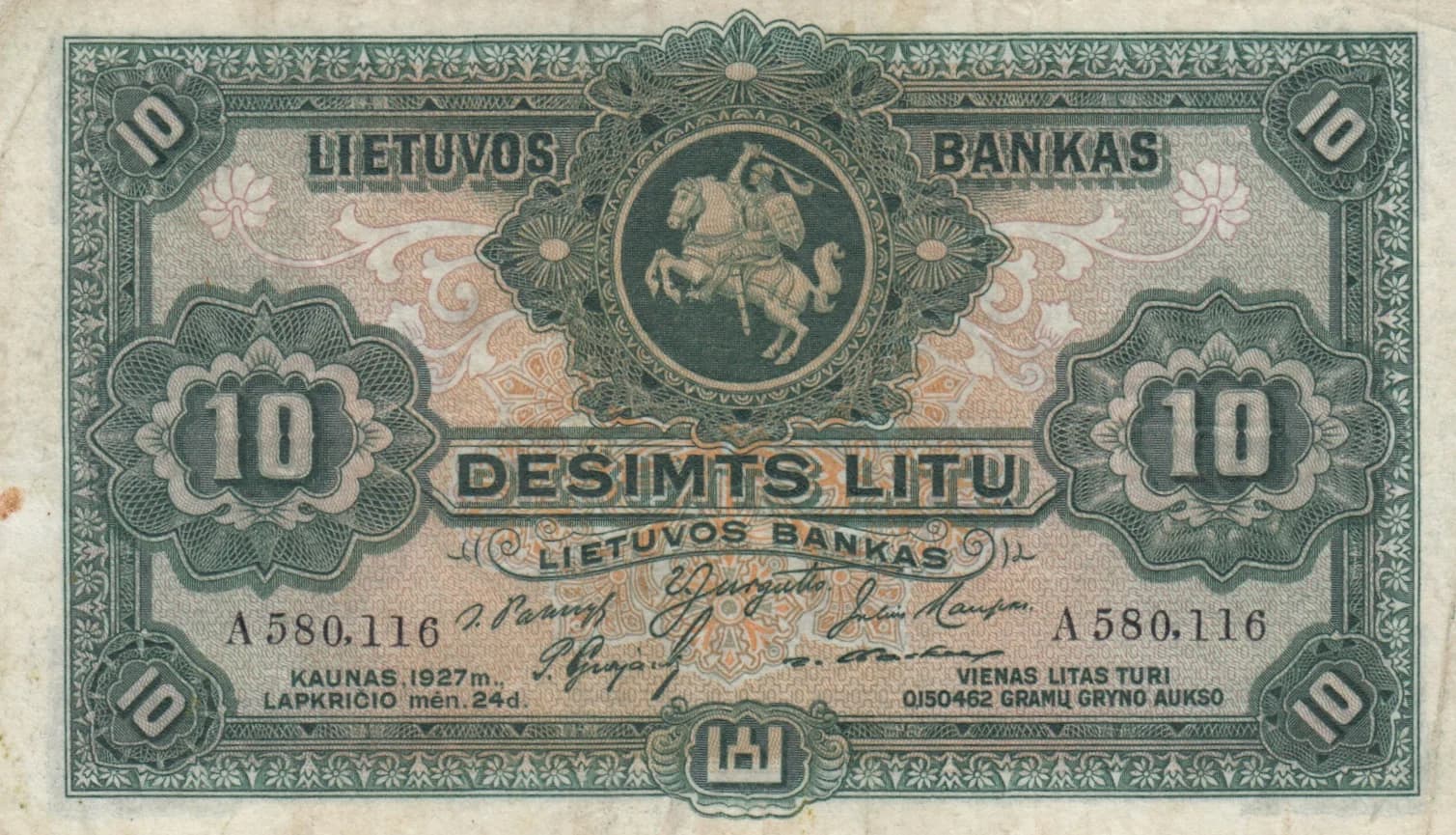
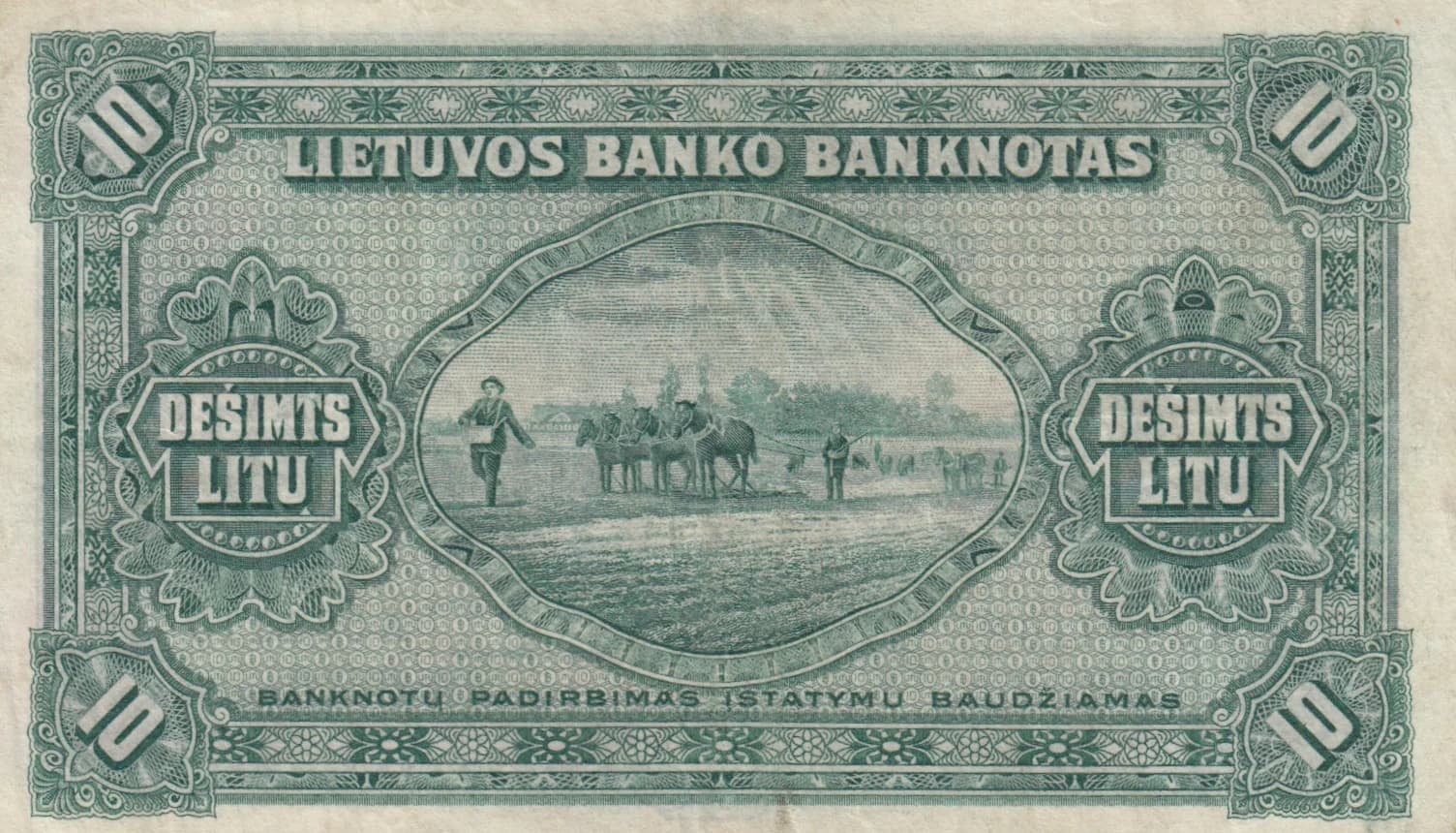
This is a VF-graded 10 Litu banknote from Lithuania's 1927 regular issue, displaying the characteristic green and cream color scheme of the period with ornate Art Deco-influenced borders. The note features a striking equestrian vignette on the obverse and a pastoral agricultural scene on the reverse, both executed in fine engraved detail. Despite visible foxing and age-related discoloration consistent with its nearly century-old provenance, the note retains good structural integrity and legibility, making it a desirable example for collectors of interwar Eastern European currency.
Common. The eBay price tracking data shows multiple sales in the $28–$70 range across different condition grades, with 2016 catalogue values placing VF examples at $150. These moderate, consistent prices and availability of multiple graded examples indicate this is a standard circulating issue with no exceptional rarity. The 1927 10 Litu issue was a regular production run without known recall or short-lived status, and modern collector demand remains steady but not premium.
Issued by Lietuvos Bankas on November 24, 1927, this banknote represents Lithuania's early period as an independent nation following World War I and the Russian Revolution. The equestrian imagery on the obverse likely references Lithuanian national identity and historical heritage, while the reverse's depiction of agricultural workers and fieldwork reflects the agrarian economy that was central to Lithuania's economy during this interwar period. The note's gold standard notation (0.50462 grams of pure gold per lita) documents the monetary system's backing during Lithuania's pre-Depression economic stability.
The obverse presents a dynamic equestrian portrait—a rider mounted on a rearing horse in profile, enclosed within an elaborate circular medallion frame with ornate Art Deco-influenced floral and rosette ornamentation. Denomination numerals '10' appear in shield-shaped cartouches in all four corners. The reverse features a panoramic pastoral landscape vignette depicting agricultural laborers and horsemen engaged in fieldwork, with rural buildings visible in the background, all rendered within an ornate oval frame. The entire design employs a geometric honeycomb or lattice pattern as a background fill element, bordered by elaborate decorative frames. The equestrian imagery likely references national symbolism and historical tradition, while the agricultural scene emphasizes Lithuania's economic foundation during the interwar period.
FRONT SIDE: 'LIETUVOS BANKAS' (Bank of Lithuania), 'DESIMTS LITU' (Ten Litu), 'KAUNAS 1927 m.' (Kaunas 1927), 'LAPRICIO men. 24d' (April 24th), 'VIENAS LITAS TURI' (One lita equals), 'OJ50462 GRAMU GRYNO AUKSO' (0.50462 grams of pure gold), Serial number 'A 580.116'. BACK SIDE: 'LIETUVOS BANKO BANKNOTAS' (Banknote of the Bank of Lithuania), 'DESIMTS LITU' (Ten Litu) [appears twice in cartouches], 'BANKNOTU PADIRBIMAS ISTATYMU BAUDZIAMAS' (Counterfeiting of banknotes is punishable by law), denomination '10'.
Intaglio engraving (copperplate) printing, evidenced by the fine detail, complex line work, and intricate border patterns visible throughout both sides. The security features include precisely engraved landscape vignettes, detailed geometric patterning, and ornamental frames characteristic of high-security banknote production of the 1920s. The quality of execution suggests production by a professional European security printer, likely contracted by Lietuvos Bankas; many Lithuanian notes of this period were produced by firms such as Giesecke+Devrient or similar security printers.
The note is identified as Pick P-23 with series designation A (as noted in catalog data: 'serie A'). The serial number observed is 'A 580.116', confirming the series A variety. PMG population reports identify variants P-23a, P-23s, and P-23s2 within this Pick number; the specimen examined appears consistent with the standard P-23a variety based on design characteristics. No overprints, surcharges, or unusual signatures are apparent that would indicate a specialized variety or error note.