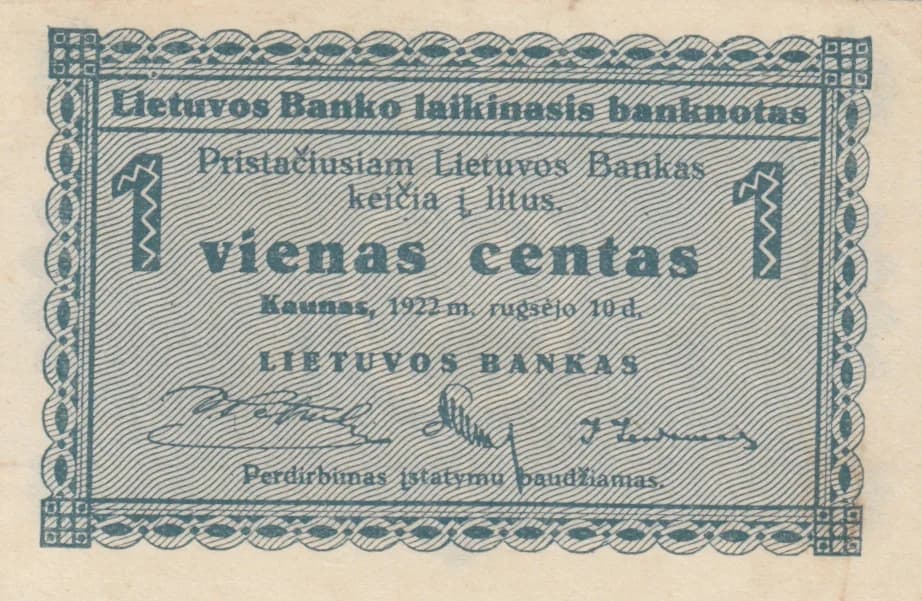
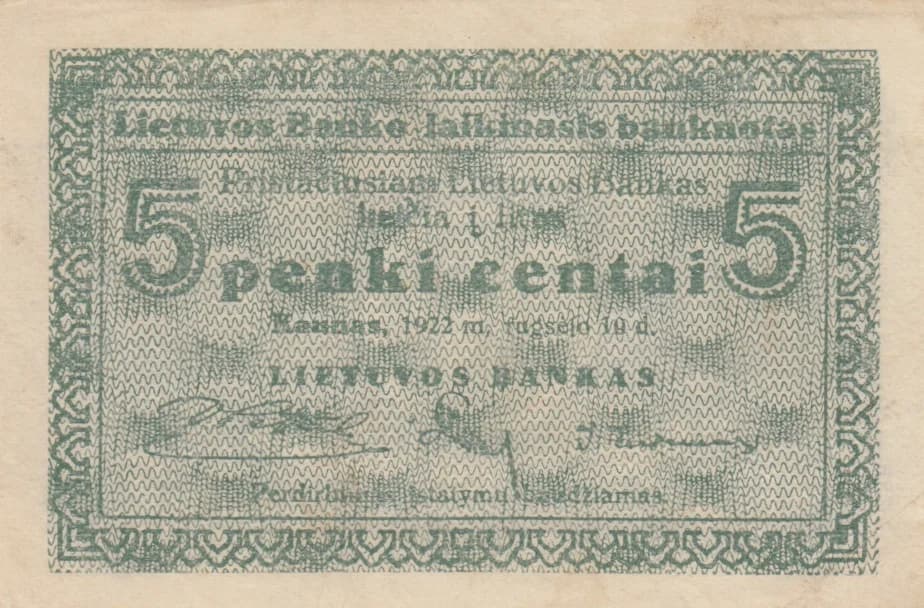
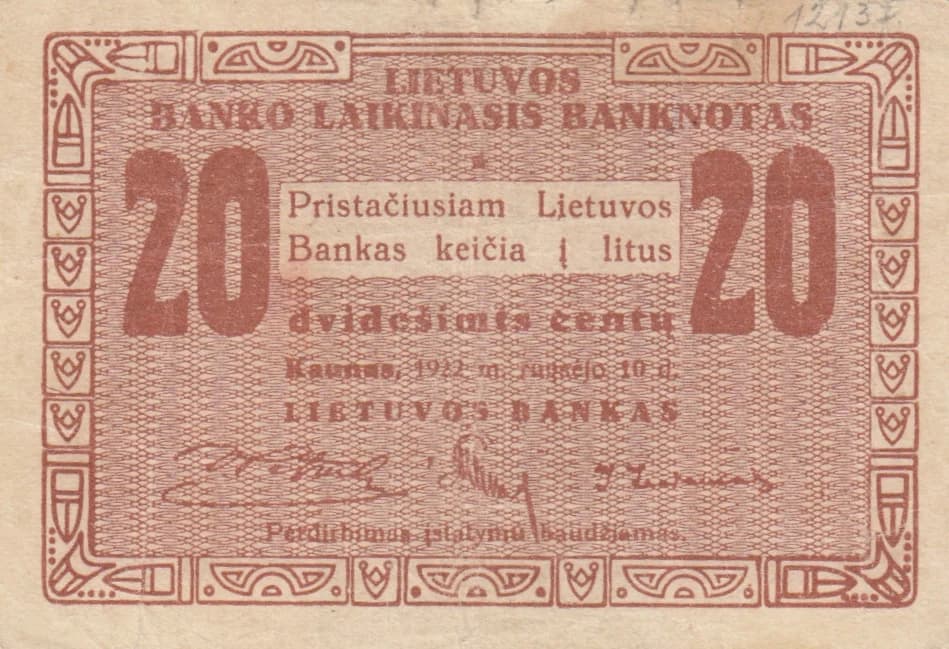
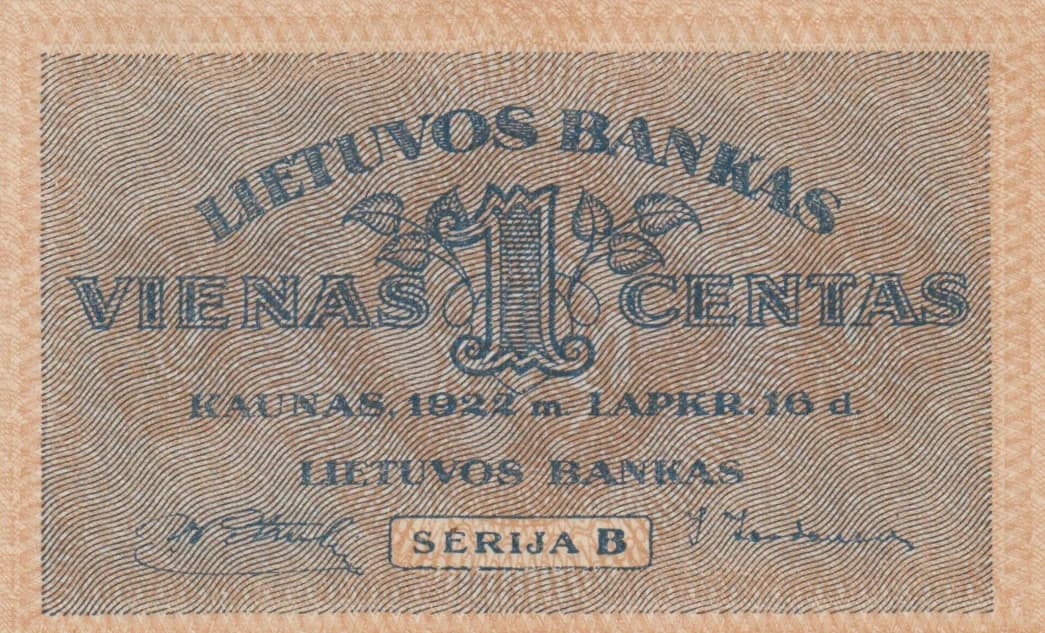
10 centu 1922
Market Prices
8 salesAbout This Note
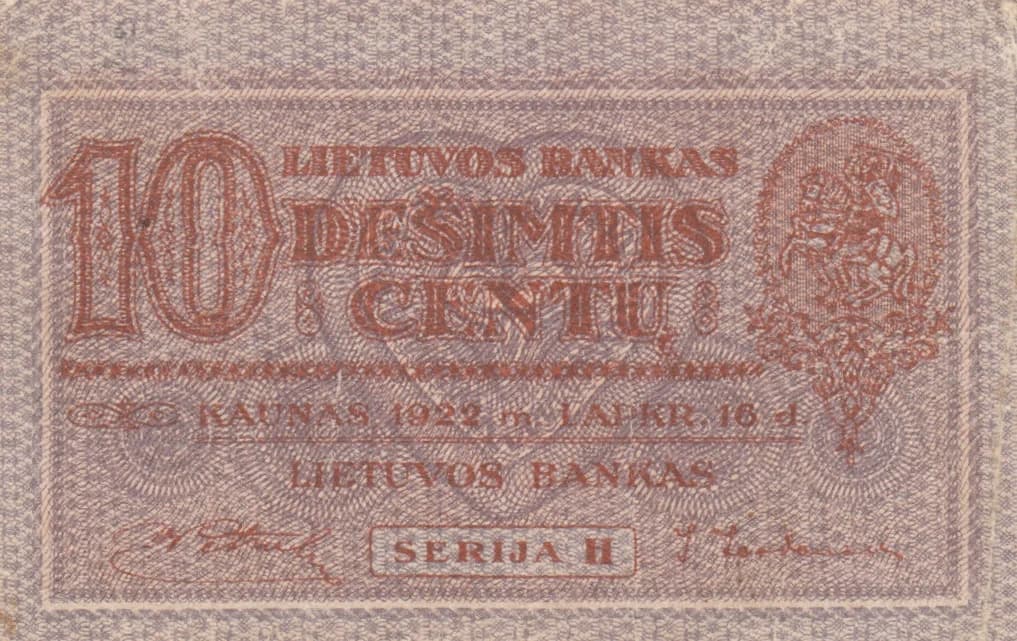
This is a VF-grade Lithuanian 10 Centų note from 1922, the first year of independent Lithuania's currency. The note features a text-based design with prominent denomination numerals and heraldic emblems on both sides, rendered in warm reddish-brown and tan tones with fine decorative line work throughout. The visual analysis confirms excellent preservation with no visible wear, though the assigned VF grade suggests some minor handling is present that isn't apparent in the scanned image.
Common. The eBay market data shows regular sales activity across multiple condition grades, with VF examples selling for approximately $38-50 based on 2015-2016 data. More recent sales (2017-2021) show F-VF grade notes consistently selling in the $18-177 range, indicating steady collector demand but no scarcity premium. The existence of multiple catalogued varieties (P-10a, P-10s1, P-10s3) and the regular appearance of this note in auction markets confirms it was produced in substantial quantities and remains readily available to collectors.
Issued by Lietuvos Bankas on November 16, 1922, this note represents Lithuania's early independence period following World War I and separation from Russian control. The design emphasizes national identity through the prominent coat of arms on the front and the formal heraldic medallion on the back, reflecting the newly sovereign state's need to establish its own monetary authority and assert independence through distinctive national symbolism.
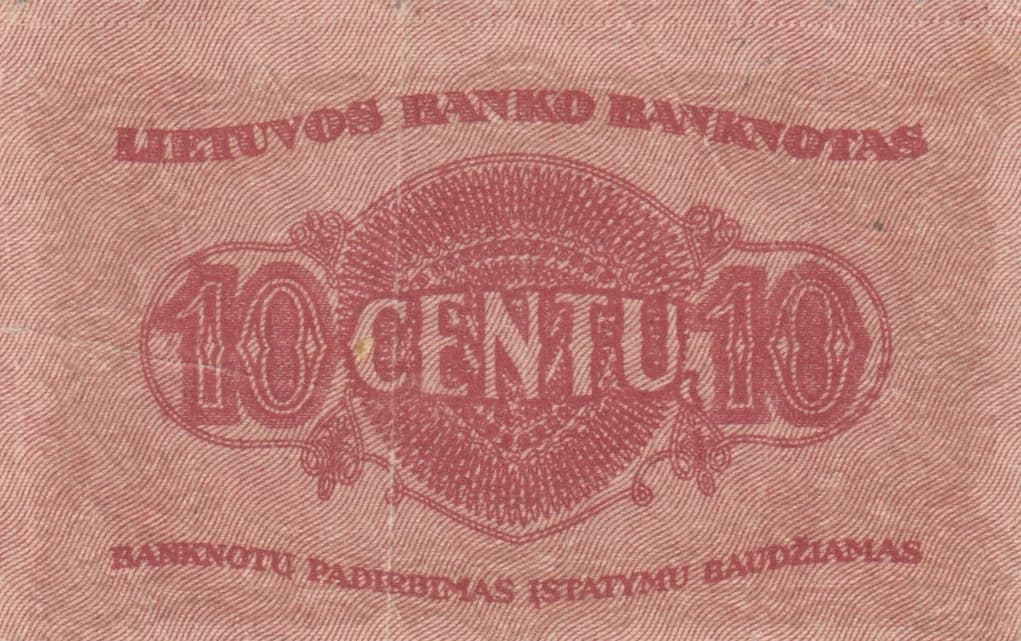
The front of the note displays a text-centric design with the denomination '10' prominently positioned on both left and right margins. The central area is dominated by ornamental borders and decorative line patterns, with the Lithuanian coat of arms (heraldic emblem) positioned on the right side and additional heraldic design elements on the left. The back features a large, intricate circular medallion or seal as the central focal point, with radiating line patterns creating a sun-burst or rosette effect, flanked by large denomination numerals. The date is spelled out in full Lithuanian text rather than numerals, emphasizing the formal, official nature of the currency. The overall design uses classical banknote security conventions of the 1920s era, relying on complex geometric patterns and fine line work for anti-counterfeiting protection.
FRONT: 'LIETUVOS BANKAS' (Bank of Lithuania), 'DEŠIMTS CENTŲ' (Ten cents), 'SERIJA II' (Series II), '10' (denomination numeral). BACK: 'LIETUVOS BANKAS' (Bank of Lithuania), '10 CENTŲ 10' (10 cents 10), 'TŪKSTANTIS DEVYNI ŠIMTAI DVIDEŠIMT ANTRAIS METAIS' (One thousand nine hundred twenty-second year).
Intaglio (engraved) printing, evident from the fine parallel line patterns, detailed hatching throughout both sides, and the precise rendering of the intricate circular medallion and heraldic designs. The quality of line work and geometric patterns is consistent with high-security banknote production typical of early 20th-century European currency printing. The specific printer for this Lietuvos Bankas issue is not definitively documented in readily available sources, though Lithuanian notes of this period were often produced by established European security printers.
The PMG population report indicates three catalogued varieties for Pick P-10: P-10a (standard), P-10s1 (specimen), and P-10s3 (specimen). The visual analysis notes 'SERIJA II' (Series II) on the front, suggesting this may represent a later printing variant within the 1922 issue. Without access to serial number details or specific signature varieties visible in the provided images, the exact variety designation cannot be definitively established, but the Series II marking is a potentially significant variety identifier.