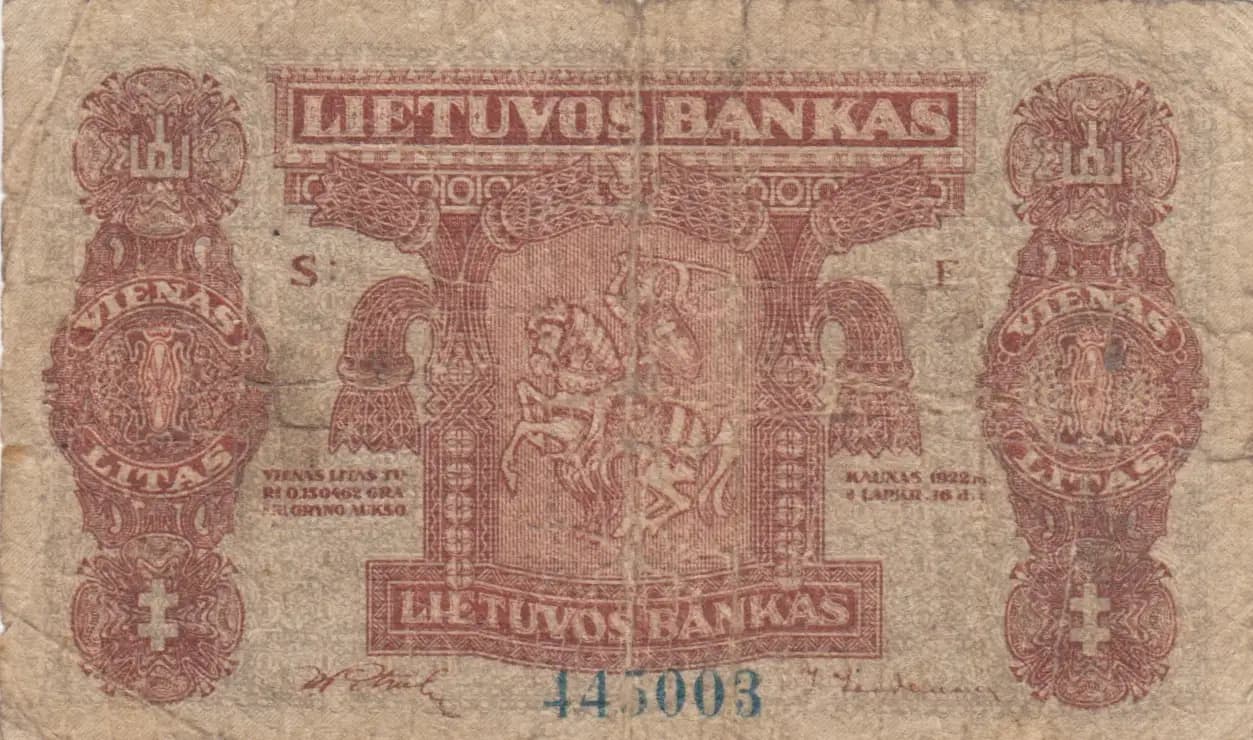
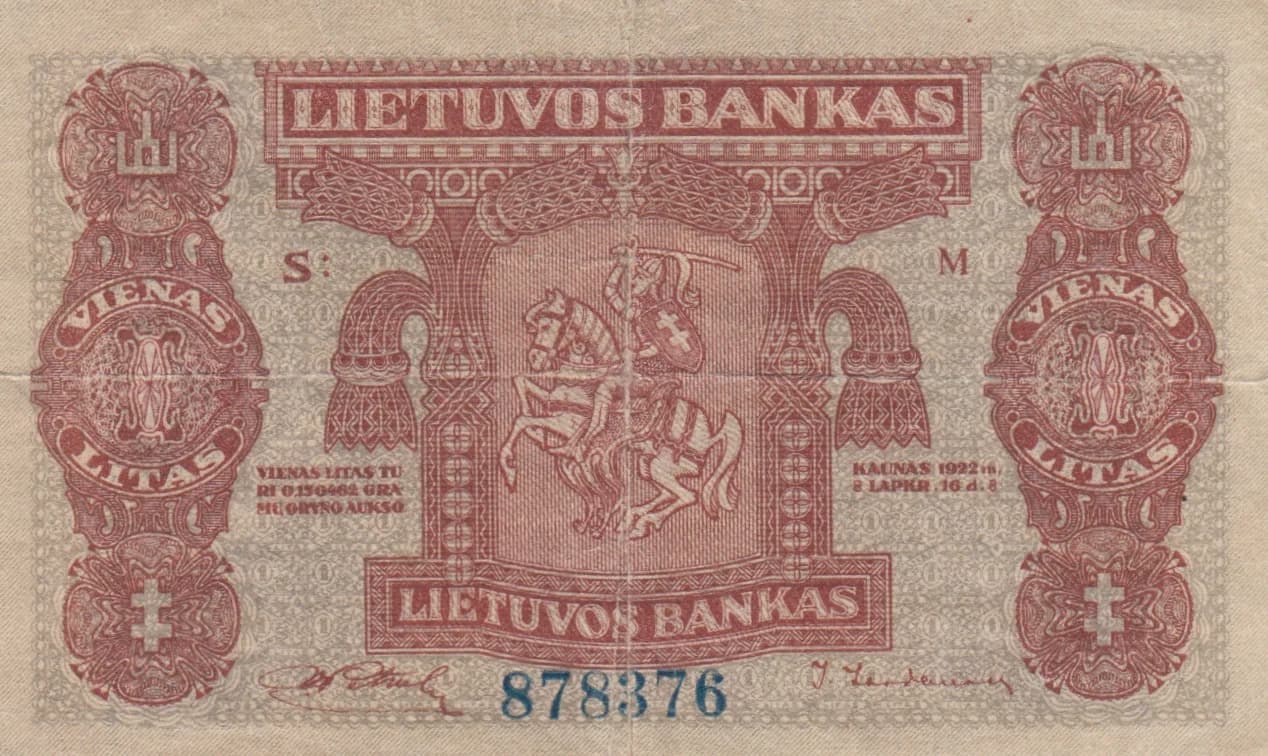
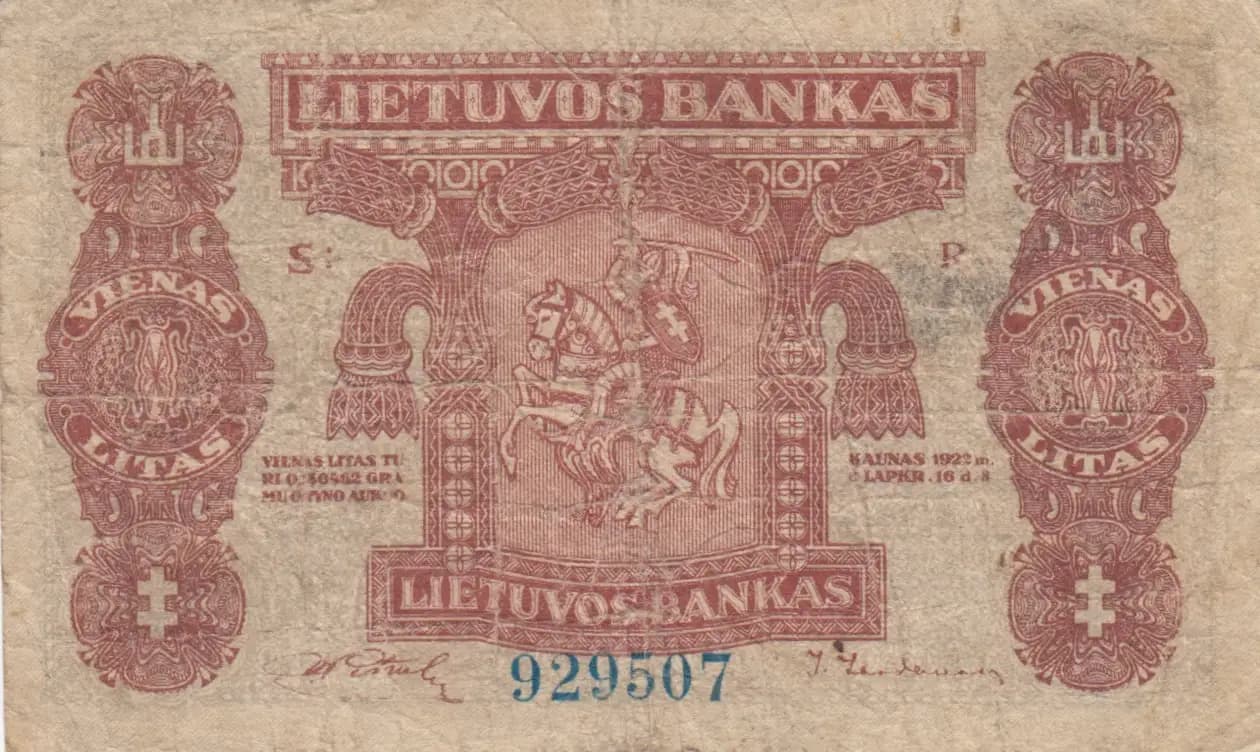
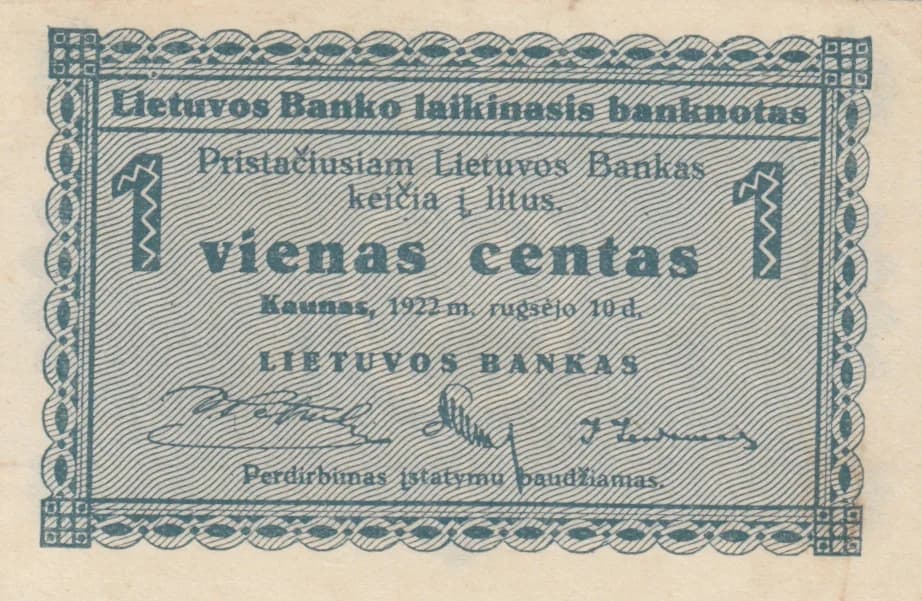
1 litas 1922
“serie S”
Market Prices
5 salesAbout This Note
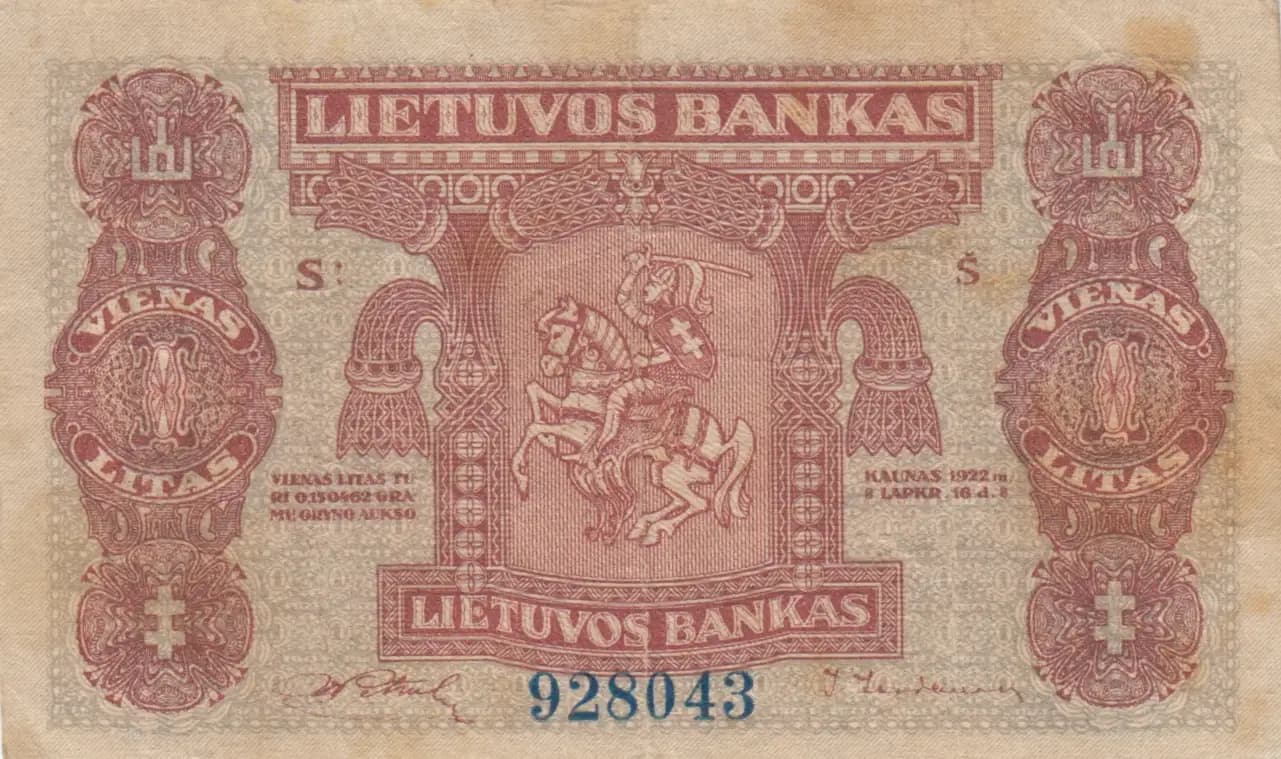
This 1 Litas note from 1922 represents an early emission of independent Lithuania's first national currency, issued by Lietuvos Bankas in Kaunas. The VF-graded example displays characteristic mauve-red coloring with ornate classical design elements, though it shows expected aging with foxing and yellowing consistent with nearly a century of circulation. The series S designation and well-preserved engraving work make this a solid collector example of this historically significant issue.
Common. The 1 Litas 1922 (Pick P-13) was produced in substantial quantities as the foundational denomination of Lithuania's early currency system and remained in circulation for an extended period. VF examples are readily available in the collector market at modest prices, indicating robust survival rates. No evidence suggests limited print runs, recalls, or special scarcity factors for this particular denomination and year.
The 1922 1 Litas note commemorates Lithuania's establishment as an independent nation following World War I and the collapse of Russian imperial rule. The classical architectural framing and heraldic imagery—particularly the double-headed eagle coat of arms and Christian cross symbolism—reflect Lithuania's assertion of national sovereignty and cultural identity during this formative period. The Kaunas dating and gold standard notation underscore the new state's efforts to establish monetary credibility in the post-war economic stabilization era.
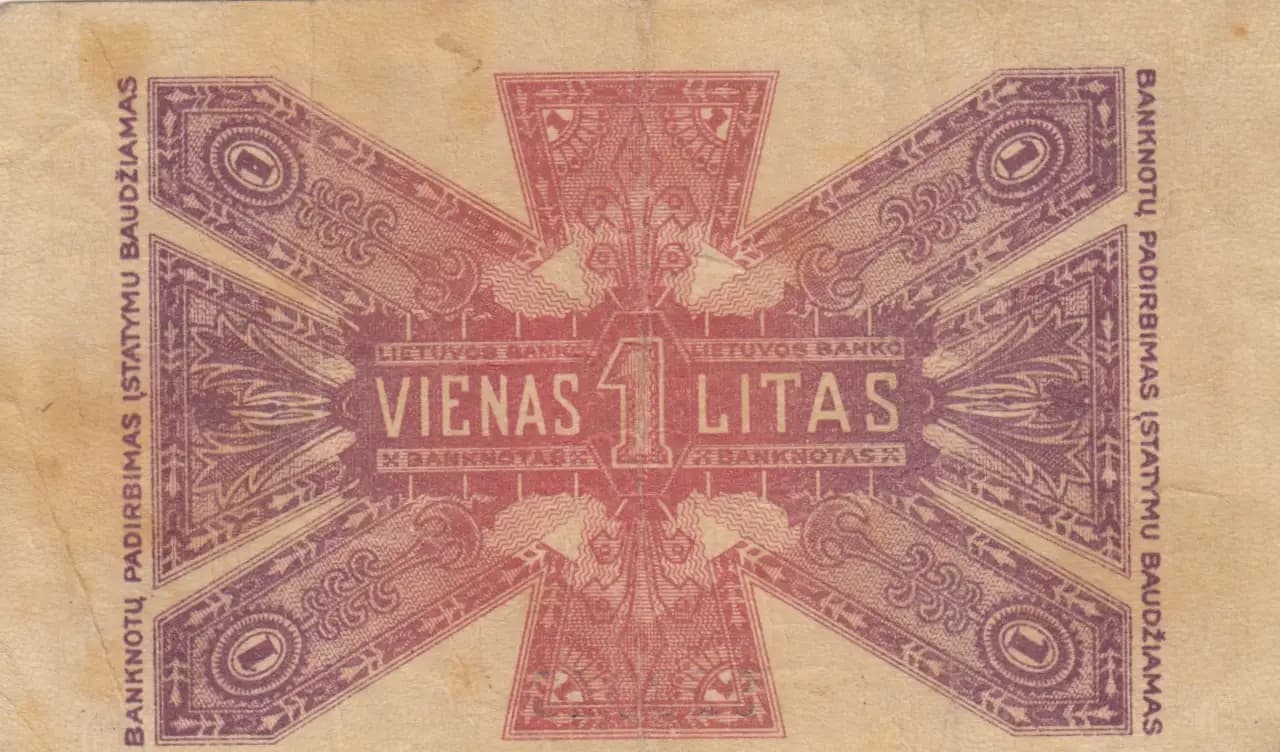
The front features a classical allegorical figure in motion (likely representing Lithuania or a national virtue) positioned within an architecturally framed composition with Doric columns, rendered in fine line engraving. Corner ornaments display the Lithuanian state coat of arms featuring a double-headed eagle, surrounded by shield designs and decorative crosses in circular medallions. The reverse displays a dominant geometric cross with trapezoidal arms radiating from a central point, each segment filled with intricate geometric patterns and small circular emblems. The composition emphasizes heraldic and nationalist symbolism appropriate to the newly independent state. All design work employs the mauve-burgundy red color scheme on cream stock, typical of Central European banknote production of the 1920s.
Front: 'LIETUVOS BANKAS' (Bank of Lithuania) appears at top and bottom in banner style. 'VIENAS LITAS PER OŠIBOJE UZ MUOIRNO AUKSO' translates to 'One litas in gold standard' or 'One litas redeemable in gold.' 'KAURAS 1922 M. LAPPOR 16 d' indicates 'Kaunas 1922, [date notation].' Serial number '928043' appears as the identifier. Back: 'VIENAS LITAS' (One litas) is inscribed on opposite sides of the central cross. 'LIETUVOS BANKAS' (Bank of Lithuania) repeats. Border text containing 'BANKNOTŲ PADRIBUS IŠDVIMAS PADEDAMOS' relates to the official banknote issuance authority.
Intaglio (recess) engraving, the standard security printing method for banknotes of this era. The fine line work visible in the borders, the detailed cross-hatching in backgrounds, and the crisp definition of the portrait and architectural elements are characteristic of high-quality intaglio production. The complex geometric patterning and ornate borders demonstrate the multi-plate engraving technique typical of early 20th-century Lithuanian banknote production. No watermark or advanced security features are noted, consistent with 1922 printing technology.
The note is identified as series S, which represents one of the sequential series designations used on this issue. Serial number 928043 is documented. Collectors should note that the 1922 1 Litas exists in multiple series (A through S or similar), and series designation can affect desirability among completionists. No overprints, date variations, or signature varieties are apparent in this example. The standard format without special markings suggests this is a regular issue specimen from the standard series production.