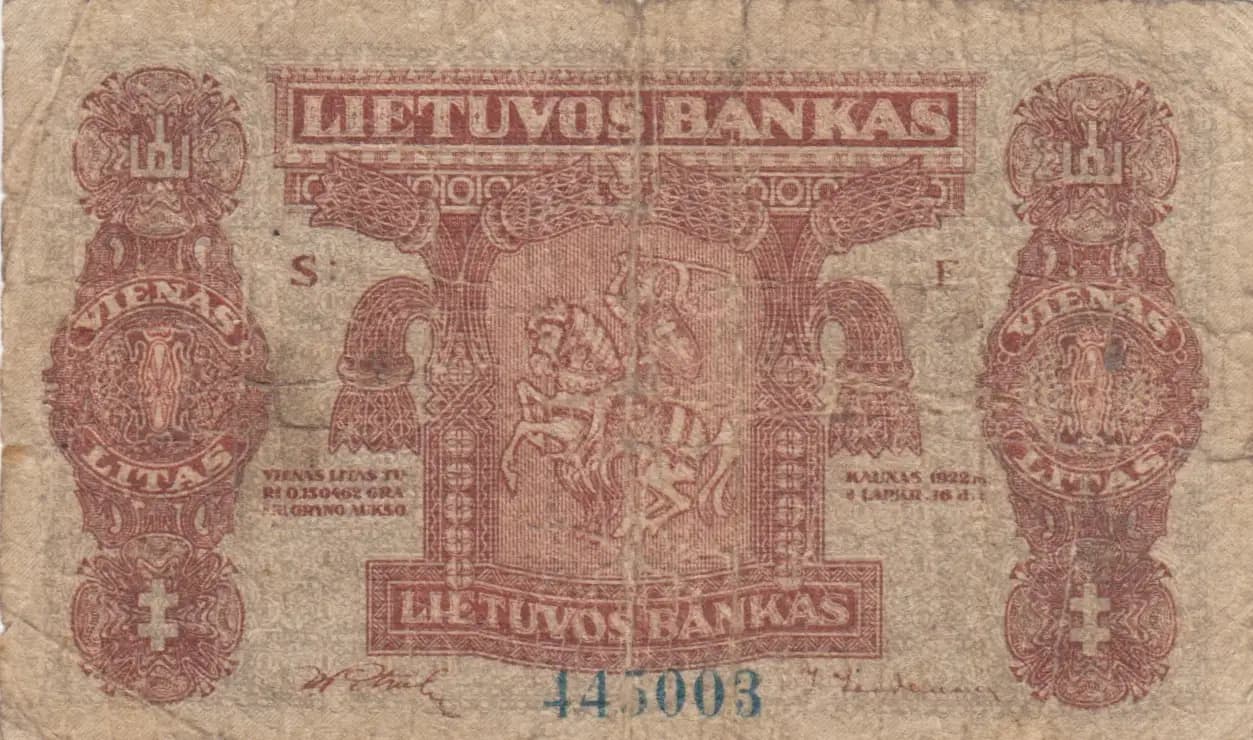
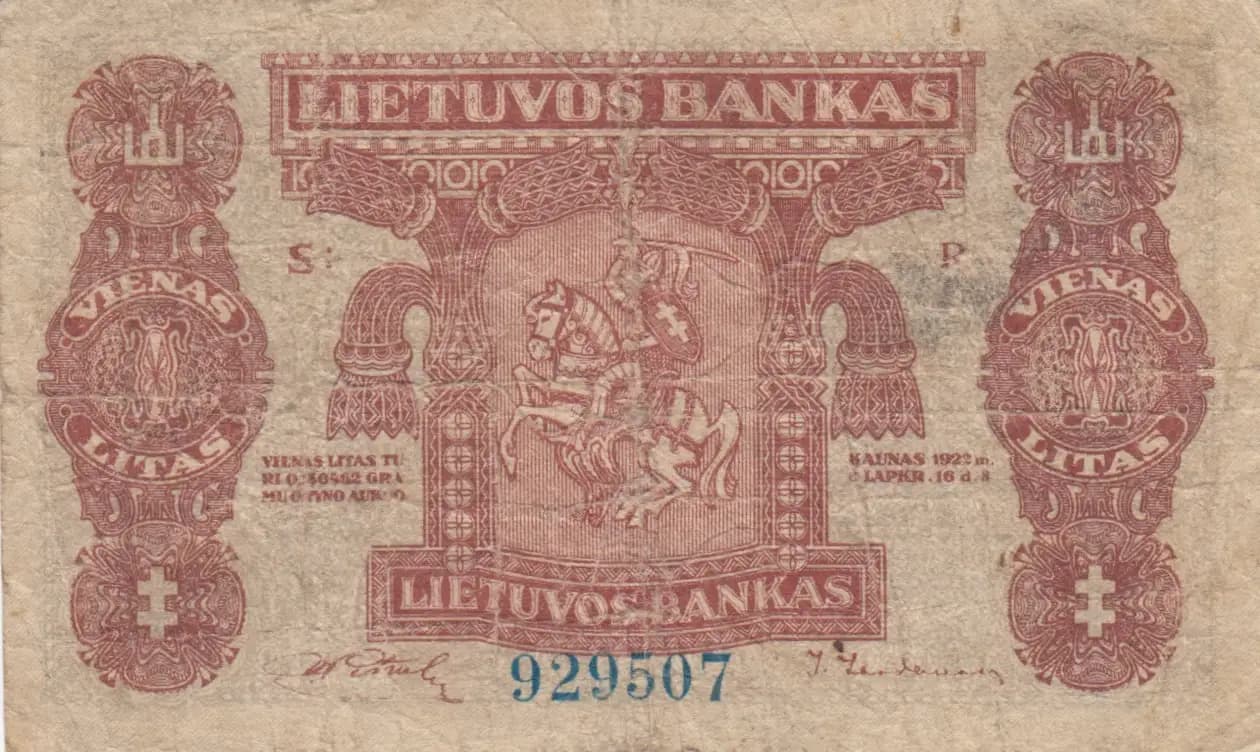
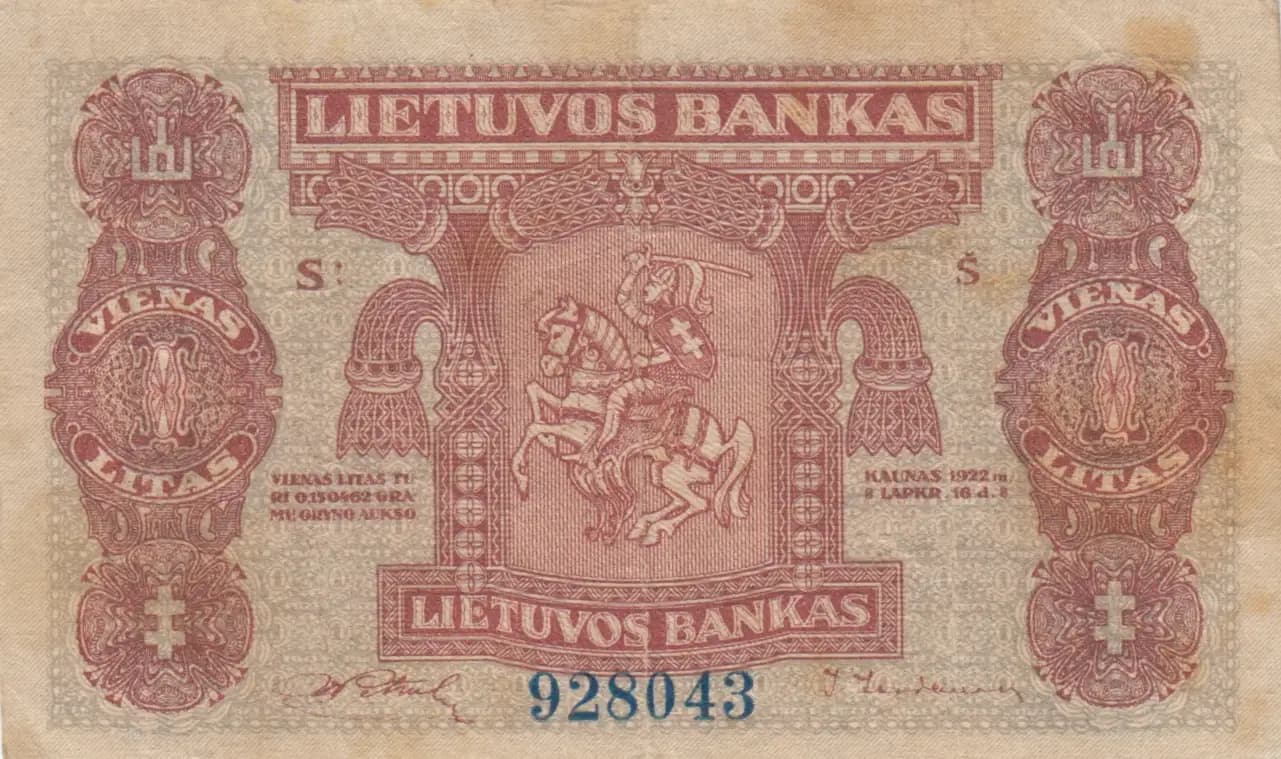
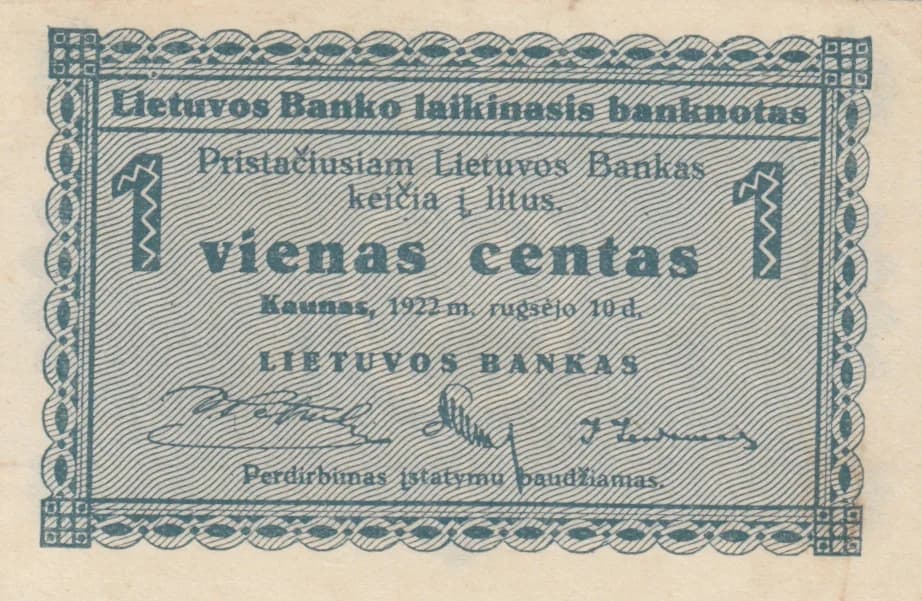
1 litas 1922
“serie M”
Market Prices
5 salesAbout This Note
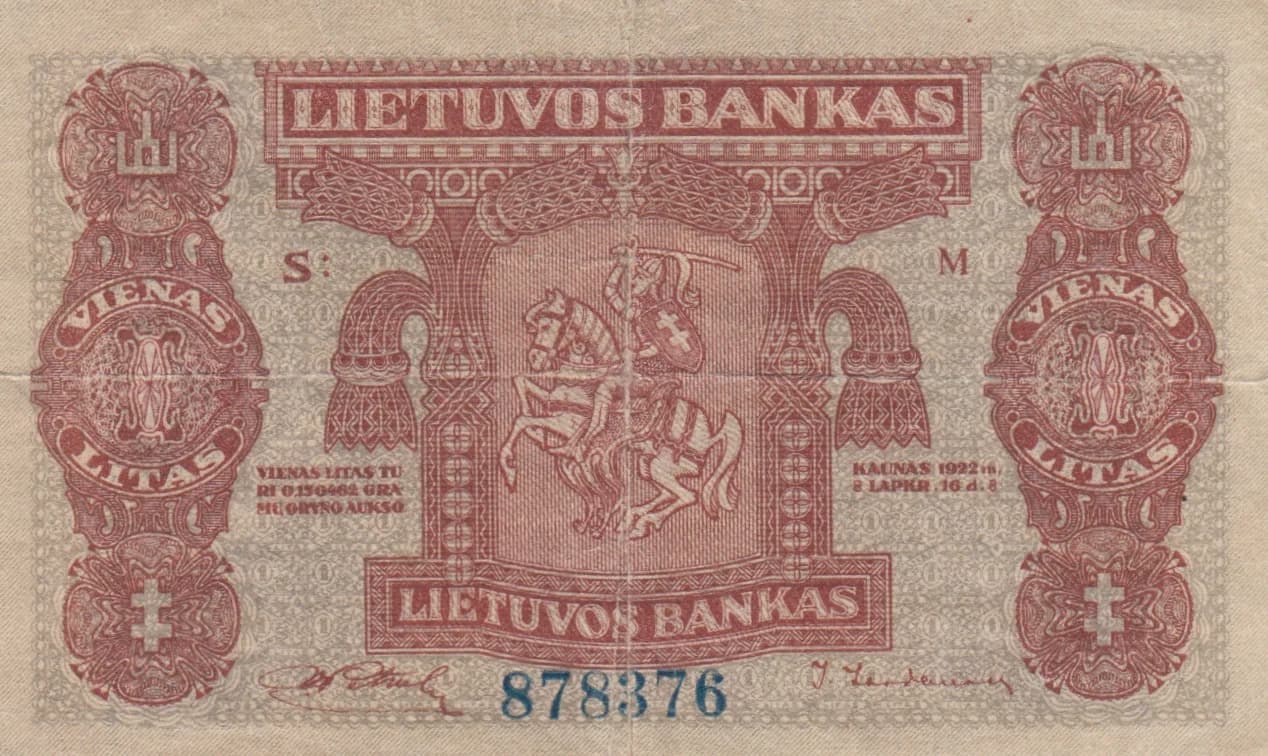
This 1 Litas note from 1922 represents an early emission of Lithuania's first independent currency following the nation's declaration of independence. The VF-graded specimen exhibits the characteristic cream and burgundy color scheme with ornate engraved designs featuring the Lithuanian coat of arms (the Vytis—a knight on horseback) prominently displayed on both sides. Despite moderate age-related discoloration and creasing consistent with circulation, the note remains structurally sound with clear visibility of all design elements, making it a desirable example of Lithuania's foundational numismatic history.
Common. The 2016 catalogue value of $220 for VF specimens and the consistent eBay sales history showing F-condition examples regularly selling in the $165-$185 range (2020-2021) indicate a steady, robust market with multiple specimens in circulation among collectors. The note represents a regular issue with substantial print run appropriate for a newly independent nation's foundational currency. The absence of any premium pricing or collector scarcity notation, combined with straightforward market performance, confirms this as a common date and denomination within Lithuanian numismatics.
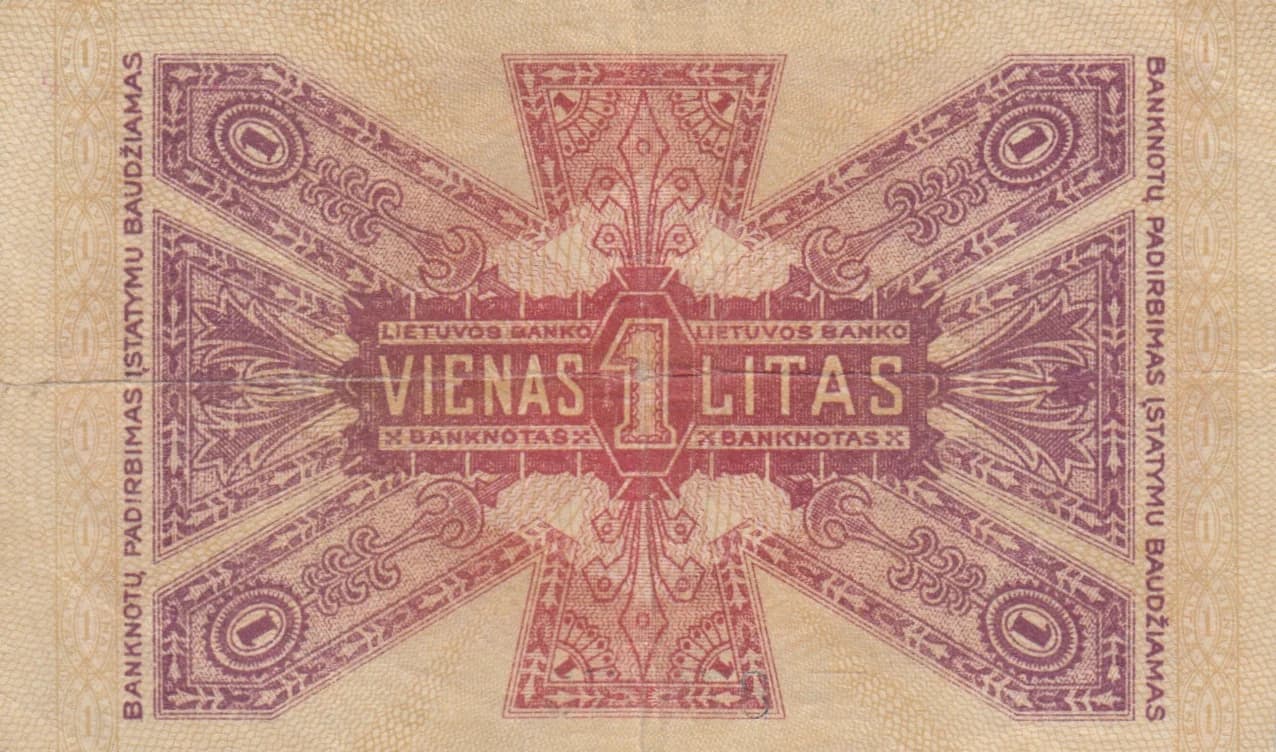
Issued on November 16, 1922, by Lietuvos Bankas (Lithuanian Bank), this note commemorates Lithuania's establishment as an independent nation following World War I and the dissolution of the Russian Empire. The front features the Vytis (the Grand Duke of Lithuania on horseback within a shield), a symbol deeply rooted in Lithuanian national identity and heraldry dating back centuries. The cross design on the reverse reflects both Christian symbolism important to Lithuanian culture and the geometric Art Deco aesthetic popular in early 20th-century European banknote design.
The obverse (front) presents a formal heraldic design centered on the Vytis—the national coat of arms of Lithuania depicting a knight (Grand Duke) on horseback within a shield, flanked by identical coat of arms shields on both sides within ornamental medallions. The design is framed by intricate filigree borders executed in fine engraved lines characteristic of early 20th-century security printing. The reverse (back) employs a distinctive cross-shaped composition with radiating rectangular sections, each containing ornamental patterns and text. Four circular decorative medallions occupy the quadrant corners, featuring shell or fan-like motifs rendered in fine linework. The denomination 'VIENAS LITAS' (One Lita) is prominently centered. The overall color palette of cream, beige, burgundy, and brown reflects the printing technique and aging of the paper stock over a century.
Front side: 'LIETUVOS BANKAS' (Lithuanian Bank); 'KAUNAS 1922 LAPKR. 16' (Kaunas 1922, November 16—the issue date); Serial number '878376' with letter designations 'S' and 'M' (series indicator). Back side: 'LIETUVOS BANKO VIENAS LITAS BANKNOTAS' (One Lita Banknote of Lithuanian Bank); Additional text relating to banknote production and authorization by Lithuanian Bank officials. The partial or unclear inscriptions suggest either archaic Lithuanian orthography, printer's marks, or text affected by image quality/age.
Intaglio engraving, the standard security printing method for banknotes of this era. The fine line work, intricate filigree patterns, and deep engraved detailing visible throughout both sides confirm the use of steel engraving plates. The ornamental borders, geometric patterns, and heraldic designs show the characteristic sharpness and precision of intaglio work. No specific printer attribution is definitively identifiable from the visual analysis, though European security printers of the 1920s frequently handled Lithuanian currency production; the execution suggests a reputable printing house familiar with central European standards.
The specimen is identified as series 'M' with serial number 878376 and letter designation 'S', consistent with the known P-13a variant catalogued by Pick. The PMG population report indicates P-13a and P-13s3 variants exist for this base Pick number; this note's characteristics align with the standard P-13a emission. The serial numbering and series letter placement are typical of 1922 Lithuanian Bank emissions. No overprints, unusual signatures, or date variations are evident that would indicate a premium or error variety.