5 livres 1964 specimen
Market Prices
About This Note
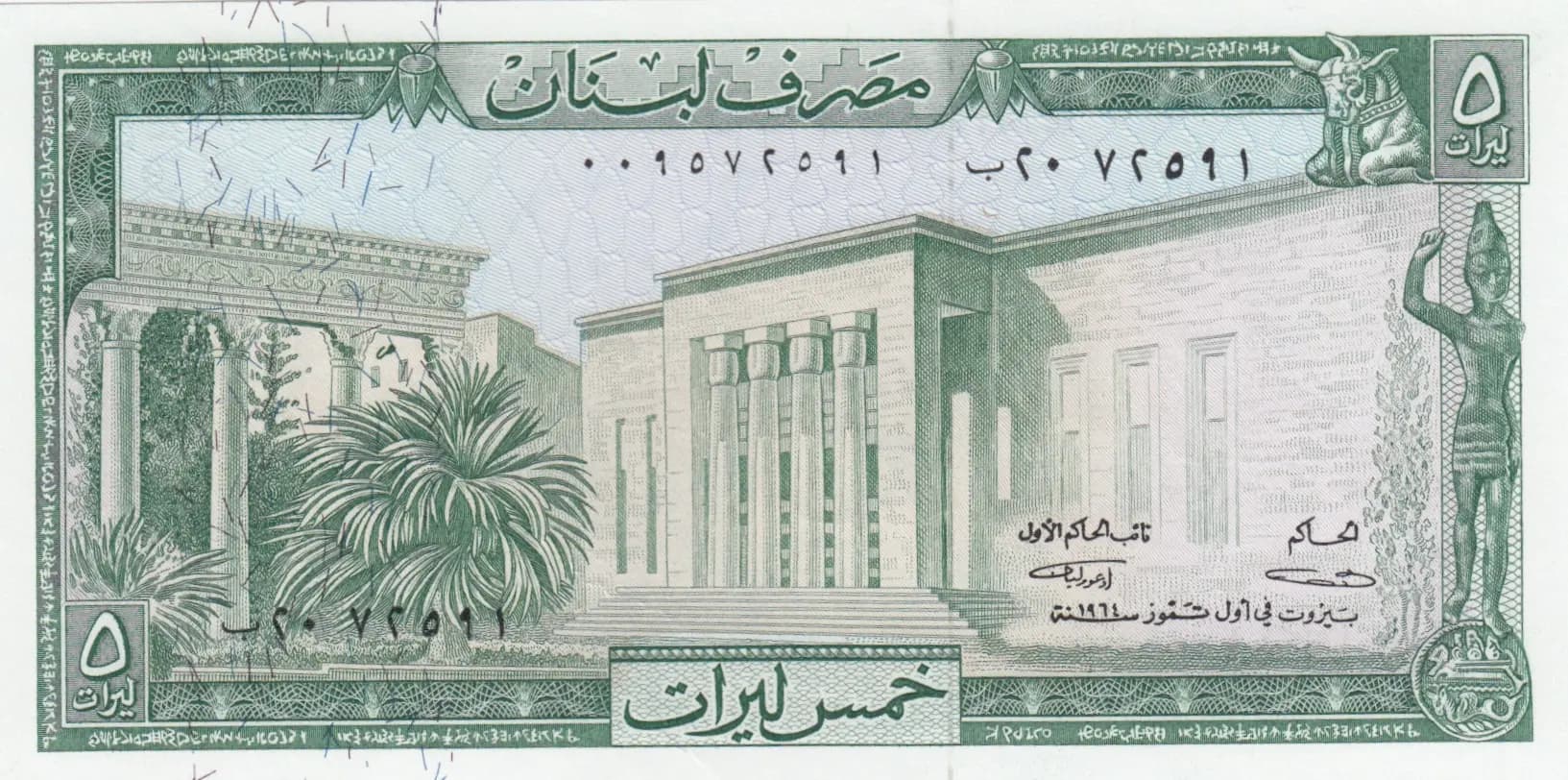
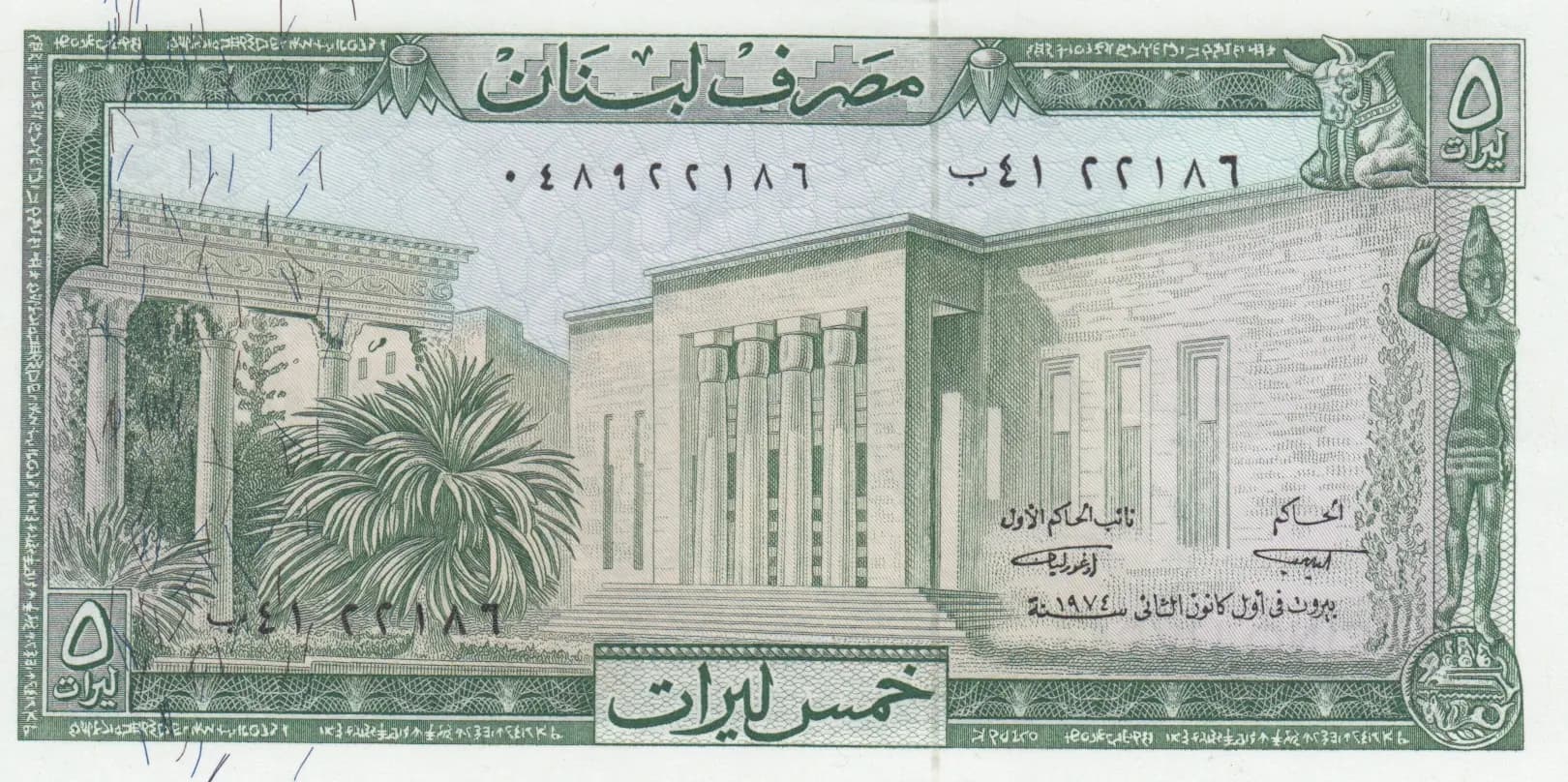
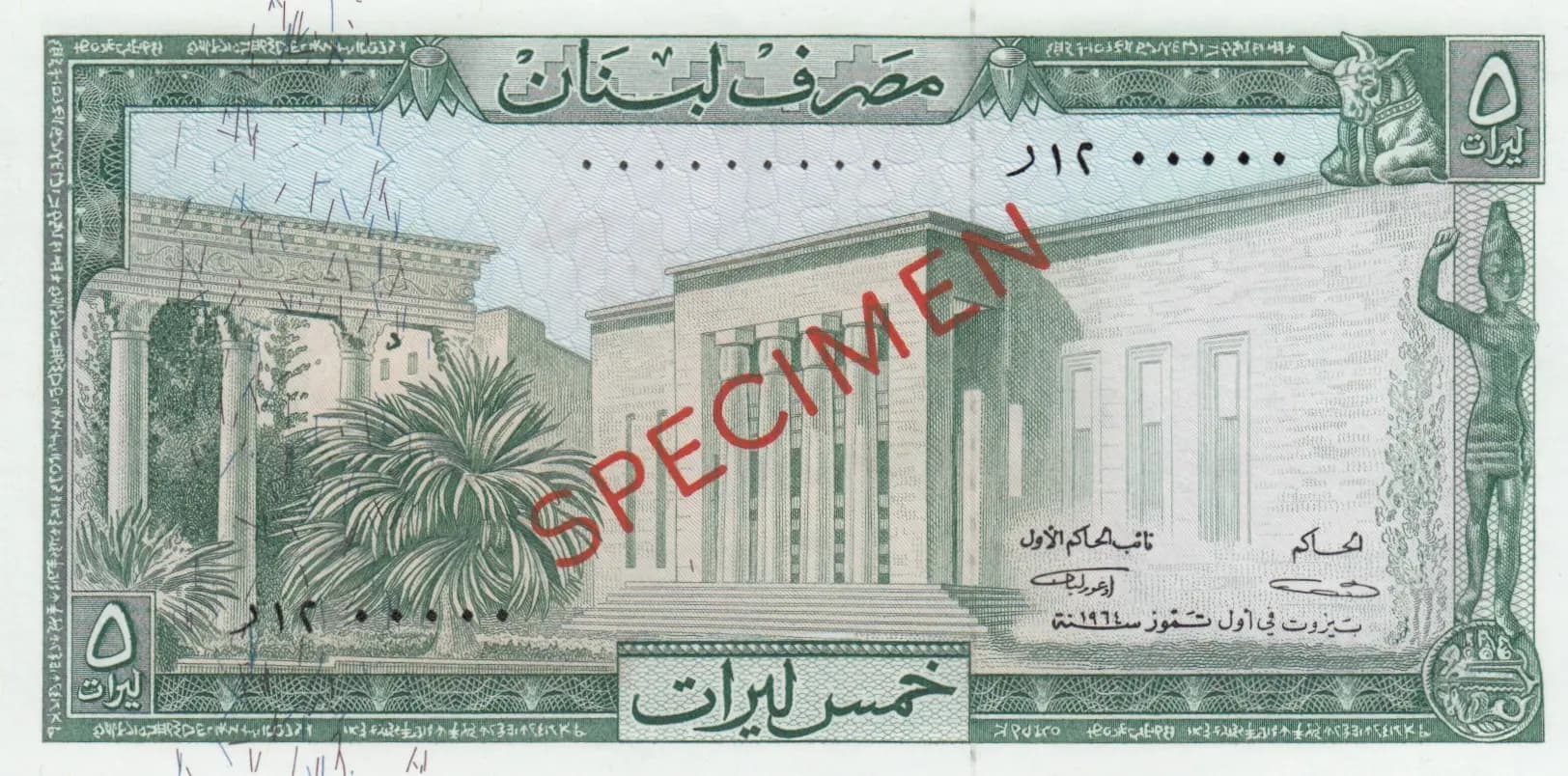
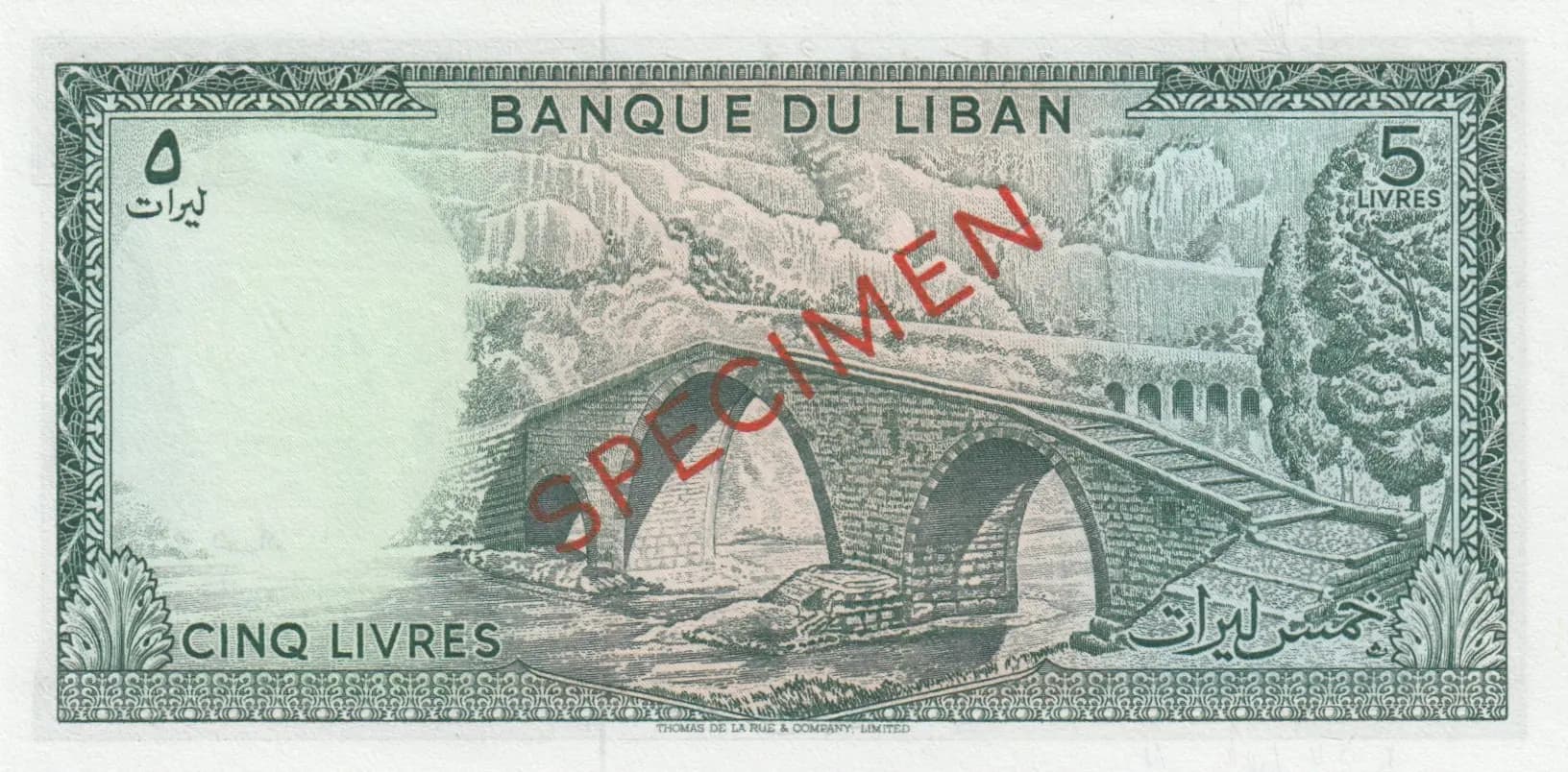
This is a Lebanese 5 Livres specimen note from 1964, issued by Banque du Liban and printed by Thomas de la Rue. The note features exceptional engraved imagery on both sides—the obverse displays the classical National Museum of Beirut with columned architecture and palm trees, while the reverse showcases the picturesque arched Bridge over the Kalb River with mountainous backdrop. As an UNC-graded specimen with the characteristic red diagonal 'SPECIMEN' overprint, this note represents both a historically significant currency issue and an attractive example of mid-20th century Lebanese banknote design.
Common. This is a regular issue from 1964-1986 with a substantial and extended print run spanning over two decades. The eBay market data confirms common status, with UNC specimens trading at modest prices ($1.50–$15.00 USD range in recent sales), well below the threshold that would indicate scarcity. Specimen notes with overprints are typically less collectible than regular circulation notes but do not command significant premiums. The fact that this note is catalogued in PMG with only one variant further suggests a straightforward, widely-printed issue.
This 1964 issue reflects Lebanon's period as a prosperous banking center and culturally vibrant nation before the civil conflicts of the 1970s-1980s. The National Museum depicted on the obverse symbolizes Lebanon's ancient Phoenician and Greco-Roman heritage, while the Bridge over the Kalb River on the reverse represents the country's natural beauty and infrastructure development. The bilingual French-Arabic inscriptions reflect Lebanon's post-independence identity and its positioning as a Francophone nation in the Arab world.
The obverse features the National Museum of Beirut (Musée National), prominently displayed as a Neoclassical building with multiple tall fluted columns and a windowed facade, flanked by a palm tree on the left, symbolizing Lebanon's Mediterranean character and cultural patrimony. The reverse depicts the Bridge over the Kalb River (Jisr al-Kalb), an ancient Roman arched stone bridge spanning a river with rocky terrain, coniferous trees, and mountains in the background, representing the nation's geographical beauty and historical engineering. Both sides employ ornate decorative borders with geometric patterns and palm frond motifs in the Art Deco style typical of 1960s currency design. The denomination '5' appears in corner circles on both sides. The color scheme transitions from green, blue, and light yellow on the obverse to green and gray tones on the reverse.
FRONT SIDE: مصرف لبنان (Masraf Lubnan) = 'Bank of Lebanon'; ٥ (5 in Arabic numerals); لبرات (Livres); حاكم البنك المركزي (Governor of the Central Bank); النائب الأول (First Deputy); SPECIMEN (English overprint). BACK SIDE: BANQUE DU LIBAN (French) = 'Bank of Lebanon'; 5 LIVRES / CINQ LIVRES (French denomination); لبرات (Arabic for Livres); THOMAS DE LA RUE & COMPANY, LIMITED (printer attribution); SPECIMEN (English overprint).
Intaglio engraving (line engraving and fine line work throughout), as evidenced by the precise detail, fine line patterns in the borders, and the intricate architectural and landscape renderings. The printer was Thomas de la Rue & Company, Limited, London, one of the world's premier currency printers. Security features include fine engraved border designs and watermarked paper (ancient galley watermark noted in external references). The red 'SPECIMEN' overprint was applied as a separate pass, typical of specimen notes issued for presentation or archive purposes.
This is catalogued as P-62s (the 's' designation indicates specimen status). The red diagonal 'SPECIMEN' overprint is the defining characteristic of specimen notes, which were produced in limited quantities for official distribution, bank archives, and numismatic purposes—distinct from regular circulation P-62 notes. The visual analysis shows handwritten marks and annotations consistent with archive handling. No signatures or serial numbers are clearly visible in the provided imagery to establish further specific sub-varieties, though signature varieties may exist among regular P-62 circulation notes of the same period.