5 livres 1974
Market Prices
15 salesAbout This Note
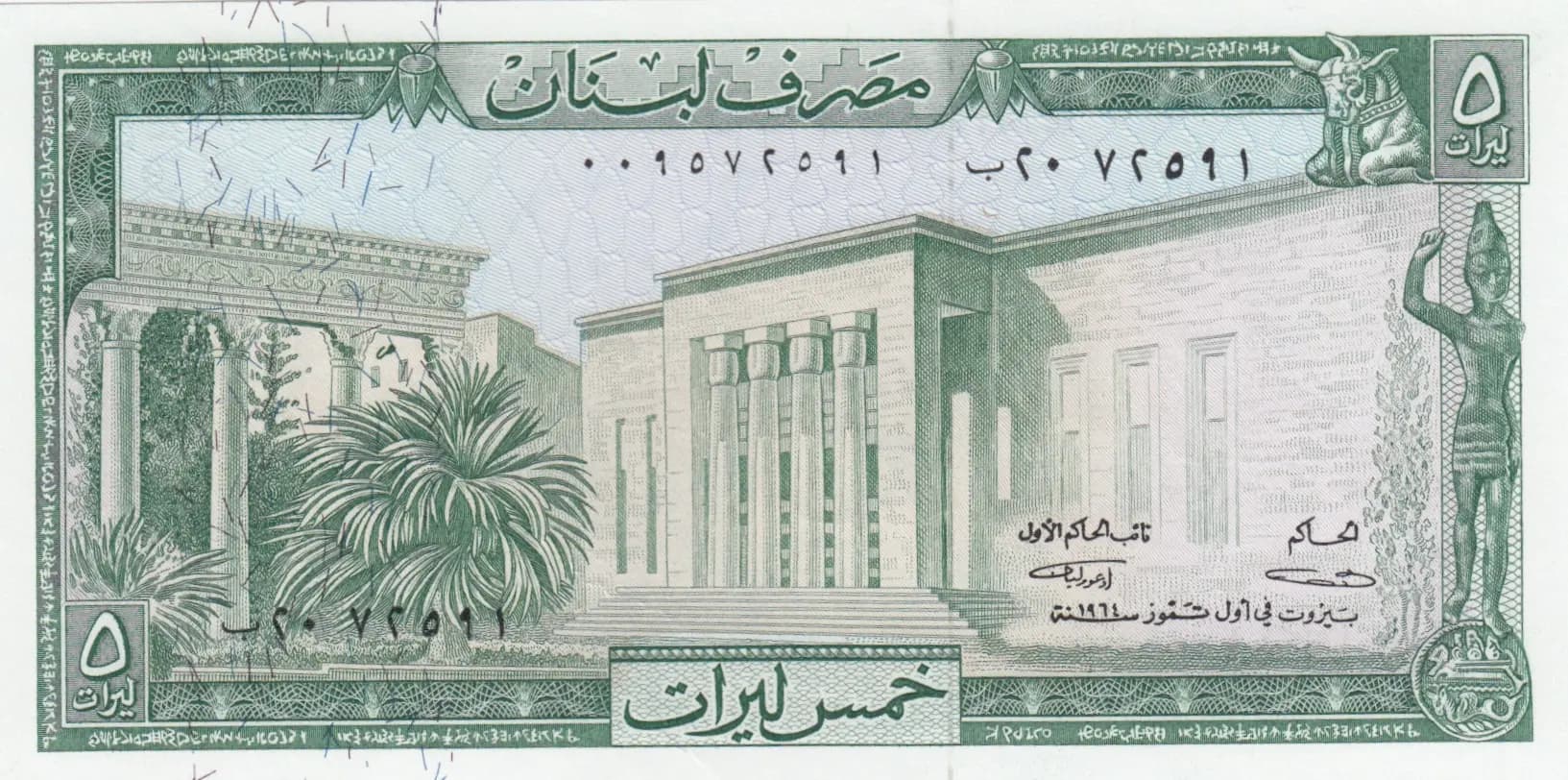
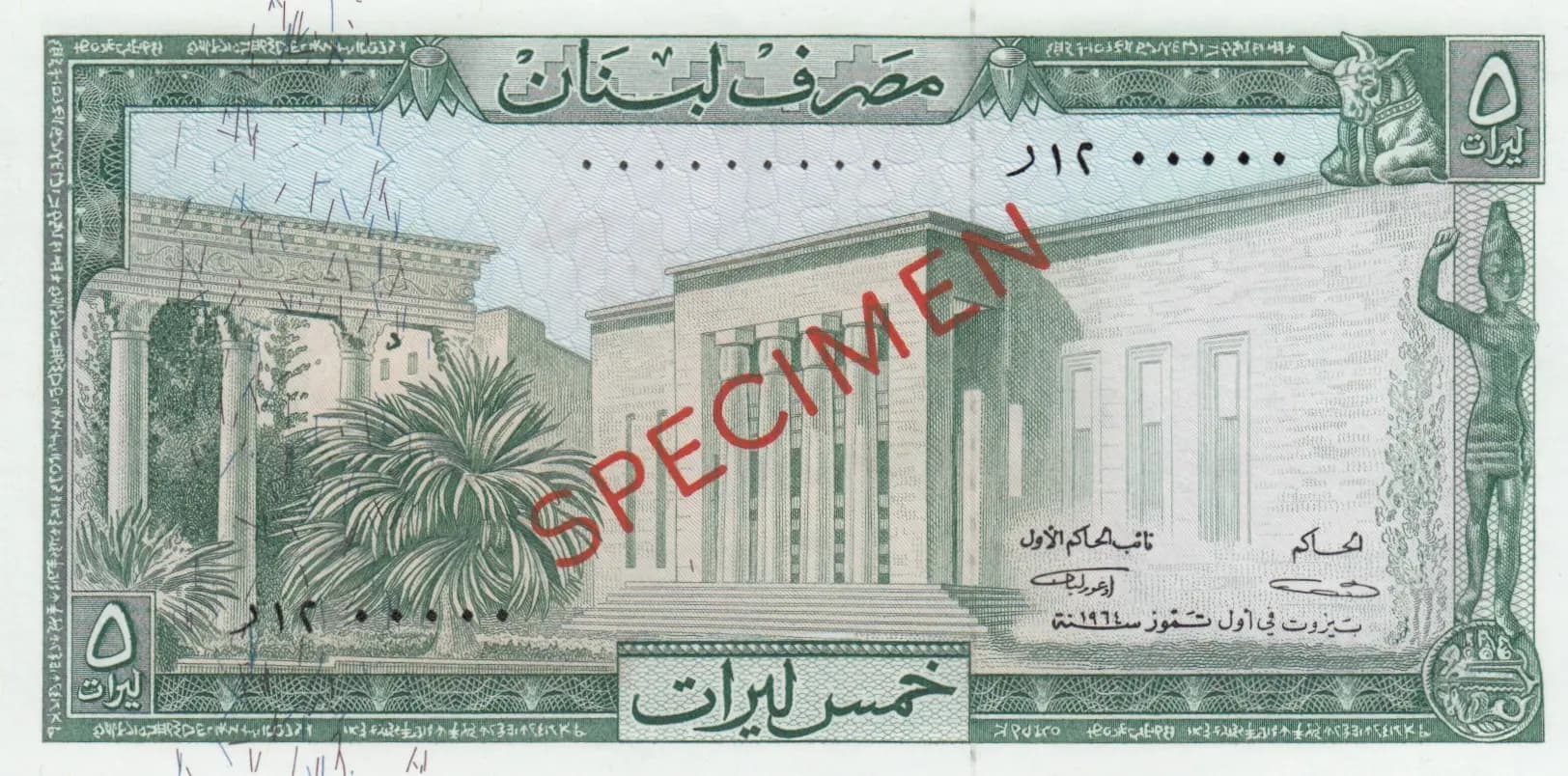
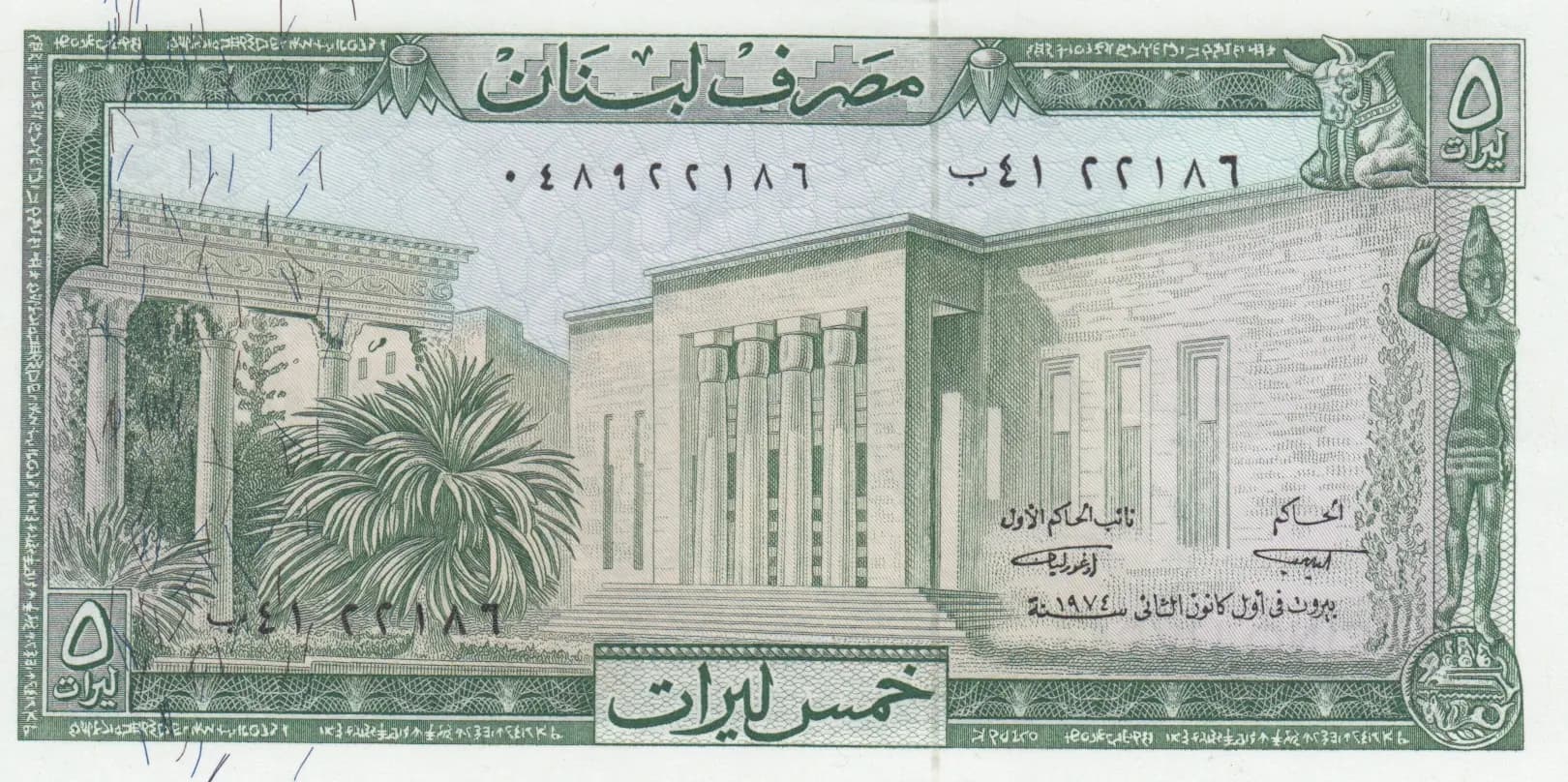
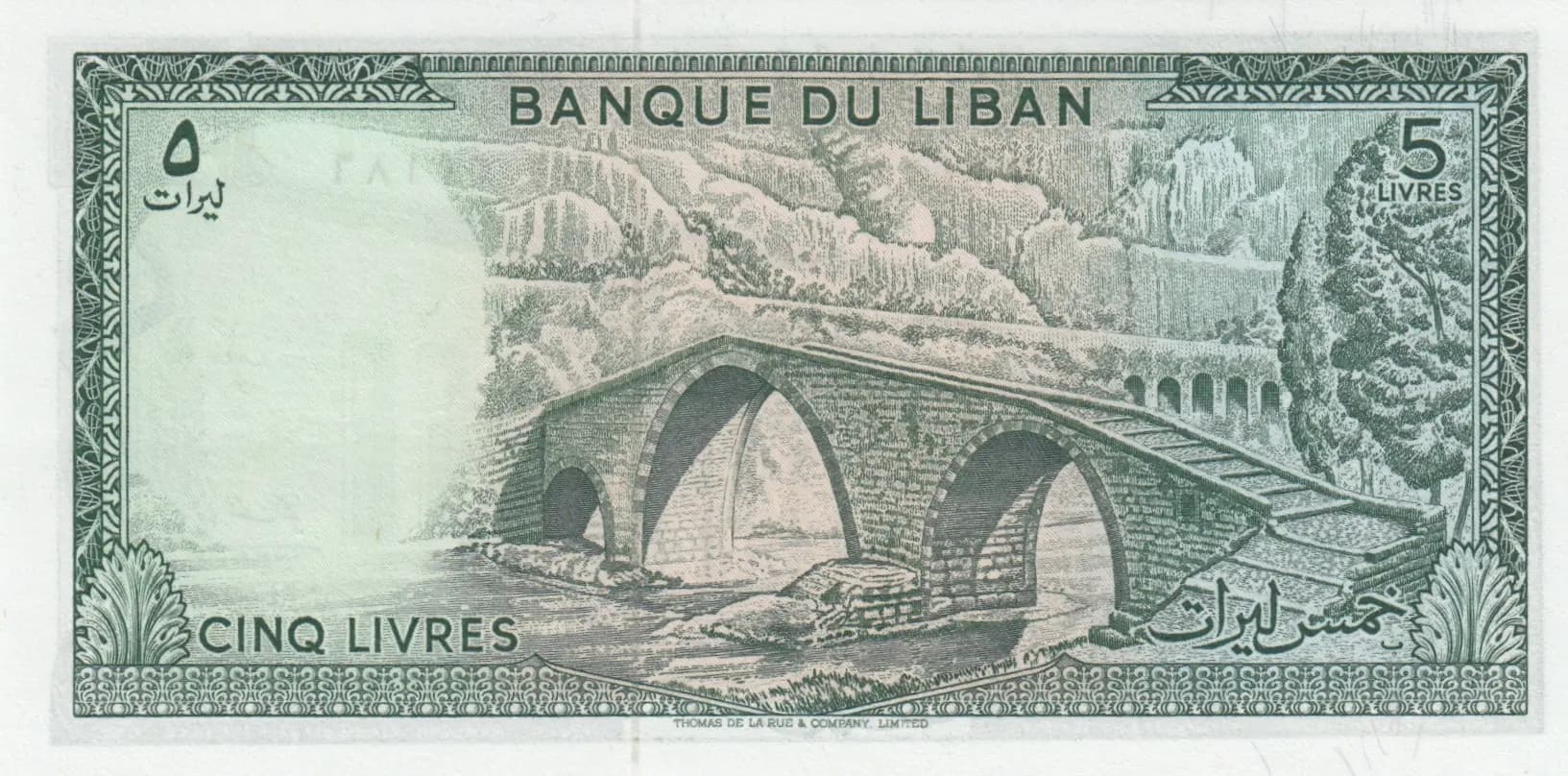
This is a Lebanese 5 Livres banknote from the 1974 issue (Pick P-62c), printed by Thomas de la Rue and issued by Banque du Liban. The note features striking green monochromatic engraving on the obverse depicting the National Museum of Beirut with classical columned architecture flanked by palm and cypress trees, while the reverse showcases a beautifully detailed multi-arched stone bridge spanning the River Kalb with mountainous forested terrain. The specimen shown displays moderate wear with visible handwriting on the front and some creasing, consistent with circulated condition rather than the cataloged UNC grade.
Common. This banknote is a regular issue from an extended production period (1972-1986 for the 5 Livres denomination), with significant print runs typical of a primary circulation denomination for a major Middle Eastern nation. eBay market data shows consistent availability with modest pricing (UNC examples selling for $1-10 historically, with 2019 catalog value of $10 UNC), indicating robust supply. No scarcity factors such as short print runs, recall status, or unusual variety status apply to this standard P-62c issue.
Issued during Lebanon's period of relative prosperity in the mid-1970s, before the onset of the Civil War, this banknote represents the nation's cultural and infrastructural pride. The National Museum depicted on the obverse symbolized Lebanon's position as a regional center of art and learning, while the River Kalb bridge on the reverse exemplifies the country's modern engineering achievements. The bilingual French-Arabic inscriptions reflect Lebanon's dual cultural heritage and its status as a cosmopolitan Mediterranean nation during this era.
The obverse features the National Museum of Beirut (Musée National) as the primary architectural subject, rendered in detailed engraving with a modern classical facade characterized by prominent columns, a flat roofline, and symmetrical composition. The building is framed by ornamental landscaping including a palm tree on the left and cypress-like evergreens on the right, emphasizing Lebanon's Mediterranean flora. Decorative emblem or shield appears in the upper right corner. The reverse depicts the Kalb River Bridge (Jisr al-Kalb), a multi-arched stone structure of classical engineering spanning a river valley with dense mountain forests and scattered cypress trees in the background, rendered with fine cross-hatching and detailed landscape engraving. Both sides employ ornate guilloche border patterns with repeating geometric and floral motifs typical of Thomas de la Rue's security printing standards.
FRONT: مصرف لبنان (Masraf Lubnan - Bank of Lebanon), حاكم البنك (Hakim al-Bank - Governor of the Bank), الرئيس (al-Ra'is - President), بموجب القانون الصادر سنة ١٩٧٦ (By virtue of the law issued in the year 1976), بنك لبنان (Bank of Lebanon). Serial numbers appear in both Arabic and Persian numerals. BACK: BANQUE DU LIBAN (Bank of Lebanon in French), CINQ LIVRES / خمس لبرات (Five Livres in French and Arabic), ۵ / ٥ (denomination 5 in Persian and Arabic numerals), THOMAS DE LA RUE & COMPANY LIMITED (printer attribution).
Intaglio engraving (recess printing) executed by Thomas de la Rue & Company Limited, London, one of the world's premier security printers of the period. The technique is evidenced by the fine line work, detailed guilloche patterns, precise cross-hatching in the landscape elements, and the overall crisp definition visible in the architectural and natural features. The monochromatic green color scheme was achieved through single-color intaglio printing on a blue and light yellow underprint base, creating the distinctive appearance described in catalog references.
This specimen represents the P-62c variety of the Lebanese 5 Livres series. The Pick catalog recognizes multiple date variants within the broader series (1972, 1974, 1.2.1978, 1.4.1978), with this example bearing the 1974 date. The note displays the standard signatures and layout for this variety. Serial numbers are present in both Arabic and Persian numerals. The note's legal authorization text references law issued in 1976, consistent with the extended circulation period of this denomination throughout the mid-to-late 1970s.