100 livres 1964 specimen
Market Prices
1 saleAbout This Note
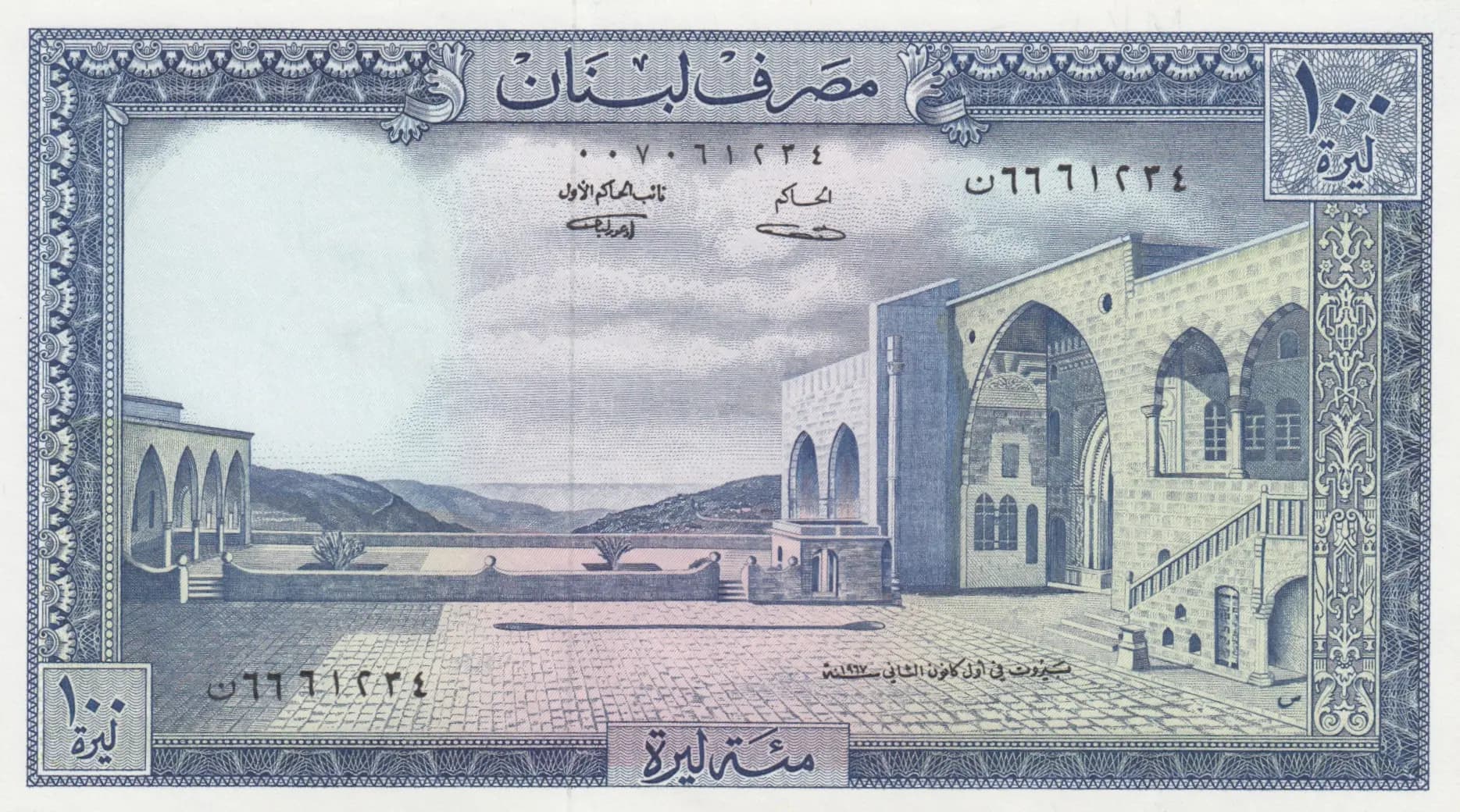
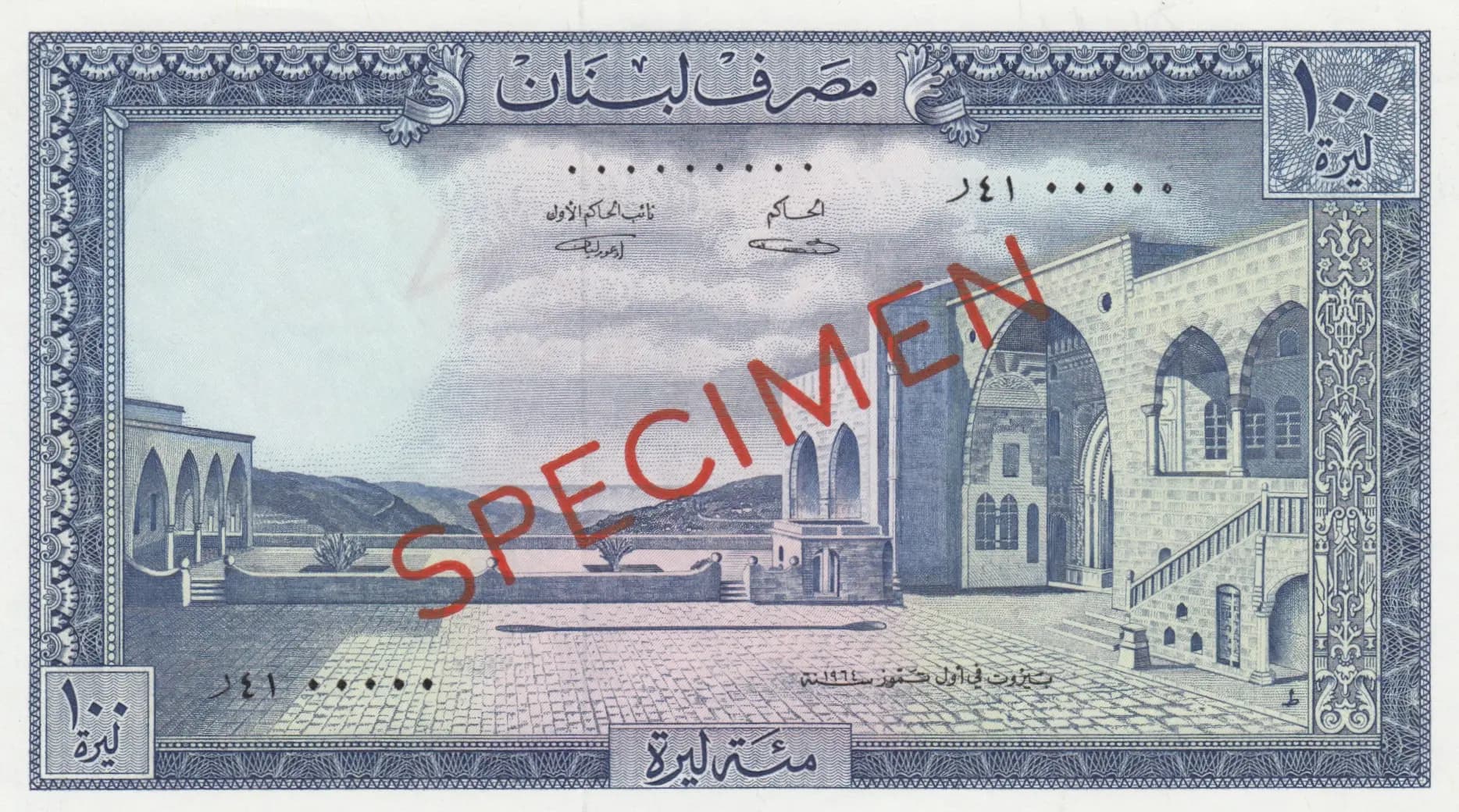
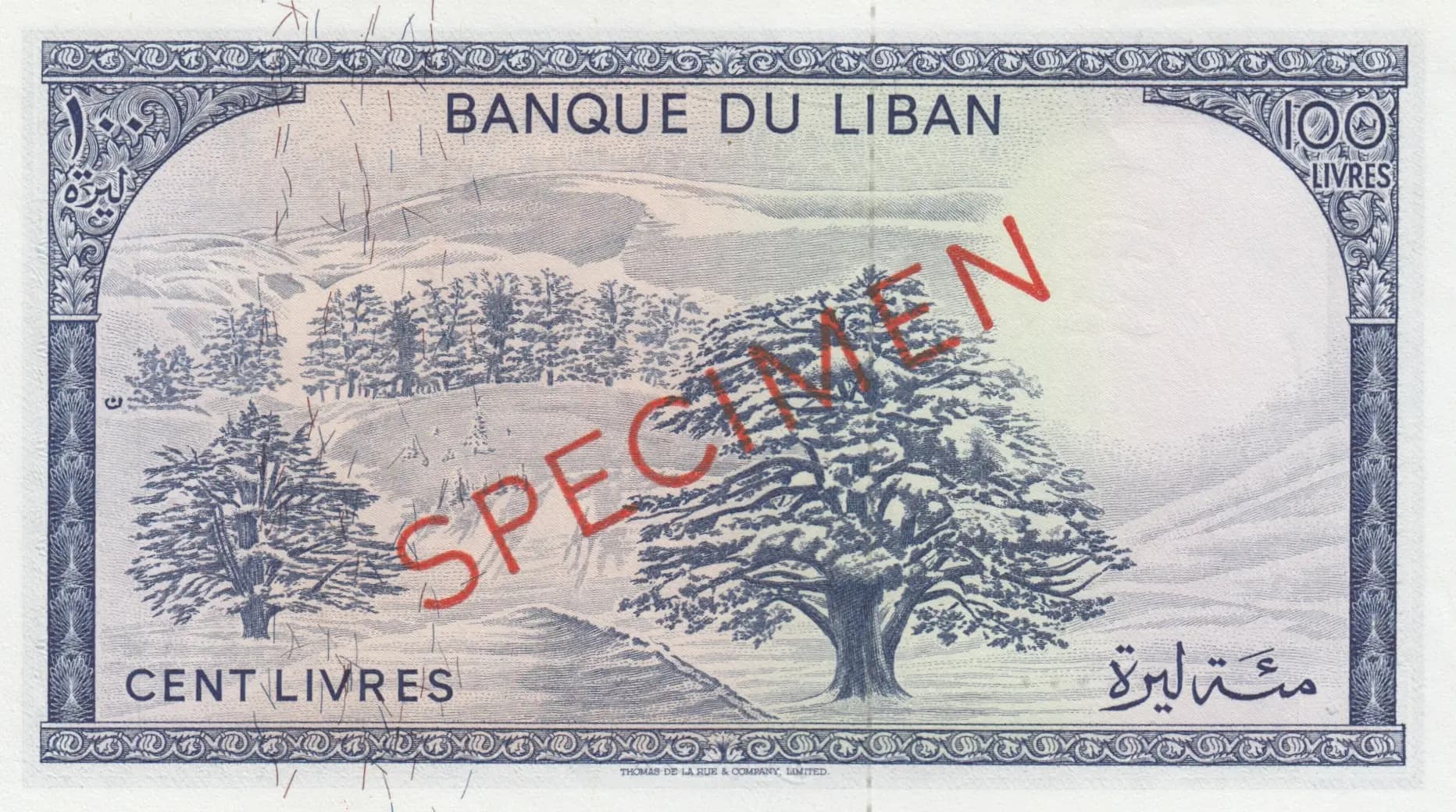
This is a 1964 specimen note of the Lebanese 100 Livres issued by Banque du Liban and printed by Thomas de la Rue. The obverse features an intricate engraving of the Palais Beit-ed-Din with its distinctive Islamic courtyard architecture rendered in blue-grey tones on a light pink and blue underprint, while the reverse displays a majestic cedar tree in a snowy mountain landscape—both iconic symbols of Lebanon. As a specimen note bearing the characteristic red diagonal 'SPECIMEN' overprint, this uncirculated example showcases the fine engraving work and security printing techniques typical of de la Rue's banknote production, with no visible circulation wear despite its nearly 60-year age.
Common. While specimen notes are less frequently encountered in circulation than regular issue notes, the 1964-1988 series Lebanese 100 Livres was produced in substantial quantities by a major international security printer. The eBay market data showing a 2014 sale of $242.50 for an UNC specimen reflects moderate collector demand but not rarity premiums. Specimen notes from this series and denomination are regularly available on the numismatic market, indicating healthy supply relative to collector demand. The note's accessibility and the straightforward nature of specimen notes from this widely-distributed series support a common rarity classification.
The Lebanese 100 Livres from 1964 reflects Lebanon's post-independence identity, with the note's iconography celebrating the nation's cultural heritage and natural patrimony. The Palais Beit-ed-Din, depicted on the obverse, is a restored Ottoman-era architectural masterpiece located in the Chouf Mountains, symbolizing Lebanon's rich historical continuity, while the cedar tree on the reverse is the central element of Lebanon's flag and has been a national symbol since ancient times. This note was issued during a relatively stable period in Lebanon's early post-colonial era, before the country experienced significant political upheaval, making early specimen notes from this series increasingly significant to collectors of Levantine currency.
The obverse depicts the Palais Beit-ed-Din (also known as Beiteddine Palace), a restored 19th-century Ottoman palace located in the Chouf district of Lebanon, shown with its characteristic multi-story stone architecture featuring multiple arched doorways, windows, and colonnades arranged around a central tiled courtyard. The architectural rendering captures the palace's distinctive Islamic design elements with fine engraving detail. The reverse features a prominent cedar of Lebanon (Cedrus libani) as the central motif, depicted with snow-capped branches in a mountain forest setting, referencing both the natural grandeur of Lebanon's landscape and the cedar's status as the national emblem. Both sides incorporate elaborate ornamental borders with geometric and floral patterns typical of de la Rue's security printing aesthetic. The note carries the characteristic specimen overprint and includes text in Arabic, French, and English, reflecting Lebanon's multilingual official and cultural context.
FRONT: 'مصرف لبنان' (Banque du Liban / Bank of Lebanon), 'مائة ليرة' (Cent Livres / One Hundred Livres), '100' (numerical denomination), 'SPECIMEN' (English overprint indicating sample note). BACK: 'BANQUE DU LIBAN' (Bank of Lebanon in French), '100' (numerical denomination), 'LIVRES' (currency designation), 'CENT LIVRES' (One Hundred Livres in French), 'مئة ليرة' (One Hundred Livres in Arabic), 'SPECIMEN' (English overprint), 'THOMAS DE LA RUE & COMPANY, LIMITED' (printer attribution).
Intaglio (engraved) printing by Thomas de la Rue & Company, Limited, London, as indicated by the fine line work, intricate border patterns, and depth of detail visible throughout the design. The note exhibits the hallmarks of de la Rue's security printing standards of the era, with multiple layers of decorative engraving providing both aesthetic appeal and counterfeit resistance. The specimen overprint was applied separately as an authentication feature for sample/reference notes distributed to banks and collectors.
This note is cataloged as P-66s in the Pick catalog system, the 's' suffix denoting this as a specimen note variant. The PMG population report indicates five cataloged varieties (P-66a through P-66d, plus P-66s), with all confirmed variants showing Thomas de la Rue as printer. As a specimen note, this example would bear the standard red 'SPECIMEN' diagonal overprint and lacks the serial numbers and signature lines found on circulation-intended notes. No date variations or signature varieties are applicable to specimen notes of this type, which were issued as reference/sample pieces rather than for currency circulation.