5 piastres 1942
“w/o stamp”
Market Prices
22 salesAbout This Note
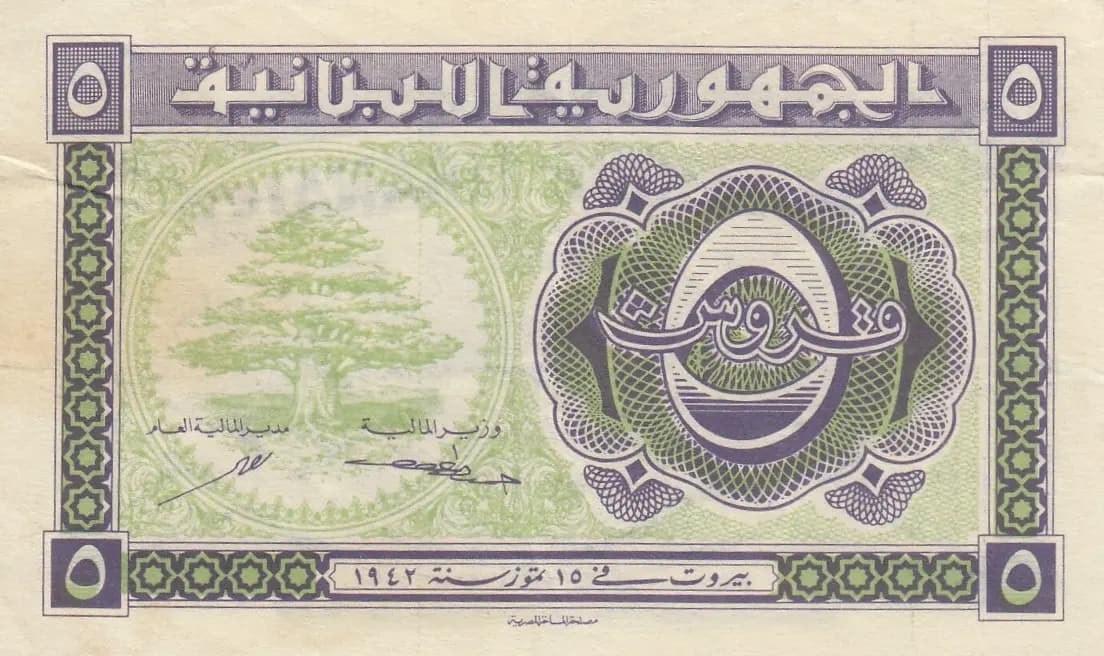
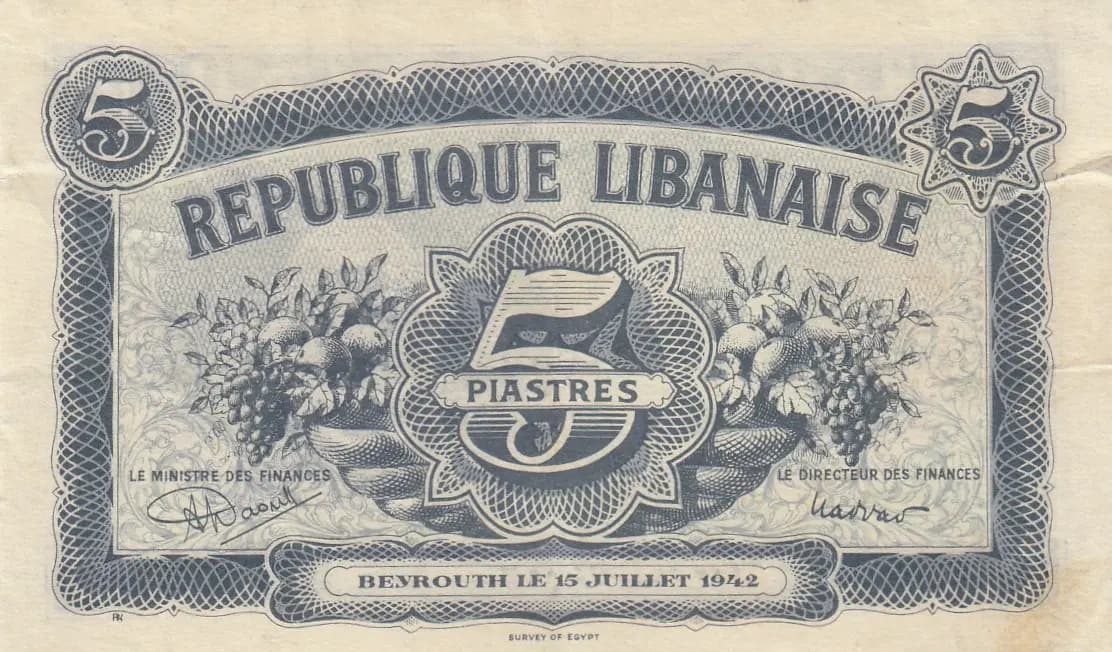
This is a Lebanese 5 Piastres note from 1942, representing an early emission of the newly independent Lebanese Republic following French Mandate administration. The note exhibits Very Fine condition with visible age-appropriate wear including creasing and minor foxing, yet retains clear design legibility and all security features intact. The bilingual French-Arabic design with cedar tree and grape motifs reflects Lebanon's national symbolism and the transitional political period of the early 1940s.
Common. eBay auction data from 2010-2025 shows consistent availability with VF condition examples regularly selling in the $7.50-$16.27 range and lower grades (F, VG) trading for $2-$11. The 2016 catalogue valuation of $10 for VF aligns with observed market prices. The note was a regular issue from the newly established Lebanese central banking system with no documented recall or short print run. Current market liquidity remains steady, confirming this as a standard early Lebanese Republic note rather than a scarce variety.
Issued on 15 July 1942, just two months after Lebanon's formal independence declaration on 22 November 1941, this note marks the Republic's early monetary autonomy under the newly established central banking authority. The cedar tree depicted on the reverse is Lebanon's national emblem and appears on the country's flag, while the grape clusters on the obverse symbolize the nation's agricultural heritage. The bilingual French-Arabic inscriptions reflect Lebanon's unique cultural identity and the lingering influence of French administration during this transitional period.
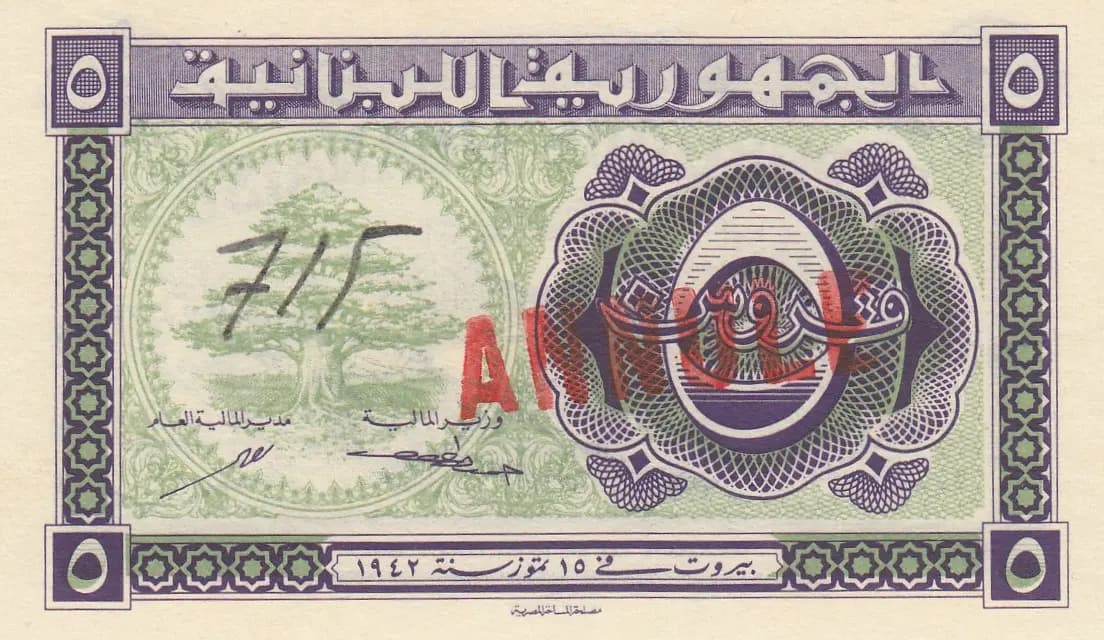
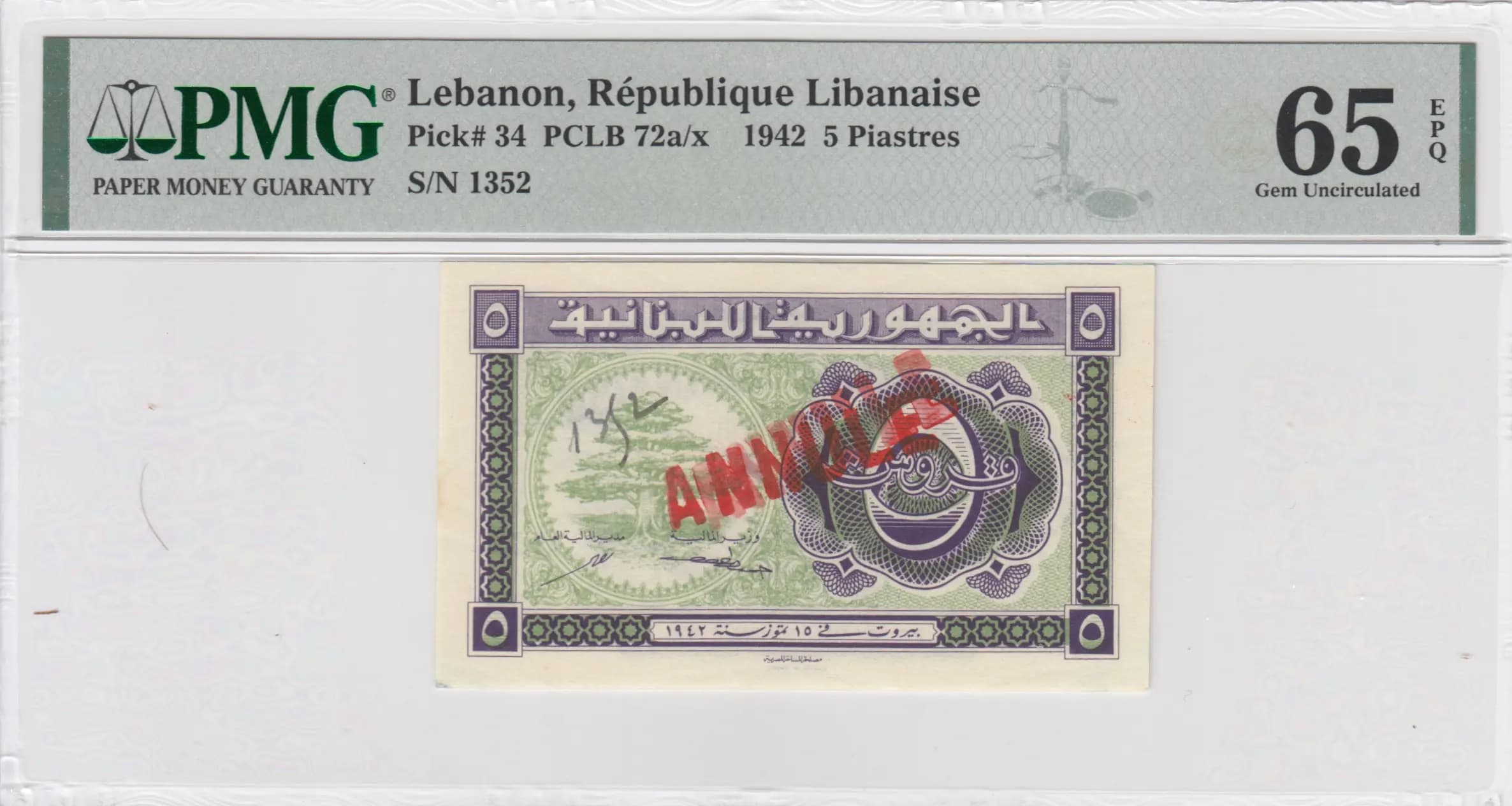
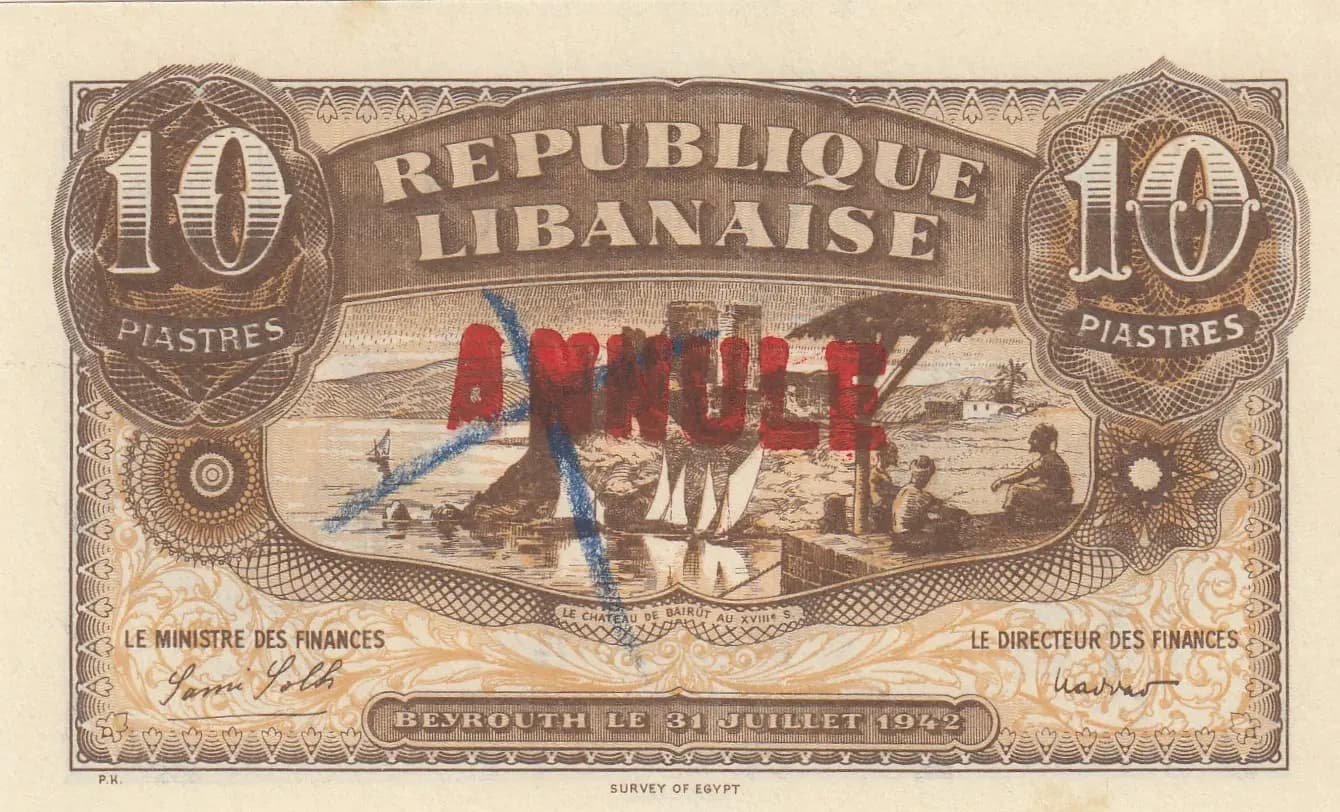
The obverse features a central shield medallion containing the numeral '5' flanked by grape clusters with vine leaves in a navy and cream color scheme, with geometric border patterns and ornamental framing. The reverse displays a large cedar tree of Lebanon in a circular vignette on the left side with an ornate oval medallion containing Arabic calligraphy and elaborate decorative scrollwork on the right, executed in green and purple tones. Both sides incorporate fine geometric star patterns in the borders and denomination numerals in corner circles. The bilingual presentation—French on the obverse, Arabic on the reverse—underscores the nation's dual cultural and administrative heritage at this formative moment in its independence.
FRONT (Obverse): 'REPUBLIQUE LIBANAISE' (Lebanese Republic); '5 PIASTRES' (denomination); 'LE MINISTRE DES FINANCES' (The Minister of Finance); 'LE DIRECTEUR DES FINANCES' (The Director of Finance); 'BEYROUTH LE 15 JUILLET 1942' (Beirut 15 July 1942); 'SURVEY OF EGYPT' (printer attribution); '5' (numeral denomination). BACK (Reverse): 'جمهورية لبنان الشرقية' (Republic of Greater Lebanon); 'وزير المالية' (Minister of Finance); 'محافظ البنك المركزي' (Governor of Central Bank); 'بيروت ١٥ تموز ١٩٤٢' (Beirut 15 July 1942); '5' (numeral denomination).
Intaglio engraving with fine-line security printing, produced by the Survey of Egypt as indicated by the printer attribution. The technique demonstrates multiple layers of complex cross-hatching patterns, intricate geometric designs, and elaborate decorative elements characteristic of high-security currency production of the era. The fine-line engraving throughout both sides provided anti-counterfeiting measures through the reproduction complexity that period printing technology could not easily replicate.
This example is noted in the collector reference as 'w/o stamp' (without stamp), indicating the absence of postal or banking stamps that sometimes appear on notes from this era. The note bears handwritten signatures of the Minister of Finance and Governor of the Central Bank, consistent with P-34 standard specifications. No serial number or specific serial range is visible in the condition assessment provided, though the PMG population report confirms this Pick number (P-34) with 1 catalogued variant. The 15 July 1942 date is the standard issue date for this series.