5 rubli 1919
“serie G”
Market Prices
About This Note
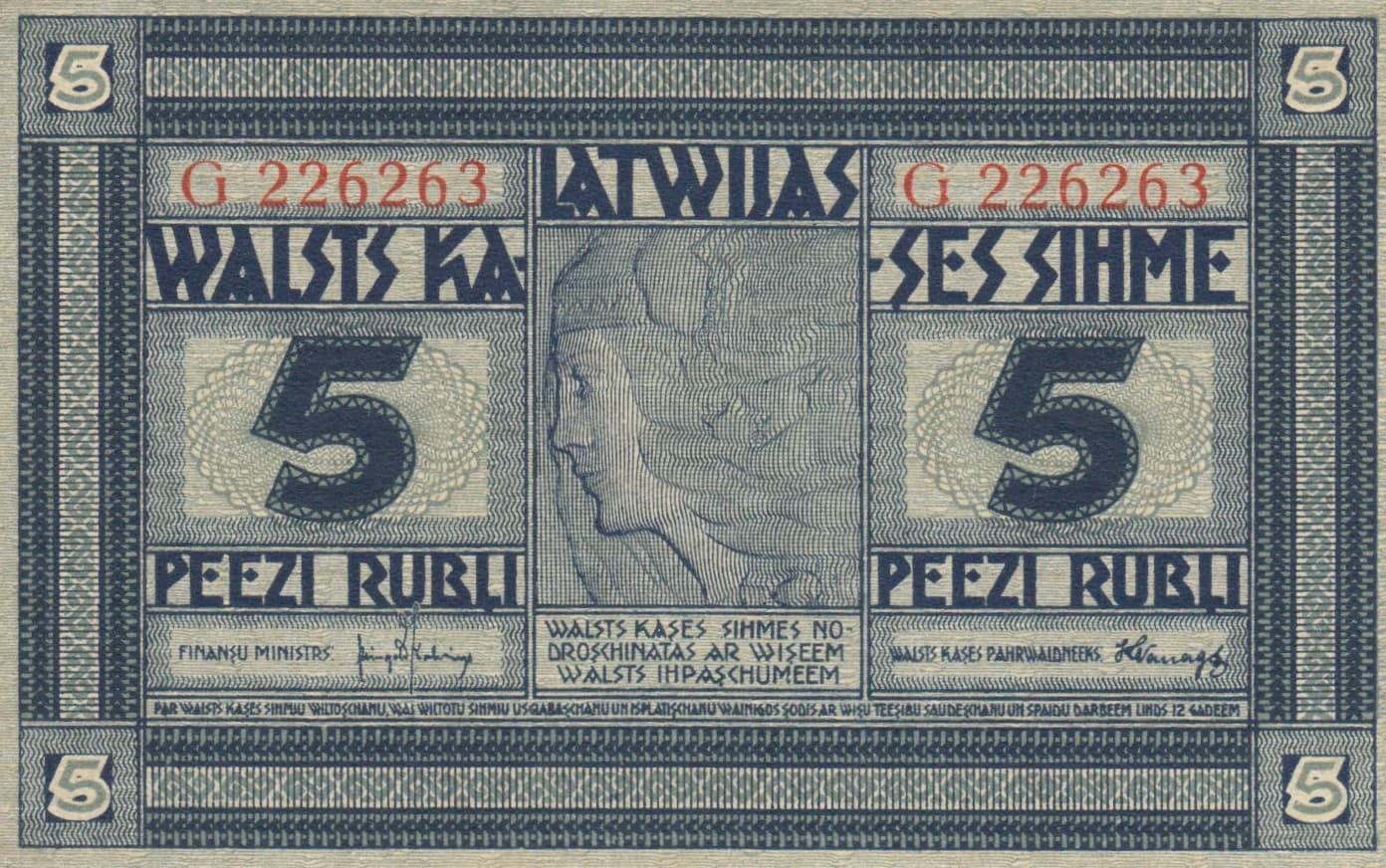
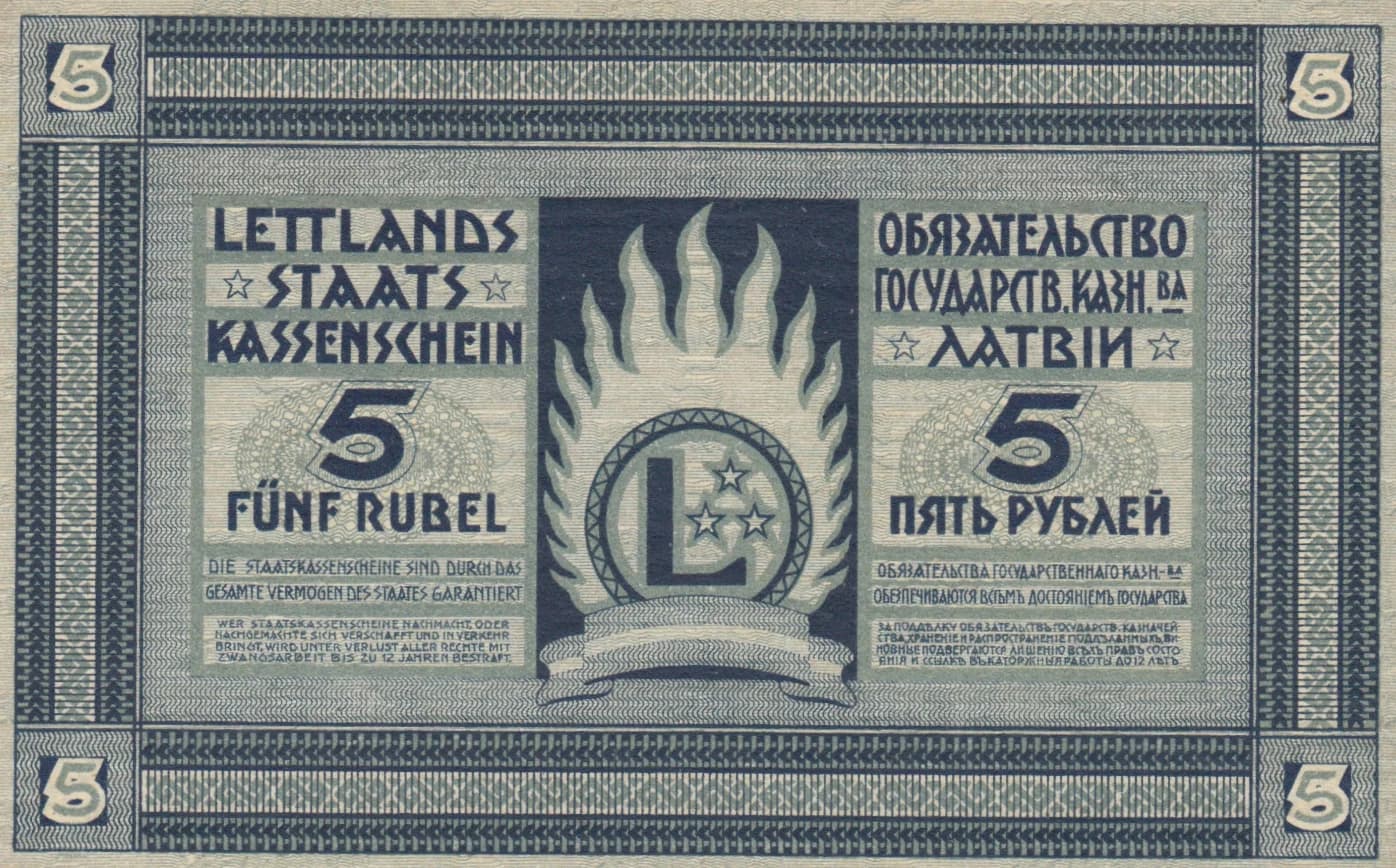
This is a 5 Rubli note from 1919 issued by the Latvian Government during the early independence period, graded UNC. The obverse features a classical male portrait in profile facing left, centered between decorative numeral '5' panels, rendered in blue and cream tones with intricate linear security patterns. The reverse displays a striking flaming torch surrounded by a wreath with stars, with bilingual German and Russian text reflecting Latvia's multilingual administrative context of the period.
Common. eBay market data shows UNC specimens trading in the $35-$60 range, with catalog values around $200 UNC (2016 pricing). The ready availability of this denomination at modest prices, combined with the fact it was a standard regular issue during Latvia's early independence period, indicates substantial original circulation and print runs. No indication of limited mintage or recall status exists.
The 5 Rubli denomination represents Latvia's early monetary sovereignty following independence from the Russian Empire in 1918. The bilingual German-Russian inscriptions on the reverse reflect the transitional administrative period when Latvia was establishing its own government structures while the region remained influenced by both former Imperial Russian and German Central Powers remnants. The torch and wreath symbolism on the reverse evokes classical representations of liberty and state authority, appropriate for a newly independent nation.
The obverse features a three-panel layout with a central male portrait in classical engraving style facing left, flanked by identical side panels containing the numeral '5'. The portrait represents a classical allegorical or historical figure appropriate to state currency of the period. The reverse centers on a flaming torch enclosed within a decorative wreath adorned with stars, with a circular emblem containing the letter 'L' (for Latvia) at the torch's base. The wreath and torch composition symbolizes liberty and the state's foundational authority. Both sides employ fine-line engraving with geometric security patterns throughout, using a blue and cream color palette with black accents. The serial number appears in red/orange ink on the obverse.
OBVERSE: 'LATVIJAS WALTS KAS SIHMES' (Latvia's State Notes), 'PEEZI RUBLI' (Five Rubles), 'FINANDU MINISTRY' (Finance Ministry), 'WALTS KASES PAHRVALDNEEKS' (State Treasury Manager), Serial number 'G226263'. REVERSE German text: 'LETLANDS STAATS KASSENSCHEIN' (Latvia's State Treasury Note), 'FÜNF RÜBEL' (Five Rubles), 'DIE STAATSKASSENSCHEINE SIND DURCH DAS GESAMTE VERMÖGEN DES STAATES GARANTIERT' (The state treasury notes are guaranteed by the entire assets of the state), 'WER STAATSKASSENSCHEINE NACHMACHE ODER NACHGEMACHTE SICH VERSCHAFFUNG IN VERKEHR BRINGT, WIRD UNTER VERLUSST ALLER RECHTE MIT ZWANGSARBEIT VON 1 BIS 12 JAHREN BESTRAFT' (Whoever counterfeits state treasury notes or brings counterfeit notes into circulation will be punished with forced labor from 1 to 12 years, losing all rights). REVERSE Russian text: 'ОБЯЗАТЕЛЬСТВО' (Obligation), 'ГОСУДАРСТВ.КАССЫ ЛАТВИИ' (State Treasury of Latvia), 'ПЯТЬ РУБЛЕЙ' (Five Rubles).
Intaglio engraving (line engraving/recess printing), characteristic of high-security banknote production. The fine linear geometric patterns, intricate portrait detailing, and precise wreath work demonstrate professional security printing standards. The note exhibits the hallmark characteristics of early 20th-century European state currency production, likely produced by an established security printer contracted by the Latvian government, though specific printer attribution would require additional research into Latvian numismatic records.
This specimen is identified as Pick P-3fH with series 'G' prefix on the serial number (G226263). The PMG population report indicates multiple cataloged varieties of the 5 Rubli denomination (P-3e, P-3f, P-3s, P-37s), suggesting variations in signature combinations, series prefixes, or design elements. The 'H' suffix designation in P-3fH likely indicates a specific signature or administrative variant within the P-3f base type. Series G and the six-digit serial number format are consistent with the 1919 issue specifications.