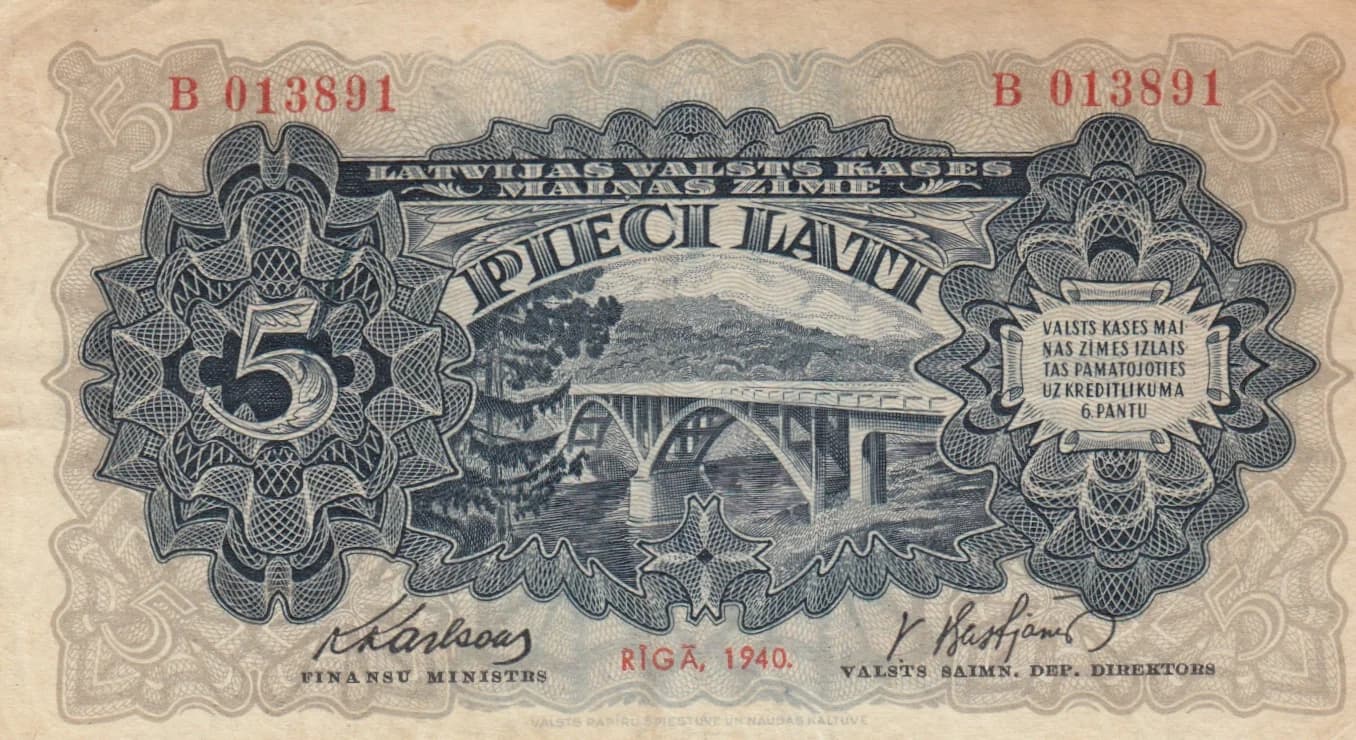
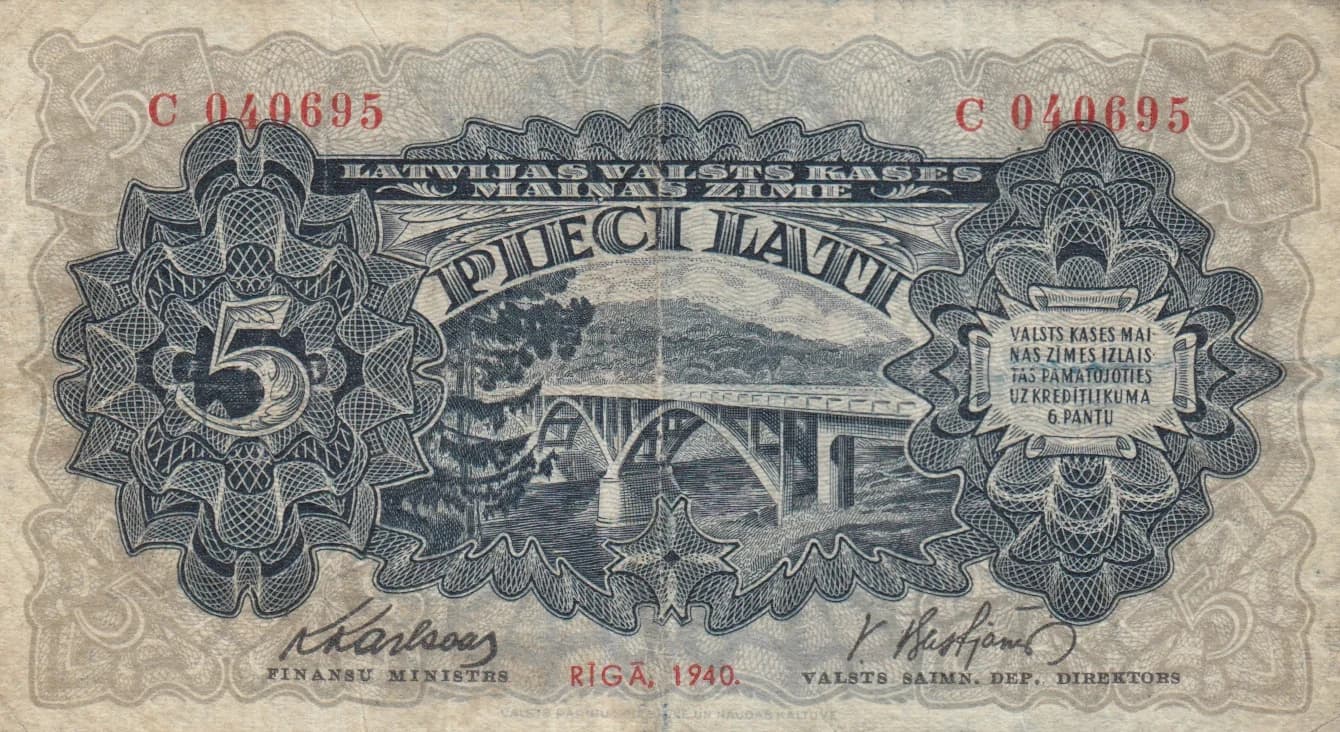
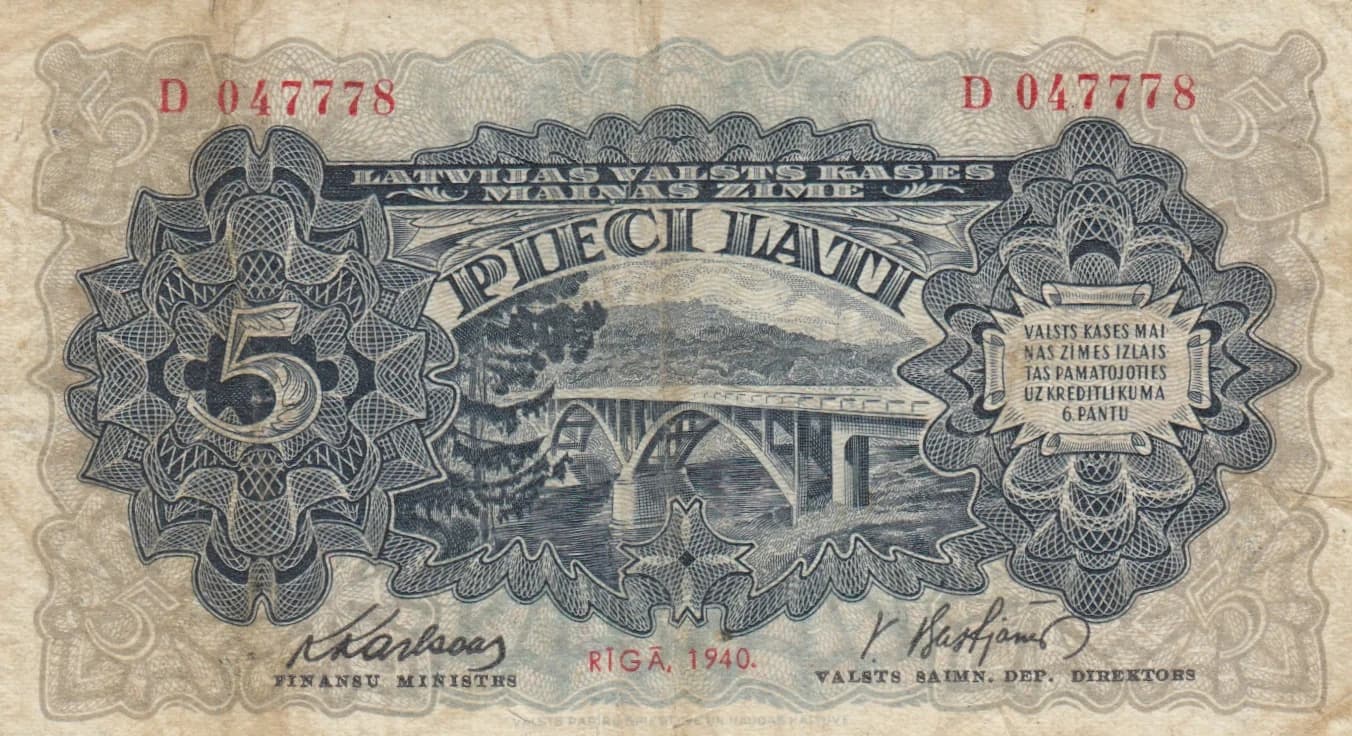
5 latu 1940
“serie A”
Market Prices
7 salesAbout This Note
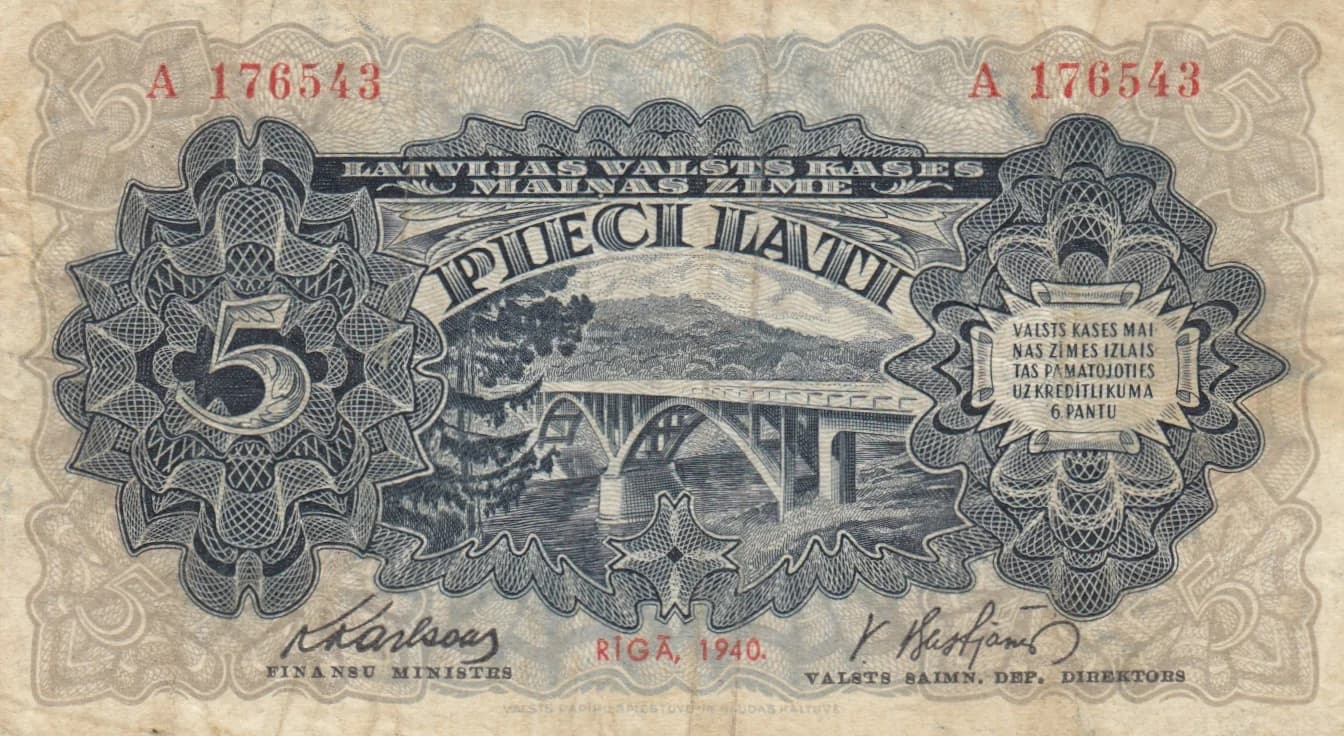
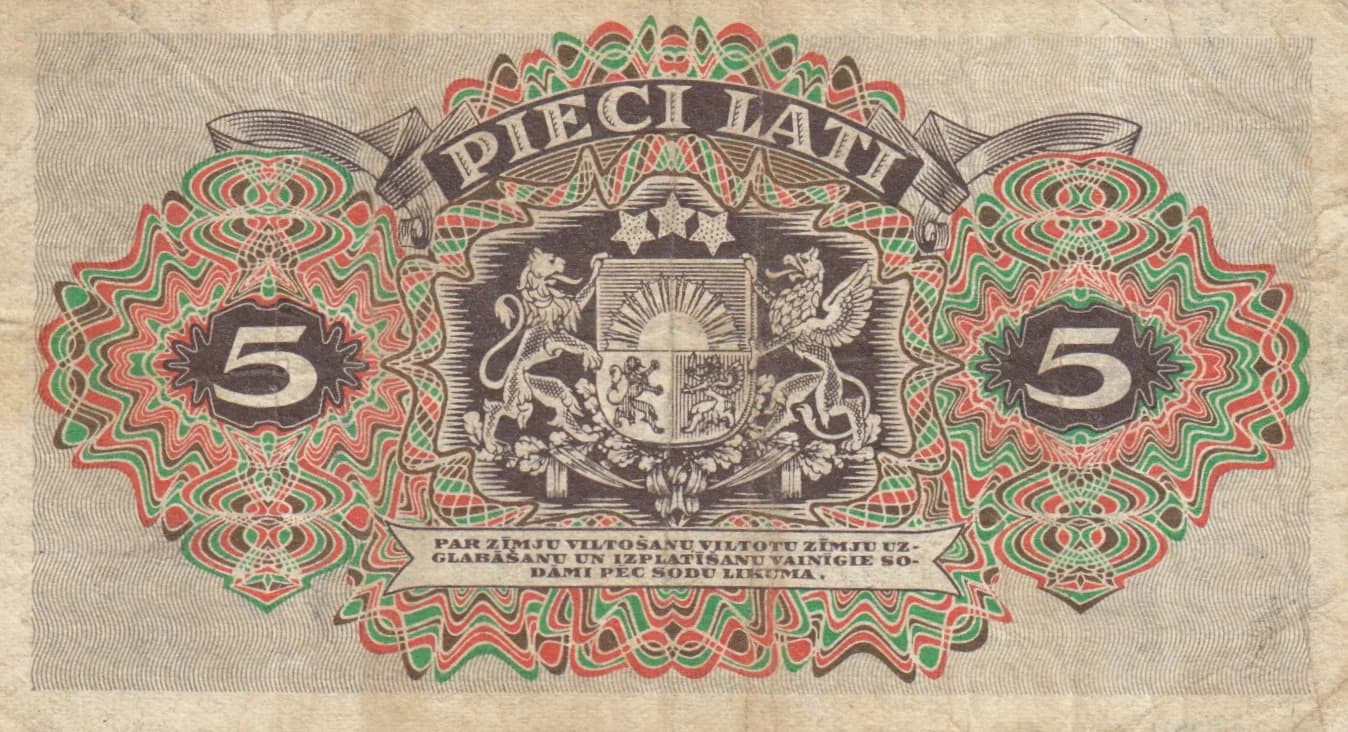
This is a VF-grade 5 Lati banknote from 1940, issued by the Latvian State Treasury during a pivotal moment in Latvia's history. The note displays crisp engraving with the iconic bridge vignette on the obverse and the multi-colored Latvian coat of arms on the reverse, with serial number A 176543. While showing expected age-related wear and patina consistent with circulation, the note retains good structural integrity and relatively vibrant color printing, making it an attractive example for collectors of interwar Baltic currency.
Common. The 5 Lati 1940 (P-34a) is commonly encountered in the numismatic market. Recent eBay sales data shows VF examples selling in the $23.50-$37 range (2016-2020), with catalog values at $170 VF as of 2016. The sustained availability at moderate prices and consistent eBay auction activity indicate a stable supply of circulated examples. While Latvia's brief independence (1918-1940) and subsequent occupation lend historical significance, print run volumes were sufficient that this denomination remains accessible to collectors without premium pricing.
This 5 Lati note was issued in 1940, the final year of Latvia's independence before Soviet occupation and the beginning of World War II. The imagery reflects pre-war Latvia's national pride: the Guaja River bridge represents the nation's infrastructure and development, while the elaborate coat of arms with its lion, eagle, and rising sun symbolizes the sovereignty that would soon be lost. The note's issuance by Latvijas Valsts Kases (Latvian State Treasury) under the credit law framework demonstrates the formal monetary authority of the independent Latvian state in its last year of autonomy.
The obverse features a classical landscape composition centered on a bridge spanning the Guaja River, a significant waterway in Latvia, with forested hills visible in the background. The design is framed by an ornate geometric border with intricate linework typical of high-security banknote engraving. Large decorative numerals '5' appear in ornamental cartouches on both left and right margins. The reverse displays the quartered coat of arms of Latvia at center, featuring a lion (representing strength), an eagle (sovereignty), and a rising sun (national aspiration), surrounded by elaborate heraldic mantling, wreaths, and flourishes. The multi-color printing—combining black, red, and green inks—adds to both the aesthetic impact and the security features. Both sides employ fine line engraving throughout, with the geometric border patterns and heraldic complexity serving as anti-counterfeiting measures.
FRONT SIDE: 'PIECILAUT' (Five latu - denomination); 'LATVIJAS VALSTS KASES NAUDAS ZĪME' (Latvian State Treasury banknote); 'VALSTS KASES NAUDAS ZIMES IZLAISTĀS PAMATOJUŠIES UZ KREDITLIKUMA 6 PANTU' (Issued under Credit Law paragraph 6); 'FINANSU MINISTRS' (Minister of Finance); 'VALSTS SAIMNIECĪBAS DEPARTAMENTA DIREKTORS' (State Treasury Department Director); 'RIGA, 1940' (Riga, 1940); Serial number: A 176543. BACK SIDE: 'PIECILATI' (Five latu); 'PAR ZIMIJU VILTOŠANU VILTOTU ZIMIJU UZ-GLABAŠANU UN IZMANTOŠANU VAINĪGIE SODĀMI PEC SODU LIKUMA' (Counterfeiting, possession, and use of counterfeit notes are punished according to the Penal Code).
Intaglio engraving (line engraving and steel-plate printing), executed by Valsts Papīru Spiestuve un Naudas (State Paper Printing House and Mint), Riga. The note employs multi-color printing with black as the primary ink complemented by red and green inks, particularly visible in the heraldic elements and border designs on the reverse. The fine parallel lines, intricate geometric patterns, and complex heraldic detail are characteristic of high-quality intaglio security printing used for official state currency of the period.
This note is cataloged as P-34a in the Pick standard. The PMG population report indicates three variants exist for the base Pick number: P-34a, P-34b, and P-34c (with different signature combinations noted as #2 and #3). The observed example with series 'A' and serial number A 176543 is consistent with the standard P-34a variety. The red serial numbers and signatures visible in the visual analysis should be cross-referenced against known signature combinations to definitively confirm the specific variety, though the absence of noted signature variations in the collector notes suggests this is the standard P-34a issue.