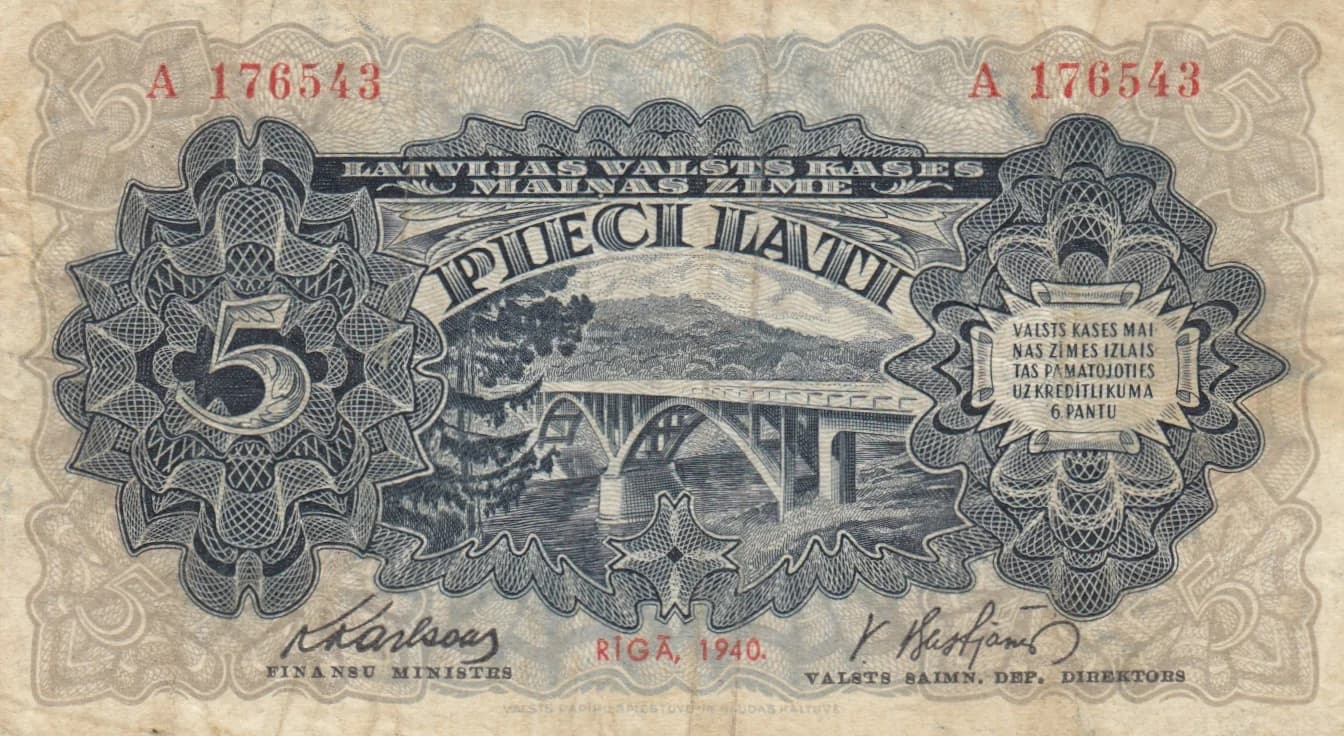
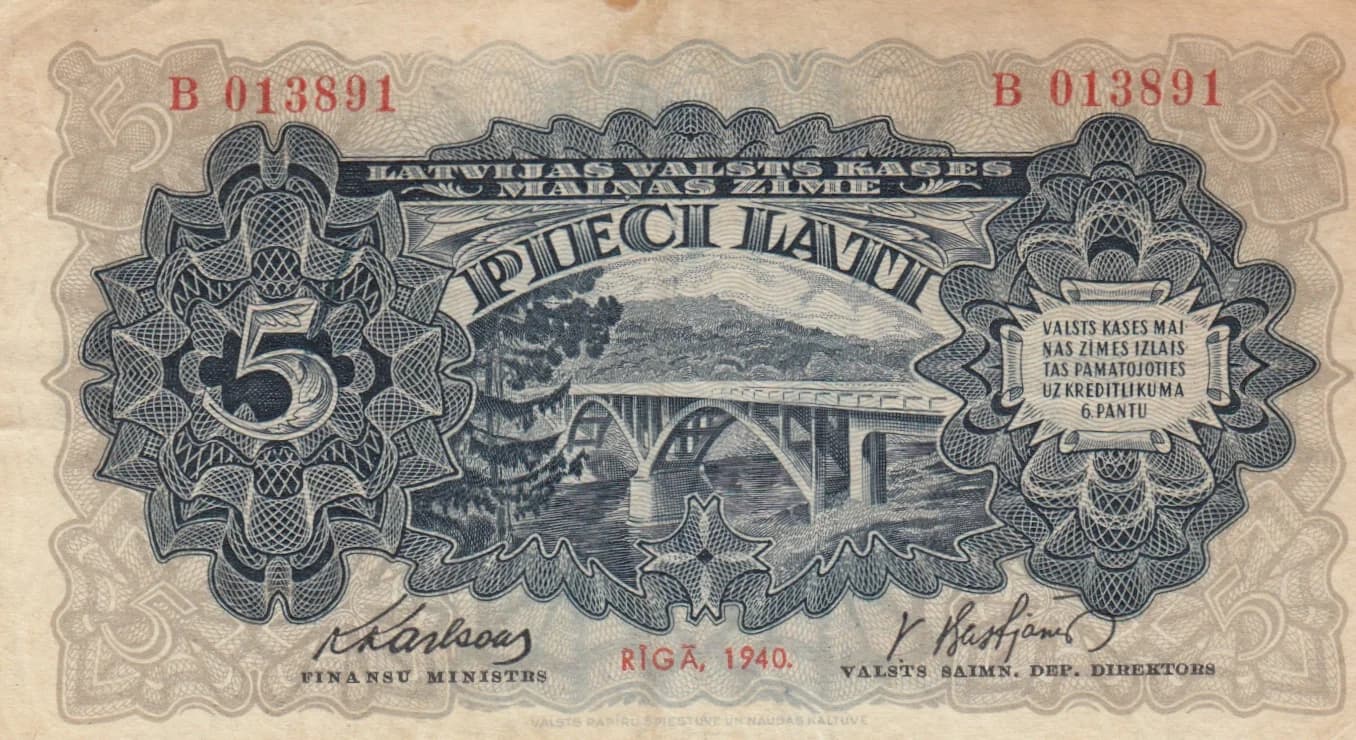
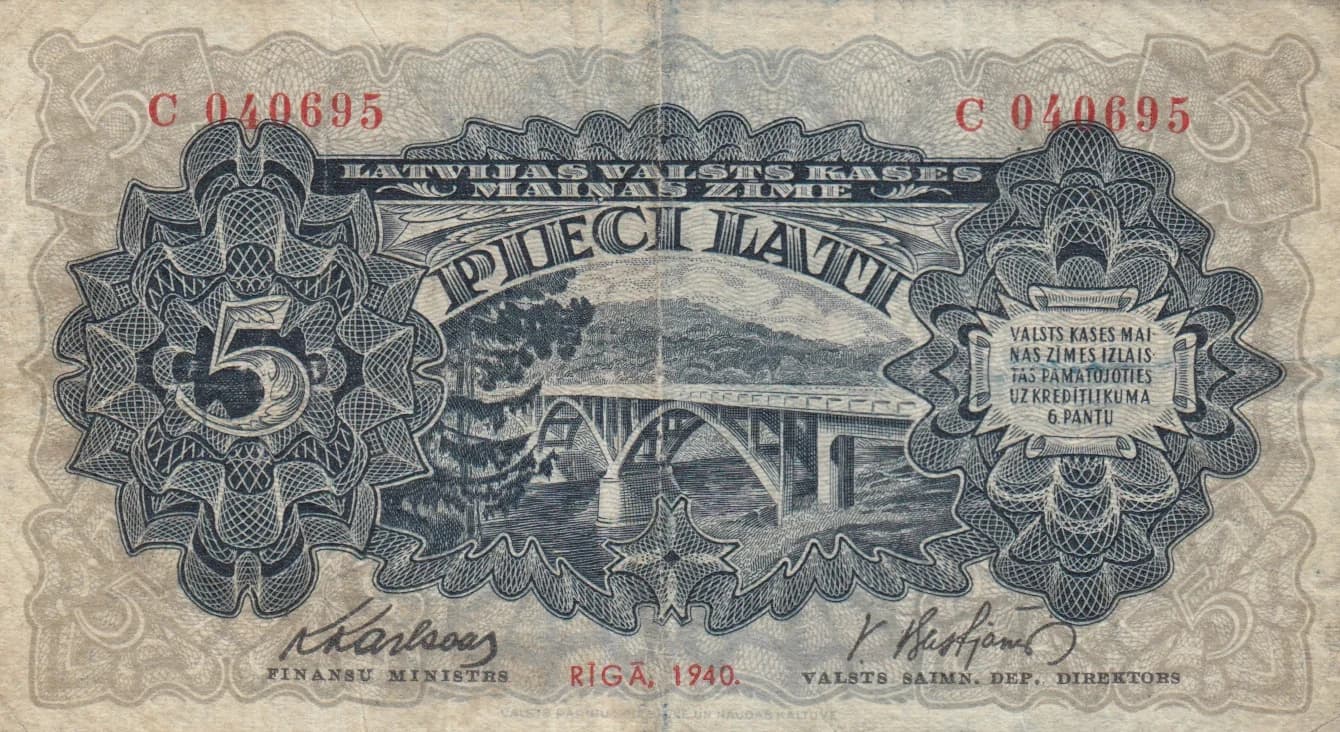
5 latu 1940
“serie D”
Market Prices
7 salesAbout This Note
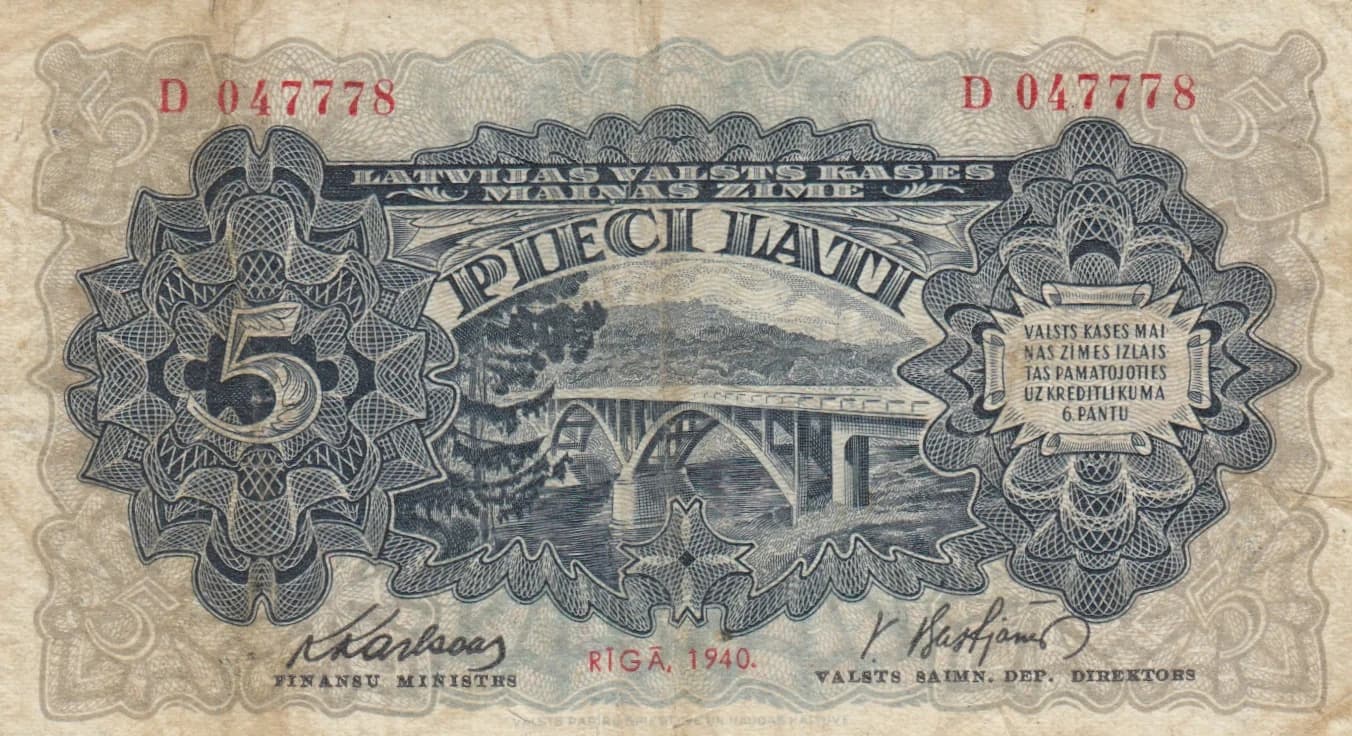
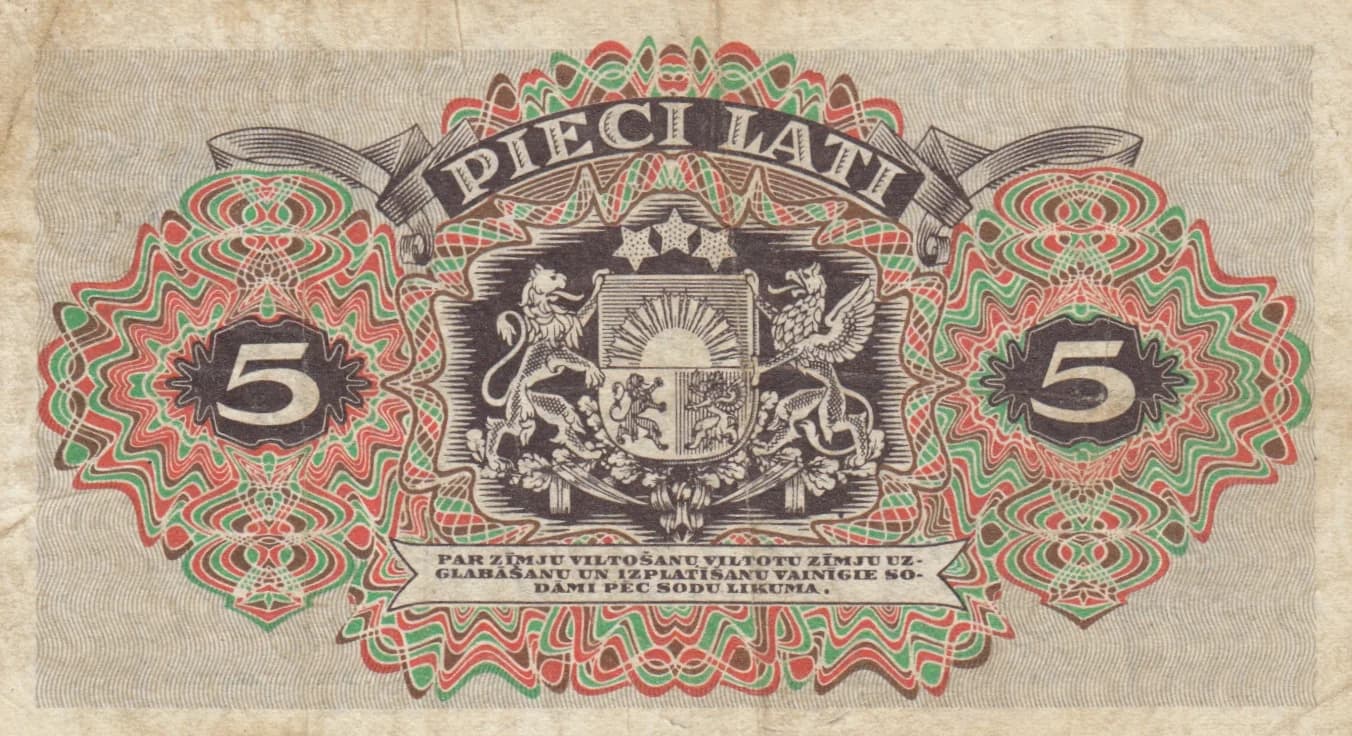
This is a VF-graded 5 latu banknote from 1940, issued by the Latvian Government during a pivotal moment in the nation's history. The note features an elegant bridge vignette on the obverse and the Latvian coat of arms with gryphon supporters on the reverse, rendered in a cream and multi-color palette with fine line engraving throughout. Despite showing its age with visible creasing, foxing, and yellowing consistent with 80+ years of circulation, the note retains good visual clarity and represents an important piece of interwar Latvian currency.
Common. The 5 latu denomination from 1940 (Pick P-34a) was issued in substantial quantities as part of regular currency circulation by the Latvian Government. While the specific print run figures are not definitively documented in standard references, the widespread availability of this note in the numismatic market and its presence in VF condition indicate it was not produced in limited quantities. No evidence suggests this was a short-lived issue or subject to recall that would elevate its rarity. Notes from this series regularly appear in dealer inventories and auction listings at modest prices consistent with common-grade interwar European banknotes.
Issued in 1940, this note was produced during the final year of Latvia's first independence period, just months before the Soviet occupation in June 1940. The prominent display of the national coat of arms with its gryphon supporters and rising sun symbolizes Latvian sovereignty and national identity during a period of increasing geopolitical pressure. The inscriptions referencing the State Treasury and Finance Ministry represent the legitimate governmental authority of the Latvian state at this critical juncture in Baltic history.
The obverse features a picturesque landscape vignette depicting a bridge spanning a waterway with trees lining the banks, symbolizing Latvia's natural beauty and infrastructure. The reverse showcases the Latvian national coat of arms—a shield containing heraldic elements, flanked by two gryphon or eagle supporters representing strength and guardianship, with a rising sun motif above the shield. The denomination '5' appears in prominent ornate rosettes on both sides of each face. The entire note is bordered by intricate geometric patterns in cream, blue-black, red, and green, with fine lace-like decorative elements characteristic of early 20th-century European banknote design. The bridge depicted is representative of Latvian engineering achievements of the period.
FRONT SIDE: 'LATVIJAS VALSTS KASES NAUDAS ZĪME' (Latvia State Treasury Bank Note) / 'PIECILATI' (Five Latu) / 'VALSTS KASES MAINASZIEMES IZLAISTAIS PAMATOJOTJES UZ KREDITLIKUMA 6.PANTH' (State Treasury Notes issued under credit law paragraph 6) / 'RIGA, 1940' (Riga, 1940) / 'FINANSU MINISTRS' (Finance Minister) / 'VALSTS SAIM. DEP. DIREKTORS' (State Treasury Department Director) / Serial number: D 0477778 (appears top left and top right). BACK SIDE: 'PIECILATI' (Five Latu) / 'PARZIMJU VILTOSANU VILTOTU ZIMU UZ GLABASAN UN IZPLATISAN VAINIGE SO DAMI PEC SODU LIKUMA' (Counterfeiting, counterfeiting marks, storage and distribution is punishable under criminal law).
Intaglio engraving (line engraving), evidenced by the fine, crisp line work visible throughout the border patterns, vignettes, and coat of arms details. The note displays the characteristic sharp definition and subtle variations in line density typical of high-quality intaglio printing. Multiple colors (red and green) appear to have been applied through successive printing passes. This note was likely produced by a specialized security printer; based on the Pick catalog designation and historical records, Latvian currency of this period was printed by established European security printers, though specific printer attribution would require additional documentation.
Series D is noted in the collector information. The serial number D 0477778 identifies this as part of the D series printing. Varieties for this Pick number are primarily distinguished by series letters and signature combinations. The 1940 5 latu exists with different series designations (A through D documented), and signatures of the Finance Minister and Treasury Department Director vary by printing run. This particular note's D series and specific serial number range may have been part of a later printing within the 1940 issue. No overprints or special markings are evident in the visual analysis.